What to Revise in January of Year 13 Maths
What to revise in January of Year 13 Maths: prioritise weak topics, revisit Year 12 foundations and use a balanced weekly plan before exam season begins.
January creates an uncomfortable feeling for many Year 13 students. The exams are no longer distant, but lessons are still moving through new material. You may feel that you should revise everything while somehow keeping pace with integration, differential equations, hypothesis testing or moments.
The practical answer to what to revise in January of Year 13 Maths is simpler: diagnose your weakest foundations, secure the Year 13 topics already taught, and maintain regular contact with pure maths, statistics and mechanics. January is not the month for endless full papers. It is the month for building the knowledge that will make those papers useful later.
Imagine a student called Sam. The name is hypothetical, but the situation is familiar. Sam returns after Christmas with half-finished notes, an approaching mock and a list headed “Revise maths”. By the end of the first week, that list has created plenty of guilt and almost no direction. What Sam needs is not more urgency. It is a sequence.
Your January revision checklist
A useful January revision plan should include:
- one short diagnostic using mixed questions or a recent mock;
- two priority weaknesses from Year 12 pure maths;
- one current Year 13 pure topic each week;
- regular statistics and mechanics practice;
- retrieval of formulae, definitions and standard methods;
- careful marking and an error log;
- one mixed or timed session each weekend;
- protected time for current homework and new lessons.
You can find topic resources through the Edexcel A Level Maths revision collection, while students rebuilding earlier content can use the Edexcel AS Level Maths revision resources. If you follow AQA, OCR or another specification, check your own specification and teacher’s teaching order before selecting topics.
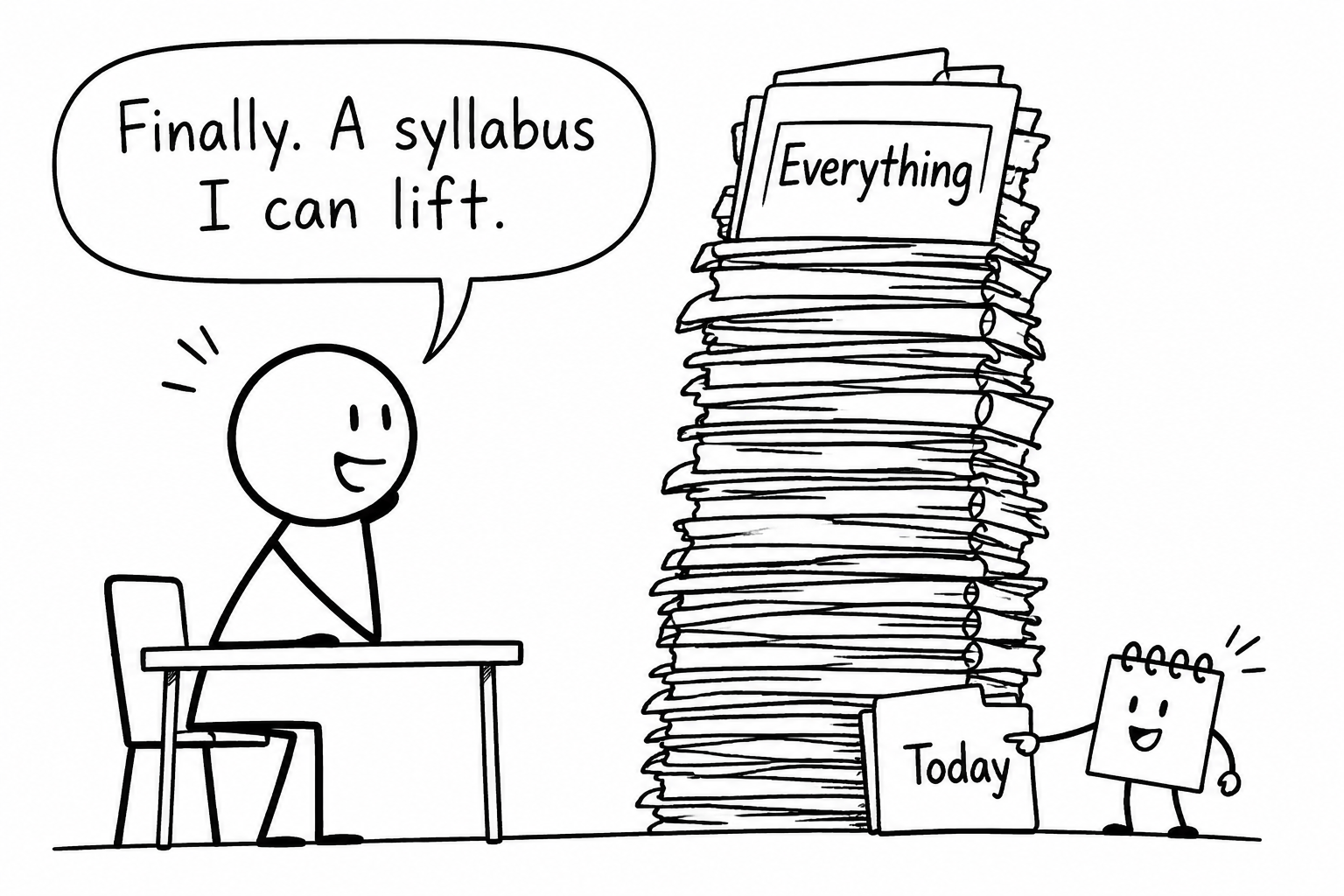 A student chooses one manageable revision folder instead of an impossible pile
How January fits into the Year 13 journey
January sits between learning and exam preparation. Treating it like May usually backfires because you have probably not completed the course. Yet treating it like an ordinary teaching month leaves too much repair work for Easter.
A better division is:
- January: diagnose gaps, strengthen foundations and consolidate taught Year 13 content.
- February and March: complete more mixed practice and connect topics.
- Easter onwards: increase timed papers, analyse performance and target remaining weaknesses.
This is not a rigid national timetable. Schools teach specifications in different orders, and mock dates vary. The important principle is that revision should match the point you have reached.
Sam therefore stops asking, “Have I revised all of integration?” A better question is, “Can I identify the method, carry it out accurately and recognise when the answer needs checking?” For example, integration revision might move from standard forms to substitution, integration by parts and then applications, but only if those stages have already been taught.
Start with evidence, not instinct
Students often revise the topic that feels most intimidating or the one that is easiest to organise. Neither choice necessarily produces the most progress.
Begin with a diagnostic session of about 454545 minutes. Use part of a mock, a mixed worksheet or selected questions from the A Level Maths past papers collection. At this stage, you do not need to sit an entire paper.
Mark the work and classify each lost mark:
- knowledge: you could not recall a fact, definition or method;
- selection: you knew several methods but chose the wrong one;
- execution: your approach was sound, but algebra or arithmetic failed;
- communication: you omitted reasoning, notation or a conclusion;
- timing: you could answer the question, but not efficiently enough.
This distinction matters. If you repeatedly differentiate incorrectly, more knowledge practice may help. If you can differentiate but fail to recognise a stationary-point problem, you need mixed questions that practise method selection.
What to prioritise in Year 13 maths revision
Repair the Year 12 foundations that unlock later work
Year 13 pure maths rests heavily on algebra, functions, trigonometry, exponentials, logarithms, differentiation and integration. Weak manipulation can make a new topic appear harder than it really is.
Choose no more than two foundational weaknesses at once. Useful candidates include:
- rearranging and simplifying algebraic expressions;
- solving equations and inequalities;
- graph transformations and composite functions;
- exact trigonometric values and identities;
- differentiation and integration fundamentals;
- exponentials and logarithms.
The goal is not to reread every Year 12 chapter. It is to repair the specific skills obstructing current work.
Consolidate Year 13 topics as they are taught
Reserve at least one session each week for the newest substantial topic from lessons. Within 484848 hours of a lesson, close your notes and attempt a few questions without support. Return to the topic several days later with a harder or mixed set.
That gap is valuable. Immediate success can come from short-term familiarity. Delayed practice shows whether the method is actually retrievable.
Use MathsGenie’s free revision lessons, practice questions, mark schemes and video solutions to move from explanation to independent practice. A video solution should resolve a precise difficulty, not replace your attempt.
Keep statistics and mechanics visible
Pure maths often consumes the timetable because it contains many connected topics. Statistics and mechanics then disappear until a mock exposes the problem.
Give each applied strand regular space, even if the sessions are shorter. In statistics, revisit interpretation as well as calculation. In mechanics, practise drawing and modelling before reaching for a formula. Your exact content will depend on your exam board and what your class has covered.
For Edexcel students, statistics and mechanics are assessed together on the third paper, so neither strand should become an afterthought. The Edexcel A Level Maths overview helps you navigate the available topic material.
A weekly January revision template
Sam’s original plan assigned entire evenings to broad labels such as “calculus”. The revised template gives each session a job.
Monday: foundation repair
Spend 404040-606060 minutes on one Year 12 weakness. Review the method briefly, complete focused questions and mark them immediately.
Tuesday: current Year 13 pure maths
Practise the topic currently being taught. Start without notes. Use a revision lesson or video solution only after you have identified where you became stuck.
Wednesday: rest or other subjects
A sustainable timetable leaves space. Year 13 maths matters, but it is not your only subject.
Thursday: statistics or mechanics
Alternate the main focus each week. Include a few retrieval questions from the other applied strand so that it does not disappear entirely.
Friday: short recall session
Use 202020-303030 minutes for definitions, formulae, graphs and previously corrected errors. Keep this deliberately light.
Weekend: mixed practice and review
Complete 606060-909090 minutes of mixed questions. Time part of the session, mark every answer and choose next week’s priorities from the evidence.
Once this rhythm is clear, build your January schedule in the MathsGenie Revision Planner rather than repeatedly redrawing it on paper.
If you need a broader framework, visit the MathsGenie revision planning guides. The one-month maths revision plan is written for GCSE students, but its cycle of diagnosis, targeted practice and review is a useful planning model when adapted to A Level depth.
Make every session produce evidence
A completed worksheet is not automatically a successful session. Finish by recording:
- the topic and question source;
- whether you worked independently;
- the reason for each error;
- one action for the next session.
Your error log should be short enough to use. “Integration bad” tells you almost nothing. “Forgot the constant of integration” or “did not recognise that substitution was needed” gives you a revisable target.
Reattempt selected errors after several days. If you can now solve them independently, the correction has become learning rather than copying.
Common January revision mistakes
Trying to complete full papers too early
Full papers can diagnose weaknesses, but repeated papers are inefficient if large sections contain untaught material. Use selected past-paper questions now, then increase complete timed papers as the course is completed.
Revising only pure maths
Statistics and mechanics need regular retrieval. A small weekly commitment is easier than rebuilding both strands near the exams.
Making the timetable too ambitious
Six planned sessions that repeatedly get missed are less useful than four sessions you can sustain. Build around lessons, homework, other subjects, sleep and genuine rest.
Watching solutions before attempting questions
Recognition feels easier than recall. Attempt the question first, identify the exact point of failure, then use the solution. Finish by closing it and trying again.
Ignoring the mark scheme
The answer alone does not always show where marks are earned. Mark schemes reveal required reasoning, acceptable notation and where accuracy marks depend on method.
Build a January plan you can follow
By the end of January, Sam has not “finished” A Level Maths. That was never the right goal. The improvement is quieter: weak foundations have names, current topics are reviewed each week, and every mistake influences the next session.
You now have the same structure, but knowing the plan and following it are different tasks. Exams have fixed dates, so every unplanned week reduces the time available for spaced practice. Build your day-by-day January schedule in the MathsGenie Revision Planner.