

What to Revise in February of Year 13 Maths
What to revise in February of Year 13 Maths: prioritise weak topics and follow a realistic weekly plan for pure and applied content before spring.
February is an awkward month in Year 13. The course may not be finished, mock results can expose uncomfortable gaps, and the summer exams feel both distant and alarmingly close. If you are wondering what to revise in February of Year 13 Maths, the short answer is this: repair important Year 12 foundations, consolidate the Year 13 content already taught, and begin mixed exam practice without trying to complete full papers every evening.
The aim is not to know everything by the end of the month. It is to enter spring with fewer hidden weaknesses and a revision routine you can sustain.
Your February revision checklist
By the end of February, try to have:
- reviewed your latest mock or assessment question by question;
- identified three priority topics in pure maths and two in applied maths;
- revisited the Year 12 skills that those topics depend on;
- completed targeted exam questions using mark schemes;
- attempted at least one mixed or timed set each week;
- kept a record of errors that need another attempt;
- planned the next week from evidence, rather than instinct.
Your exam board matters. Edexcel, AQA, OCR and Eduqas organise their specifications and papers differently, so compare your plan with the specification used by your school. The overall principle remains the same: pure mathematics, statistics and mechanics all need regular attention.
For wider planning principles, the MathsGenie revision blog and A Level Maths revision resources provide a useful starting point.
How February fits into Year 13 maths revision
Imagine a hypothetical student called Sam. January’s mock has just been returned. Sam remembers revising integration for hours, yet lost marks on an algebraic rearrangement near the beginning of a question. In mechanics, the method looked familiar, but a sign error changed the final acceleration.
The temptation is to respond with more hours. February rewards a better response: better diagnosis.
At this point in Year 13, your revision has three jobs:
- Retention: keep earlier material available, particularly algebra, trigonometry and differentiation.
- Consolidation: secure the Year 13 topics your class has recently completed.
- Application: practise deciding which method an unfamiliar question requires.
These jobs overlap. A differential equation may require confident integration. A mechanics question may depend on resolving forces and solving simultaneous equations. A hypothesis test requires both a correct procedure and a conclusion written in context.
February is therefore a bridge. Autumn was largely about learning new material. Spring will increasingly involve mixed questions, timed practice, past papers and mark schemes, followed later by predicted papers where appropriate. February is when you make that transition gradually.
What to prioritise this month
Begin with evidence from your mock
Sam starts by sorting lost marks into four categories:
- the topic was not understood;
- the method was known but could not be recalled;
- the mathematics was correct until an algebra or arithmetic error;
- the answer did not meet the wording or level of explanation required.
That distinction matters. Watching another lesson may help with the first problem, but it will not necessarily cure the fourth. Use your script, teacher feedback and the official mark scheme to diagnose what happened.
Choose priorities according to frequency, dependency and weakness. A weak skill that appears throughout the course deserves attention before an isolated mistake. Algebraic manipulation, functions, trigonometric identities, differentiation and integration often connect to several later topics.
Strengthen pure mathematics foundations
Your exact February list should follow what your class has covered, but useful areas to test include:
- algebra, functions and coordinate geometry;
- sequences, series and binomial expansion;
- trigonometric equations and identities;
- exponentials and logarithms;
- differentiation and its applications;
- integration, including substitution and integration by parts where specified;
- numerical methods, vectors and differential equations where already taught.
Do not simply reread examples. Try a question without notes, mark it, then redo it later from a blank page. If you cannot recognise when to use a method such as
∫udvdx dx=uv−∫vdudx dx,\int u\frac{dv}{dx}\,dx=uv-\int v\frac{du}{dx}\,dx,∫udxdvdx=uv−∫vdxdudx,memorising the formula alone is not enough. Your practice must include choosing the method, carrying it out accurately and interpreting the result when the question has a context.
Keep statistics and mechanics active
Applied maths is easy to postpone because pure topics often feel larger. That creates a predictable problem in spring: methods that once seemed straightforward have faded.
For statistics, review the content already covered from areas such as probability, statistical distributions, sampling, hypothesis testing and interpretation. Practise complete conclusions in context, not just calculations.
For mechanics, revisit modelling assumptions, kinematics, forces, Newton’s laws, moments and projectiles as appropriate to your course. Draw a clear diagram before calculating. Decide on a positive direction and preserve it throughout the solution.
A balanced week does not require equal time for every strand. It does require regular contact with each one.
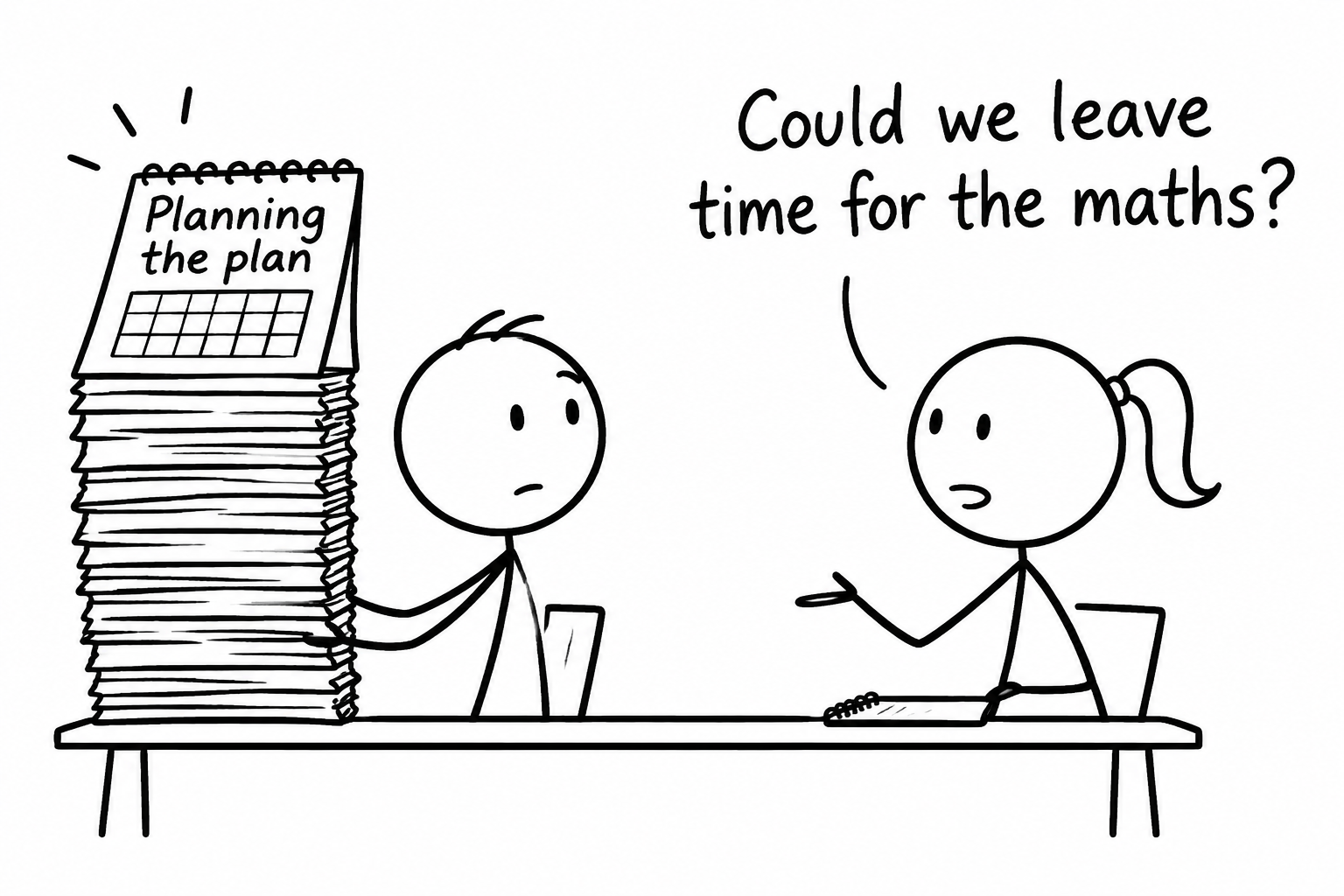 A stick-figure student discovers that planning revision should leave time for doing maths
A four-week February revision plan
Sam turns the month into four distinct stages. This prevents every session from becoming another vague promise to “do calculus”.
Week one: diagnose and rebuild
Review your latest assessments and create a short priority list. Choose one pure foundation, one recent Year 13 topic and one applied topic. Use revision lessons or video solutions only where understanding is missing, then answer several questions without support.
The outcome of the week should be a specific error list, not a folder of highlighted notes.
Week two: targeted practice
Complete exam-style questions on your selected weaknesses. Begin with untimed practice, but write full solutions. Check each answer against the mark scheme and note whether you lost method marks, accuracy marks or marks for interpretation.
Return to incorrect questions after a gap. A corrected answer copied immediately from a solution can feel fluent without being securely learned.
Week three: mixed retrieval
Mix topics within sessions. For example, combine a trigonometric equation, a differentiation problem and a mechanics question. Mixed practice is harder because the method is no longer announced by the worksheet title. That difficulty is useful: the examination will also ask you to select an approach.
Include one timed set, but keep it shorter than a full paper if your class has not completed the specification.
Week four: review and adjust
Repeat questions from week one and compare your approach. Then choose the next priorities from your results. A topic can leave the priority list only when you can solve an unfamiliar question without notes, not merely when the worked solution makes sense.
Once this structure begins to feel like a lot to organise, use the MathsGenie Revision Planner to turn your February priorities into a practical schedule.
A weekly template you can repeat
A workable Year 13 maths revision week might look like this:
| Session | Focus | Suggested activity |
|---|---|---|
| First session | Pure weakness | Review the method, then complete targeted questions |
| Second session | Applied maths | Alternate statistics and mechanics priorities |
| Third session | Current class content | Consolidate the topic taught most recently |
| Fourth session | Mixed retrieval | Answer questions from several earlier topics |
| Fifth session | Timed practice | Complete a short timed set and mark it carefully |
| Weekly review | Planning | Redo errors and select next week’s priorities |
The sessions do not have to be identical in length. On a busy school day, a focused question set is more useful than an ambitious session you continually postpone. During February half-term, you can extend one or two sessions while retaining rest and time for other subjects.
For another view of how maths plans develop from diagnosis into exam practice, see the A Level Maths revision-plan guide. Students making the transition into the full course may also find the GCSE to A Level Maths curriculum guide helpful when tracing foundational gaps.
Common February revision mistakes
Trying to revise the entire specification
A huge checklist creates motion without priority. Select a small number of weaknesses, improve them, then update the list.
Completing only comfortable topics
Familiar questions protect confidence but conceal gaps. Keep some confidence-building work, then spend most of the session on topics that currently cost marks.
Watching solutions without attempting questions
Video solutions are most valuable after a genuine attempt. Pause before each step and decide what you would do next.
Marking work without revisiting it
The mark scheme diagnoses the error; the second attempt helps repair it. Schedule incorrect questions again several days later.
Starting full papers too soon
Full papers are useful, but an incomplete course can make the score misleading. In February, combine targeted practice with mixed timed sections. Increase full-paper practice as more of the specification is completed.
Build your February schedule
Sam’s improvement begins when the plan stops living as a complicated sketch on paper and becomes a routine that can actually be followed. You now have the same monthly structure, but knowing the plan and carrying it out are different tasks, and every unplanned week before fixed summer exams is revision time you cannot reuse. Build your February schedule in the Revision Planner.















