What to Bring: GCSE Arabic Exam Checklist
What to bring GCSE Arabic exam day: pack black pens and a clear pencil case, then leave dictionaries, phones, watches, notes and earbuds safely outside.
Exam mornings make small uncertainties feel enormous. A student can know months of vocabulary and still spend breakfast wondering whether a dictionary is allowed or whether a watch must be removed.
If you are searching for what to bring GCSE Arabic exam day, the short answer is simple: take at least two black ink pens in a transparent pencil case, your school ID or candidate card if your centre requires it, and a clear, label-free bottle of water if your centre permits drinks. Leave dictionaries, revision notes, phones, watches, earbuds and other smart devices outside the exam room.
The front of your question paper and your centre's instructions always take priority. However, the checklist below reflects the current Pearson Edexcel GCSE Arabic specification and JCQ exam-room rules at the time of writing.
Your GCSE Arabic exam checklist
Pack this the night before:
- At least two working black ink or black ballpoint pens
- A transparent pencil case, if you use one
- Your candidate card or school identification, if requested by your centre
- A completely transparent water bottle with every label removed, if your centre allows drinks
- Any medication or approved equipment arranged in advance through your exams officer
Do not pack these for the exam room:
- An Arabic, English or bilingual dictionary
- Vocabulary sheets, flashcards or revision notes
- A mobile phone
- Any watch, including an analogue watch
- Earphones, earbuds or AirPods
- A tablet, smart glasses or another smart device
- A calculator
- Correction fluid, correction tape or an erasable pen
- A non-transparent pencil case
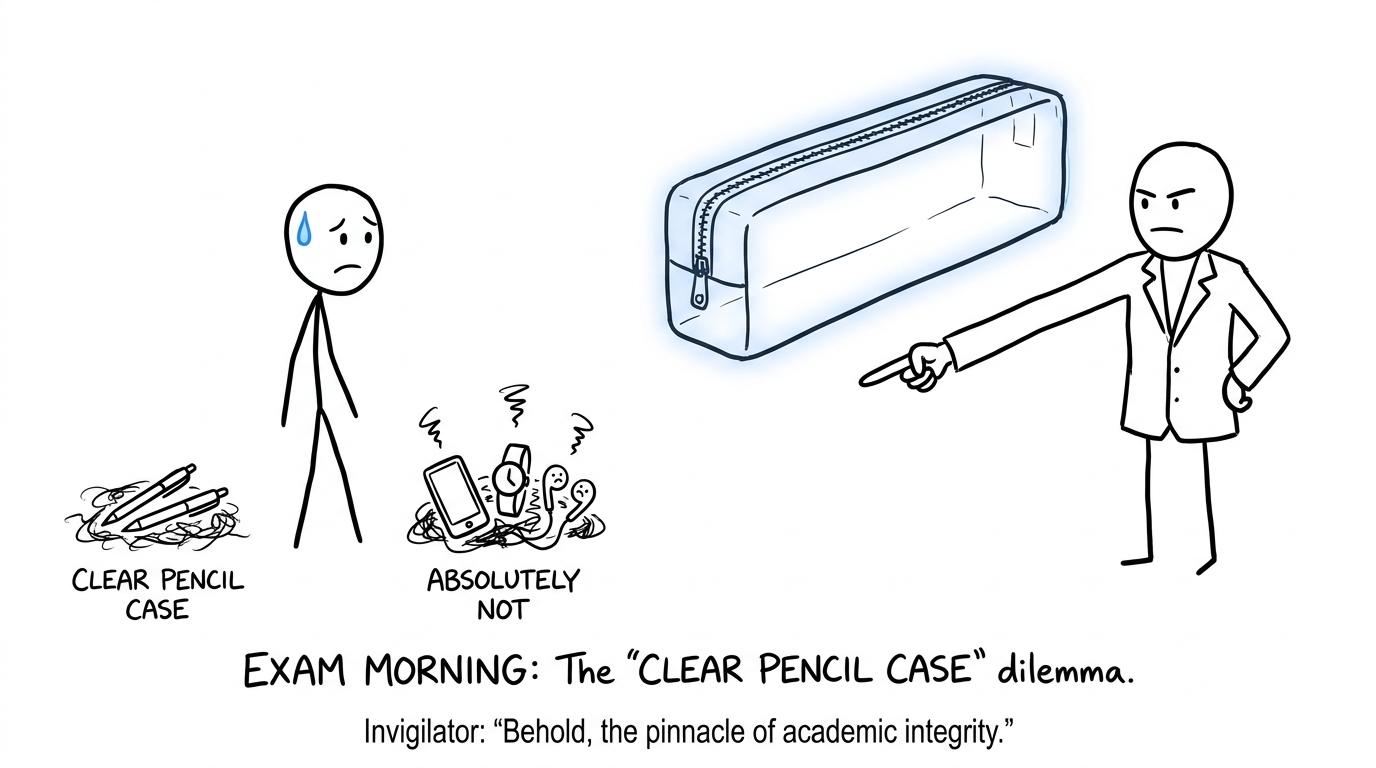 A student discovers that the transparent pencil case is the true exam-room celebrity
What you should bring to the GCSE Arabic exam
Two reliable black pens
Pearson's GCSE Arabic papers instruct candidates to use black ink or a black ballpoint pen. JCQ rules also tell candidates to write clearly in black ink because completed papers are normally scanned for marking.
Bring at least two pens. A spare pen is not a sophisticated revision strategy, but it removes one entirely avoidable problem. Test both pens the evening before and choose ones with which you can form Arabic letters clearly and comfortably.
Do not use a gel pen, erasable pen or correction pen for your answers. If you make a mistake, cross it out neatly and continue. There is no need to turn one incorrect word into an ink-covered excavation site.
A see-through pencil case
JCQ requires any pencil case brought into the exam room to be transparent. Invigilators must be able to see its contents without opening it.
A clear case containing two black pens is enough for GCSE Arabic. You may carry an ordinary pencil and eraser if your centre allows them, but the written Arabic papers specifically require black ink. Geometry equipment that belongs in a maths exam bag, such as compasses and a protractor, serves no purpose here.
Identification if your centre asks for it
Schools and private exam centres have their own identification procedures. Your centre may provide a candidate card at your desk, ask you to bring school identification or require photographic identification if you are a private candidate.
Check this before exam day rather than assuming. You should also know your candidate number, centre number, room and arrival time. These administrative details feel unimportant until one of them is missing.
Water, subject to your centre's rules
JCQ allows centres to decide whether food and drink may enter the exam room. Where water is permitted, the bottle should be completely transparent and all labels must be removed. A transparent reusable plastic bottle can be acceptable too.
Your school may impose a stricter rule, so follow its candidate handbook. If you need food, drink or medication because of a medical condition, speak to the exams officer in advance. Do not wait until you are standing outside the examination hall.
What the centre provides
You do not need to bring listening equipment, a recording or headphones for the listening paper. The centre organises the official audio and equipment under controlled conditions.
For the speaking assessment, the centre supplies the secure role-play and picture-based materials. Under the current Pearson specification, you receive supervised preparation time and may make limited notes on paper supplied or controlled by the centre. You must not arrive with prepared sentences, personal notes or your own stimulus material.
The principle is useful beyond Arabic: if an item forms part of a secure assessment, the centre provides it. Your job is to arrive on time with permitted writing equipment and follow the teacher's or invigilator's instructions.
What to leave at home
Dictionaries and translation tools
Dictionaries are not permitted in Pearson Edexcel GCSE Arabic. That applies to listening, reading and writing, as well as the preparation time and assessment for speaking.
Do not bring a bilingual dictionary merely to use before the exam and then place it under your chair. Leave it outside the room according to your centre's arrangements. Electronic translators and calculator devices offering language translation are also unsuitable.
This is one reason exam preparation should include unaided recall. The night before, choose a calm routine rather than a frantic vocabulary search. The same principle helps with maths: MathsGenie's GCSE exam week checklist uses short practice, immediate marking and early packing to reduce last-minute decisions.
Phones, watches and smart technology
JCQ's prohibition is broader than “do not use your phone”. You must not possess an unauthorised device in the exam room, even if it is switched off and you never intend to touch it.
Leave behind:
- Mobile phones
- Smartwatches and fitness trackers
- Analogue and digital watches
- Earbuds and earphones
- MP3 or MP4 players
- Tablets
- Smart glasses
- Any other web-enabled or communicating device
A watch may seem harmless, particularly if it has no smart functions, but current JCQ rules prohibit all watches. The exam room should have a visible clock.
If you accidentally bring a prohibited item, hand it to an invigilator when asked and before the examination begins. Do not hide it in a pocket or place it beneath your desk.
Notes, books and prepared material
Revision cards, vocabulary lists, model paragraphs and handwritten notes are unauthorised materials. Possessing them can be treated as malpractice whether or not you read them.
Finish revising before you enter the controlled exam area. Put notes in your bag where your centre tells you to store it, not in a blazer pocket that you might forget to empty.
Calculators and unnecessary maths equipment
A calculator is not required for any of the four Pearson Edexcel GCSE Arabic papers. The sample writing papers state that candidates do not need other materials, while the language specification expressly prohibits dictionaries.
Keep your Arabic kit separate from your maths kit. When your maths examination arrives, use the correct equipment and practise beforehand through the GCSE maths revision hub, Edexcel GCSE Maths past papers or the page for your own board and tier.
Does the required equipment change by Arabic paper?
The basic prohibited-item rules remain the same, but each assessment feels different.
Listening
Bring your black pens. The centre provides and controls the recording equipment. Read the front of the paper carefully and use the official reading time as directed. Personal headphones and audio devices are not permitted.
Speaking
Attend at the time and place given by your centre. Do not bring a dictionary, prepared script or revision cards into preparation. The teacher or exams officer manages the assessment materials and any paper you are allowed to use for notes.
Reading
Bring black pens and no dictionary. Answer in the language requested by each section rather than assuming that every response must be in Arabic. The paper includes questions with different language instructions, so read each instruction closely.
Writing
Use black ink and write legibly. Do not bring a dictionary or prepared phrases. You may cross out mistakes neatly, but correction fluid, correction tape and erasable pens are prohibited.
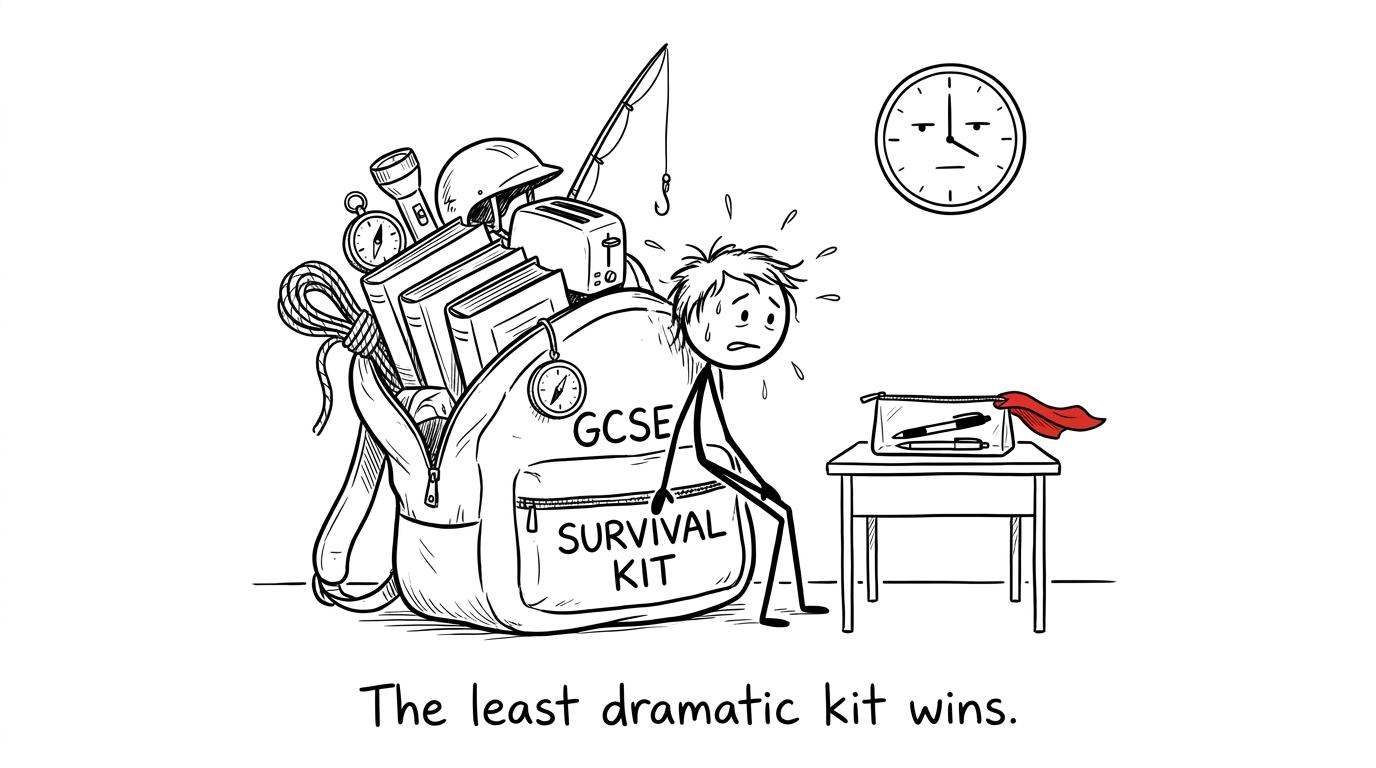 A heroic clear pencil case quietly defeats an enormous overpacked exam bag
A calm plan for the night before
Packing is most useful when it closes the day rather than beginning another round of revision.
- Check the date, start time, room and required arrival time
- Confirm that you are sitting the correct Foundation or Higher tier
- Read your centre's candidate instructions
- Test and pack two black pens
- Remove the label from your water bottle if water is allowed
- Empty your pockets of notes and technology
- Decide where your phone and watch will stay
- Set an alarm and protect your sleep
If maths is also on your exam timetable, avoid trying to maintain every topic at once. Use the GCSE maths revision timetable to plan small sessions, or complete an Edexcel GCSE Maths mini test before checking the mark scheme. Nearer the maths papers, GCSE predicted papers can provide realistic timed practice.
Common GCSE Arabic exam-day mistakes
Assuming a switched-off phone is allowed
It is possession that creates the problem. A switched-off phone in your pocket remains an unauthorised item. Follow your centre's storage process before entering the room.
Wearing an ordinary watch
The rule covers analogue, digital and smart watches. Remove yours before the exam and leave it in the approved place.
Bringing a dictionary for “emergencies”
GCSE Arabic does not permit dictionary use. Bringing one into the assessment or speaking preparation area may create a malpractice issue.
Writing in blue, erasable or gel ink
Use black ink or black ballpoint pen. Pack a spare so that a failed pen does not tempt you to use unsuitable stationery.
Taking personal notes into the speaking preparation room
Any notes allowed during speaking preparation are made under the centre's controlled arrangements. Do not take in a prepared answer, vocabulary page or script.
Treating school rules as optional details
JCQ and Pearson set the wider framework, but your centre controls practical arrangements such as identification, arrival, bags and drinks. Read its instructions as carefully as you would read an exam question.
Arrive with less to worry about
The ideal GCSE Arabic exam kit is deliberately uninteresting: two black pens, a clear pencil case, approved identification where required and perhaps a transparent bottle of water. Everything else should either be supplied by the centre or left outside.
That simplicity has a wider lesson. Good exam preparation is not about making the final morning intense. It is about removing decisions before nerves can enlarge them.
Pack tonight, check your centre's instructions and leave prohibited items safely behind. Then keep your maths revision equally organised with MathsGenie's free GCSE maths resources: use revision lessons and practice questions to repair individual topics, mini tests to check progress, and past papers, predicted papers, mark schemes and video solutions to prepare for the real examination.