What GCSE Reform Means for Private Candidates
What GCSE reform means for private candidates: confirmed dates, current GCSE Maths rules and a clear checklist for parents arranging an exam entry in England.
Updated: 3 November 2026
GCSE reform does not create a separate exam or lower standard for private candidates. Your child must enter through an approved exam centre and prepare for the specification examined in their chosen series.
That is the answer to what GCSE reform means for private candidates. Timing matters: England's revised national curriculum is planned for first teaching from September 2028, while updated GCSEs are expected to begin teaching in phases from 2029 and 2030. Reform headlines do not automatically change the GCSE Maths course your child is taking now.
Work backwards from the intended exam series, exam board, specification and tier.
The parent checklist
Before changing books, tutors or revision plans, establish:
- the country whose qualification system applies
- the intended exam year and series
- the awarding organisation and exact specification
- foundation or higher tier
- whether a centre has agreed to make the entry
GCSE and International GCSE are different qualifications with different specifications and assessment arrangements. Use the appropriate GCSE Maths revision resources or Edexcel International GCSE Maths resources.
What has been confirmed
The Curriculum and Assessment Review published its final report in November 2025. The Department for Education then confirmed a revised national curriculum for England, planned for first teaching from September 2028.
Updated GCSEs follow later. The government's response sets out two phases, with first teaching intended for 2029 and 2030. Wait for final subject content, Ofqual conditions and accredited exam-board specifications before treating proposed changes as examinable material.
| Position at 3 November 2026 | Meaning for parents |
|---|---|
| Revised national curriculum planned from September 2028 | Existing GCSE specifications do not automatically change then |
| Updated GCSEs planned for first teaching in 2029 and 2030 | Check the Maths phase and first assessment date |
| Exam time intended to fall by an average of 2.52.52.5-333 hours across eight or nine GCSEs | This is not a reduction of that size in Maths alone |
| Ofqual will regulate revised qualifications | Final assessment arrangements depend on regulatory decisions |
| Formula sheets retained throughout current GCSE Maths specifications | Prepare using the current specification's arrangements |
In 2026, the Department for Education changed its subject-content expectations and Ofqual decided that formula sheets should continue for the remaining lifetime of current GCSE Maths specifications. Future reformed qualifications will have their arrangements confirmed separately.
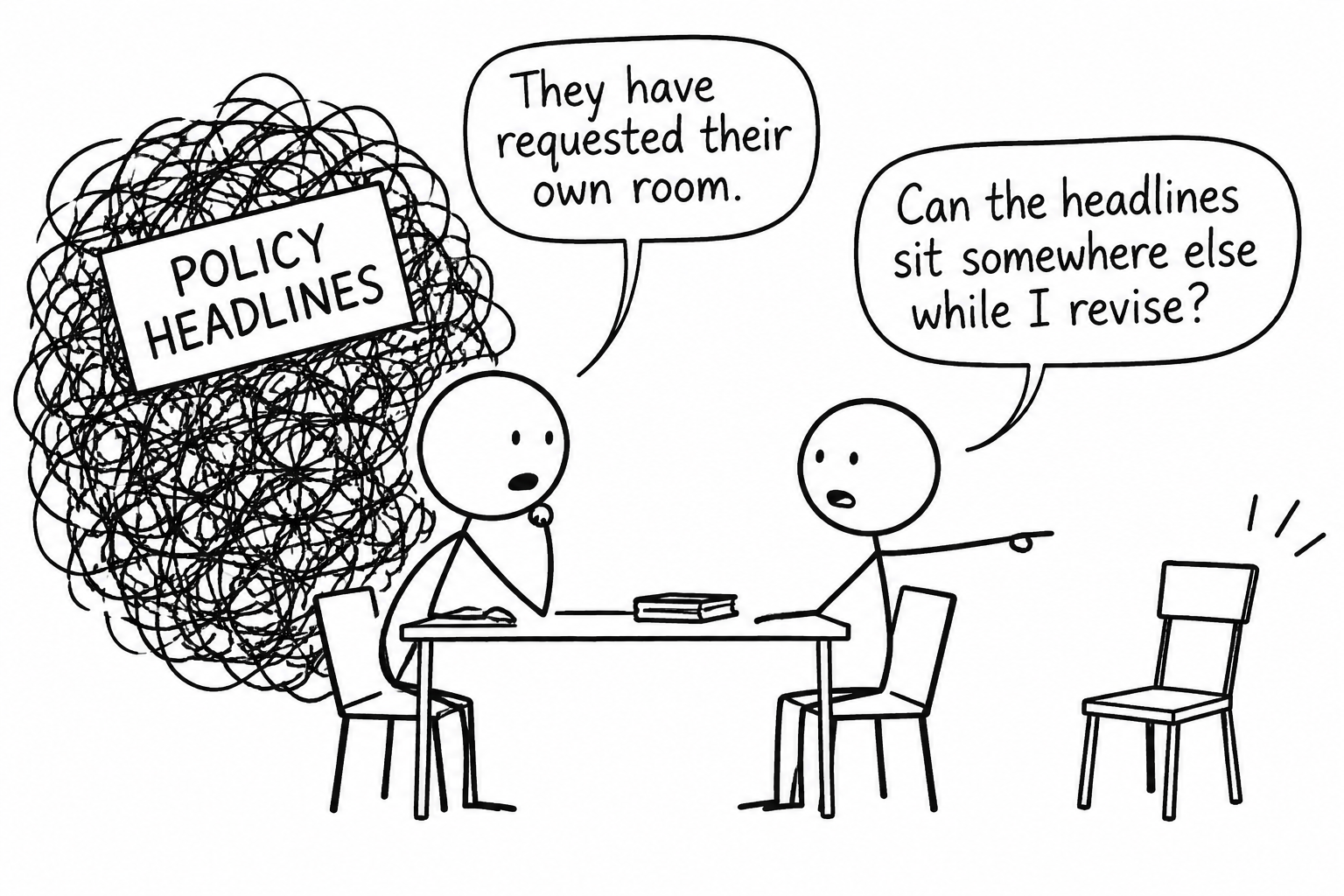 A parent and student negotiate with an oversized tangle of GCSE policy headlines
What changes for private candidates
Private entry does not change the academic standard. Candidates taking the same specification, tier and series face the same papers, grade boundaries and GCSE grading scale.
The practical responsibility differs. Families normally need to find a centre willing to accept the candidate, arrange entry through that centre and pay its fees. Acceptance of GCSE Maths does not guarantee acceptance of every board or specification.
Before paying, request written confirmation of:
- the qualification title, specification code and awarding organisation
- the tier and every required paper
- entry fees, administration charges and internal deadlines
- arrangements for results and post-results services
Discuss access arrangements or reasonable adjustments at the first enquiry. The centre may need evidence and time to complete its process; previous arrangements do not automatically transfer without checks.
The adult private-candidate resit guide offers entry guidance for older learners. Your chosen centre remains the authority for its arrangements.
Choose materials around the confirmed entry
Start with the examination date
Write down the intended series and year. GCSE Maths is normally available in summer. November entry is available to candidates aged at least 161616 on 313131 August of that year, according to Ofqual's 2026 student guidance.
A younger private candidate should not assume November is available simply because a centre offers it.
Confirm the specification
Ask for the exact awarding organisation and specification code. “GCSE Maths higher” is insufficient. Edexcel, AQA, OCR and Eduqas offer regulated qualifications, but their papers are not interchangeable.
Use the matching resources once the entry is confirmed. For example, Edexcel GCSE Maths revision organises lessons by topic and grade.
Build revision around that course
Begin with revision lessons and practice questions, then attempt matching papers. The Edexcel GCSE Maths past-paper collection provides papers, mark schemes and worked solutions to support checking and correction.
For learners returning after a long gap, the GCSE Maths with no background knowledge guide explains how to rebuild foundations before tackling full papers.
Review official changes before entering
Check the position each academic year and again before entry. For reformed qualifications, look for final Department for Education subject content, Ofqual assessment rules and an accredited exam-board specification.
A consultation describes possible changes. The final specification establishes what candidates must learn.
Common mistakes to avoid
Switching content too early
Current candidates need their current specification. Speculative material can absorb revision time without helping them gain marks on their actual papers.
Confusing curriculum and qualification dates
September 2028 concerns the revised national curriculum. The planned GCSE teaching phases follow in 2029 and 2030. Neither date alone identifies your child's first examination under a revised specification.
Booking before checking compatibility
Confirm the board, specification, tier and series before paying. Raise access arrangements during that first conversation, allowing time for evidence and centre procedures.
Mixing resources without a plan
Underlying maths overlaps across boards, but assessment details differ. Prioritise matching papers and mark schemes. The GCSE mock exam builder can support practice, but a homemade mock is not an official prediction.
Keep the specification in view
You cannot control the reform timetable. You can confirm the right entry and help your child practise what will actually be assessed.
Start with MathsGenie's free GCSE Maths lessons, choose the confirmed course and build a manageable routine around practice questions, past papers and careful corrections.