

What Does GCSE Economics Actually Test?
What does GCSE Economics actually test? Learn how marks reward knowledge, application, analysis, evaluation and confident use of quantitative skills.
The uncomfortable moment in GCSE Economics is not forgetting what inflation means. It is remembering the definition perfectly, writing it down confidently, and still receiving fewer marks than expected.
So, what does GCSE Economics actually test? The short answer is: both content knowledge and the ability to use it. Examiners reward accurate economic knowledge, but they also assess whether you can apply ideas to a given context, analyse chains of cause and effect, interpret quantitative evidence and reach supported judgements.
That distinction changes how you should revise. Facts are the raw material. Skills are what turn them into marks.
The GCSE Economics assessment checklist
Across current AQA and OCR GCSE Economics specifications, the broad assessment structure is built around three objectives:
| Assessment objective | What it assesses | Weighting |
|---|---|---|
| AO1 | Knowledge and understanding of economic ideas, concepts and terminology | 35%35\%35% |
| AO2 | Application of knowledge and understanding to economic contexts | 35%35\%35% |
| AO3 | Analysis and evaluation of economic issues and evidence | 30%30\%30% |
This means almost two-thirds of the available marks are connected to applying, analysing or evaluating knowledge rather than simply recalling it.
Your practical checklist is therefore:
- learn accurate definitions, models and relationships;
- identify the specific economic context in each question;
- use information from extracts, tables and diagrams;
- explain complete chains of reasoning;
- interpret percentages, averages, index numbers and graphs;
- evaluate by considering significance, assumptions and alternative outcomes;
- make a judgement that answers the precise question.
Always use the specification and assessment materials for your own exam board. AQA and OCR organise their papers and content differently. Students taking a Pearson Edexcel International GCSE should follow that qualification's specification rather than assuming the domestic GCSE structure is identical.
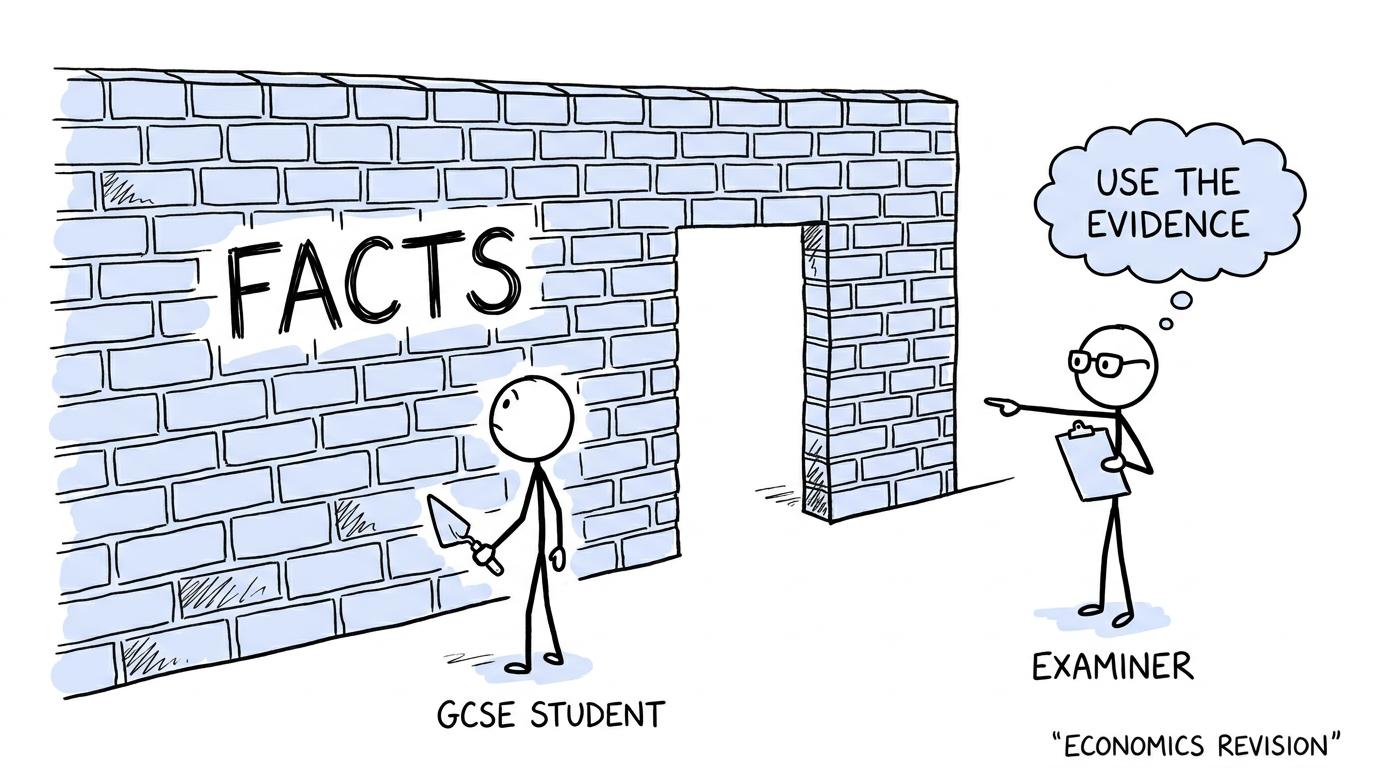 A student has built a wall of facts but forgotten the door marked use the evidence
Content knowledge is necessary, but it is the starting point
AO1 rewards what you know and understand. This includes economic terminology, theories, objectives, institutions and relationships.
You might need knowledge of markets, demand and supply, costs, revenue, profit, competition, labour markets, government policies, inflation, unemployment, economic growth and international trade. The exact organisation depends on your board.
Strong knowledge is precise. Saying that inflation means “prices going up” is less secure than recognising it as a sustained increase in the general price level. Similarly, economic growth concerns an increase in an economy's output, not automatically an improvement in every person's living standards.
Definitions matter because they give reasoning a stable first step. But a memorised paragraph cannot automatically answer every question. The same policy may affect households, firms, workers and the government differently. Its effect may also change between the short run and the long run.
Treat knowledge like money in a bank account: having it matters, but the exam asks whether you can spend it wisely.
Application turns general knowledge into an answer
AO2 is where many apparently knowledgeable answers lose marks. Application means selecting economic knowledge and connecting it directly to the context supplied.
A question may include a business's costs, an industry's level of competition, a country's unemployment rate or a change in consumer income. Those details are not decoration. They tell you which parts of your knowledge are relevant.
Effective application can involve:
- referring to figures or trends from the source;
- linking a policy to the named market or country;
- explaining how a particular firm, worker or household might be affected;
- choosing the economic concept that fits the evidence;
- avoiding a generic response that could answer any question.
Copying a sentence from an extract is not necessarily application. The important move is to connect the evidence to economic reasoning. Ask: why does this detail matter?
A useful revision habit is to underline the named agent, market, policy and period before planning an answer. This stops a familiar topic from pulling you towards a rehearsed but irrelevant paragraph.
Analysis earns marks through connected reasoning
Analysis is not the same as adding more separate facts. It means showing how one change leads to another.
A strong analytical chain has a clear direction:
- identify the initial economic change;
- explain the immediate effect;
- connect it to the behaviour of consumers, firms, workers or government;
- develop the resulting effect on an economic objective;
- keep every link relevant to the question.
Words such as “therefore” and “consequently” can help, but they do not create analysis by themselves. The logic between the statements must be valid.
For example, the relationship between revenue, costs and profit may support a chain of reasoning:
Profit=Total revenue−Total costs\text{Profit} = \text{Total revenue} - \text{Total costs}Profit=Total revenue−Total costsKnowing the formula is AO1. Selecting it for a particular business is application. Explaining how a change in revenue or costs could alter the firm's decisions is analysis.
This is why exam technique cannot be separated from content. You need enough knowledge to build the chain, then enough discipline to show each link.
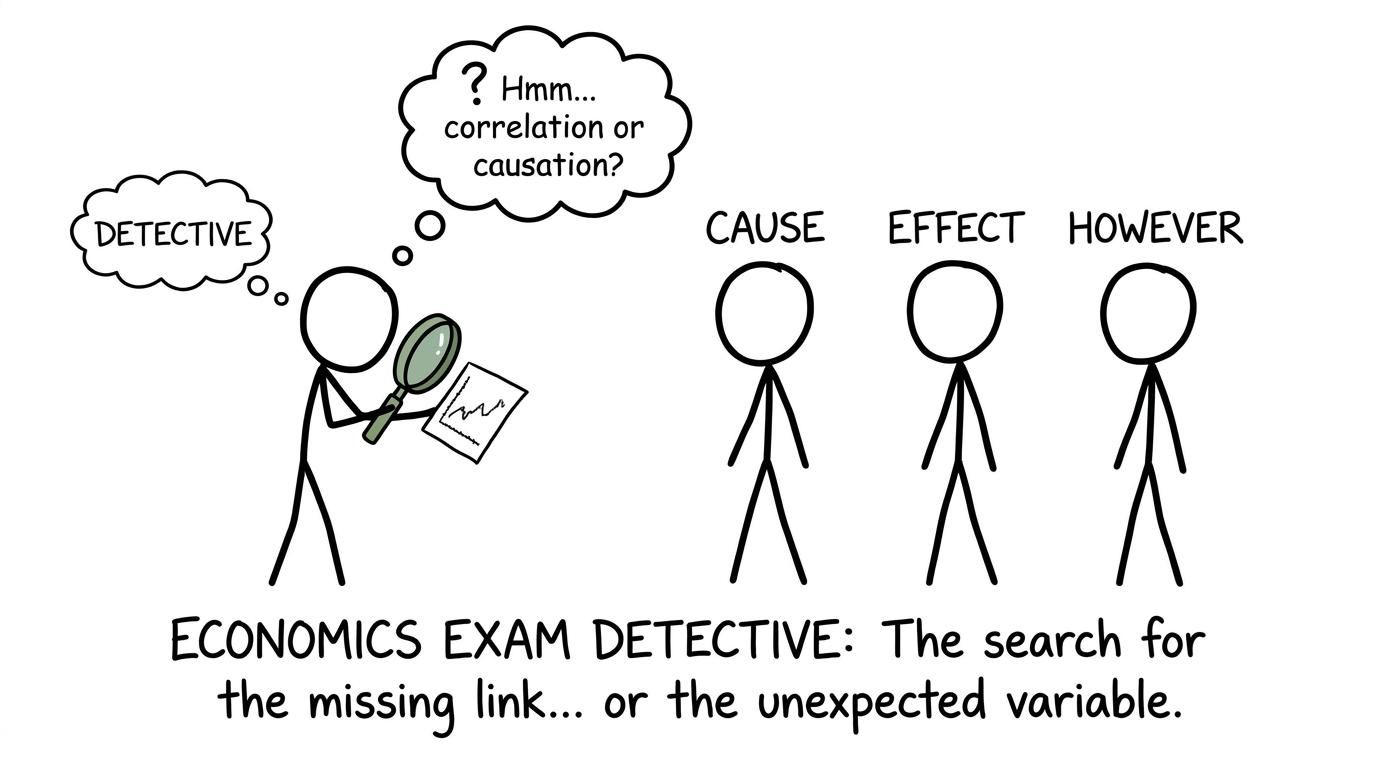 A student detective investigates cause, effect and however
Evaluation is more than writing “however”
Evaluation asks you to weigh evidence, recognise limitations and reach a supported conclusion. It becomes especially important in extended responses.
Examiners are not rewarding disagreement for its own sake. A sentence beginning with “however” earns little if it merely introduces an unrelated fact. Effective evaluation changes how convincing the original argument appears.
Useful evaluative questions include:
- How large is the change?
- How quickly will people or firms respond?
- Does the outcome depend on consumer confidence or business expectations?
- Might the short-run and long-run effects differ?
- Which group gains, and which group may lose?
- Is there enough evidence to support the claim?
- What other factor could influence the outcome?
A final judgement should answer the question rather than announce that “it depends”. Explain what it depends on and identify the condition that matters most. The best conclusion often follows naturally from the analysis already developed.
What quantitative skills does GCSE Economics assess?
GCSE Economics is not a second GCSE Maths paper, but numerical skills are part of the qualification. Current specifications require quantitative skills to be assessed, with at least 10%10\%10% of the overall marks connected to them.
Depending on the specification and question, students may need to work with:
- fractions, ratios and percentages;
- percentage changes;
- averages;
- costs, revenue and profit;
- interest;
- index numbers;
- economic data in tables and charts;
- demand and supply diagrams;
- the construction or interpretation of graphs.
The percentage-change relationship is particularly useful:
Percentage change=new value−original valueoriginal value×100\text{Percentage change} = \frac{\text{new value}-\text{original value}}{\text{original value}} \times 100Percentage change=original valuenew value−original value×100MathsGenie's free percentages practice questions can strengthen the calculation itself. For wider data-handling confidence, use the GCSE Statistics revision hub and its lessons, questions and papers.
The mathematical answer may not be the end of the task. Economics questions can also require you to interpret what a figure means in context. Check the units, dates, labels and base year, then connect the result to the issue being examined.
How command words reveal the skill being assessed
Command words are clues about the job the examiner wants you to perform.
Define or state
These usually focus on concise, accurate knowledge. Give the requested information without burying it beneath an unnecessary paragraph.
Calculate
Show a suitable method, keep track of units and check whether rounding is required. Even when using a calculator, visible working makes your process clear.
Explain or analyse
Develop connected reasoning. Do not stop after identifying an effect; explain why it occurs and where it leads.
Discuss, assess or evaluate
Consider the strength of the argument, relevant alternatives and contextual evidence before reaching a reasoned judgement. The exact expectations depend on the question and mark tariff, so use your board's specimen materials and mark schemes.
The number of marks is another signal. A short question does not require an essay, while an extended response needs structure and depth. Marks reward relevant development, not simply length.
Revise Economics as a performance, not a storage task
A revision session can feel productive while remaining passive. Highlighting definitions creates familiarity, but the exam requires retrieval and decision-making under time pressure.
A stronger routine separates the skills:
- Knowledge: retrieve definitions, relationships and diagrams without notes.
- Application: attach each idea to an unfamiliar context.
- Analysis: build a complete cause-and-effect chain.
- Evaluation: identify the strongest condition or limitation.
- Quantitative work: calculate, interpret and check data accurately.
Practise planning responses before writing them in full. Then compare your work with official mark schemes and examiner guidance from your board. Look for the point where your reasoning stopped, not only the fact you forgot.
Maths revision can support the quantitative part of this process. The Edexcel GCSE Statistics revision area provides data-focused practice, while MathsGenie's guide to using past papers in phases explains how to move from diagnosis to timed performance.
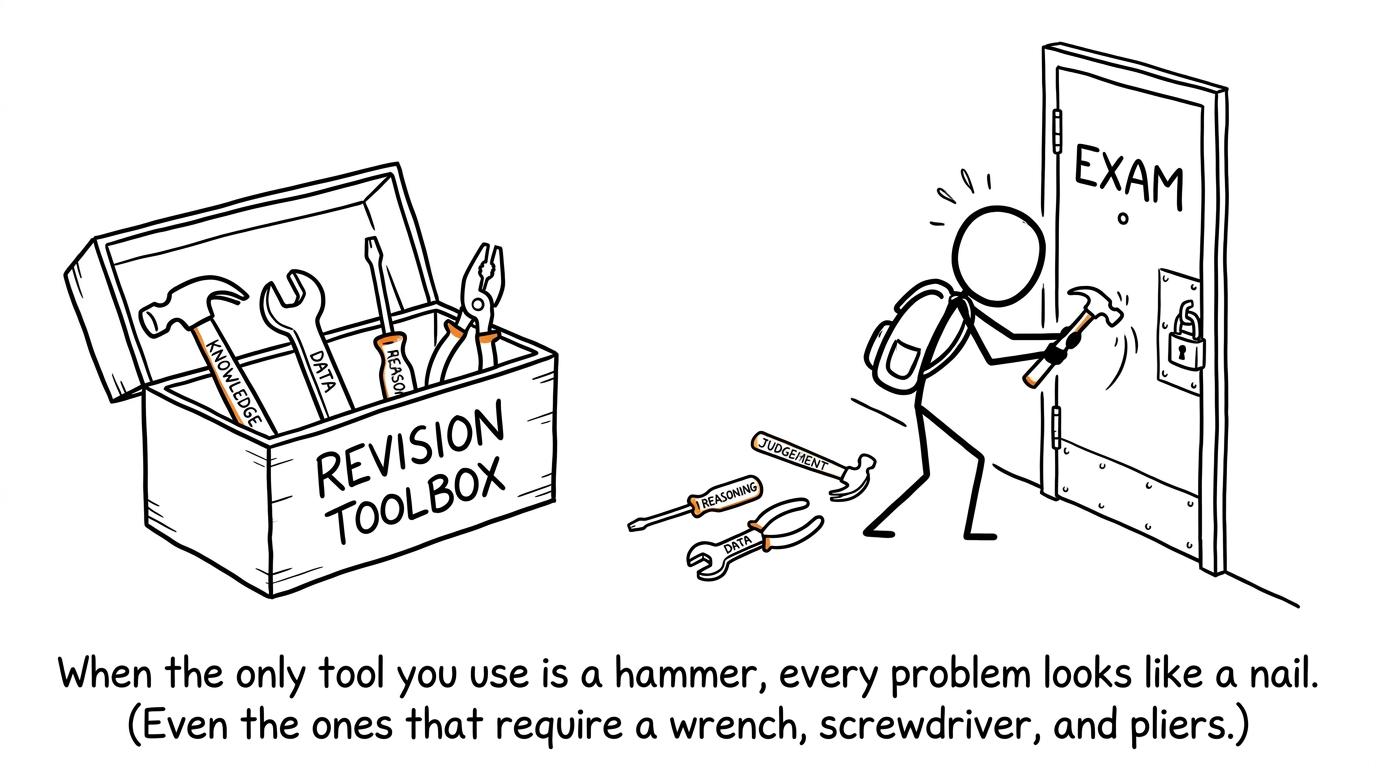 A student tries to open an exam door using only the knowledge tool
Common mistakes that cost GCSE Economics marks
Writing everything you know
A long answer can still be irrelevant. Select the knowledge that answers the exact question and develop it properly.
Ignoring the context
Generic explanations often limit application marks. Use the supplied business, market, country, period and data.
Jumping over links in the reasoning
If a conclusion seems obvious to you, it may still need explaining. Show how the initial change produces the final effect.
Offering empty evaluation
“However, this may not happen” is not enough. State why, under what conditions and how that changes the judgement.
Treating data as decoration
When evidence is provided, read its units and time period carefully. Use it to support or challenge the argument rather than merely copying it.
Revising calculations without interpretation
An accurate percentage is useful, but an economics response may also require its meaning. Practise moving from calculation to contextual explanation.
Using the wrong board's materials
AQA and OCR papers differ in their structure and wording. Pearson Edexcel International GCSE is a separate qualification. Confirm the code on your course materials and practise with the correct specification.
The real answer: knowledge and skills work together
What GCSE Economics actually tests is your ability to think economically with the knowledge you have learned. AO1 supplies the concepts. AO2 makes them relevant. AO3 turns them into reasoning and judgement. Quantitative skills help you read the evidence beneath the argument.
That is encouraging, because skills improve through deliberate practice. You do not need to write the longest answer in the room. You need to notice what the question is asking, choose relevant knowledge and develop it carefully.
For the numerical side of your revision, make MathsGenie your free practice base. Use revision lessons and practice questions to repair weak methods, then test your accuracy with GCSE predicted papers, mini tests, past papers, mark schemes and video solutions. The one-month GCSE revision plan can help you organise that work into a repeatable routine.
Learn the content. Practise the skill. Then make the two work together.











