University GCSE Statistics Requirement: Does It Matter?
University GCSE Statistics requirement explained: learn when your grade matters, when it does not, and how to check UK course entry criteria confidently.
A GCSE result can feel permanent when you are waiting for it. It is easy to imagine an admissions tutor, years later, examining every mark with a magnifying glass. The reality is less dramatic. A specific university GCSE Statistics requirement is uncommon. Most UK courses focus on your Level 3 qualifications and specify GCSE English Language and GCSE Maths where they need evidence of literacy or numeracy.
However, universities can still see your GCSE Statistics qualification, and some assess your wider GCSE profile. Your grade may therefore matter as part of the overall picture, particularly for competitive or quantitative courses. The safest answer is simple: check the exact course page for your intended entry year and never assume GCSE Statistics can replace GCSE Maths.
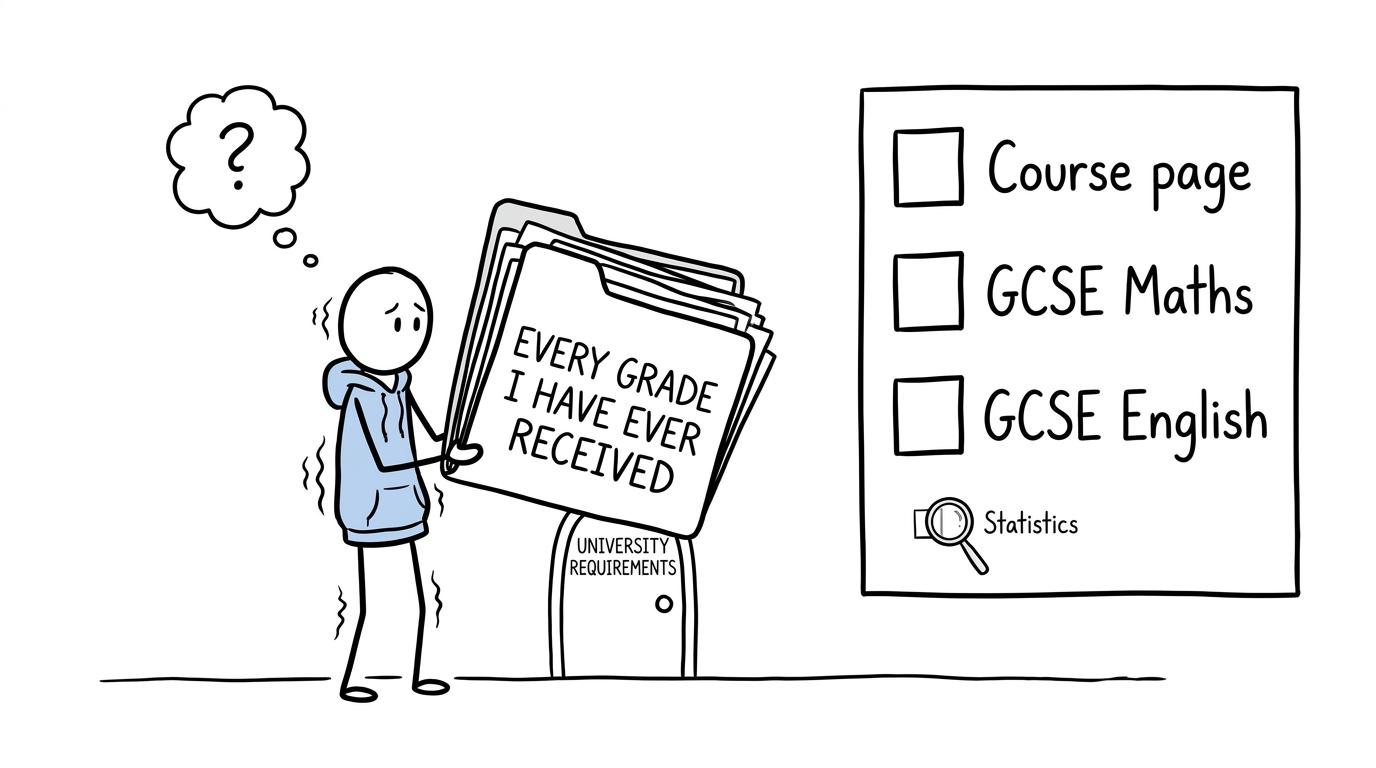 A student wondering whether every GCSE grade is inspected at university
The short answer at a glance
Here is the practical checklist:
- Universities may receive details of your achieved GCSE qualifications through your application.
- A named requirement for GCSE Statistics itself is rare.
- GCSE Maths and English Language requirements are much more common.
- Some selective courses consider the number and pattern of strong GCSE grades.
- Medicine, dentistry and other professionally regulated or highly competitive courses may examine GCSE results more closely.
- A good Statistics grade can support a quantitative academic profile, but it does not normally replace a required Maths grade.
- Requirements vary between universities, courses and entry years.
- If the wording is unclear, ask the university admissions team in writing.
That distinction matters. A university can consider a qualification without making it a formal condition of entry.
Do universities look at your GCSE Statistics grade?
They can, but most do not isolate it as the decisive grade.
Universities set their own admissions criteria. Current UCAS guidance explains that requirements vary by course and provider, while many courses expect pre-sixteen qualifications such as GCSE English and Maths. Course offers then tend to centre on A Levels, T Levels, BTECs, Scottish Highers or another recognised Level 3 route.
Your GCSE Statistics grade usually sits within your broader academic record. An admissions tutor might see that record in one of three ways:
- as evidence that you meet a published subject requirement;
- as part of a scored or reviewed GCSE profile;
- as additional evidence of quantitative interest and ability.
The third role is supportive rather than decisive. A strong grade may fit naturally alongside A Level Maths, Economics, Psychology, Geography, Biology or another data-rich subject. But it will not usually rescue an application that misses a clearly stated compulsory requirement.
When a GCSE Statistics grade can matter
When the course reviews your overall GCSE profile
Some competitive courses do more than check minimum grades. They may consider how many GCSEs you achieved at higher grades, which subjects you took and how your attainment compares with the opportunities available at your school.
In that situation, Statistics is another full qualification in your profile. A grade 888 or 999 can strengthen the overall record, while a lower grade may be noticed without automatically ending your chances. The precise importance depends on the university's selection method.
Medicine provides the clearest reason to read the small print. Current medical course pages often specify minimum grades in English Language, Maths and sciences, and some also score a selection of GCSE results. The named numeracy subject is ordinarily GCSE Maths, not GCSE Statistics. Nevertheless, Statistics may contribute where an institution scores an applicant's broader collection of GCSEs.
When you apply for a quantitative course
Statistics is directly relevant to degrees involving data, uncertainty or research methods. Examples include statistics, data science, economics, psychology, geography, social science and some biological sciences.
Relevant does not mean required. Published criteria for mathematics and statistics degrees commonly place much more weight on A Level Maths and, for some highly mathematical courses, Further Maths. They may also require a particular GCSE Maths grade.
A good GCSE Statistics result can still make your subject choices look coherent. It suggests that you have encountered ideas such as sampling, correlation, probability and interpreting data. What it cannot do is stand in for the algebraic preparation expected from GCSE or A Level Maths unless the university explicitly says that it can.
If you are considering a data-heavy route, the free GCSE Statistics revision hub is a useful place to consolidate those foundations before sixth form.
When two applications are academically close
Universities sometimes use several pieces of evidence to distinguish between applicants who meet the headline conditions. GCSE attainment may form part of that context, alongside predicted grades, achieved qualifications, admissions tests, references and contextual information.
It would be misleading to claim that one Statistics grade acts as a universal tie-breaker. Admissions policies differ. The sensible conclusion is narrower: every declared qualification may contribute to the picture, but its weight depends on the published selection process.
When your grade probably will not be central
For many courses, GCSE Statistics is neither named nor specially scored. If you meet the required GCSE English and Maths grades and satisfy the Level 3 offer, your Statistics result may have little practical effect.
This is especially likely where a course:
- states only a standard GCSE Maths or numeracy requirement;
- bases its offer mainly on three A Levels or an equivalent qualification;
- does not describe a GCSE scoring system;
- has no subject-specific connection to statistics;
- assesses applicants holistically rather than ranking individual GCSE subjects.
Do not translate “not central” into “hidden problem”. A single disappointing result usually needs to be understood beside the rest of your application. Universities may also use contextual admissions information, although policies differ and should be checked directly.
GCSE Statistics is not the same as GCSE Maths
This is the most important technical distinction.
GCSE Statistics is a regulated qualification graded from 999 to 111, with foundation and higher tiers available in current specifications. It develops valuable knowledge of data collection, representation, probability and statistical interpretation.
GCSE Maths covers a broader mathematical curriculum, including number, algebra, ratio, geometry, probability and statistics. When a university asks for “GCSE Mathematics at grade 666”, it normally means the specified Mathematics qualification or an equivalency that the university has formally approved.
You should not assume that GCSE Statistics at grade 999 compensates for GCSE Maths at grade 555. It may show strength in data handling, but the admissions condition is still unmet unless the university confirms an accepted alternative.
The reverse is also true: taking GCSE Statistics is not unnecessary merely because you already take Maths. It is an additional qualification with deeper statistical content. Use the dedicated AQA GCSE Statistics resources or Edexcel GCSE Statistics revision resources so that your practice matches your board and tier.
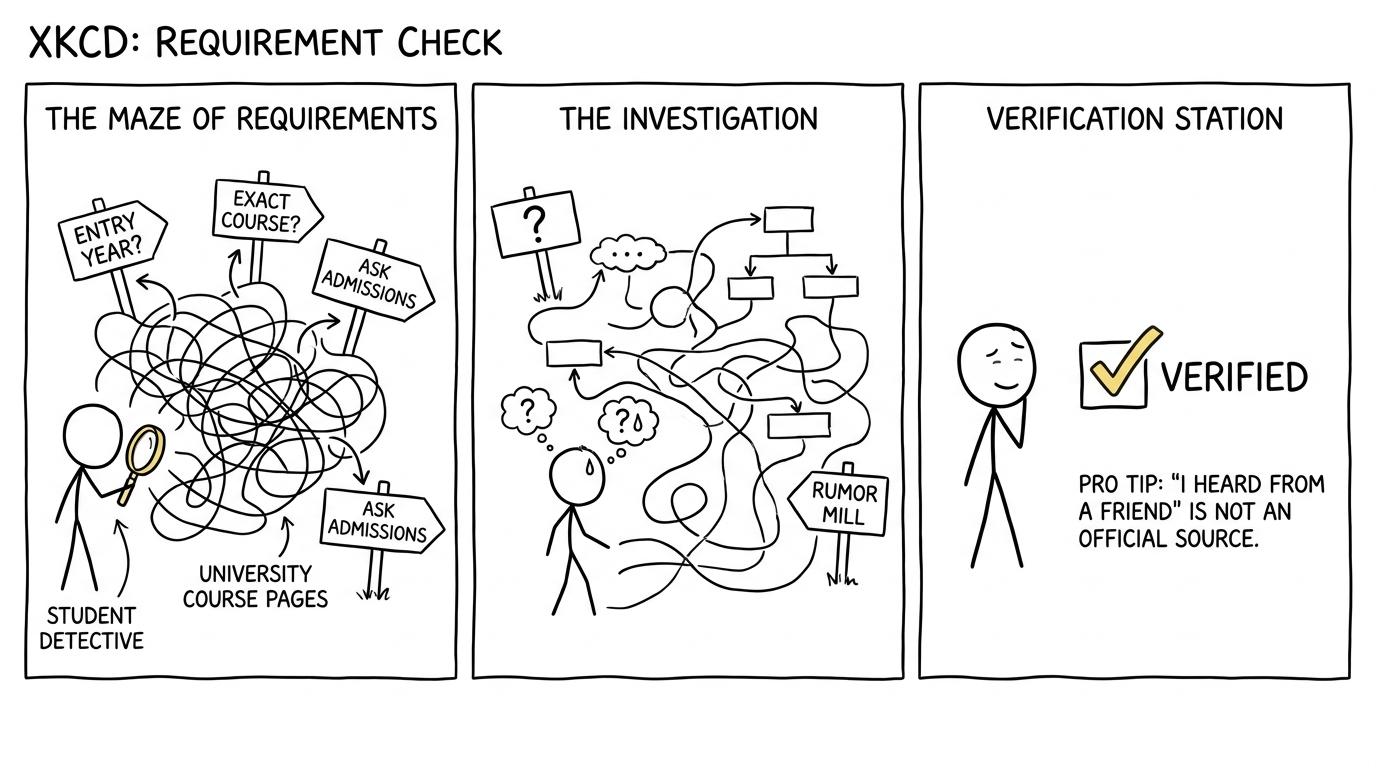 A student detective checking the exact university requirements
How to check a university GCSE Statistics requirement
Requirements change, so a remembered rule from an older student is not enough. Use this process for every course you are seriously considering.
Read the exact course page
Check the university's official page for the degree, campus and intended year of entry. Similar course titles can have different criteria, and a foundation year may not use the same requirements as direct first-year entry.
Look for sections called:
- entry requirements;
- GCSE requirements;
- subject requirements;
- selection process;
- accepted qualifications;
- contextual offers.
Separate minimum requirements from typical profiles
A minimum is normally a threshold you must meet. A typical profile describes what may be common among entrants or competitive applicants, but it is not automatically a formal condition.
Also distinguish between “required”, “preferred”, “recommended” and “considered”. Those words are not interchangeable.
Check whether GCSEs are scored
For highly competitive courses, search the admissions policy for details of GCSE scoring. Find out which subjects count, how many qualifications are included and whether Maths, Further Maths and Statistics are treated separately.
Do not infer a scoring rule from a discussion forum. If the official wording does not answer your question, contact admissions and include the exact title of your qualification, exam board, grade and proposed course.
Save the answer
Keep a screenshot or written reply with the date and entry year. Admissions pages can change as universities publish criteria for new cycles. A simple spreadsheet of courses, GCSE conditions and Level 3 offers prevents avoidable surprises.
What to do if your Statistics grade is lower than expected
First, establish whether the grade affects anything concrete. Check sixth-form entry, your intended A Level subjects and the university courses you are considering. Worry becomes useful only when it produces a specific next action.
If the result appears inconsistent with your performance, speak to your school about access to scripts or a review of marking. Reviews have rules, deadlines and possible outcomes, including marks moving down as well as up, so take informed advice rather than reacting immediately.
If a resit is appropriate, use the GCSE Statistics resit plan and the guide for a GCSE Statistics grade lower than expected. A better revision cycle is more valuable than simply repeating the same preparation.
For skills shared with GCSE Maths, such as averages, graphs and probability, use the wider GCSE Maths revision hub. Higher-tier students can also strengthen data interpretation through the cumulative frequency revision lesson.
How to make Statistics useful beyond the grade
A qualification matters partly because of the result. It also matters because of what it prepares you to do next.
Statistics teaches you to question where data came from, whether a sample is representative and whether a conclusion is justified. Those habits appear across A Level subjects and university courses. They are also valuable whenever a graph, survey or headline makes a confident claim from limited evidence.
Revision should therefore build understanding as well as secure marks. Use this cycle:
- revisit one focused lesson;
- answer practice questions without notes;
- check the mark scheme;
- record the reason for each lost mark;
- return to the same skill after a short gap;
- move into timed past papers once individual topics are secure.
Students planning to continue with Maths can preview how statistical ideas develop through the Edexcel A Level Maths revision hub. The notation becomes more advanced, but the central habit remains the same: interpret before calculating.
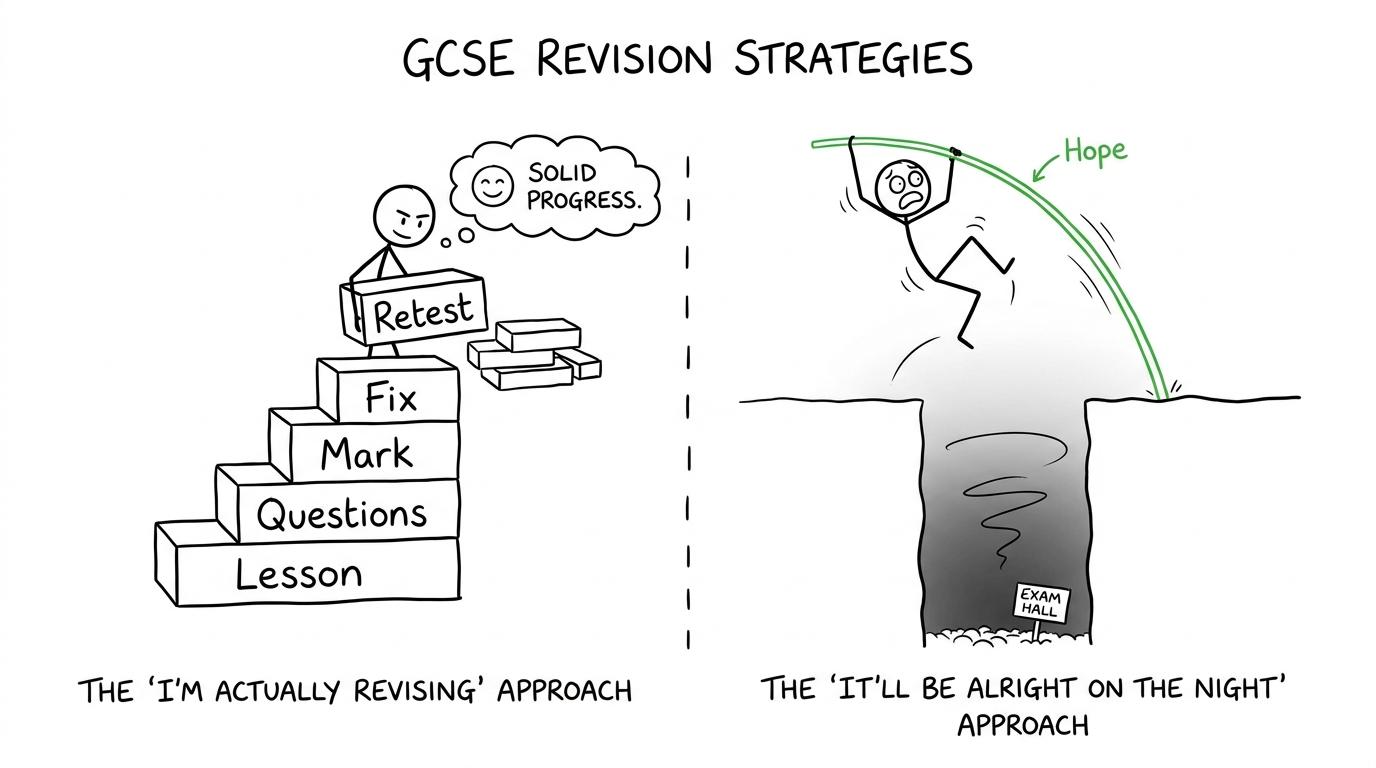 One student builds revision step by step while another relies on hope
Common mistakes when thinking about university requirements
Assuming Statistics replaces Maths
It usually does not. If the course names GCSE Maths, meet that condition or obtain written confirmation of an accepted equivalent.
Looking only at the headline A Level offer
A course advertised with an offer such as AAAAAAAAA may still have separate GCSE conditions. Read the complete entry requirements.
Treating every university as identical
There is no single UK-wide university GCSE Statistics requirement. Each provider sets its own criteria, and different departments within one university may use different policies.
Using old or second-hand information
Requirements can change between admission cycles. Check the official page for your intended year rather than relying on an old prospectus, video or forum comment.
Believing one grade defines the application
A GCSE result can matter without defining your future. Focus on thresholds you must meet, then strengthen the qualifications and evidence that carry the greatest weight for your chosen course.
Your next step
In most cases, universities will not demand a particular GCSE Statistics grade. They are more likely to specify GCSE Maths and English, consider your broader GCSE record, and concentrate on the Level 3 qualifications relevant to the degree. Statistics matters most when it is explicitly named, included within GCSE scoring or used as supporting evidence for a quantitative pathway.
Check early. Keep the exact wording. Ask admissions when anything is ambiguous. Then return your attention to the part you can control: becoming more secure at the subject.
MathsGenie gives you a free route from uncertainty to action. Choose your exam board, work through revision lessons and practice questions, use mini tests to find gaps, and complete past papers with mark schemes and video solutions. Add predicted papers at the right stage and place each task in your revision planner. Your grade is one line on an application; the habits used to earn it can carry much further.