University GCSE English Language and Literature Requirement
University GCSE English Language and Literature requirement explained: when grades matter, how courses differ, and what to check before applying in the UK.
A university course can feel years away while you are revising simultaneous equations or trying to remember a circle theorem. Then someone says, “Universities still look at your GCSEs,” and suddenly an English result begins to feel permanent.
The short answer is yes: a university GCSE English Language and Literature requirement can affect an application. However, English Language is requested far more often than English Literature. Some courses set a minimum English Language grade, while others consider GCSE results as part of the wider application. The exact rule depends on the university, course and entry year.
That distinction matters. A disappointing Literature result does not automatically close university doors, but an unmet Language requirement may need to be addressed.
The quick university GCSE English checklist
Before choosing a university course, check:
- whether it specifies GCSE English Language;
- whether English Literature is mentioned separately;
- the minimum grade required;
- whether an equivalent qualification is accepted;
- whether resits are allowed;
- whether the rule is different for your chosen course;
- whether international English-language requirements also apply to you; and
- whether requirements have changed for your intended entry year.
Do not rely on a general university admissions page when a course-specific page is available. The detailed course entry requirements are usually the most relevant source, and admissions teams can clarify ambiguous wording.
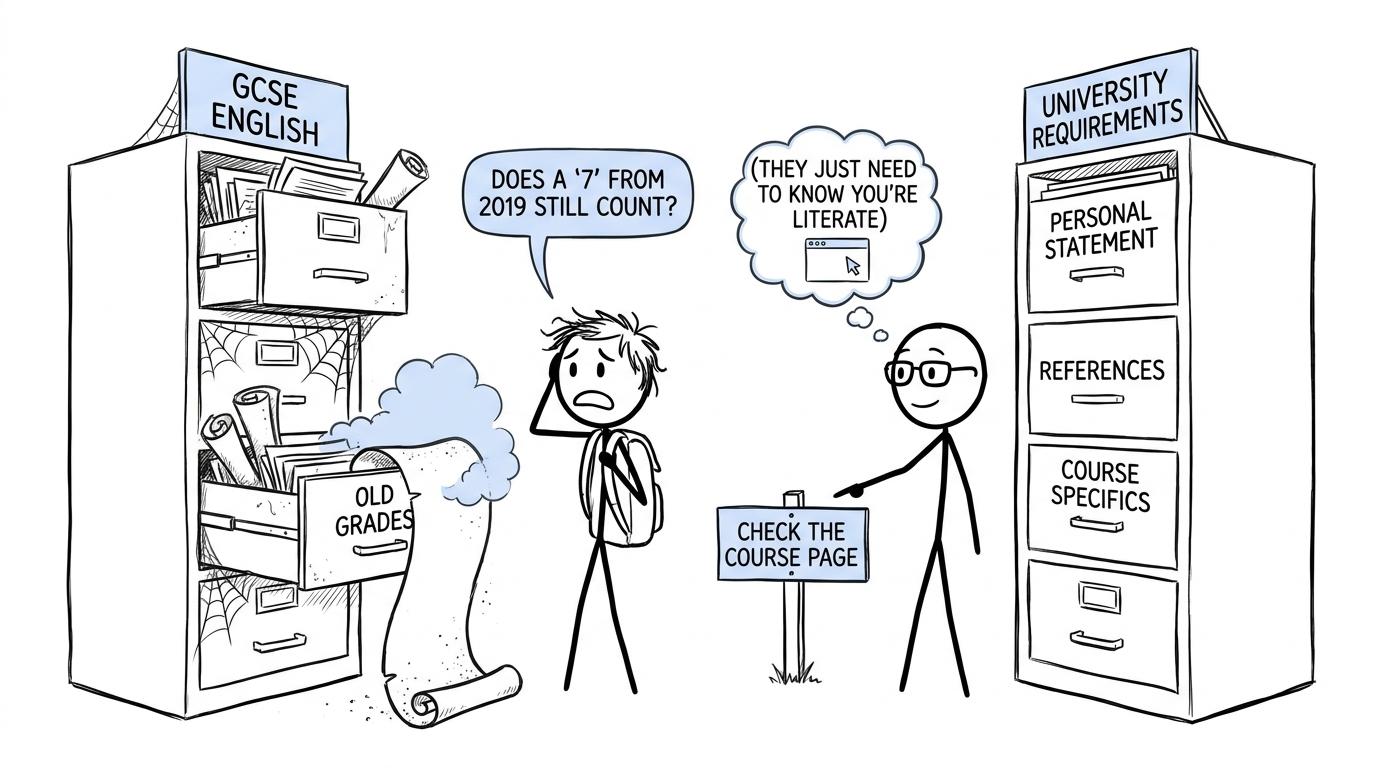 A student discovers that checking the course page is calmer than worrying about every old grade
Do universities look at GCSE English grades?
Universities can see the qualifications declared in an application and may use GCSE results in several ways. A grade might be:
- a compulsory minimum entry requirement;
- part of an assessment of your overall academic record;
- especially relevant to a competitive or professionally regulated course;
- considered alongside A Levels, admissions tests, interviews and contextual information; or
- largely unimportant once the course’s basic requirements have been met.
There is no single rule covering every UK university. Two courses with similar names can have different requirements, even within the same institution. Requirements can also change between admissions cycles.
For most applicants, A Levels or another Level 333 qualification carry more weight because they are more recent and closely connected to the intended degree. That does not make GCSEs invisible. It means their importance is usually narrower: they may establish a baseline, show subject preparation or help a university assess an application with several forms of evidence.
English Language and English Literature are not interchangeable
English Language and English Literature are separate GCSE qualifications. Universities normally recognise that difference.
Why English Language is requested more often
English Language is commonly used as evidence that an applicant can understand written material and communicate clearly. Degree courses involve reading instructions, constructing arguments and presenting ideas accurately, so some universities set a minimum grade such as grade 444, 555 or 666.
The required grade varies. It should never be assumed from the subject name or the university’s general reputation.
When English Literature matters
A specific English Literature requirement is less common outside degrees closely connected with literature, language or the humanities. Even for an English degree, universities often focus more heavily on A Level subjects and grades, although GCSE conditions may still apply.
Some course pages may accept English Literature as an alternative to English Language. Others explicitly require Language and will not treat Literature as a substitute. Only the published wording or confirmation from admissions can settle that question.
The safest principle is simple: if a page says “GCSE English Language”, do not silently read it as “either English GCSE”.
When your GCSE English grade is most likely to matter
The importance of the grade depends on what job it is doing within the admissions process.
It is a stated minimum requirement
This is the clearest situation. If a course requires a particular English Language grade, meeting the A Level offer does not necessarily cancel that condition. Universities may reject an application that falls below a published GCSE minimum, although policies on resits, equivalent qualifications and contextual admissions differ.
You are applying for a highly competitive course
Courses such as medicine and dentistry may inspect GCSE profiles more closely than many other degrees. Yet their methods vary substantially. One medical school might impose several subject-specific GCSE minimums, while another may place greater emphasis on an admissions test, predicted grades or interview performance.
Never transfer the requirements from one medical or dental school to another. Check each institution individually.
The degree leads towards a regulated profession
Certain professional routes may involve additional academic expectations. Teacher training is one example where providers must consider whether applicants meet required standards in English and maths, with an additional science expectation for primary teaching routes. The precise evidence and equivalency arrangements should be checked with the provider.
Healthcare and other professional programmes may also publish detailed subject conditions. These can be stricter than the university’s broad undergraduate policy.
Your later qualifications do not clearly demonstrate English
An admissions team may pay more attention to GCSE English if your A Level choices are mainly numerical, scientific or practical. This does not mean that taking Maths, Further Maths and Physics is a disadvantage. It means the GCSE result may remain the clearest formal evidence of English attainment.
The university assesses your wider academic record
Some universities evaluate GCSEs as part of a complete academic profile rather than as a simple pass-or-fail gateway. In that context, one grade sits among your other qualifications, school context and more recent performance.
A single result is rarely the whole story unless it breaches an explicit minimum.
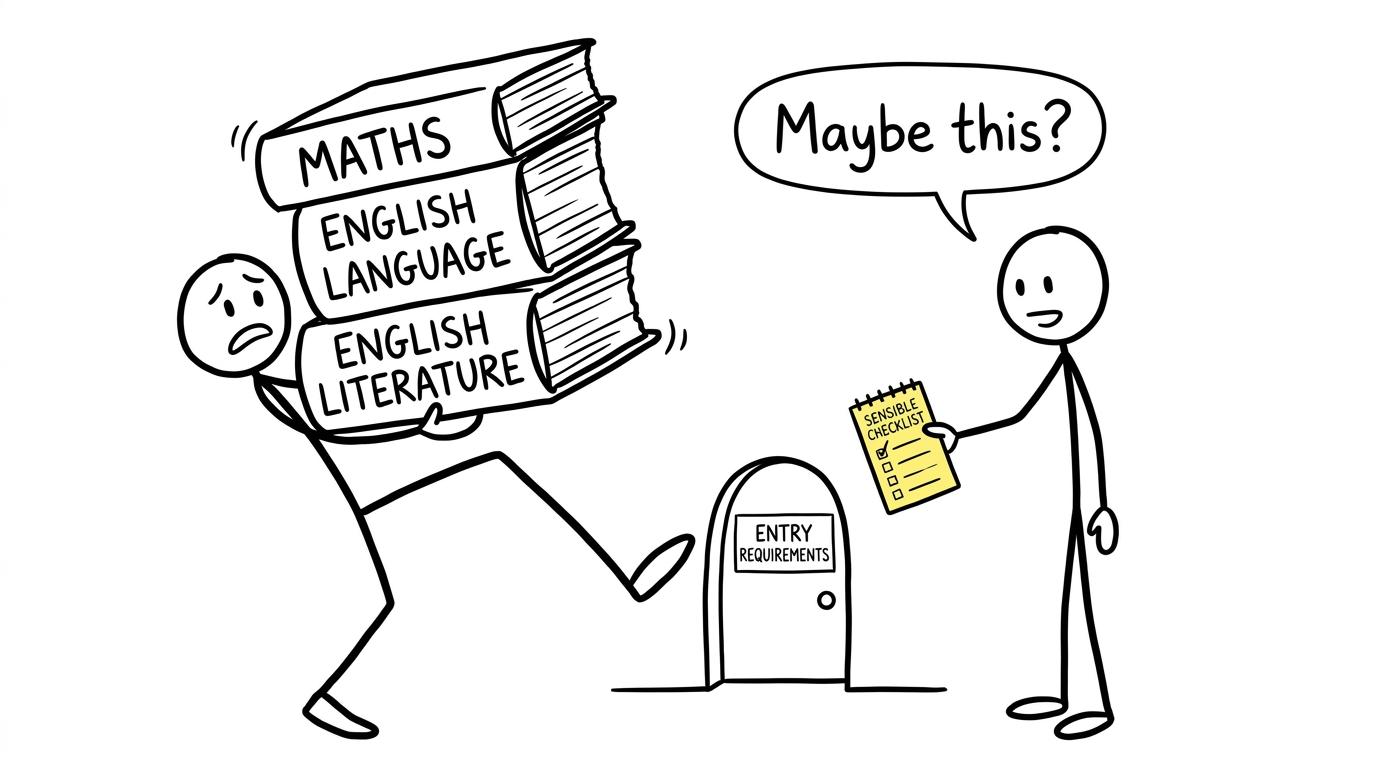 A student balances several subjects while a checklist makes the university doorway less mysterious
When English Literature may not matter much
For many maths, engineering, computing and science degrees, English Literature is unlikely to be a central selection factor. The course may care much more about A Level Maths, Further Maths or another relevant science.
However, “not central” is different from “never seen”. Applicants are expected to provide the qualifications requested during the application process accurately. A university may still consider the overall GCSE record, and a separate English Language minimum can remain in force.
Think of the Literature grade as one piece of a large application rather than a label attached to your future. Its significance comes from the rules of the particular course, not from the anxiety surrounding the result.
What if your grade is below the requirement?
Start by reading the exact wording. Look for notes about accepted subjects, resits, equivalent qualifications and contextual offers. Then contact the university’s admissions team before applying if anything is uncertain.
Possible routes may include:
- resitting GCSE English Language;
- presenting an accepted equivalent qualification;
- applying to a course with different GCSE conditions;
- asking whether your circumstances may be considered contextually; or
- completing a foundation year, where suitable and available.
None of these routes is guaranteed. An equivalent accepted by one university may not be accepted by another, and a foundation year can still have GCSE conditions. Written confirmation from the relevant admissions team is more dependable than advice copied from an old forum discussion.
If you are still taking GCSEs, the best response is not panic but targeted revision. Protecting time for English does not require abandoning maths. A realistic plan can divide attention according to need while keeping both subjects moving.
For maths, the MathsGenie GCSE revision programme organises topics by grade and provides videos and practice questions. Once the content feels familiar, GCSE past papers and mark schemes can show whether that knowledge survives under exam conditions.
Why maths students should take the requirement seriously
A student aiming for engineering or economics may naturally give most revision time to Maths. That is sensible up to a point. Relevant subjects usually deserve substantial attention.
The risk appears when one requirement is treated as unimportant simply because it is unrelated to the degree title. A course asking for strong A Level Maths and GCSE English Language is not offering a choice between them. Both conditions can matter.
Revision therefore works best as a constraint problem: first protect the subjects needed to keep future options open, then distribute additional time where it can produce the greatest improvement. MathsGenie helps make the maths part more efficient through focused lessons rather than unfocused rereading.
You can use GCSE mini tests to identify short gaps, then return to the relevant lesson instead of revising an entire grade. Closer to the examinations, MathsGenie predicted papers provide fresh exam-style practice alongside official past papers.
Students continuing with mathematics can also explore A Level Maths revision resources and A Level past papers. This helps connect today’s GCSE preparation with the qualifications universities are likely to examine most closely later.
How to check a university requirement properly
University websites contain several layers of information. Reading only the headline A Level offer can cause important GCSE conditions to be missed.
Use this process:
- Open the page for the exact course, not merely the department homepage.
- Select the correct year of entry where the website provides that option.
- Read the complete entry requirements section.
- Look for separate GCSE, subject and English-language headings.
- Check whether the wording says Language, Literature or either qualification.
- Read policies covering resits, equivalents and contextual admissions.
- Save the page or note the date on which you checked it.
- Ask admissions for clarification if your qualification does not match the wording exactly.
International English-language conditions are not necessarily the same as a GCSE English requirement. Applicants should check both where relevant rather than assuming that satisfying one automatically satisfies the other.
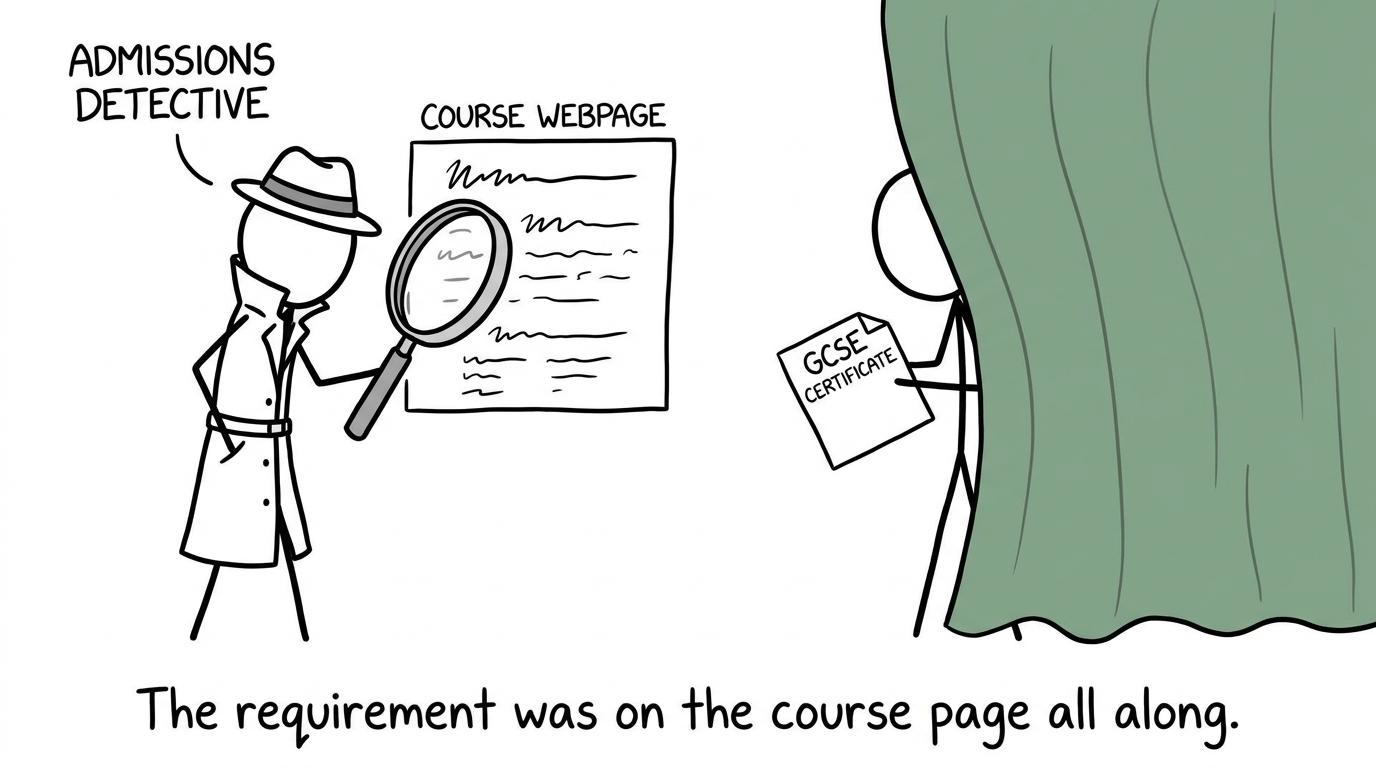 An admissions detective finds the requirement on the course page
Common mistakes when judging GCSE English requirements
Assuming English Language and Literature are equivalent
They may be alternatives on a particular course, but this must be stated or confirmed. A Literature grade does not automatically meet a Language condition.
Looking only at the A Level offer
A course advertising an A Level range can still list GCSE English and maths requirements further down the page.
Using another university’s rules
Similar courses can assess GCSEs differently. This is especially important for medicine, dentistry and professional programmes.
Trusting outdated discussions
Entry requirements can change. Advice written for an earlier admissions cycle may no longer apply to your entry year.
Hiding or omitting a result
Applications should contain the qualifications requested accurately. If a grade is a concern, investigate resits, equivalents or alternative courses rather than hoping it will be overlooked.
Letting one grade define the whole application
A weak result may create a practical obstacle, but obstacles can be investigated. The useful questions are whether the grade is required, what alternatives are accepted and what action remains possible.
Keep your future options open with purposeful revision
Universities do sometimes look back at GCSE English Language and Literature, but they do not all look in the same way. English Language is more commonly a formal requirement. Literature tends to matter where it is specifically requested, accepted as an alternative or considered within the wider academic profile.
The calmest approach is also the most effective: check each course, read the precise wording and act early if your grade may fall short. Then return your attention to what you can still improve.
For GCSE maths, begin with MathsGenie’s free revision lessons and practice questions, test yourself using past papers with mark schemes, and add predicted papers and mini tests when you need fresh practice. University requirements can feel distant, but good revision is built in the present: one clearly chosen topic at a time.