Typing Answers Under Timer for GCSE Art and Design
Typing answers under timer GCSE Art and Design practice can sharpen planning and annotation, but only when paired with realistic practical rehearsal.
The timer starts. Your thoughts feel clear, but turning them into useful words suddenly takes too long. If you have searched for typing answers under timer GCSE Art and Design, the short answer is yes: timed typing can improve how quickly you retrieve ideas, organise annotations and make decisions. But it is not a complete rehearsal for the qualification.
GCSE Art and Design is not a conventional written examination. You are assessed through a portfolio and an externally set assignment, with practical work, visual evidence and purposeful annotation contributing to the same creative journey. Typing quickly is useful only when it helps you explain that journey more clearly. It cannot replace experimentation, recording, refinement or the physical process you will use under supervised conditions.
The best approach is therefore mixed: type to build fluency and structure, then practise in the format and conditions your school will actually use.
The quick verdict
Timed typed practice is worthwhile when you use it to:
- retrieve specialist vocabulary without relying on notes;
- organise observations into short, purposeful annotations;
- explain artistic choices, effects and next steps;
- recognise when you are merely describing an image;
- become calmer when making decisions against the clock.
It is less useful when you:
- type long essays that your course does not require;
- measure progress only through words per minute;
- rehearse on a computer when your assessed work will be handwritten or integrated into a physical sketchbook;
- treat written speed as a substitute for practical preparation;
- copy memorised comments that do not relate to your own developing work.
The principle is familiar from maths revision. A calculator may help you calculate efficiently, but it does not choose the method. In the same way, a keyboard may increase output, but it does not create critical understanding.
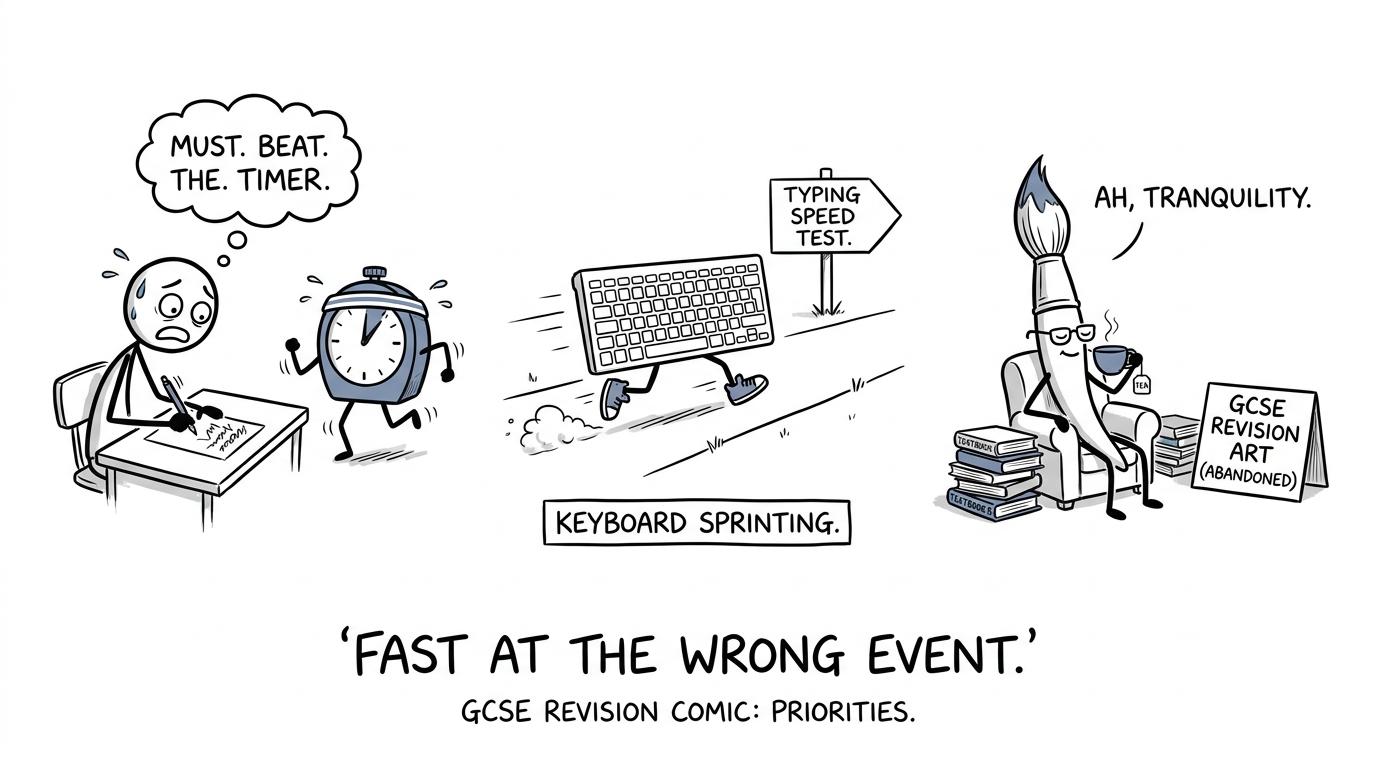 A keyboard racing while a paintbrush calmly drinks tea
What GCSE Art and Design actually assesses
Across GCSE Art and Design specifications, the four assessment objectives are equally weighted:
- AO1: develop ideas through investigations and demonstrate critical understanding of sources;
- AO2: refine work by exploring ideas and experimenting with media, materials, techniques and processes;
- AO3: record ideas, observations and insights as work progresses;
- AO4: present a personal and meaningful response that realises intentions and shows understanding of visual language.
Each objective contributes 25%25\%25% of the qualification. Written annotation is particularly relevant to AO3, although effective writing may also provide evidence for the other objectives. Exam-board guidance consistently treats annotation as support for visual and practical evidence, not as its replacement.
That distinction matters. You are not usually practising a bank of fixed Art and Design “answers” in the way that you might answer GCSE maths questions. You are learning to express why you selected a source, what an experiment revealed, how your ideas changed and what you intend to do next.
AQA, Pearson Edexcel, OCR and Eduqas all use portfolio and externally set components, although precise administrative rules and mark totals differ. The externally set component generally contributes 40%40\%40%, with a supervised period of 101010 hours following preparatory work. Always follow your own teacher’s instructions because access to work, digital equipment and preparatory material is controlled by the relevant specification and your centre.
Unlike GCSE maths, Art and Design does not have foundation and higher tiers. The grades are still awarded on the GCSE 999 to 111 scale, but every student develops evidence against the same four broad objectives.
Where timed typing genuinely helps
It reduces the delay between seeing and explaining
A student may understand why a composition feels unbalanced yet struggle to put that judgement into words. Short timed typing sessions force the thought to become explicit. With repetition, useful terms such as contrast, scale, texture, rhythm, composition and tone become easier to retrieve.
The gain is not simply faster fingers. It is a shorter route from observation to decision.
It encourages compact structure
Purposeful annotation does not need to be extended prose. Pearson’s guidance, for example, makes clear that there is no requirement for long pieces of writing. A concise comment that connects a choice to its effect and future development can be more valuable than a page of description.
Try building every timed response around three questions:
- What did I notice, choose or change?
- What effect did this have on my intention?
- What should I retain, reject or develop next?
This creates movement. Description records what is visible; analysis explains why it matters.
It reveals whether you know the vocabulary
Typing without notes is a form of retrieval. If you repeatedly pause because you cannot name a process or visual quality, the timer has exposed a knowledge gap. That is useful evidence, not failure.
This resembles the diagnostic approach used in MathsGenie’s guide to finding weak GCSE topics. A timed attempt reveals the bottleneck; the next revision session repairs it.
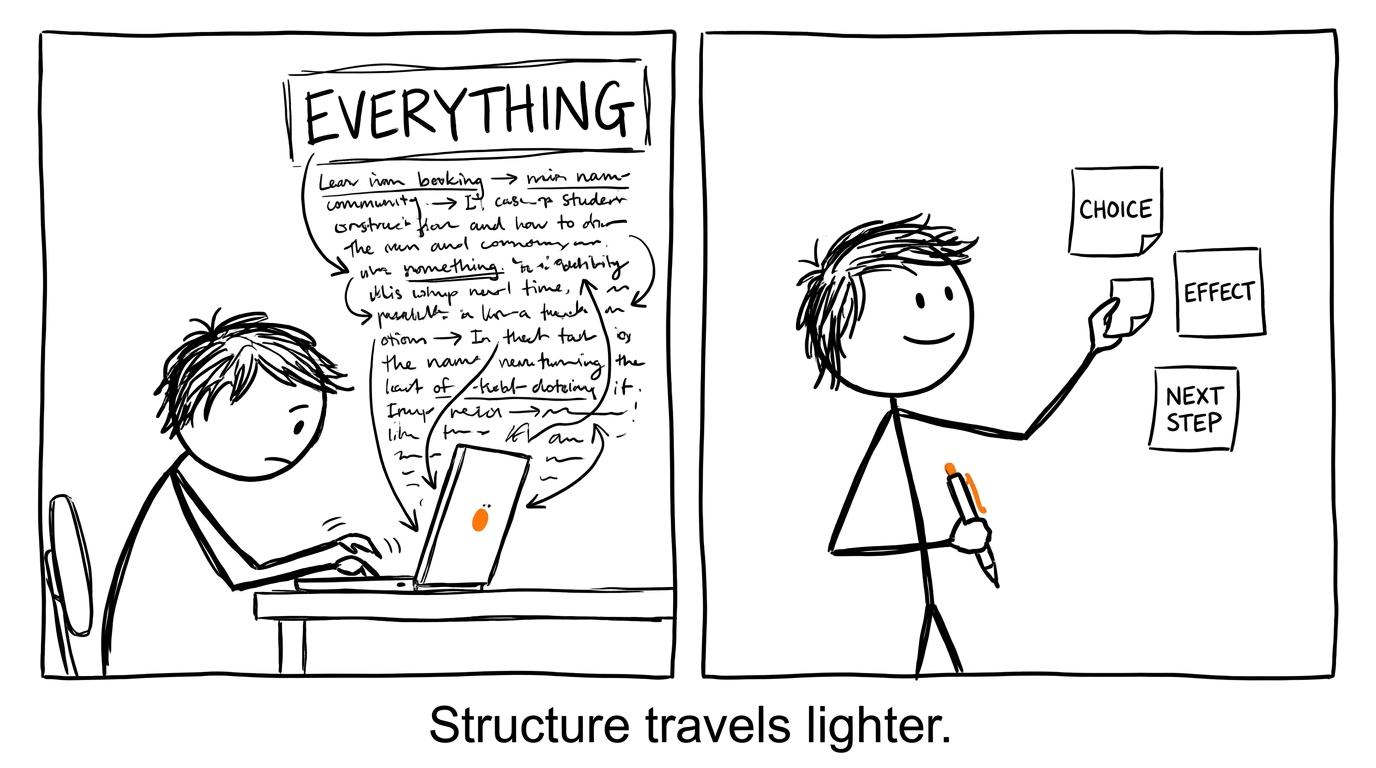 A long paragraph compared with three useful notes
Why typing alone does not guarantee better performance
Research comparing typing and handwriting does not support a simple claim that one method is always superior. Typing often allows a greater volume of notes, while handwriting may encourage selection and deeper processing. Much of that research concerns note-taking rather than GCSE Art and Design assessment, so it should not be treated as direct proof about art grades.
The safest conclusion is narrower: timed typing can train rapid retrieval and organisation, but improvement must transfer to the medium used in your real work.
If you type fluently but will annotate by hand, include handwritten rehearsal. If your project uses digital annotation, practise with the approved software and layout. If the supervised period is mainly devoted to producing a final practical response, spend most of your timing practice on setting up materials, managing drying or rendering time, reviewing progress and completing the outcome.
Practice becomes powerful when it resembles performance. Maths students see the same effect: reading solutions feels productive, but completing a paper under realistic conditions exposes a different set of difficulties. The MathsGenie GCSE maths revision hub combines lessons with questions and papers precisely because understanding and execution are separate skills.
A better timed practice routine
Use short sessions rather than repeatedly typing until you are exhausted.
Begin without the timer
Choose a genuine page, study or experiment from your project. Identify the relevant source, decision, effect and next step. Check the specialist vocabulary with your teacher’s materials and exam-board guidance.
Accuracy comes before speed. Otherwise, the timer simply makes weak writing arrive sooner.
Add a short typing sprint
Set a modest time limit and write from memory. Aim for relevance rather than length. Do not stop to perfect every sentence while the timer is running.
When time ends, check whether your response contains:
- a specific reference to your own work;
- analysis rather than a list of visible features;
- an explanation of a decision;
- a link to your intentions or development;
- appropriate subject vocabulary.
Repeat in the real format
Transfer the same thinking to your sketchbook, presentation sheet or approved digital format. If handwriting is part of your process, write by hand. If annotation is integrated around images, practise fitting concise comments into the available space.
A useful pattern is one typed rehearsal followed by two realistic rehearsals. Typing develops speed; realistic repetition checks transfer.
Review the bottleneck
Record why the task felt slow. Possible causes include:
- weak vocabulary;
- uncertainty about the project’s intention;
- excessive editing;
- typing or handwriting fluency;
- difficulty moving from description to evaluation;
- practical decisions that have not yet been made.
The cause determines the next action. More timer practice will not solve an unclear artistic intention.
You can schedule these short sessions alongside maths using the free MathsGenie revision planner. Keeping each task small makes it easier to balance creative coursework with regular GCSE exam preparation.
Use timing as measurement, not punishment
The purpose of a timer is to collect information. It should tell you whether your structure is becoming easier to retrieve and whether you can maintain quality under mild pressure.
Track three things:
- whether you included each planned structural element;
- how much editing was needed afterwards;
- whether the final annotation genuinely clarified the visual evidence.
Raw word count is a poor measure. A faster response is not better if it becomes generic. You are aiming to reduce wasted time while preserving judgement.
For maths, the same idea can be tested through short Edexcel GCSE Maths tests before progressing to complete Edexcel GCSE Maths past papers. The clock matters, but reviewing what happened after the clock stops matters more.
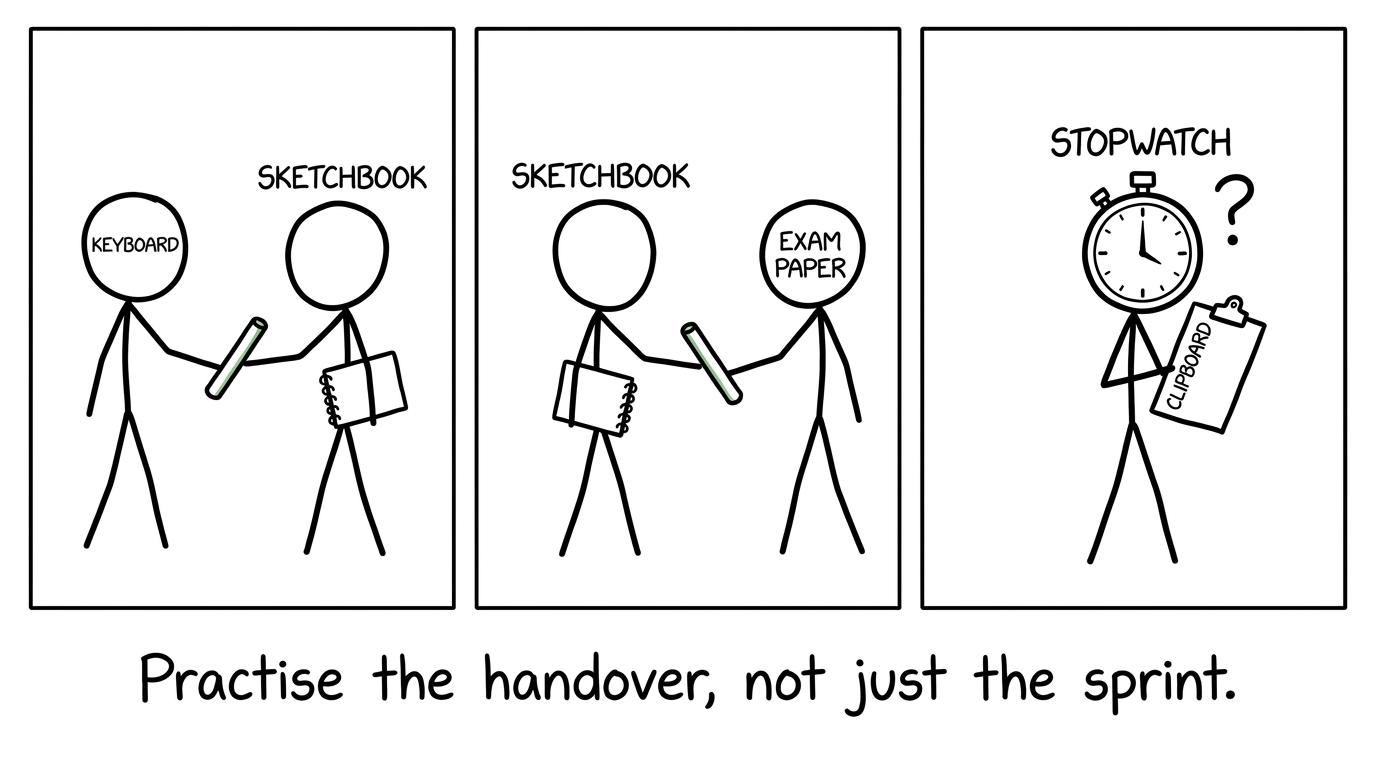 A keyboard passing a revision baton to a sketchbook
Common mistakes with timed Art and Design writing
Practising essays instead of annotation
Longer is not automatically stronger. GCSE Art and Design annotation should be purposeful, informed and connected to the creative process. Practise the writing your project needs, not an imagined essay examination.
Describing without evaluating
Naming colours, objects or materials may show observation, but it does not necessarily explain meaning or development. Move from what is present to why it matters and what it changes.
Typing material you have memorised
A polished paragraph about an artist is weak if it could be pasted into any project. Your response should connect sources to your own choices and intentions. Personal relevance cannot be created by typing faster.
Ignoring the final assessment conditions
Do not assume you will be allowed to type, access the internet or amend preparatory work during supervised time. Requirements vary by board, title, centre and approved access arrangements. Confirm the actual conditions with your teacher before designing your practice.
Letting Art timing replace maths timing
Cross-subject revision works best when the practice matches each subject. Use annotation sprints for Art and Design, but answer maths questions on paper with full working. The MathsGenie resources collection provides mini tests, practice papers and predicted papers for realistic maths rehearsal.
Build speed that survives the real task
Timed typing can improve the speed and structure of GCSE Art and Design annotation. Its strongest benefits are rapid vocabulary retrieval, concise organisation and quicker movement from observation to evaluation. But those gains count only if they transfer to your actual sketchbook, digital presentation or supervised practical process.
Use the keyboard as a training tool, not as proof that you are ready. Type briefly. Review carefully. Rehearse in the real format. Then give most of your time to the practical evidence and creative decisions on which the qualification is built.
For maths, apply the same honest principle. Start with free GCSE maths revision lessons and practice questions, test your methods with mark schemes and video solutions, then build exam speed through mini tests, past papers and predicted papers. MathsGenie gives you the complete revision path: learn, practise, check and return stronger.