Turning Points from Completing the Square Exam Questions
Turning points from completing the square exam questions explained through three GCSE examples, clear working, common mistakes and focused exam practice.
Finding the turning point without guessing
You can complete a square correctly and still lose your way at the final line. Does the number inside the bracket give the horizontal coordinate? Does its sign change? And what makes the point a maximum rather than a minimum?
Turning points from completing the square exam questions become clearer when you rewrite the quadratic as y=a(x−h)2+ky=a(x-h)^2+ky=a(x−h)2+k. The turning point is (h,k)(h,k)(h,k). Your working needs to show how you reached that form, not simply announce the coordinates.
Imagine a student working through three questions, each slightly harder than the last. Their aim is not to memorise three answers. It is to recognise the same structure beneath different coefficients.
The method to keep beside your working
Before starting, check that you can:
- Factor out the coefficient of x2x^2x2 when necessary.
- Halve the coefficient of xxx inside the bracket.
- Subtract the square of that halved coefficient to keep the expression equivalent.
- Simplify every constant, including any outside multiplier.
- Find where the squared bracket equals zero.
- State the coordinates and identify a maximum or minimum.
The reason this works is that a square cannot be negative. In y=a(x−h)2+ky=a(x-h)^2+ky=a(x−h)2+k, the squared term is zero when x=hx=hx=h. If a>0a>0a>0, every other value makes yyy larger, so (h,k)(h,k)(h,k) is a minimum. If a<0a<0a<0, every other value makes yyy smaller, so it is a maximum.
MathsGenie's Completing the Square lesson provides the matching topic resource.
Use MathsGenie's Lessons and Question Bank to rehearse this same sequence until you can write it without checking the checklist.
Three GCSE exam-style questions, step by step
These are original practice questions, not reproduced past paper questions. The notes identify working that demonstrates a valid method; exact mark allocations depend on the question's official mark scheme.
Start with a coefficient of one
Question: By completing the square, find the coordinates of the turning point of y=x2+6x+5y=x^2+6x+5y=x2+6x+5. State whether it is a maximum or minimum.
Our student halves the coefficient of xxx, giving 333. They write:
x2+6x=(x+3)2−9x^2+6x=(x+3)^2-9x2+6x=(x+3)2−9Why subtract 999? Expanding (x+3)2(x+3)^2(x+3)2 produces x2+6x+9x^2+6x+9x2+6x+9, so the extra constant must be removed.
They now include the original constant:
y=(x+3)2−9+5=(x+3)2−4y=(x+3)^2-9+5=(x+3)^2-4y=(x+3)2−9+5=(x+3)2−4The square is zero when:
x+3=0⇒x=−3x+3=0\quad\Rightarrow\quad x=-3x+3=0⇒x=−3At that value, y=−4y=-4y=−4. Therefore, the turning point is (−3,−4)(-3,-4)(−3,−4), and it is a minimum because the coefficient of the square is positive.
Method-mark evidence: The line (x+3)2−9+5(x+3)^2-9+5(x+3)2−9+5 shows both the completed bracket and the necessary compensation. Keeping it visible makes the reasoning clearer than jumping straight to the coordinates.
The student's useful discovery is simple: they do not need to remember a mysterious sign-changing rule. They can set the bracket equal to zero.
Handle a coefficient outside the square
Question: Write y=2x2−12x+7y=2x^2-12x+7y=2x2−12x+7 in completed-square form. Hence find its minimum point.
This time, immediately halving −12-12−12 would be a mistake. The student first factors 222 from the terms containing xxx:
y=2(x2−6x)+7y=2(x^2-6x)+7y=2(x2−6x)+7Now they complete the square inside the bracket:
y=2((x−3)2−9)+7y=2\bigl((x-3)^2-9\bigr)+7y=2((x−3)2−9)+7The outside multiplier applies to the compensation as well:
y=2(x−3)2−18+7y=2(x-3)^2-18+7y=2(x−3)2−18+7 y=2(x−3)2−11y=2(x-3)^2-11y=2(x−3)2−11The square becomes zero at x=3x=3x=3. The minimum point is therefore (3,−11)(3,-11)(3,−11).
Method-mark evidence: Factoring correctly and forming (x−3)2−9(x-3)^2-9(x−3)2−9 reveal the key algebraic steps. The separate simplification line shows that the student has multiplied the entire bracket by 222.
If you understand the algebra but struggle to picture the result, MathsGenie's quadratic graphs revision connects coordinates with the shape of the curve.
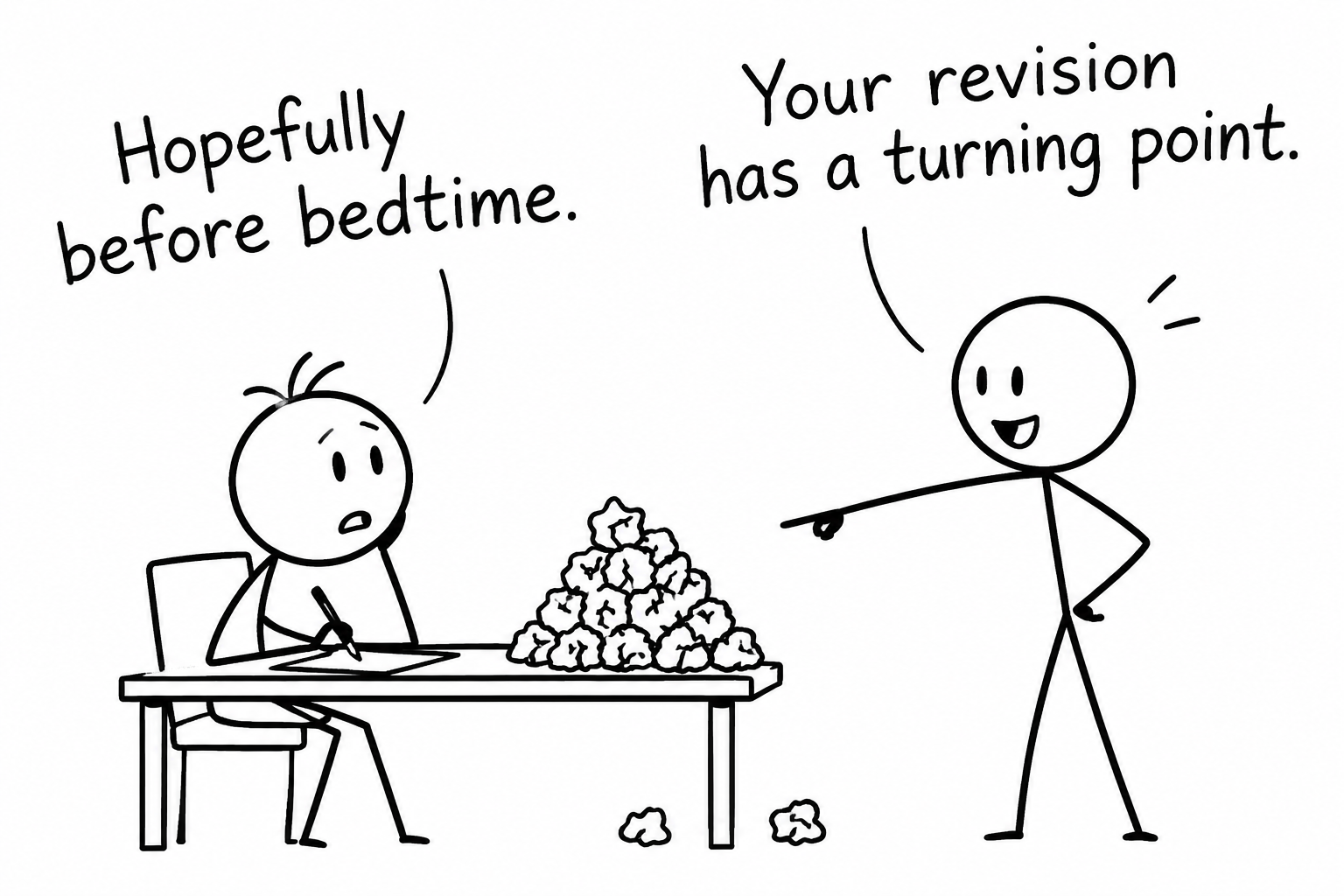 Stick-figure revision comic about finding a turning point before bedtime
Manage a negative coefficient and fractions
Question: By completing the square, find the maximum point of y=−2x2−6x+1y=-2x^2-6x+1y=−2x2−6x+1.
The student notices two potential distractions: the negative leading coefficient and an odd coefficient after factorising. Neither changes the method.
First, factor out −2-2−2:
y=−2(x2+3x)+1y=-2(x^2+3x)+1y=−2(x2+3x)+1Half of 333 is 32\frac{3}{2}23, whose square is 94\frac{9}{4}49. Therefore:
y=−2[(x+32)2−94]+1y=-2\left[\left(x+\frac{3}{2}\right)^2-\frac{9}{4}\right]+1y=−2[(x+23)2−49]+1Multiplying out the constant part gives:
y=−2(x+32)2+92+1y=-2\left(x+\frac{3}{2}\right)^2+\frac{9}{2}+1y=−2(x+23)2+29+1 y=−2(x+32)2+112y=-2\left(x+\frac{3}{2}\right)^2+\frac{11}{2}y=−2(x+23)2+211The bracket equals zero when x=−32x=-\frac{3}{2}x=−23. The maximum point is (−32,112)\left(-\frac{3}{2},\frac{11}{2}\right)(−23,211).
It is a maximum because multiplying a non-negative square by −2-2−2 gives a non-positive result. Nothing can be added to 112\frac{11}{2}211 that makes the expression larger.
Method-mark evidence: The factorised expression, fractional compensation and correct multiplication by −2-2−2 each make the method inspectable. Fractions are not a reason to skip working or switch to rounded values.
What the examiner needs to see
The student's three solutions share a useful pattern: rewrite, simplify, interpret. Keep those stages separate enough to follow.
If a question says “by completing the square”, show that method. Finding coordinates by another route does not demonstrate the requested algebra. If it says “hence”, use your completed-square form to explain the next answer.
Distinguish a minimum value from a minimum point. In the second example, the minimum value is −11-11−11, but the minimum point is (3,−11)(3,-11)(3,−11).
For turning points from completing the square past paper questions, compare your working with the mark scheme supplied with that particular paper. MathsGenie's Completing the Square exam booklet also provides focused topic practice, while its GCSE video lessons offer another way to revisit the explanation.
Common mistakes and quick checks
Copying the bracket's sign into the coordinate. For (x+3)2(x+3)^2(x+3)2, solve x+3=0x+3=0x+3=0. The horizontal coordinate is −3-3−3.
Forgetting to compensate. Replacing x2+6xx^2+6xx2+6x with (x+3)2(x+3)^2(x+3)2 changes the expression. Subtract the added 999.
Leaving the compensation outside its multiplier. In 2((x−3)2−9)2\bigl((x-3)^2-9\bigr)2((x−3)2−9), the constant contribution is −18-18−18, not −9-9−9.
Assuming every turning point is a minimum. Check the coefficient of the square. A negative coefficient means a maximum.
Confusing a turning point with a root. A root occurs where y=0y=0y=0. A turning point is where the quadratic changes from decreasing to increasing, or the reverse.
Finally, expand your completed-square expression. Recovering the original quadratic is a direct check on your algebra.
Exam-style practice
Try these without looking back at the examples. Show the completed-square form before giving your answer.
- Find the minimum point of y=x2−8x+3y=x^2-8x+3y=x2−8x+3.
- Find the minimum point of y=3x2+12x−2y=3x^2+12x-2y=3x2+12x−2.
- Find the maximum point of y=−x2+5x−1y=-x^2+5x-1y=−x2+5x−1.
Answers:
- y=(x−4)2−13y=(x-4)^2-13y=(x−4)2−13, giving (4,−13)(4,-13)(4,−13).
- y=3(x+2)2−14y=3(x+2)^2-14y=3(x+2)2−14, giving (−2,−14)(-2,-14)(−2,−14).
- y=−(x−52)2+214y=-\left(x-\frac{5}{2}\right)^2+\frac{21}{4}y=−(x−25)2+421, giving (52,214)\left(\frac{5}{2},\frac{21}{4}\right)(25,421).
Turn the method into reliable working
Our imagined student now has one repeatable method rather than three disconnected solutions. Your next challenge is applying it independently when the signs and coefficients change.
Start with MathsGenie's Lessons, then use the Completing the Square Question Bank to practise showing the algebra that leads to each turning point.