Transformations GCSE Maths Resit: Grade 4 Guide
Transformations GCSE maths resit guide for grade 4. Learn the four methods, follow worked examples and avoid common errors with free targeted practice.
A resit can make familiar topics feel strangely unfamiliar. You may recognise a reflection or rotation on the page, yet still hesitate when the question asks you to describe it fully. For transformations GCSE maths resit revision, the solution is not to relearn all of geometry. It is to master four methods, know the details each description requires and practise plotting accurately.
Transformations are part of the geometry content assessed at GCSE. For a student working towards grade 444, they are a useful revision target because the rules are precise. Once you know what the examiner needs, there is less room for uncertainty.
Start with the MathsGenie transformations lesson, then use the method below to turn recognition into marks.
Your transformations grade 4 checklist
There are four transformations to recognise, draw and describe:
- Translation: a movement described by a column vector.
- Reflection: a flip in a stated mirror line.
- Rotation: a turn with a centre, angle and direction.
- Enlargement: a change in size from a centre using a scale factor.
Before leaving this topic, check that you can:
- transform every vertex of a shape accurately;
- keep the original shape unchanged when translating, reflecting or rotating;
- use coordinates to check a movement;
- describe a single transformation fully;
- recognise whether an enlargement should make a shape larger or smaller.
The transformations revision guide gives you a concise reference when one of these details slips from memory.
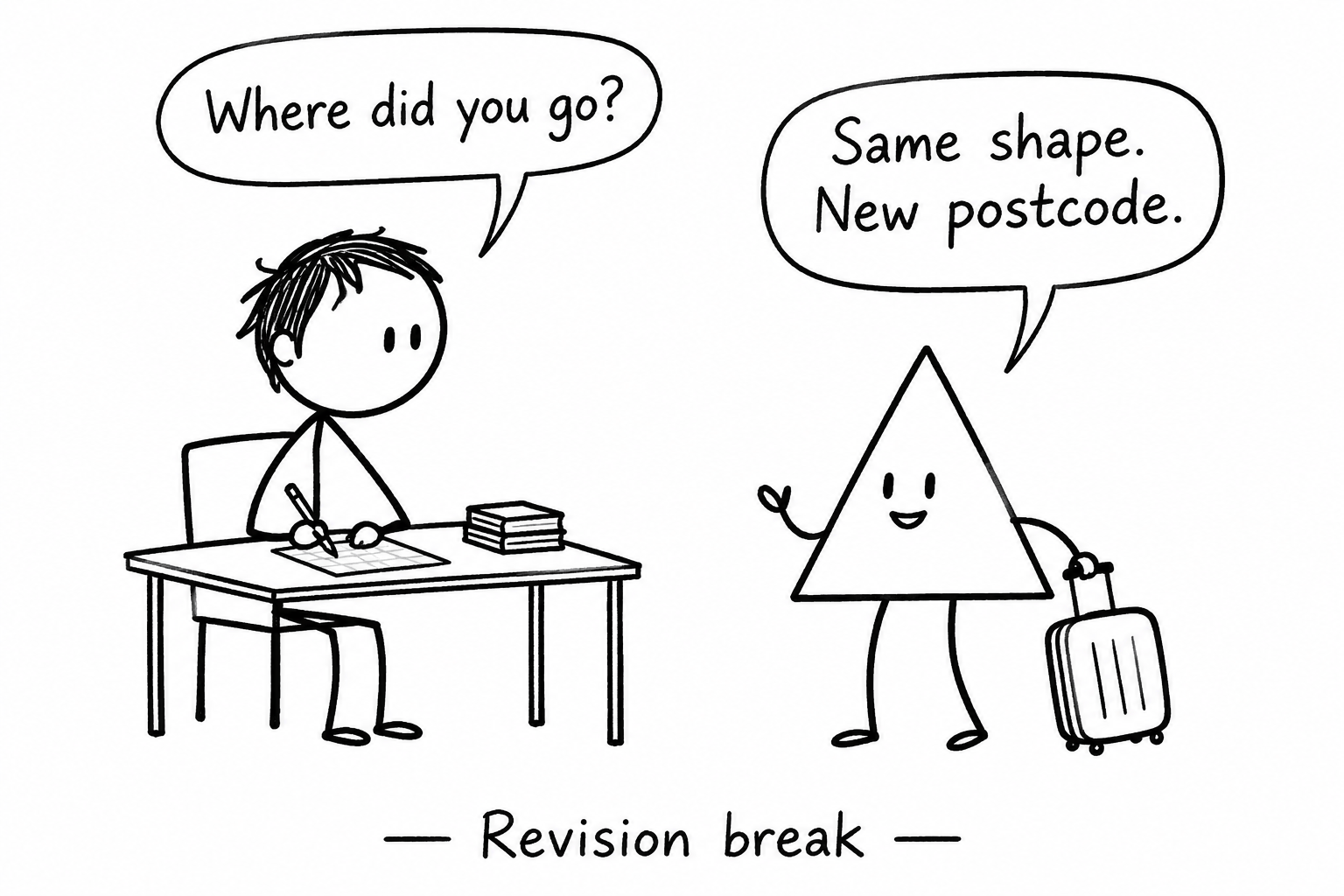 A triangle tells a GCSE resit student that it has the same shape but a new postcode
Learn what each transformation needs
The difficult part is often not moving the shape. It is remembering the complete mathematical description. A nearly correct answer can still omit the detail that identifies one unique transformation.
Translation
A translation slides every point by the same horizontal and vertical distance. It does not turn, flip or resize the shape.
Describe a translation using a column vector:
(ab)\begin{pmatrix} a \\ b \end{pmatrix}(ab)The top number gives the horizontal movement. A positive value moves right and a negative value moves left. The bottom number gives the vertical movement. A positive value moves up and a negative value moves down.
Always measure from a point on the original shape to the matching point on the image. Do not reverse that journey.
Reflection
A reflection flips a shape across a mirror line. Every point and its image must be the same perpendicular distance from that line.
A complete description names the mirror line, such as:
x=2x=2x=2or
y=−1.y=-1.y=−1.A diagonal mirror line may have an equation such as y=xy=xy=x. If you are drawing the image, plot each reflected vertex separately before joining the points with straight lines.
Rotation
A rotation turns a shape around a fixed centre. To describe it fully, state:
- the angle;
- the direction, clockwise or anticlockwise;
- the centre of rotation.
For example, a complete answer could be a rotation of 90∘90^\circ90∘ clockwise about (2,1)(2,1)(2,1). Saying only that the shape has been rotated is not enough because many different rotations could produce different images.
Enlargement
An enlargement changes every distance from the centre of enlargement by the same scale factor. If the scale factor is 222, each image point is twice as far from the centre. If it is 12\frac{1}{2}21, each distance is halved.
To describe an enlargement fully, give:
- the scale factor;
- the centre of enlargement.
The angles remain unchanged, and corresponding side lengths stay in the same ratio. Exact requirements can vary with tier and exam board, so use resources matched to your specification through the GCSE maths revision hub.
Worked example: describing a translation
Triangle ABCABCABC has vertices:
A=(1,2),B=(4,2),C=(2,5).A=(1,2),\qquad B=(4,2),\qquad C=(2,5).A=(1,2),B=(4,2),C=(2,5).It is translated to triangle A′B′C′A'B'C'A′B′C′ with vertices:
A′=(−2,6),B′=(1,6),C′=(−1,9).A'=(-2,6),\qquad B'=(1,6),\qquad C'=(-1,9).A′=(−2,6),B′=(1,6),C′=(−1,9).Describe the translation.
Use one matching pair, such as AAA and A′A'A′. The horizontal change is:
−2−1=−3.-2-1=-3.−2−1=−3.The vertical change is:
6−2=4.6-2=4.6−2=4.Check another pair:
1−4=−3,6−2=4.1-4=-3,\qquad 6-2=4.1−4=−3,6−2=4.The movement is consistent, so the translation is:
(−34).\boxed{\begin{pmatrix}-3\\4\end{pmatrix}}.(−34).The order matters. The horizontal movement goes on top and the vertical movement goes underneath. Writing the values in reverse would describe a different translation.
Worked example: rotating a shape
Triangle PQRPQRPQR has vertices:
P=(1,1),Q=(4,1),R=(1,3).P=(1,1),\qquad Q=(4,1),\qquad R=(1,3).P=(1,1),Q=(4,1),R=(1,3).Rotate the triangle 90∘90^\circ90∘ clockwise about the origin.
For a 90∘90^\circ90∘ clockwise rotation about (0,0)(0,0)(0,0), the coordinate rule is:
(x,y)⟶(y,−x).(x,y)\longrightarrow(y,-x).(x,y)⟶(y,−x).Apply the rule to each vertex:
P=(1,1)⟶P′=(1,−1),P=(1,1)\longrightarrow P'=(1,-1),P=(1,1)⟶P′=(1,−1), Q=(4,1)⟶Q′=(1,−4),Q=(4,1)\longrightarrow Q'=(1,-4),Q=(4,1)⟶Q′=(1,−4), R=(1,3)⟶R′=(3,−1).R=(1,3)\longrightarrow R'=(3,-1).R=(1,3)⟶R′=(3,−1).The rotated triangle therefore has vertices:
P′=(1,−1),Q′=(1,−4),R′=(3,−1).\boxed{P'=(1,-1),\quad Q'=(1,-4),\quad R'=(3,-1)}.P′=(1,−1),Q′=(1,−4),R′=(3,−1).Plot all three points and join them in the corresponding order. Then check that the side lengths have not changed. A rotation changes position and orientation, but not size or shape.
Mistakes that cost marks
Giving an incomplete description
A rotation needs its angle, direction and centre. A reflection needs its mirror line. An enlargement needs its scale factor and centre. A translation needs a vector. Treat these as fixed checklists rather than optional details.
Moving from the image back to the original
This reverses a translation vector and can also cause confusion when identifying other transformations. Follow the wording and move from the stated original shape to its image.
Counting grid lines instead of squares
Measure the number of square spaces travelled. Marking small horizontal and vertical steps can make your counting easier to check.
Swapping the translation vector
In a vector, horizontal movement comes first:
(horizontalvertical).\begin{pmatrix} \text{horizontal} \\ \text{vertical} \end{pmatrix}.(horizontalvertical).A movement of 333 left and 222 up is therefore:
(−32),\begin{pmatrix}-3\\2\end{pmatrix},(−32),not (2−3)\begin{pmatrix}2\\-3\end{pmatrix}(2−3).
Using the wrong centre
For rotations and enlargements, the centre controls the whole transformation. Do not assume it is the origin. Read the question carefully and mark the centre before moving any vertices.
Drawing freehand without checking vertices
Transform each vertex first, then join the image. A small plotting error can distort the entire shape. The transformations exam booklet provides focused questions and answers for practising this accurately.
Make transformations part of resit revision
Post-16 revision has to compete with lessons, work and everything else in the week. That makes short, targeted practice more valuable than repeatedly reading notes.
Use the MathsGenie revision planner to give transformations a specific place in your schedule. Begin with a revision lesson, answer questions without looking at the method, and use the answers or video solutions to diagnose errors. Return to the topic several days later and try it again from memory.
A grade 444 is not secured by one topic alone, but confidence grows through small areas becoming dependable. Transformations can become one of those areas because every method has a clear structure.
When you are ready, use the GCSE Mock Exam Builder to build a targeted practice paper. Include transformations alongside the other grade 444 topics you need most. Complete it under timed conditions, check your working with the mark scheme and turn every missed detail into the focus of your next practice session.