The Quadratic Formula Exam Questions: GCSE Guide
The quadratic formula exam questions explained through three GCSE examples, clear working, method-mark guidance and practice to build your exam confidence.
The quadratic formula exam questions: make your method visible
You recognise the formula. Then an exam question puts a negative sign somewhere awkward, and suddenly the first substitution feels harder than the algebra itself.
The quadratic formula exam questions become more manageable when you follow the same routine: rearrange the equation, identify the coefficients, substitute carefully, calculate both solutions and check what the question asks. Showing those stages also makes your method visible when an answer goes wrong.
Imagine a student working through three questions of increasing difficulty. These are original exam-style examples, not quotations from past papers. The marking notes highlight working worth showing, rather than promise a particular allocation: the actual marks depend on the question and its mark scheme.
Your quadratic formula checklist
For an equation in the form
ax2+bx+c=0,a≠0,ax^2+bx+c=0,\qquad a\ne0,ax2+bx+c=0,a=0,the quadratic formula is
x=−b±b2−4ac2a.x=\frac{-b\pm\sqrt{b^2-4ac}}{2a}.x=2a−b±b2−4ac.Before reaching for your calculator:
- Move every term to one side so the other side is zero.
- Identify aaa, bbb and ccc, including their signs.
- Write the substituted formula, using brackets around negative numbers.
- Calculate the positive and negative branches separately.
- Keep full calculator precision until the final rounding step.
- Check whether both solutions make sense in context.
If you are unsure which solving method to choose, the solving quadratics revision page provides useful context. When a question explicitly requests the formula, make that method clear in your working.
Question one: substitute without losing a sign
Solve x2−5x+3=0x^2-5x+3=0x2−5x+3=0 using the quadratic formula. Give your answers to two decimal places.
Our imagined student starts by writing the coefficients on a separate line. It feels almost too simple, but it removes a decision from the next stage:
a=1,b=−5,c=3.a=1,\qquad b=-5,\qquad c=3.a=1,b=−5,c=3.The important detail is that bbb is negative. Therefore, −b-b−b is positive:
x=−(−5)±(−5)2−4×1×32×1.x=\frac{-(-5)\pm\sqrt{(-5)^2-4\times1\times3}}{2\times1}.x=2×1−(−5)±(−5)2−4×1×3.Now simplify:
x=5±25−122=5±132.x=\frac{5\pm\sqrt{25-12}}{2} =\frac{5\pm\sqrt{13}}{2}.x=25±25−12=25±13.The symbol ±\pm± represents two calculations:
x=5+132≈4.30,x=\frac{5+\sqrt{13}}{2}\approx4.30,x=25+13≈4.30, x=5−132≈0.70.x=\frac{5-\sqrt{13}}{2}\approx0.70.x=25−13≈0.70.Where the method becomes visible: the substituted formula shows that the student has selected the correct coefficients and used them appropriately. That is much stronger evidence of a valid approach than two unexplained decimals.
The final answers retain two decimal places, including the trailing zero in 0.700.700.70. The question's requested precision is part of the answer, not an optional presentation choice.
Now you have the routine, use MathsGenie's Quadratic Formula Lessons and Question Bank to practise the same sequence without finding fresh questions yourself.
Question two: rearrange before using the formula
Solve 3x2+4x=63x^2+4x=63x2+4x=6. Give your answers to three significant figures.
This question introduces a quieter difficulty: the equation is not yet in the required form.
The student initially wants to write c=6c=6c=6. Instead, they pause and subtract 666 from both sides:
3x2+4x−6=0.3x^2+4x-6=0.3x2+4x−6=0.Only now can they identify the coefficients:
a=3,b=4,c=−6.a=3,\qquad b=4,\qquad c=-6.a=3,b=4,c=−6.Substitution gives
x=−4±42−4×3×(−6)2×3.x=\frac{-4\pm\sqrt{4^2-4\times3\times(-6)}}{2\times3}.x=2×3−4±42−4×3×(−6).The negative constant changes the subtraction inside the square root into an addition:
x=−4±16+726=−4±886.x=\frac{-4\pm\sqrt{16+72}}{6} =\frac{-4\pm\sqrt{88}}{6}.x=6−4±16+72=6−4±88.Calculate both branches:
x=−4+886≈0.896805,x=\frac{-4+\sqrt{88}}{6}\approx0.896805,x=6−4+88≈0.896805, x=−4−886≈−2.230139.x=\frac{-4-\sqrt{88}}{6}\approx-2.230139.x=6−4−88≈−2.230139.To three significant figures:
x≈0.897orx≈−2.23.x\approx0.897\quad\text{or}\quad x\approx-2.23.x≈0.897orx≈−2.23.Where the method becomes visible: show the rearranged equation and the substituted formula. They distinguish a sound algebraic approach from a calculator guess. Correct rearrangement may also attract credit where the question's mark scheme allows it.
Notice that three significant figures does not mean three decimal places. Leading zeros do not count as significant figures.
For another set of questions to attempt independently, use the quadratic formula exam booklet.
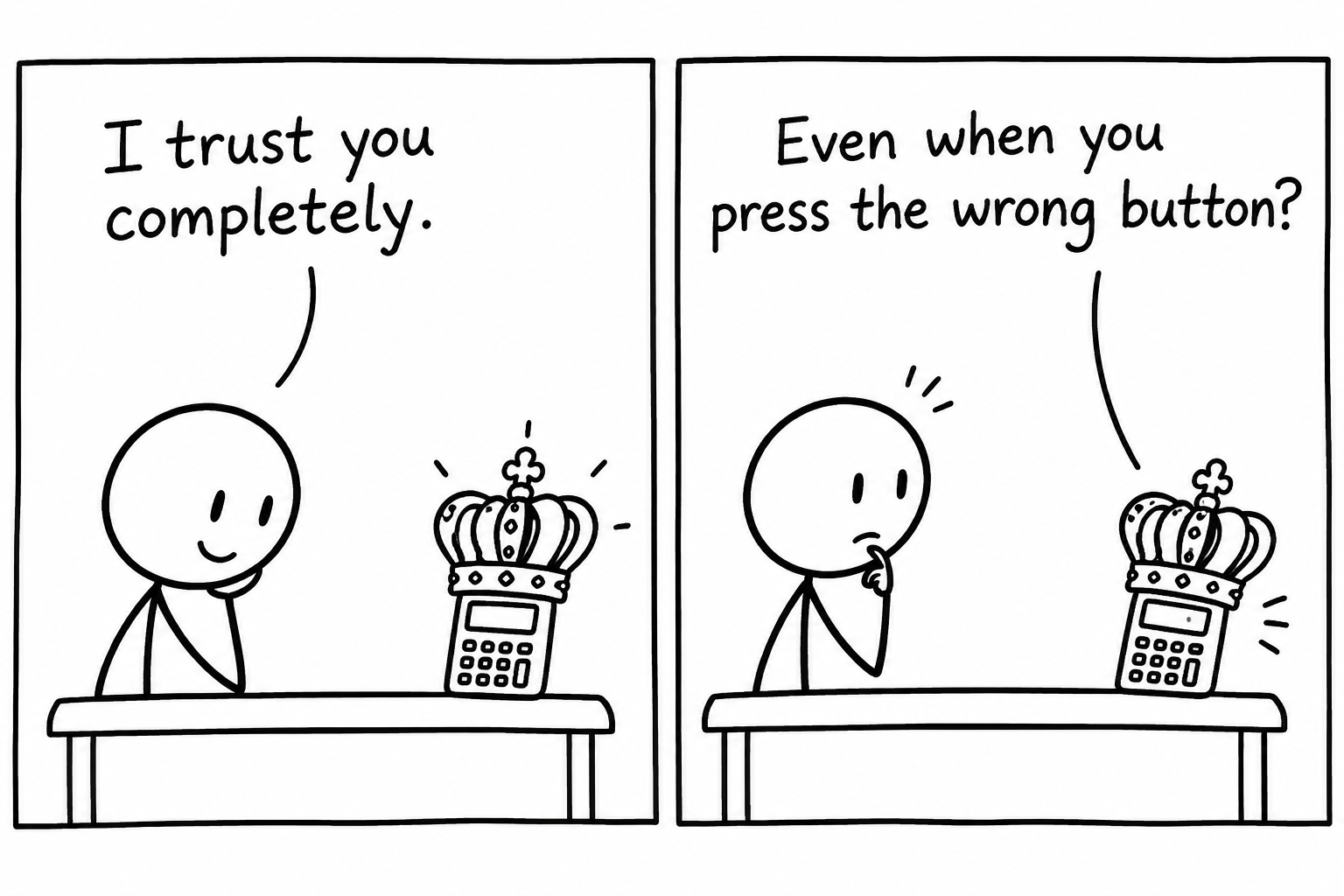 A stick-figure student discovers that trusting a calculator still means checking the buttons pressed
Question three: build the equation and interpret the answer
A rectangle has width x cmx\text{ cm}x cm and length (x+3) cm(x+3)\text{ cm}(x+3) cm. Its area is 20 cm220\text{ cm}^220 cm2. Find its width to two decimal places.
There is no equation waiting at the start. The student must build one from the relationship between length, width and area:
x(x+3)=20.x(x+3)=20.x(x+3)=20.Expand and rearrange:
x2+3x−20=0.x^2+3x-20=0.x2+3x−20=0.Now the familiar routine returns:
a=1,b=3,c=−20.a=1,\qquad b=3,\qquad c=-20.a=1,b=3,c=−20. x=−3±32−4×1×(−20)2×1=−3±892.x=\frac{-3\pm\sqrt{3^2-4\times1\times(-20)}}{2\times1} =\frac{-3\pm\sqrt{89}}{2}.x=2×1−3±32−4×1×(−20)=2−3±89.The two algebraic solutions are
x≈3.216991orx≈−6.216991.x\approx3.216991\quad\text{or}\quad x\approx-6.216991.x≈3.216991orx≈−6.216991.A rectangle cannot have a negative width. Reject the negative solution and state:
Width≈3.22 cm.\text{Width}\approx3.22\text{ cm}.Width≈3.22 cm.Where the method becomes visible: forming the area equation demonstrates mathematical modelling. Substitution demonstrates the solving method. Rejecting the negative root demonstrates interpretation. The precise credit for each stage depends on the mark scheme.
The student has not learnt a different formula for the harder question. They have learnt to recognise where the familiar formula belongs.
Common mistakes in quadratic formula GCSE exam answers
Reading coefficients too early
Identify coefficients only after the equation has been rearranged. In 3x2+4x=63x^2+4x=63x2+4x=6, the constant becomes −6-6−6 when everything is moved to the left.
Squaring a negative number incorrectly
Use brackets: (−5)2=25(-5)^2=25(−5)2=25. Without brackets, −52=−25-5^2=-25−52=−25. Write brackets in your working and use them on your calculator.
Dividing only the square-root term
The entire numerator is divided by 2a2a2a. Enter the numerator and denominator as complete groups, or use your calculator's fraction template.
Forgetting the second solution
Treat ±\pm± as an instruction to perform two calculations. In a context question, calculate both before deciding whether one must be rejected.
Rounding halfway through
Rounding the square root early can change the final answer. Keep the exact expression or full calculator value until the last step.
Exam-style practice: check the working, not just the answer
Try these without looking back at the worked examples:
- Solve 2x2−3x−4=02x^2-3x-4=02x2−3x−4=0, giving both answers to two decimal places.
- Solve 4x2+x=74x^2+x=74x2+x=7, giving both answers to three significant figures.
For the first question, your answers should be x≈2.35x\approx2.35x≈2.35 or x≈−0.85x\approx-0.85x≈−0.85. For the second, they should be x≈1.20x\approx1.20x≈1.20 or x≈−1.45x\approx-1.45x≈−1.45.
If an answer differs, find the first line where your working changes direction. Was it rearrangement, substitution, calculator entry or rounding? That diagnosis gives your next attempt a purpose.
When tackling the quadratic formula past paper questions, check the actual mark scheme rather than assuming every question awards marks identically. The AQA quadratic formula question bank offers questions with worked solutions and marking guidance.
Turn recognition into a reliable exam routine
Our imagined student finishes with something more useful than three remembered answers: a repeatable method. Your remaining task is to follow it on unfamiliar questions, especially when signs, rearrangement or context add difficulty.
Start your next practice session with MathsGenie's Quadratic Formula Lessons and Question Bank, and show every substitution before checking your answers.