Tell Your Teacher You're Struggling With GCSE Astronomy
Tell teacher struggling GCSE astronomy concerns early, get precise support, strengthen the maths and observations, and build a realistic revision plan.
Sometimes the hardest sentence in a lesson is not an answer. It is: “I don’t understand this yet.”
If you searched tell teacher struggling GCSE astronomy, the short answer is yes: tell your teacher as early as you can. You are not admitting that you cannot do the subject. You are giving your teacher the information needed to help you identify the problem, protect time for mandatory observations and build a manageable route back into the course.
Quietly trying to catch up can feel safer. But silence hides the exact difficulty. Your teacher may assume you are following the lesson, while you spend each new topic trying to repair the last one.
A quick checklist before you speak to your teacher
You do not need a perfect explanation. Bring a few useful details:
- Name one or two topics that feel unclear.
- Take a marked test, unfinished question or page of notes if you have one.
- Explain whether the difficulty is knowledge, calculations, observations or exam answers.
- Say how long you have felt behind.
- Ask for one specific next step.
- Agree when you will review your progress.
A simple opening is enough: “I’m finding GCSE Astronomy difficult, especially the calculation and observation questions. Could you help me work out what I should tackle first?”
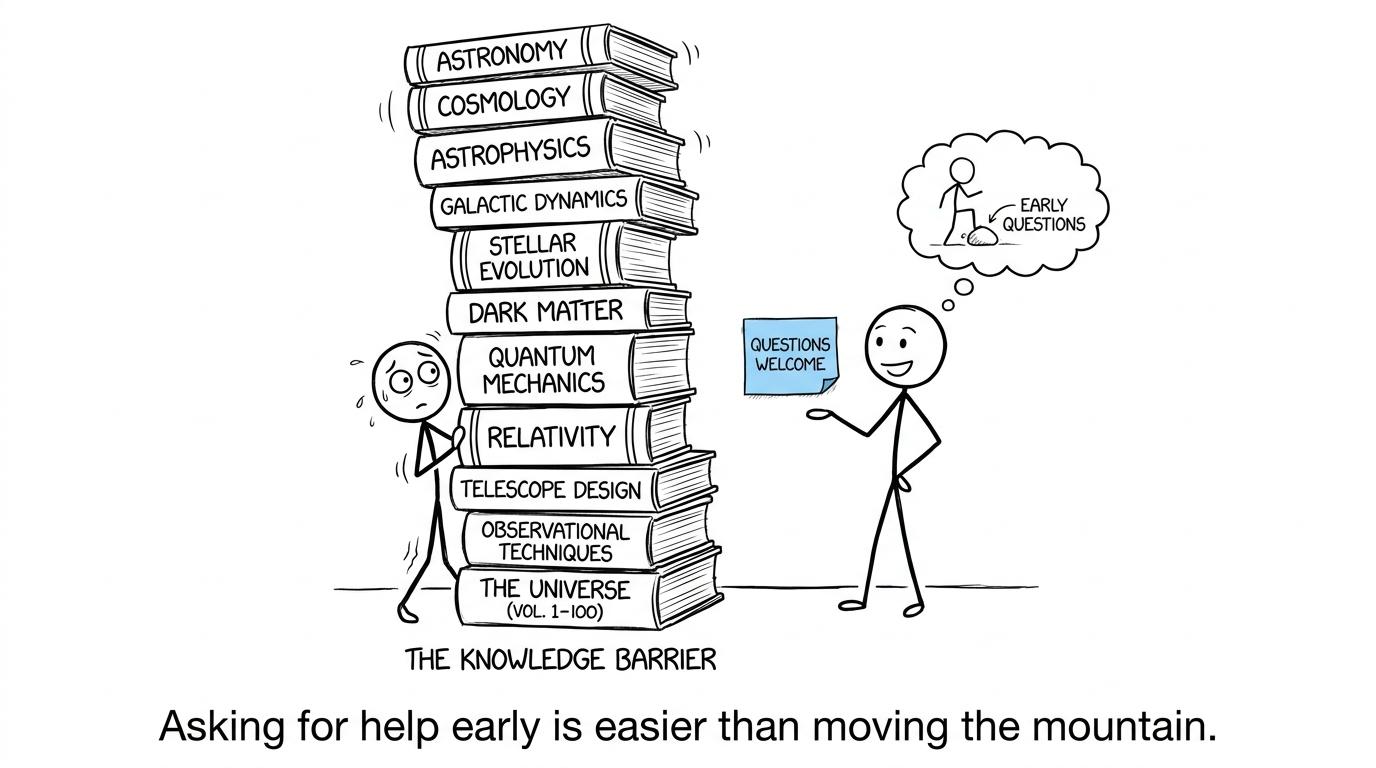 A student discovers that hiding behind astronomy books is less useful than asking a question
Why flagging the problem early tends to help
Struggling rarely begins as a dramatic event. More often, one uncertain idea becomes two. A missed calculation makes the next graph harder. An observation record feels incomplete, so it is avoided. Eventually, the subject seems like one enormous gap when it is usually several smaller gaps sitting close together.
Telling your teacher early changes the problem from “I am bad at astronomy” into something that can be examined. Perhaps you understand stellar evolution but mishandle standard form. Perhaps you know the content but cannot interpret command words. Perhaps poor weather or access to equipment has affected an observation.
Those problems require different solutions. More general revision will not necessarily fix them.
Early conversations matter particularly in GCSE Astronomy because observational work cannot always be recreated at the last minute. Under the current Pearson Edexcel GCSE Astronomy specification, students must undertake at least one unaided and one aided observation. Knowledge and understanding developed through observational work are then assessed in the written examinations. Your centre also has responsibilities connected with confirming completion.
Weather, visibility, equipment and suitable observing times do not obey a revision timetable. If you are uncertain about your observations, tell your teacher now rather than waiting for the final weeks.
What your teacher can do that solo revision cannot
Independent revision is valuable, but it begins after you know what to revise. A teacher can help with the diagnosis.
Separate a content gap from a maths gap
Astronomy combines scientific ideas with mathematical and observational skills. The Pearson Edexcel written papers allocate at least 20%20\%20% of the marks to mathematical skills. These can include calculations, graphs, ratios, significant figures, units, standard form and inverse-square relationships.
A question about stars may feel like an astronomy problem when the real obstacle is expressing a large distance as a×10na\times10^na×10n, where 1≤a<101\leq a<101≤a<10. A gravity or brightness question might become difficult because the relationship involves 1x2\frac{1}{x^2}x21. Your teacher can often recognise that distinction from one piece of work.
Once the underlying skill is clear, use MathsGenie’s free standard form revision resources or direct and inverse proportion revision to rebuild the maths alongside your astronomy lessons.
Check whether exam technique is costing marks
The current GCSE Astronomy qualification has two externally examined papers: Naked-eye Astronomy and Telescopic Astronomy. Each lasts 1 hour and 45 minutes, is worth 100100100 marks and contributes 50%50\%50% of the qualification. Questions can include multiple-choice items, short answers, calculations, graphical work and extended responses. Calculators may be used, and the examination includes a formula and data sheet.
That mixture matters. Knowing a fact is not the same as applying it to unfamiliar data. Completing a calculation is not the same as presenting enough working to make the method visible. Your teacher can compare your answer with the mark scheme and show whether the lost marks came from recall, application, analysis or communication.
Help you recover missed observational learning
Observations are not simply a box to tick. They develop a cycle of planning, observing, analysing and evaluating. The written papers assess observational knowledge and skills, with at least 15%15\%15% of the marks devoted to this area.
If you missed an observing session, could not use the equipment confidently or do not understand what your records show, your teacher needs to know. They may be able to explain the school’s arrangements, clarify what evidence you should retain or help you connect the practical activity to examination questions.
Do not improvise an unsafe observation or fabricate results. Follow your teacher’s instructions, particularly for solar observation and the use of optical equipment.
How to explain that you are struggling
You do not have to give a speech in front of the class. Speak after the lesson, ask for a short meeting or send a concise email through your school’s approved system.
Use three parts:
- What is happening: “I am falling behind on telescopes and calculation questions.”
- What you have tried: “I reread my notes and attempted the homework, but I still cannot choose the right method.”
- What you need: “Could you tell me which topic to revise first and give me a few questions to check it?”
Specificity makes help easier to provide. “I understand nothing” expresses a real feeling, but it gives your teacher little diagnostic evidence. “I can describe parallax, but I cannot interpret the diagrams or substitute into the formula” gives them somewhere to begin.
You may also ask:
- Which specification statements does this topic cover?
- Is the issue my astronomy knowledge or the underlying maths?
- Which question should I retry after revising?
- How should I record my observation work?
- When can we check whether the plan is working?
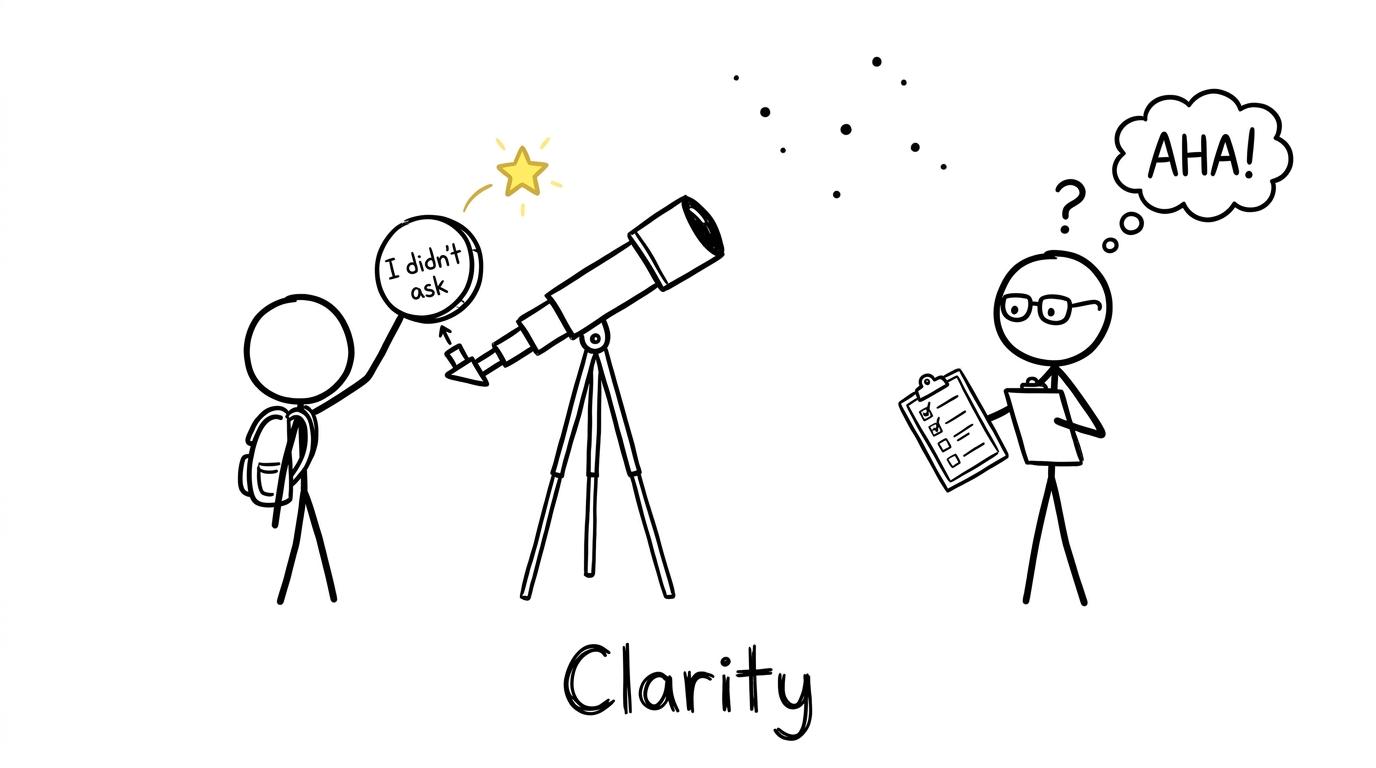 A telescope becomes more useful once the student removes the lens cap labelled I didn't ask
Turn the conversation into a small recovery plan
A helpful conversation should finish with an action, not simply reassurance. Keep the plan narrow enough to follow.
Diagnose one cluster at a time
Sort mistakes into four groups:
- astronomy knowledge;
- mathematical method;
- observational skills;
- examination technique.
Choose the group currently blocking the most questions. Then select one or two precise skills. If angular calculations and scale diagrams are the issue, your teacher may direct you towards geometry or trigonometry. MathsGenie’s SOHCAHTOA revision page offers lessons, practice questions, videos and revision guides for the relevant GCSE maths skill.
Use a learn, practise, check cycle
First, relearn the idea using your class materials and your teacher’s guidance. Next, complete a short set of questions without copying a solution. Finally, mark the work and write down why each mark was lost.
For broader maths gaps, the GCSE maths topics by exam board and tier checklist can help you locate supporting skills. MathsGenie covers Edexcel, AQA, OCR and Eduqas GCSE Maths, but remember that GCSE Astronomy itself follows its own specification. Use maths resources to strengthen transferable techniques rather than treating a maths paper as an astronomy paper.
Bring evidence to the follow-up
At the agreed check-in, show your teacher the corrected question, an updated observation record or a short error list. Evidence makes the second conversation better than the first. It reveals whether the original gap has closed or whether a different explanation is needed.
Maths mini tests and papers can also reveal whether a supporting skill survives under pressure. Use Edexcel GCSE Maths past papers if that matches your maths course, then study the mark scheme rather than looking only at the final score. The purpose is diagnosis, not self-judgement.
What if speaking to your teacher feels difficult?
Write down your first sentence before the lesson. If speaking face to face feels overwhelming, send a brief message asking when you can talk. You may also speak to your form tutor, head of department, pastoral lead or another trusted member of staff.
If the difficulty may be connected to an additional learning need, health issue, anxiety or circumstances outside school, you do not have to explain every private detail to your subject teacher. Say enough to describe the effect on your learning and ask who can arrange appropriate support. A parent or carer can help you contact the school if needed.
If your first request is overlooked, ask again politely and keep it specific. If the problem continues, approach another trusted adult or the relevant head of department. Asking twice is not being difficult. It is making sure an important message has been heard.
Common mistakes when asking for help
Waiting until the course feels impossible
You do not need to reach a crisis before asking. Earlier support leaves more time to revisit topics and organise observations.
Saying only that the whole subject is hard
Bring one question, topic or marked response. A small piece of evidence can reveal a wider pattern.
Expecting the teacher to remove all difficulty
Support should make the next step clearer, but improvement still requires practice. Use the explanation, attempt questions independently and return with evidence.
Revising only comfortable topics
Familiar revision feels productive because it is smooth. Your error list is less comfortable but more informative. MathsGenie’s guide to the best order for learning GCSE maths topics can help you repair prerequisite skills in a sensible sequence.
Treating predicted papers as predictions of everything
Predicted papers are useful for fresh exam-style maths practice, not guarantees about what will appear. Use GCSE predicted papers after topic revision, then return to weak skills identified by the mark scheme.
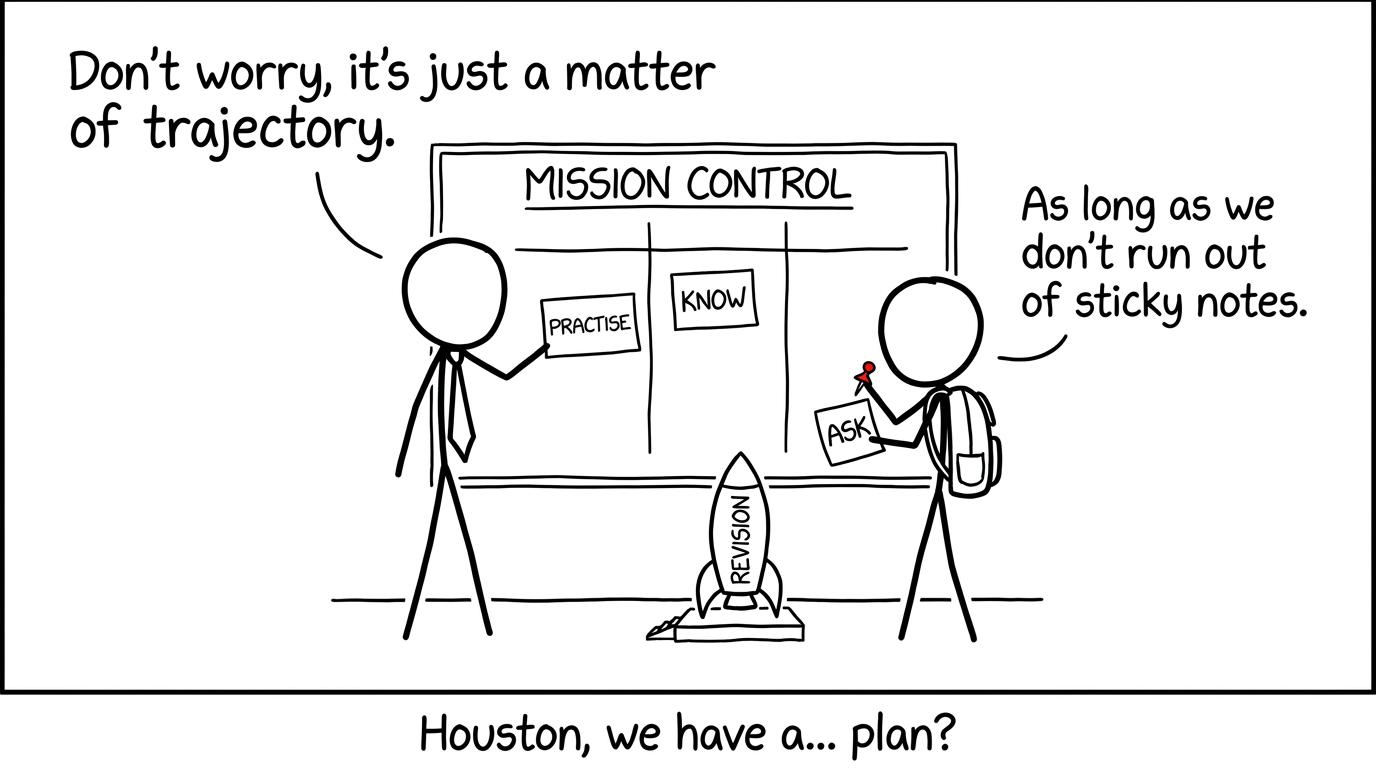 Student and teacher calmly organise a revision mission into Know, Practise and Ask
Asking early is a revision strategy
There is a quiet cost to hiding confusion. Every lesson built on an uncertain idea asks you to carry more weight. Speaking up does not solve the course in one moment, but it stops the uncertainty from growing unnoticed.
Tell your teacher what is difficult, show what you have attempted and agree one measurable next action. Then use MathsGenie to strengthen the supporting maths: revision lessons to rebuild understanding, practice questions and video solutions to develop methods, mini tests to check recall, and past papers, mark schemes and predicted papers to improve examination technique.
Start small today. Choose one astronomy question that you cannot yet answer, identify the maths or observational skill beneath it, and take it to your teacher. A clear question is often the first visible sign that progress has already begun.