

Tell Parents You're Struggling With GCSE Dance
Tell parents you're struggling with GCSE Dance using a calm script, clear evidence and a practical support plan that avoids blame, panic or lectures.
Sometimes the hardest part of falling behind is not the unfinished work. It is carrying the secret of it through breakfast, school and dinner while pretending everything is fine. If you are searching for how to tell parents you’re struggling with GCSE Dance, the best approach is simple: choose a calm moment, explain the specific problem, say how it is affecting you and ask for one or two practical forms of support.
You do not need a perfect speech. You need an honest opening and enough evidence to turn a frightening conversation into a manageable plan.
A quick conversation checklist
Before speaking to your parents or carers:
- identify exactly where you are falling behind;
- check your teacher’s feedback and upcoming deadlines;
- choose a time when nobody is rushing or already upset;
- begin by asking them to listen before offering advice;
- explain what you have already tried;
- suggest a realistic next step involving home and school;
- include your wider GCSE workload, especially maths revision;
- speak to a trusted adult at school if talking at home feels unsafe or impossible.
The goal is not to prove that everything is under control. It is to stop facing the problem alone.
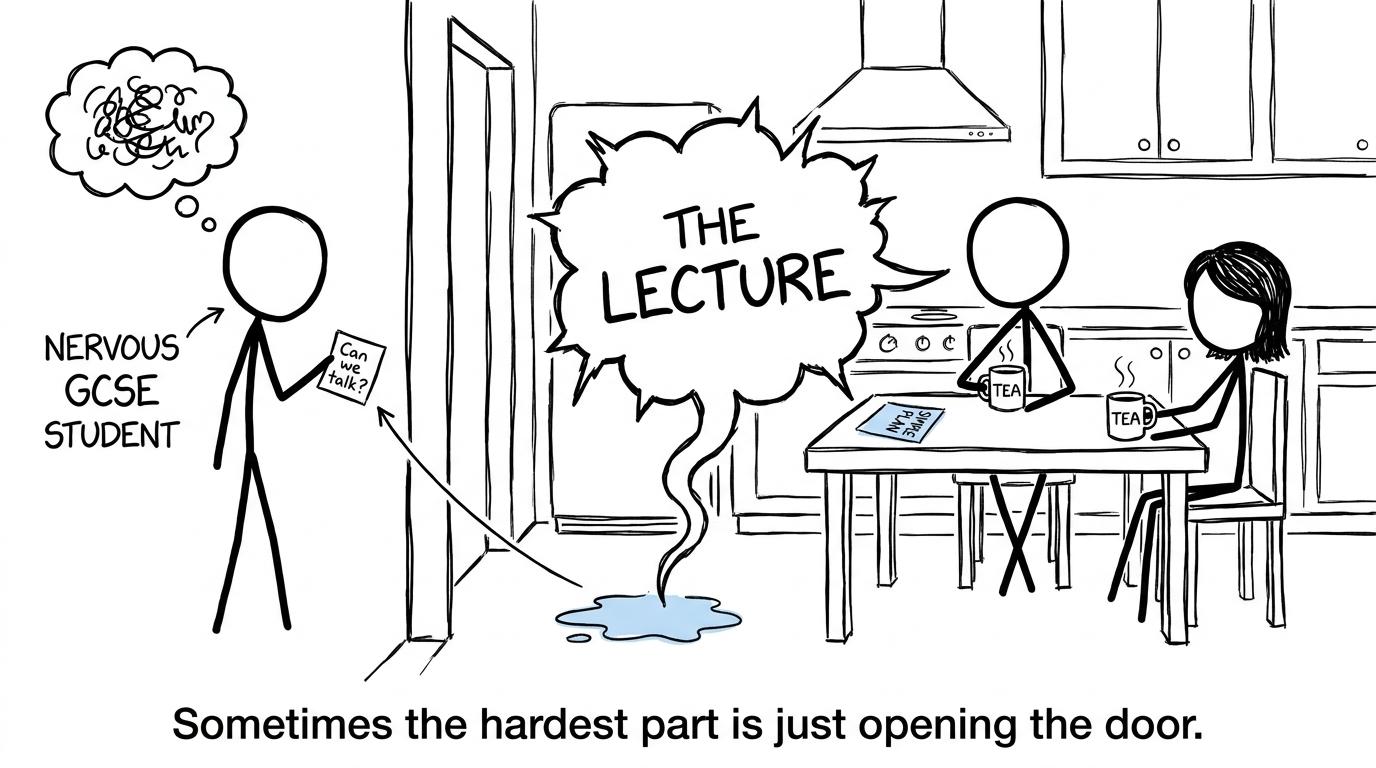 A student prepares to start a difficult conversation while the imaginary lecture monster shrinks
Work out what struggling actually means
“I’m bad at Dance” feels true when confidence is low, but it gives your parents very little to work with. A useful conversation begins with precision.
GCSE Dance includes performance, choreography and critical appreciation. Under the current GCSE assessment framework, practical non-exam assessment contributes 60%60\%60% of the qualification and the written examination contributes 40%40\%40%. On the AQA specification, for example, performance and choreography form the practical component, while Dance appreciation is assessed in a written paper.
You may be struggling with one particular area:
- remembering or refining performance material;
- applying physical, technical, expressive or mental skills;
- developing a motif or communicating a choreographic intention;
- responding to teacher feedback;
- analysing professional works in writing;
- using accurate Dance terminology;
- attending rehearsals alongside other GCSE commitments;
- managing anxiety, an injury or exhaustion;
- balancing Dance with foundation or higher tier maths revision.
Write down three facts: what is difficult, what evidence you have and what deadline comes next. For example, you might have missed choreography milestones, received repeated feedback about one skill, or found that Dance work is displacing revision in another subject.
Facts make the issue smaller. Instead of discussing your entire future, you can discuss the next rehearsal, written task or teacher meeting.
Choose a moment that gives the conversation a chance
Timing cannot guarantee a calm response, but poor timing can make one less likely. Avoid beginning as someone is leaving for work, dealing with another problem or trying to get everyone out of the door.
Try a direct request such as:
“Could we talk about GCSE Dance after dinner? I’m falling behind in part of the course. I have thought about what is going wrong and what might help. I need you to listen first before we make a plan.”
This opening does useful work. It names the subject, shows that the issue matters and asks for a particular kind of response. Giving advance notice may also feel easier than launching into the whole explanation without warning.
If speaking face to face feels overwhelming, send a short message asking for a conversation. The message is not an attempt to avoid the subject. It is a bridge into it.
Use a structure that keeps you out of an argument
A difficult conversation often turns into a lecture when everyone is trying to answer a different question. You are explaining how you feel. Your parents may immediately be asking how serious the situation is, why it happened and how it can be fixed.
Bring those questions into one structure.
Start with the situation
Say what has happened without exaggerating or minimising it:
“I am behind with my choreography development and I am not confident about explaining my decisions in the written work.”
Explain the impact
Describe what the problem is doing to your work or wellbeing:
“I keep avoiding it because I feel embarrassed, and then I lose time that I also need for maths.”
Say what you have tried
This shows that you are asking for support, not asking someone else to take responsibility:
“I have reviewed my teacher’s feedback and tried to organise extra rehearsal time, but I still need help deciding what to prioritise.”
Make a specific request
Ask for an action rather than a vague promise that things will improve:
“Could you help me arrange a meeting with my Dance teacher and protect two short rehearsal slots this week?”
That is a much easier request to answer than “Can you fix this?”
How to stop the conversation becoming a lecture
You cannot control another person’s reaction. You can, however, give the discussion boundaries.
Say early that you are telling them because you want to act before the gap grows. Then ask for listening time:
“Could I explain the whole situation for five minutes, and then I’ll listen to your questions?”
If the discussion becomes repetitive, return to the next action:
“I understand that you are worried. What I need to decide tonight is whether we contact my teacher tomorrow.”
If voices rise, suggest a pause rather than walking away without explanation:
“I want to finish this conversation, but I am finding it hard to think clearly. Can we take ten minutes and come back to the plan?”
Staying calm does not mean pretending criticism is comfortable. It means keeping the conversation attached to a decision that could help.
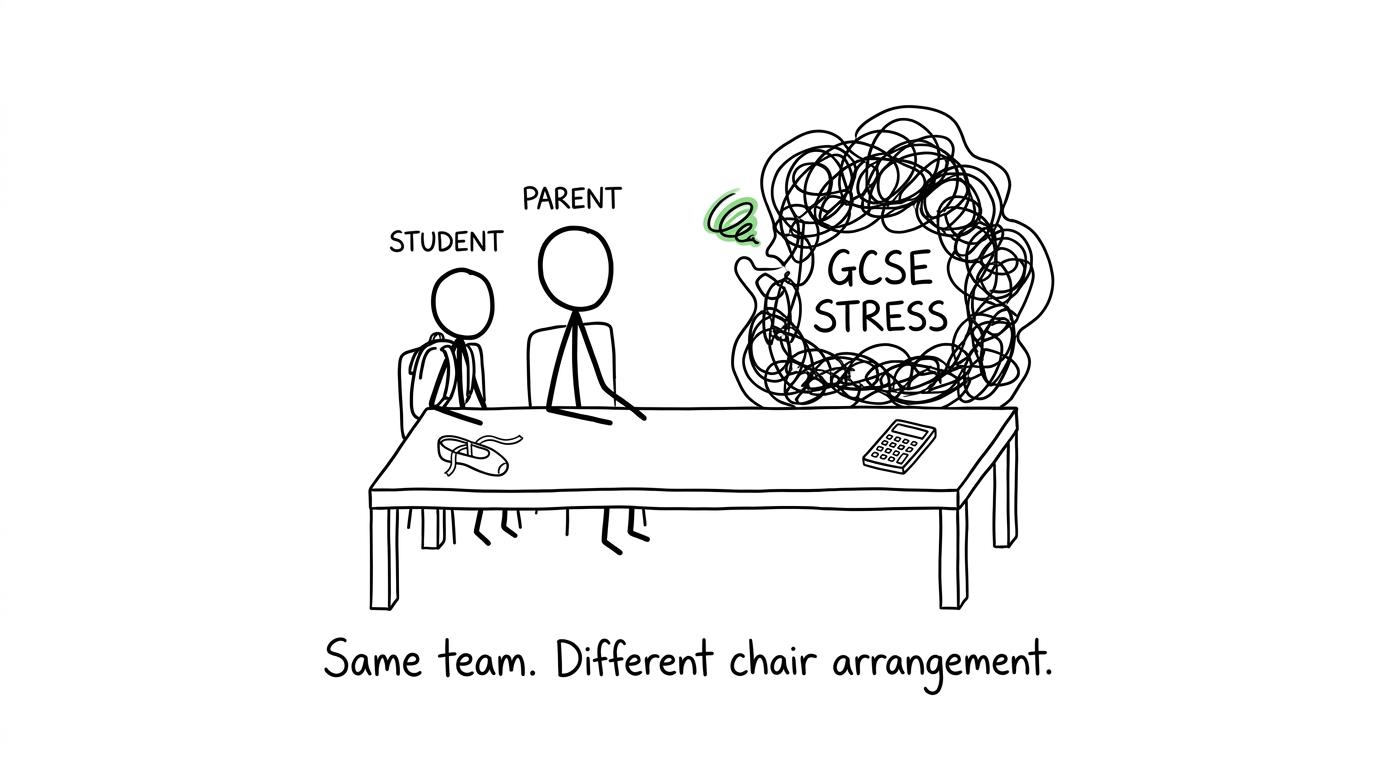 A student and parent face the GCSE stress problem together rather than opposing each other
Ask for support your parents can actually provide
Parents may not know the Dance specification or how choreography is assessed. They do not need to become Dance teachers. Their most valuable role may be helping you access the right support and protecting the conditions in which you can work.
You could ask them to:
- help you email your Dance teacher;
- attend a meeting while keeping you involved in the discussion;
- help organise transport for an agreed rehearsal;
- provide a quiet period for written work;
- reduce a non-essential commitment temporarily;
- help you create a realistic weekly timetable;
- check in once or twice a week rather than questioning you every evening;
- help you seek appropriate support if stress, low mood, pain or injury is affecting daily life.
Your teacher remains the best person to clarify assessment requirements, deadlines and subject-specific feedback. Ask what is currently secure, what needs attention first and what improvement is realistic within the available time.
Protect maths revision while solving the Dance problem
One subject can become so urgent that it takes every available hour. That often creates a second problem rather than solving the first.
Your plan should show where Dance fits alongside English, science and maths. Do not fill every evening. Use short, named sessions with a clear outcome, such as reviewing feedback or refining one section of choreography.
Do the same for maths. Start from the GCSE Maths revision hub, choose your correct exam board and tier, and focus on one weakness at a time. Edexcel, AQA, OCR and Eduqas specifications differ, so check the board shown on your school papers rather than guessing.
When time and confidence are limited, targeted practice is often more manageable than repeatedly attempting full papers. MathsGenie’s GCSE teaching and self-assessment resources can help identify weak topics, while Edexcel GCSE Maths mini tests provide shorter timed tasks.
Once you are ready for longer practice, use the GCSE past-paper library with mark schemes and available worked solutions. The guide to using GCSE past papers properly explains why marking, correcting and retesting matter more than simply completing paper after paper.
This gives you something reassuring to show your parents: not a packed timetable designed to impress them, but a repeatable revision routine. MathsGenie’s revision planner can then help you keep Dance commitments and maths preparation visible in the same week.
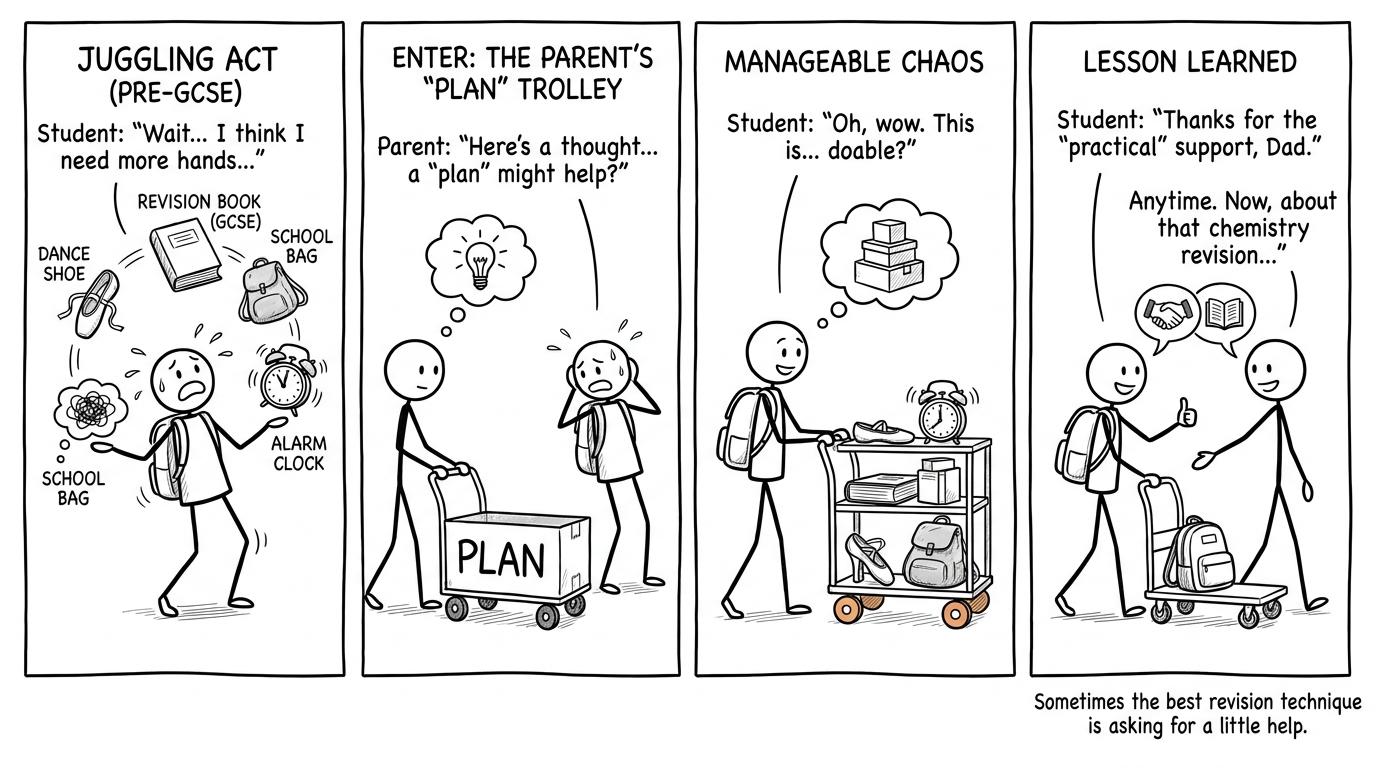 A student receives a practical plan instead of continuing to juggle every GCSE demand
What to do after the conversation
Write down what everyone agreed. A useful plan should include:
- the first action;
- who is responsible for it;
- when it will happen;
- when you will review progress;
- what you will do if the first plan does not help.
After speaking to your teacher, update your parents briefly. This prevents every conversation becoming a fresh investigation. You might agree on one scheduled check-in each week, with the rest of your time left for work, rest and normal family life.
For maths, keep the feedback loop equally clear: complete a task, mark it, record the weakness and revisit it. Advice on when to start GCSE past papers can help you choose an appropriate stage, while the article on revising Edexcel GCSE Maths efficiently offers a focused topic-practice routine.
If your parents do not respond well
Some parents react sharply because they are surprised or worried. That does not make a lecture helpful, but it may mean the first reaction is not the final one. Pause and try again when everyone is calmer, perhaps with your written notes in front of you.
If they dismiss the problem, keep returning to concrete evidence and the support you are requesting. You can also speak to your Dance teacher, form tutor, head of year, school counsellor or another trusted adult. Asking someone to help you prepare or join the conversation is reasonable.
If talking at home could place you at risk, do not force the conversation alone. Tell a trusted adult at school and ask for help with the safest next step. If exam anxiety or low mood is severe, persistent or interfering with everyday life, speak to a trusted adult and seek appropriate professional support.
Common mistakes when raising the subject
Waiting until a deadline has already passed
Early honesty leaves more options. You do not need to wait until you can prove that the situation is disastrous.
Describing yourself instead of the problem
“I am useless” invites reassurance or disagreement. “I cannot yet apply this feedback consistently” identifies something that can be addressed.
Beginning during an argument
When the conversation starts as part of another conflict, the original issue can disappear. Request a separate time.
Promising an impossible recovery plan
A timetable covering every hour may calm people for one evening, but it is unlikely to survive the week. Include rest, school hours and your other subjects.
Asking parents to solve the assessment problem
Parents can organise, listen and advocate. Your Dance teacher should explain specification requirements and give subject feedback.
Letting Dance replace every other subject
Urgency is not the same as priority. Keep small, regular maths sessions in place so that one gap does not create another.
Take the next honest step
Telling your parents that you are struggling with GCSE Dance may feel like admitting defeat. In reality, it is an attempt to change direction while change is still possible. Keep the conversation specific: this is the difficulty, this is its impact, this is what you have tried, and this is the help you need next.
Then make the wider GCSE plan workable. Use MathsGenie’s free revision lessons, practice questions, mini tests, past papers, predicted papers, mark schemes and video solutions to give your maths revision a clear structure. Start with one weak topic today. A calm plan rarely fixes everything at once; it simply makes the next useful action easier to see.











