Switch GCSE Physics to Astronomy Mid-Year?
Switch GCSE Physics to Astronomy mid-year with a realistic guide to school approval, missed content, observations, exam entries and maths catch-up.
The thought often arrives after a difficult physics lesson: perhaps astronomy would feel more meaningful. Planets, stars and galaxies can sound more inviting than circuits or electromagnetism. But if you want to switch GCSE Physics to Astronomy after the course has started, interest is only the beginning of the decision.
The short answer is that a mid-year switch may be possible, but only if your school offers Edexcel GCSE Astronomy, approves the change and can satisfy the teaching, observation and examination requirements. Astronomy will not normally replace your wider compulsory science education, and catching up can be substantial. Speak to your science teacher, head of year and exams officer before dropping any lessons or buying resources.
The mid-year switching checklist
Before treating the change as settled, confirm all of the following:
- your school currently teaches Edexcel GCSE Astronomy;
- Astronomy can occupy the correct place in your timetable;
- leaving Physics would not disrupt your required science pathway;
- an Astronomy teacher is willing and able to supervise your catch-up;
- you can complete the mandatory aided and unaided observations;
- the exams officer can enter you for the correct examination series;
- you understand how much specification content has already been taught;
- the switch still leaves enough time for revision and examination practice.
If one of these conditions cannot be met, enthusiasm alone may not make the switch workable. That is not a judgement on your ability. It is a recognition that qualifications depend on schools, timetables, equipment and formal administration as well as individual effort.
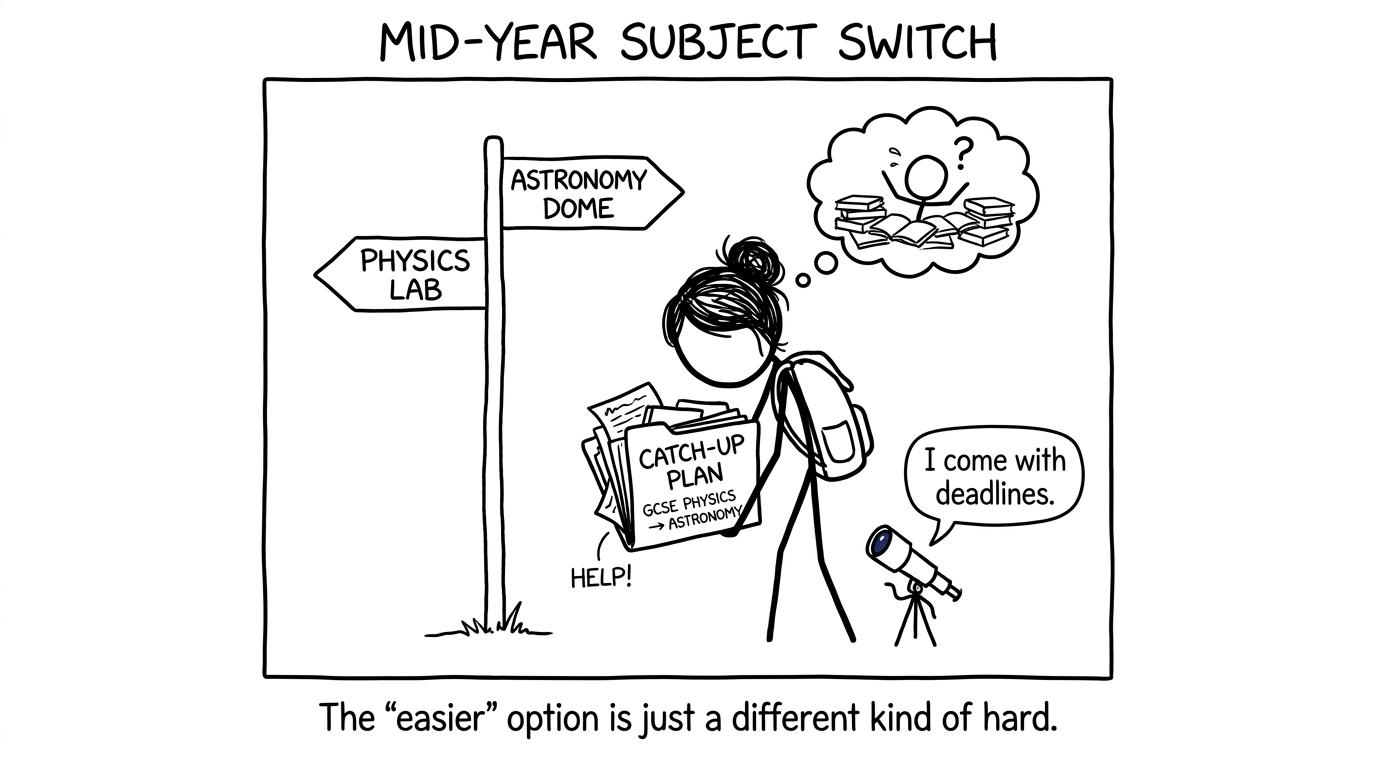 A student choosing between the physics lab and astronomy dome while carrying a catch-up plan
Can Astronomy actually replace GCSE Physics?
This is the first question to resolve because the word “replace” can be misleading.
In England, Key Stage 4 science continues to develop knowledge across biology, chemistry and physics. Schools usually deliver this through Combined Science or separate GCSEs in Biology, Chemistry and Physics. GCSE Astronomy is a distinct qualification, not a general substitute for the physics component of compulsory science.
Your situation therefore depends on your existing programme. If Physics is one of your three separate sciences, your school must decide whether changing the qualification would still meet its curriculum arrangements. If you already take Combined Science and Physics is an additional option, replacing that extra subject with Astronomy may be administratively simpler. It is never safe to assume that you can stop Physics merely because Astronomy has scientific content.
Schools also control their own timetables and examination entries. A student or parent can request a change, but the school ultimately decides whether it can teach and enter the qualification responsibly.
What GCSE Astronomy involves
The current GCSE Astronomy qualification is Pearson Edexcel specification 1AS0. It is untiered, so there are no foundation and higher papers. Every student follows the same specification and sits the same assessments.
The course contains two externally examined papers:
| Assessment | Main content | Length | Weighting |
|---|---|---|---|
| Paper 1 | Naked-eye Astronomy | 111 hour 454545 minutes | 50%50\%50% |
| Paper 2 | Telescopic Astronomy | 111 hour 454545 minutes | 50%50\%50% |
Each paper is worth 100100100 marks. Assessment includes knowledge, application, calculations, data interpretation and evaluation of observational methods. You can explore the course structure and available resources through the Edexcel GCSE Astronomy revision hub.
The subject ranges well beyond memorising facts about planets. It covers the Earth-Moon-Sun system, celestial coordinates, time, planetary systems, stellar evolution, galaxies, cosmology, telescopes and astronomical observation. Physics knowledge helps, especially with gravity, light, waves and energy, but the courses are not interchangeable.
At least 20%20\%20% of the marks must assess mathematical skills. The qualification also gives significant attention to observational knowledge. A student who enjoys space but avoids calculations, graphs or practical planning may find Astronomy different from what they imagined.
The biggest obstacle: mandatory observations
Every candidate must undertake at least one unaided observation and one aided observation. Unaided work might involve direct naked-eye observation or simple equipment, while aided work uses equipment such as binoculars, a telescope or an appropriate robotic telescope.
These are not optional enrichment activities. Students must record what they undertook and what they learnt about observational techniques. The centre must then submit an Observation Statement to Pearson. For recent summer series, Pearson has set this deadline as 15 April in the examination year, but your exams officer must check the dates for your own series.
A late switch creates several questions:
- Has the class already completed an observation that depends on a particular season?
- Is the required equipment or robotic telescope access available?
- Who will supervise the activity and check your record?
- Is there enough time to repeat an observation if weather or visibility causes problems?
- Can the school include you accurately in its formal declaration?
Astronomy answers to the sky as well as the timetable. A missed algebra lesson can be revisited tomorrow; an observation requiring particular seasonal conditions may be less flexible.
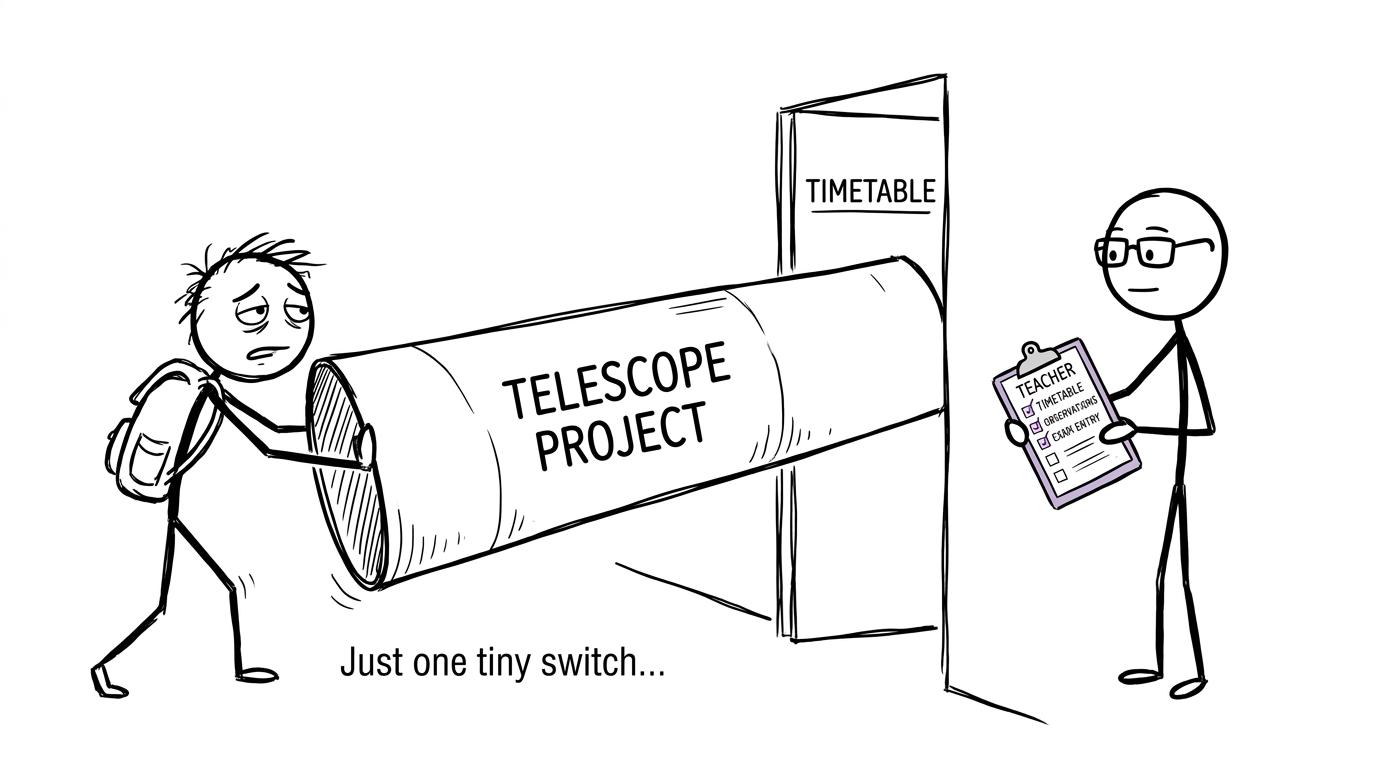 A student trying to push a telescope through a timetable doorway
What it takes to catch up mid-year
A sensible catch-up plan begins with a specification audit, not a promise to “work harder”. Ask the Astronomy teacher for a list of topics already covered and divide them into three groups:
- content you already understand through Physics or maths;
- unfamiliar content you can learn independently;
- observational or technical content requiring teacher support.
Then estimate the available weeks realistically. Include school assessments, other GCSEs and your existing maths revision. If the missed content would consume every evening, the plan is not sustainable.
Build a written agreement with your school
Your teacher should be able to state what you must complete, when it will be checked and how you will join normal class assessments. The exams officer should separately confirm entry arrangements. Examination entry deadlines vary by series, and late entries can create fees or administrative difficulties.
Do not rely on a casual conversation such as “it should probably be fine”. Ask for clear answers about the specification, observation programme, examination entry and the subject that will disappear from your timetable.
Test the subject before committing
Read the specification outline, inspect both papers and attempt a small selection of questions without treating the result as a predicted grade. The purpose is to see what the subject actually asks you to do.
You may discover that celestial observation is fascinating. You may also discover that the course contains more coordinate systems, data handling and technical explanation than expected. Either discovery is useful before the timetable changes.
Protect your mathematics
The maths shared by Physics and Astronomy is an advantage. Both can require ratios, unit conversions, graph interpretation, angles, formula substitution and very large or small quantities.
Astronomical scales make standard form revision particularly valuable. Formula questions become more manageable when you are confident with changing the subject of a formula, while angular and geometric reasoning can be supported by SOHCAHTOA revision.
The useful habits are simple: keep units attached to values, delay rounding, label graphs carefully and check whether an answer is reasonable. These are not separate “Astronomy tricks”. They are durable GCSE maths skills.
Should you make the switch?
A switch is more realistic when the school already runs the course, the class is not too far ahead, observation arrangements remain available and your current attainment shows that independent catch-up is manageable.
It is less realistic when Astronomy is not timetabled, no specialist teacher can support you, mandatory observations cannot be completed or you would be abandoning required science provision. It may also be unwise if the attraction is mainly the hope that Astronomy will be easier. It is a demanding, untiered GCSE with substantial scientific, mathematical and observational content.
Ask yourself a sharper question: are you moving towards a subject you understand, or merely moving away from a difficult month in Physics? Difficulty can be temporary. A qualification change is not.
If Physics calculations are the main problem, improving the underlying maths may be the lower-risk solution. The GCSE Maths revision hub lets you select your board and strengthen the same algebra, graphs and number skills that appear in science.
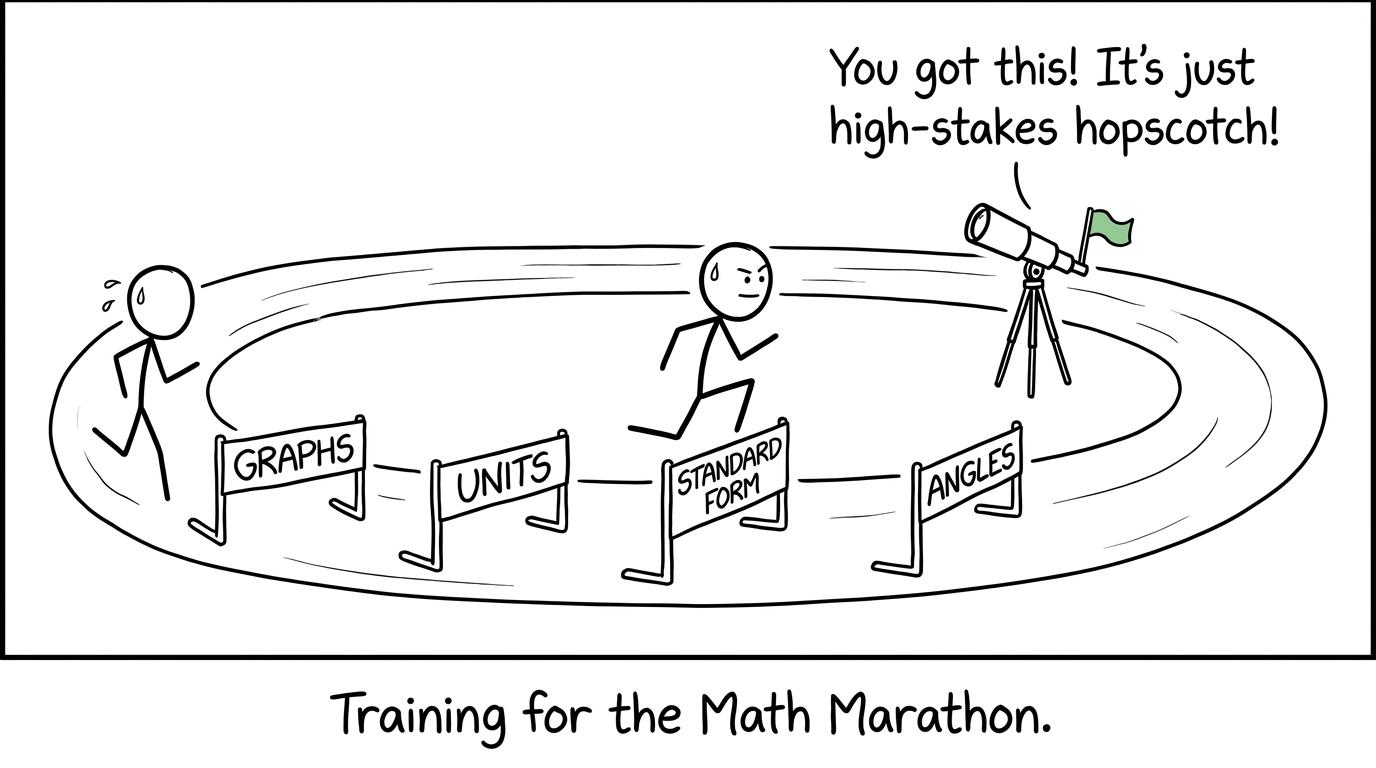 A student clearing revision hurdles while a telescope cheers
A practical conversation to have at school
Arrange a meeting and take a short list of direct questions:
- Would Astronomy replace an optional GCSE or part of my science programme?
- How many lessons and specification topics have I missed?
- Which observations has the class completed?
- Can I still complete one aided and one unaided observation safely?
- Who will assess my catch-up work?
- Has the examination entry been made, and are any deadlines approaching?
- What happens if the catch-up plan is not working after a few weeks?
Bring evidence of commitment rather than a vague promise. A weekly timetable, a topic checklist and an initial diagnostic attempt show that you understand what the change requires.
Common mistakes when changing GCSE subjects
Assuming Astronomy is simply space physics
There is overlap, but Astronomy has its own specification, terminology and observational requirements. Knowing the Physics space topic does not mean you have covered the Astronomy course.
Dropping Physics before receiving formal approval
Continue attending and completing your current work until the school confirms the change. Otherwise, you may create a gap in both subjects.
Ignoring the observation requirement
Independent reading cannot replace formally arranged observational work. Discuss it before any timetable decision is made.
Counting lessons but not independent hours
Joining a class does not erase the first part of its course. Your plan must include learning, questions, marking, corrections and later retrieval.
Neglecting your other GCSEs
A catch-up plan that damages Maths, English or your remaining sciences may cost more than the switch gains. Use short, scheduled sessions and review the workload after the first fortnight.
Make the decision with evidence
It is possible to switch GCSE Physics to Astronomy mid-year in some schools, but there is no automatic right or universal process. The deciding factors are curriculum requirements, school approval, teaching capacity, missed content, mandatory observations and examination administration.
Start with the conversation. Then audit the specification and build a catch-up timetable that leaves room for your other subjects. If the switch proceeds, use the free MathsGenie Astronomy hub alongside focused maths revision. Strengthen weak methods through revision lessons and practice questions, then use GCSE predicted papers, mark schemes, video solutions and mini tests to prepare for timed assessment.
A good decision does not remove every difficulty. It makes the difficulty visible, planned and worth accepting.