

Stop Procrastinating GCSE English Language and Literature
Stop procrastinating GCSE English Language and Literature with a practical plan for essays, quotations and unseen texts that protects maths revision.
The English book is open. The quotation sheet is ready. Yet ten minutes later, you are reorganising your pens or deciding that a maths worksheet suddenly looks inviting.
If you want to stop procrastinating GCSE English Language and Literature, do not wait to feel motivated. Reduce the first task until it is specific enough to begin: analyse one paragraph, retrieve five quotations or plan one essay argument. Then work for a short, defined period and record the next action before stopping.
English is unusually easy to postpone because “revise English” has no obvious finish line. Maths often gives you a visible task: answer the questions, check the solutions, count the marks. English can feel like an endless mixture of reading, remembering, interpreting and writing. The answer is to make English revision more concrete without allowing it to consume the time you need for GCSE maths.
The short checklist
Use this process whenever English revision keeps slipping down your list:
- Name one paper, text or assessment objective.
- Choose an output you can see, such as a paragraph or quotation map.
- Make the first action small enough to start immediately.
- Put your phone in another room or out of reach.
- Work for a short, fixed block.
- Check the work against a mark scheme or teacher guidance.
- Write down the next action before you finish.
- Keep your planned maths session protected.
That last point matters. Escaping English by doing only maths is still procrastination, while letting overdue English work swallow the whole evening damages your maths preparation. A balanced plan gives both subjects a clear boundary.
Why GCSE English gets procrastinated on
The task is often too vague
“Revise Macbeth” could mean rereading the play, learning quotations, reviewing context, planning themes or writing an essay. Faced with that many choices, it is easy to do nothing.
Replace the subject-sized instruction with a visible action:
- retrieve six quotations linked to ambition;
- plan three arguments about a character;
- analyse the effect of one structural change in an unseen extract;
- write one opening for a transactional writing task;
- compare two poems through one shared theme.
Breaking complex work into nearby sub-tasks is a widely recommended way to reduce the freedom and uncertainty that can encourage academic procrastination. The important distinction is that planning must lead quickly to an attempt. Designing an elaborate timetable is not the same as revising.
Progress is harder to measure
In maths, feedback can be immediate. You complete a question, use a solution and identify the exact step that went wrong. That clarity is built into MathsGenie’s GCSE Maths revision hub, where lessons, questions and papers are organised by exam board and topic.
English progress feels less certain because a response may contain several reasonable interpretations. But it is not unmeasurable. Count outputs rather than hours: quotations retrieved without notes, plans completed, paragraphs improved and timed questions attempted.
You can also borrow the maths habit of diagnosing errors. After marking an English response, identify whether the problem was knowledge, analysis, evidence, structure, accuracy or timing. One precise diagnosis creates a manageable next task.
The emotional risk feels higher
An unfinished essay can preserve a comforting possibility: perhaps you could write a brilliant answer if you really tried. Starting produces evidence, and imperfect evidence can feel uncomfortable.
That is why the first attempt should be deliberately small. Its purpose is not to prove your grade. Its purpose is to reveal what needs work. A rough paragraph gives your teacher something to guide; a blank page does not.
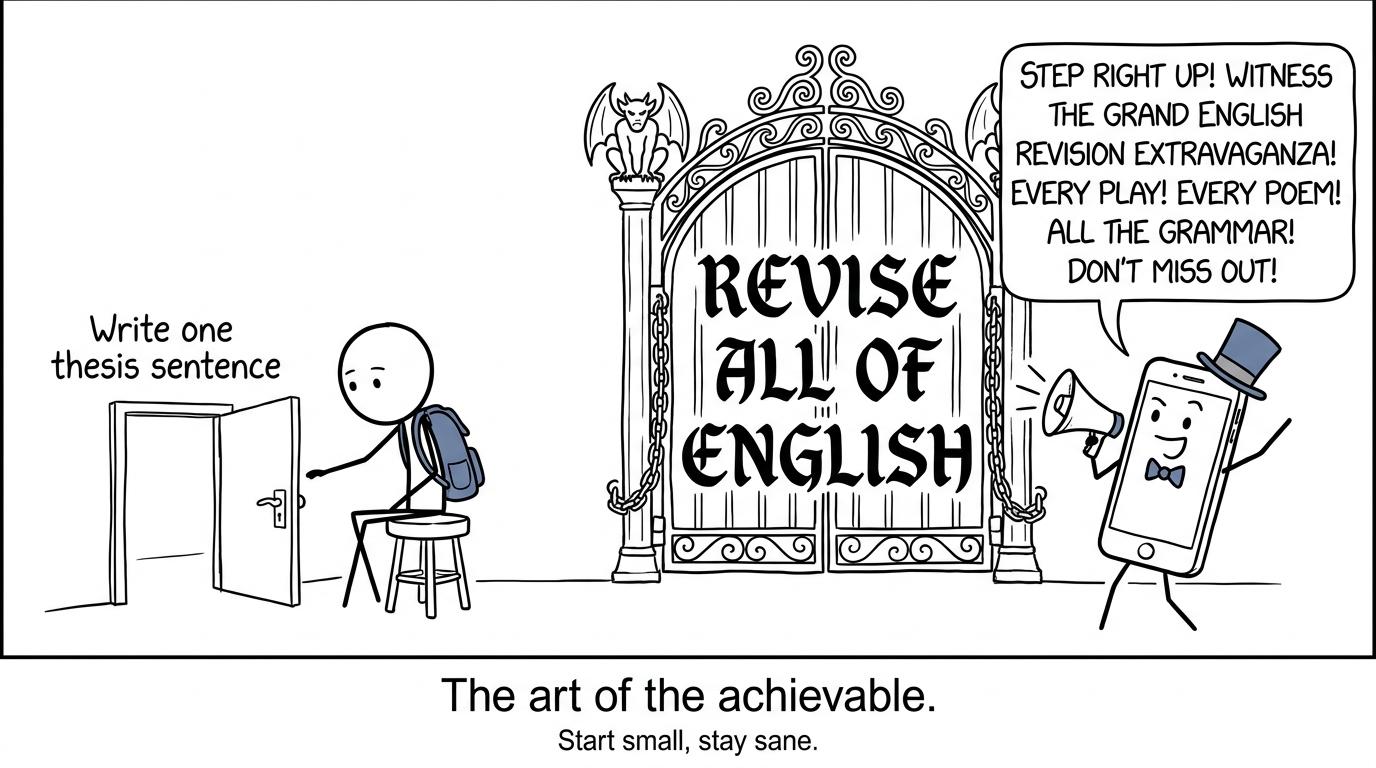 A student choosing a tiny revision door instead of an overwhelming gate
Turn each English course into concrete jobs
English Language and English Literature overlap, but they create different procrastination problems. Treating them as one enormous subject makes both harder to start.
GCSE English Language
GCSE English Language assesses reading and writing. Across exam boards, students need to understand texts, analyse writers’ choices, compare or evaluate where required, and communicate effectively for purpose and audience. Exact paper structures differ between AQA, Edexcel, OCR and Eduqas, so use your own specification and school materials.
For example, AQA divides the written qualification equally between two papers. Its assessment objectives allocate 50%50\%50% to reading and 50%50\%50% to writing, while the Spoken Language endorsement is reported separately and does not contribute to the final numerical grade. Other boards arrange questions differently.
Useful Language revision tasks include:
- annotate one unseen paragraph for language or structure;
- write a thesis answering one reading question;
- plan a comparison using evidence from both sources;
- draft one description focused on atmosphere;
- edit a response for sentence control, spelling and punctuation;
- complete one question under your board’s recommended timing.
Do not merely read model answers. Cover the model, attempt the task, then compare. Revision becomes useful when you retrieve or produce something before seeing the answer.
GCSE English Literature
Literature procrastination often comes from the apparent size of the course. In England, specifications cover substantial texts and unseen material, including Shakespeare, a nineteenth-century novel, poetry and modern prose or drama. Your precise set texts depend on your school and exam board.
AQA Literature assessments, for example, are closed book and require students to write about studied texts as well as unseen poetry. Do not assume every board uses identical timings, extracts or question arrangements.
Shrink Literature into four types of job:
- Knowledge: retrieve events, characters, themes and concise quotations.
- Interpretation: explain what an idea suggests and consider another reading.
- Method: analyse how language, form or structure creates meaning.
- Argument: organise ideas into a direct answer to the question.
A quotation is not fully revised because you highlighted it. Test whether you can recall it, connect it to more than one theme and explain why the writer’s choice matters.
Use a start ritual instead of waiting for motivation
A reliable start ritual removes negotiation. Keep it simple:
- Clear the desk.
- Put the phone beyond reach.
- Open the exact text or question.
- Write the date and task.
- Set a short timer.
- Produce the first sentence before improving anything.
An if / then plan can make the cue clearer: “If I finish dinner, then I will sit at the kitchen table and plan one Literature paragraph.” Research on implementation intentions is promising overall, although individual interventions do not work equally well for everyone. Treat the plan as a practical cue, not a guarantee.
Match the ritual with friction. Make distractions harder to reach and revision easier to begin. Leave the correct book, question and paper ready beforehand. If opening social media requires standing up and retrieving your phone, the distraction is no longer effortless.
Build an English and maths revision relay
For students preparing for maths exams, the goal is not to replace maths revision with an evening-long essay. Use bounded sessions.
A sensible school-night sequence might be:
- twenty-five minutes of English retrieval or planning;
- a five-minute break;
- twenty-five minutes of maths topic practice;
- ten minutes marking both tasks and recording corrections.
The order can change. If English is the subject you avoid, place it first so maths does not become productive-looking escape. If a maths mock is tomorrow, adjust the balance intelligently rather than following a rigid rule.
For maths, the twenty-minute GCSE maths revision routine provides a compact structure. If you need a wider weekly system, use the GCSE revision timetable guide and assign English tasks with the same precision as maths topics.
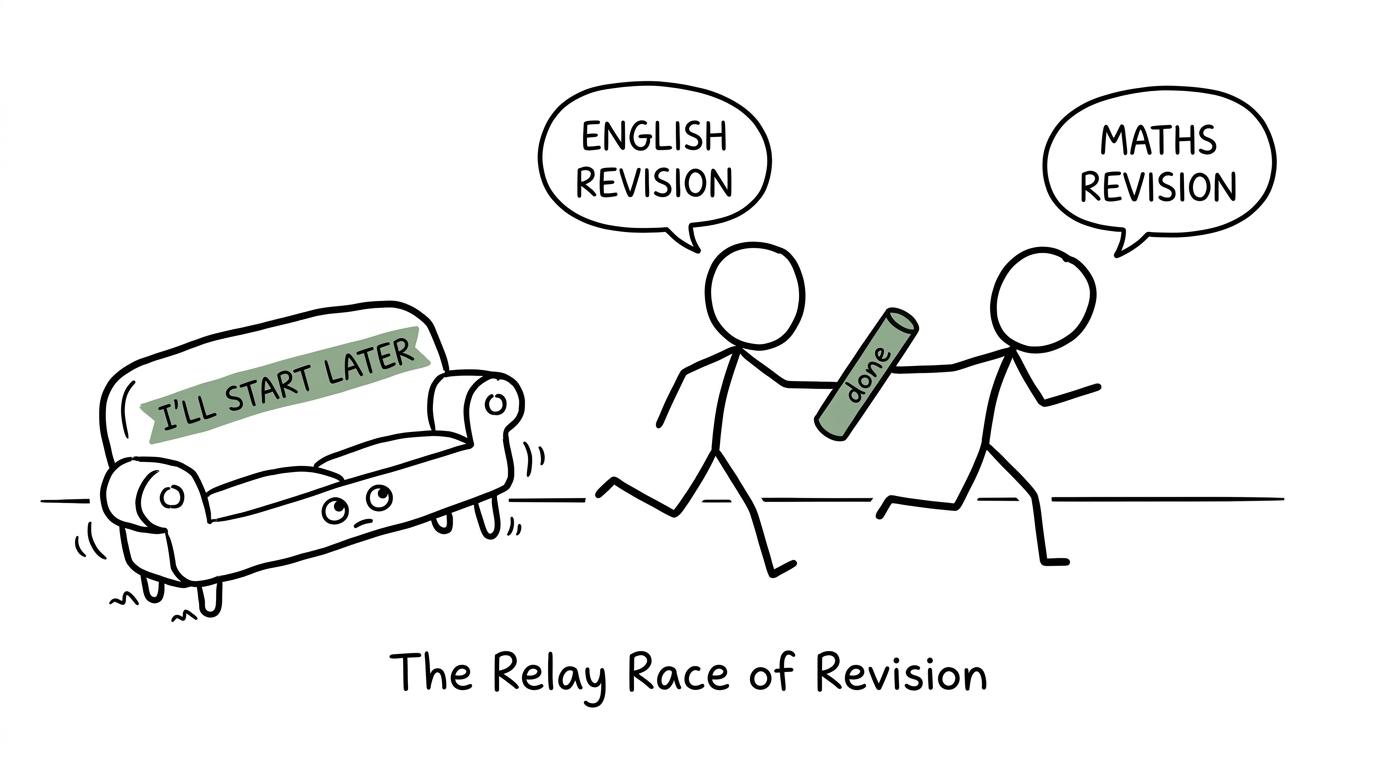 A revision relay passing the baton from English to maths
Make feedback immediate
Procrastination grows when effort disappears into a folder without a verdict. Finish each session with feedback.
For English, compare your response with the relevant assessment objectives, mark scheme, teacher comments or an official exemplar supplied through your school or exam board. Ask:
- Did I answer the exact question?
- Is there a clear argument?
- Did I select precise evidence?
- Did I analyse the writer’s choices rather than retell content?
- Is the writing controlled and accurate?
- What is the single best improvement for next time?
Apply the same loop to maths: attempt, mark, repair and retest. MathsGenie’s Edexcel GCSE Maths revision resources combine lessons and questions, while Edexcel GCSE mini tests make short, timed practice easier to begin.
When you are ready for complete papers, use the GCSE past-paper library. Edexcel students can also work through Edexcel GCSE Maths past papers with mark schemes and worked solutions where available. Save predicted papers for fresh exam-style practice alongside, rather than instead of, official past papers.
Common mistakes when trying to stop procrastinating
Writing “revise English” on the timetable
This describes a subject, not an action. Specify the paper, skill, text and output.
Making beautiful notes without retrieving anything
Colour-coded pages can feel productive while keeping the difficult work safely at a distance. Close the notes and recall quotations, plan arguments or answer questions.
Beginning with a complete timed paper
If you have avoided English for weeks, a full paper creates unnecessary resistance. Begin with one question or paragraph, then increase the length as starting becomes normal.
Using maths as an escape route
Maths practice is valuable, but not when it repeatedly replaces the English session you planned. Give each subject a defined block and a visible outcome.
Treating one missed day as failure
A plan should survive ordinary disruption. Do not double every session after one difficult evening. Resume with the next small task.
Waiting for confidence
Confidence usually follows evidence. A completed paragraph, corrected paper or remembered quotation provides that evidence. Start before you feel ready.
Start small, then keep the promise
The way to stop procrastinating GCSE English Language and Literature is not to become endlessly disciplined. It is to make the next action obvious, short and checkable. English feels less threatening when “revise everything” becomes “plan one argument and retrieve five quotations”.
Then carry the same clarity into maths. Open MathsGenie, choose your exam board and tier, and use a revision lesson to repair one weak topic. Follow it with practice questions, mark the attempt, and return later with a mini test. As exams approach, add past papers, predicted papers, mark schemes and video solutions.
One finished task rarely feels dramatic. But it changes what happens next. Begin with the smallest useful English action today, then protect the maths session that follows it.










