Staying Motivated After a Bad Mock
Staying motivated after a bad mock starts with a clear plan. Find practical GCSE maths revision steps to rebuild confidence, target gaps and support progress.
A disappointing GCSE maths mock can make weeks of revision feel wasted. But staying motivated after a bad mock starts with using the result to decide what to practise next. Review your marked paper, identify the reasons you lost marks and build a manageable revision plan around them.
Imagine a Year 11 student opening a result below their expectations. By the journey home, disappointment has become a prediction: “I am going to fail.” That reaction is understandable, but the prediction goes beyond the evidence. A mock records one performance at one stage of your course. It leaves room for improvement.
Your post-mock checklist
Give yourself time to process the disappointment, then:
- Read the marked paper alongside the mark scheme.
- Separate topic gaps, method errors, checking mistakes and timing problems.
- Choose two or three priorities.
- Practise those skills in short sessions.
- Correct your answers and retest without notes.
- Ask your teacher about anything you cannot explain.
The GCSE Maths revision hub provides a starting point for finding revision materials and papers.
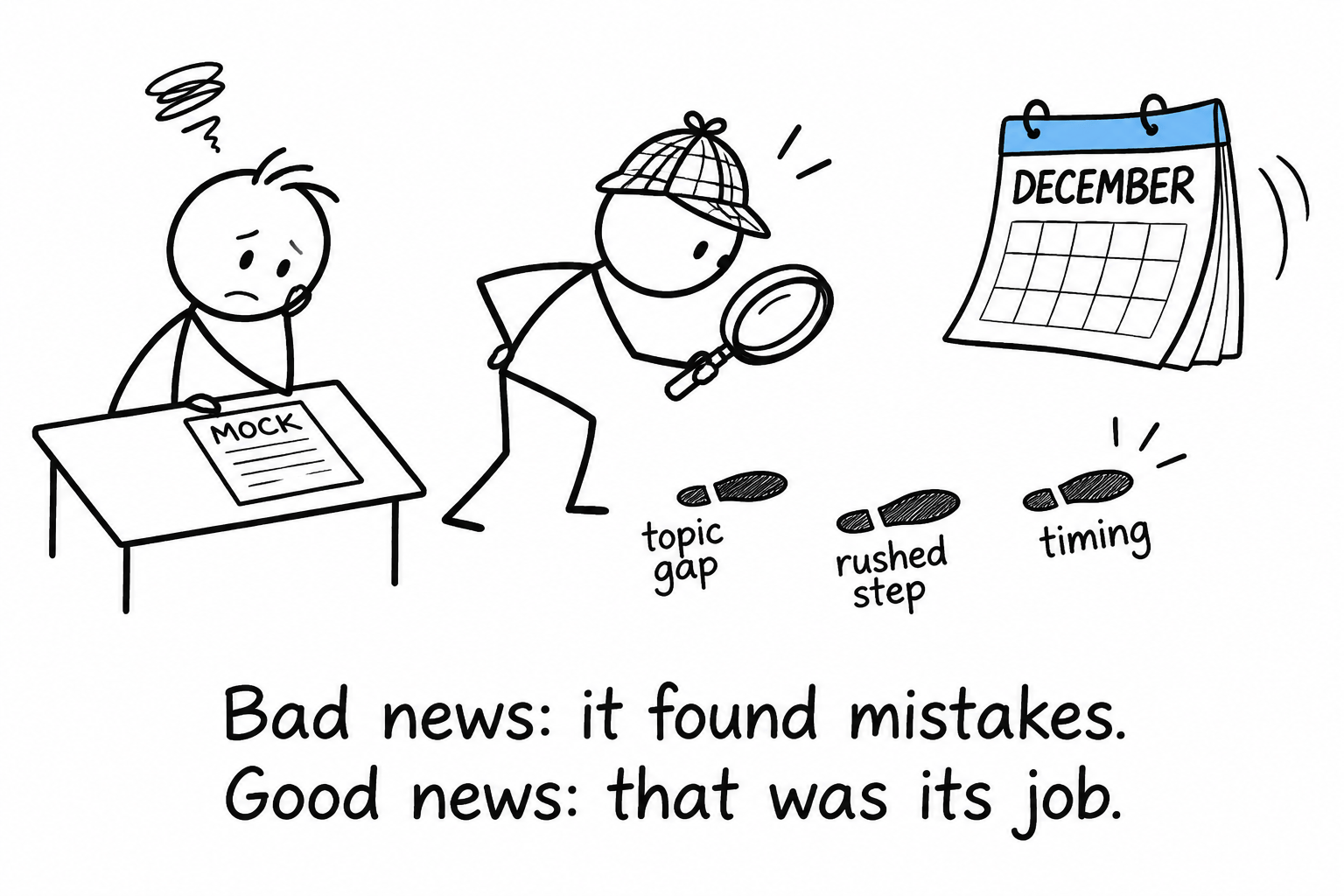 A student and a detective inspect the clues left by a disappointing mock
Why a bad mock can feel final
Mocks resemble the real exam, so receiving the result can feel final too. Yet you may still have topics to learn, methods to consolidate and exam habits to improve.
Schools use mocks differently, including to inform predicted grades, intervention and tier discussions. Ask your teacher what your result means within your school. Avoid assuming that one mock determines your final GCSE grade.
Comparisons with friends rarely identify your next step. They may have completed different papers or struggled with different topics. Your marked work offers more useful information than someone else’s grade.
Turn lost marks into useful information
A total mark tells you how the paper went. Looking at individual errors helps explain why. Label each lost mark using these categories.
Topic gaps
If you could not recall the method, return to the relevant revision lesson. Watch the explanation, then attempt practice questions independently. Topics such as rearranging formulae or circle theorems need focused attention before another full paper will be useful.
Method errors
If you recognised the topic but chose the wrong process, compare your working with the mark scheme. Find the first incorrect decision. Understanding that turning point is more useful than copying a complete solution without thinking about it.
Checking and communication mistakes
Copied values, missed negative signs, early rounding and missing working need specific responses. Build a checking routine: reread the instruction, show your method and keep exact values until the final step. Replace “I am careless” with a description of what happened.
Timing problems
Blank questions may indicate that you spent too long elsewhere. Practise recognising when you have stalled, leaving space and returning later. Short timed sets let you rehearse this without immediately sitting another complete mock.
Staying motivated after a bad mock through routine
You do not need to feel confident before beginning. Make the next task small enough to start: revise one weak skill, attempt questions and check your answers.
A manageable weekly rhythm could be:
- Monday: review a lesson and note the key method.
- Wednesday: attempt topic questions without support.
- Friday: mark the answers and correct mistakes.
- Weekend: complete a short timed check.
The 20-minute GCSE maths revision routine offers ideas for busy school days. Use the MathsGenie revision planner if you need help turning priorities into a weekly schedule.
Record progress in terms you can observe: completing a question independently, choosing the correct method or explaining a previous mistake. These changes give you evidence that your revision is helping, even before another grade arrives.
Choose practice that matches the problem
If your mock exposed weaknesses in ratio, simultaneous equations and transformations, start there. A random full paper might contain only a few questions on those skills.
Use revision lessons, practice questions, mark schemes and video solutions to address each gap. The GCSE Maths mini tests provide shorter checks for Edexcel students.
Once those topics are more secure, the GCSE Mock Exam Builder lets you select topics, question count and difficulty mix for targeted practice. Complete your paper without notes, then compare the kinds of error with your original mock.
Return to full papers when you want to assess broader performance and timing. The Edexcel GCSE Maths past papers include papers, mark schemes and worked solutions where available. For AQA, OCR or Eduqas, check that your resources match your exam board and specification.
How parents can help
Start with curiosity: “What did the paper show you?” Listen before proposing a solution. Help protect revision time, reduce distractions and encourage honest corrections.
Praise actions the student can control, such as following their plan or returning to a difficult question. Repeated comparisons and questions about the final grade can distract from that work.
Discuss foundation or higher tier concerns with the maths teacher, who can consider the student’s wider performance.
Common mistakes after GCSE maths mocks
Revising everything at once: begin with a few priorities so each session has a clear purpose.
Only choosing comfortable questions: include familiar work, but give identified weaknesses proper attention.
Reading solutions before attempting questions: try independently, check the explanation, then attempt a similar question unaided.
Repeating full papers without correcting errors: repair the gaps first so the next paper tests something you have improved.
Turning a result into an identity: “I struggled with this paper” describes evidence you can act on. A permanent label makes the next step harder to see.
Give the result a useful next chapter
You cannot change the mock you have already sat. You can change what happens after it.
Choose one weakness, open the relevant MathsGenie lesson and complete a short practice set. Mark it honestly, correct it and schedule a retest. That gives tomorrow’s revision a purpose and your next result a stronger foundation.