Staying Consistent With GCSE English Revision
Staying consistent with GCSE English revision gets easier with small routines. Build a practical Language and Literature plan for low-motivation weeks.
Motivation often disappears at the least convenient moment. Your English Literature notes feel endless, a Language paper is waiting, and maths revision still needs attention. The answer to staying consistent with GCSE English Language and Literature revision is not to force yourself into heroic sessions. It is to build a small routine that still works when your energy is low.
That means setting a minimum task, separating Language from Literature, testing yourself rather than repeatedly reading, and deciding in advance when each subject will receive attention. Motivation may start a revision session. A reliable system is what brings you back tomorrow.
Your consistency checklist
When revision feels difficult, use this simple framework:
- Set a minimum session you can complete on a difficult day.
- Give English Language and English Literature separate tasks.
- Decide what you will produce before you begin.
- Retrieve ideas from memory before checking your notes.
- Use exam questions and mark schemes regularly.
- Keep maths in the plan rather than allowing one subject to take over.
- Review the routine weekly and adjust it without abandoning it.
The aim is not to create a perfect timetable. It is to remove as many daily decisions as possible.
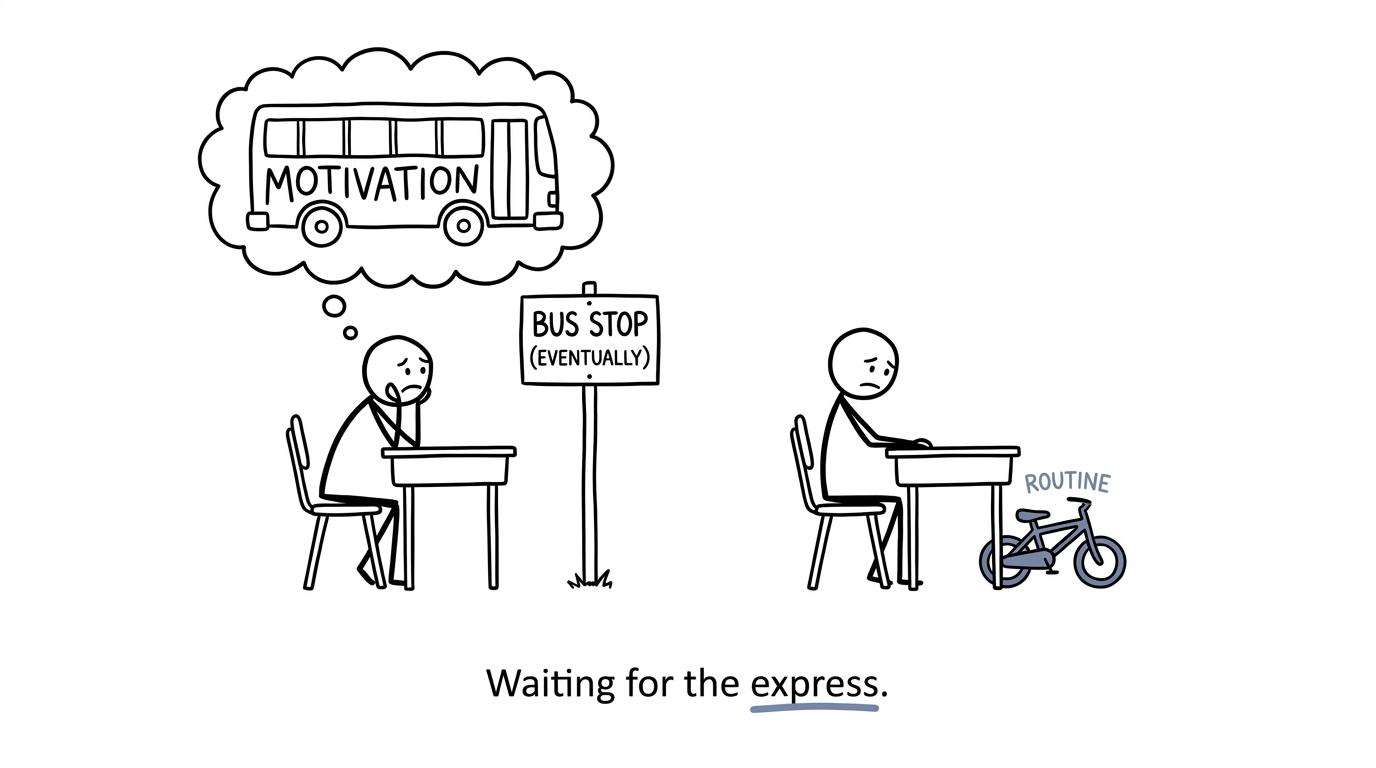 A student waits for motivation while routine is ready to go
Why motivation is an unreliable revision plan
Motivation responds to mood, sleep, confidence and how intimidating a task appears. Revision demands something steadier.
Consider the difference between these intentions:
- “Revise English tonight.”
- “Plan one Language response and recall five quotations from one Literature text after dinner.”
The first intention leaves several decisions unresolved. Which part of English? Which resource? How long should the session last? What does finishing look like? Every unanswered question gives you another opportunity to postpone starting.
The second intention defines the action and the stopping point. It lowers the amount of motivation needed because the decisions have already been made.
Consistency is therefore less about becoming permanently disciplined and more about making the next action obvious.
Build a routine with a low floor
A revision plan should have a normal version and a low-energy version. If it only works on your best days, it is not yet a dependable plan.
Choose a minimum viable session
Your minimum might be:
- recalling quotations for ten minutes;
- annotating one short extract;
- planning one paragraph without writing the full answer;
- reviewing one marked response;
- answering one Language question under a short time limit.
This is the floor, not the ceiling. You can continue when concentration is good, but completing the minimum preserves the habit when it is not.
Small sessions can feel unimpressive. That is precisely why they work. The task is too contained to justify a long argument with yourself, and repeated contact with the material is more useful than waiting for an occasional burst of enthusiasm.
Attach revision to a dependable cue
Choose a cue that already happens on most school days: arriving home, finishing dinner or taking a scheduled break from maths. Keep the starting sequence simple. Put your phone away, open the required resource and begin the named task.
A cue is more dependable than saying you will revise “later”. Later has no clear beginning.
If maths exams are also approaching, use the GCSE maths revision resources to define your maths tasks just as precisely. “Complete the questions for one topic” creates far less uncertainty than “do some maths”.
Treat Language and Literature as different subjects
English Language and English Literature sit beside each other on a timetable, but they do not require identical revision.
English Language revision should focus mainly on transferable reading and writing skills: interpreting unseen material, analysing methods, organising responses, comparing where required by your specification, and writing accurately for a particular purpose and audience.
English Literature combines analysis with secure knowledge of your set texts. You need to recall relevant references, understand characters and themes, respond to extracts, and connect evidence to a defensible interpretation.
Requirements and question structures vary across AQA, Edexcel, OCR and Eduqas. Use the specification and materials for your own exam board, and follow your teacher’s guidance about set texts and assessment objectives.
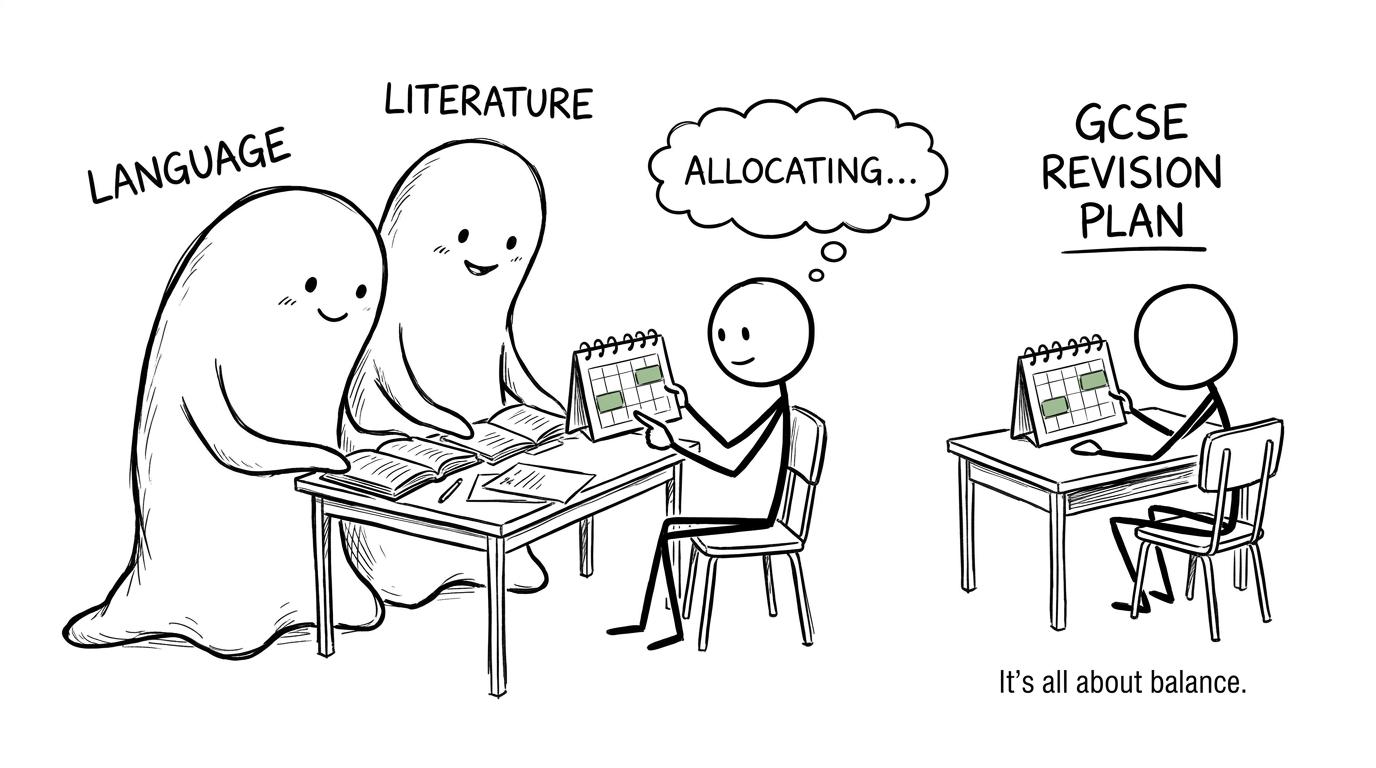 A student gives Language and Literature their own calendar spaces
Give each session a visible output
“Read the novel” describes an activity. It does not reveal what you learnt. A more useful session leaves evidence behind, such as:
- a quotation recall sheet completed from memory;
- a paragraph plan linked to a theme;
- an annotated unseen extract;
- a timed response;
- a list of improvements from a mark scheme;
- a rewritten opening or analytical paragraph.
Visible output makes progress easier to judge. It also stops revision becoming passive rereading, where familiarity can be mistaken for knowledge.
Use retrieval before review
A practical revision sequence is retrieve, check, correct, return.
First, close the book and retrieve what you know about a character, theme, quotation or writing technique. Then check your notes or text. Correct omissions and inaccurate details. Return to the same material after a gap and retrieve it again.
This is more demanding than highlighting because it exposes the difference between recognising an idea and producing it independently. That difference matters in an exam, where your notes are not there to prompt you.
For Literature, retrieval might involve rebuilding a theme map or recalling short, flexible textual references. For Language, it could mean listing the decisions you need to make for a particular question before attempting a response.
Spacing these checks across several sessions also gives forgetting a useful role. Each return requires you to reconstruct the knowledge rather than merely recognise what you read moments earlier.
Plan around maths without creating subject guilt
Students preparing for maths exams often face a false choice: spend the evening on maths and feel guilty about English, or revise English while worrying that maths is slipping.
A weekly plan solves this better than following whichever subject feels most urgent each evening. Start with fixed commitments, then place short English and maths sessions into realistic spaces. Include rest and leave some spare capacity for homework or unexpected events.
MathsGenie can make the maths side of that plan easier to define. You can select work by grade through the grade 4 revision topics, grade 5 revision topics or grade 7 revision topics, depending on your current needs and your teacher’s advice.
Alternate the mental demand where possible. A timed English response followed immediately by a demanding maths paper may be harder to sustain than combining one substantial task with a shorter recall activity.
The timetable should also reflect your actual foundation or higher tier maths entry. English Language and Literature are not divided into foundation and higher tiers in the same way, so do not transfer maths tier assumptions to English papers.
Make low-motivation weeks smaller, not empty
When energy falls, students often make one of two choices: attempt the original ambitious schedule or stop completely. There is a better option. Reduce the scale while preserving contact with each subject.
A low-energy English week might contain:
- one short Language plan;
- one quotation retrieval session;
- one paragraph reviewed against assessment guidance;
- one brief check of previous errors.
For maths, it might mean replacing a full paper temporarily with targeted practice questions or a shorter topic session. The GCSE maths past papers can be used in sections before you are ready to complete an entire paper under timed conditions.
The principle is simple: scale the routine down before you cancel it. Restarting after a complete break often requires more effort than maintaining a modest thread of progress.
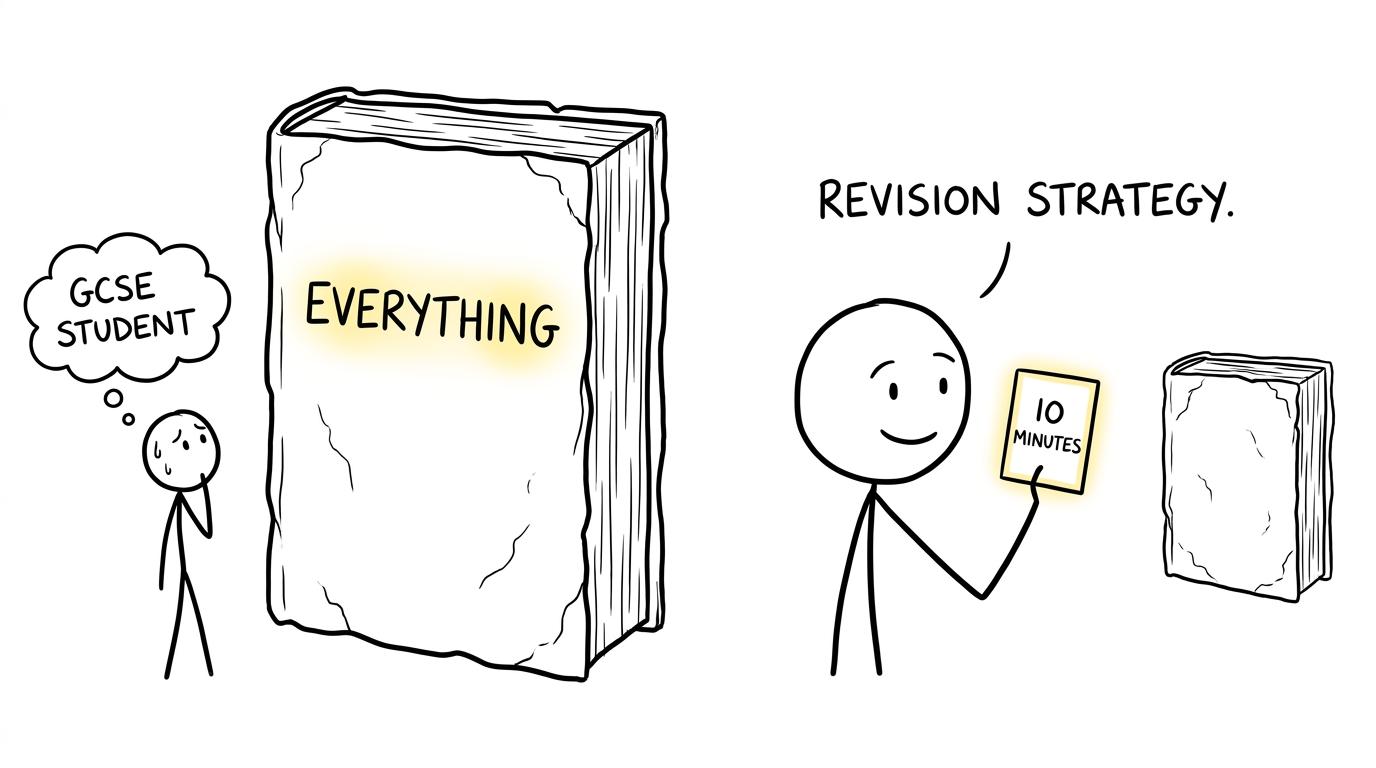 A student chooses a manageable revision card instead of everything at once
Use feedback to decide what happens next
Revision becomes difficult to sustain when every session feels interchangeable. Feedback gives the next session a reason.
After completing an English response, do not record only a mark or general feeling. Identify one specific strength and one change to practise next time. Perhaps your interpretation was clear but your evidence needed closer analysis. Perhaps the content was relevant but the structure became rushed.
Apply the same method to maths. Complete a paper, check the mark scheme, classify the errors and return to the weakest topics. MathsGenie’s predicted GCSE maths papers can provide additional exam-style practice, while official past paper practice and mark schemes help you become familiar with established question styles.
A correction should become a future task. Otherwise, feedback remains an observation rather than an improvement plan.
Common mistakes that break consistency
Building a timetable for your ideal self
A schedule containing long sessions every evening may look serious, but it leaves no room for tiredness, homework or ordinary life. Start with fewer sessions than you think you can manage. Add more only after the routine is stable.
Revising “English” without naming the task
English is too broad to be a useful instruction. Name the paper, text, question or skill and decide what you will produce.
Rereading instead of retrieving
Rereading has a place when rebuilding understanding, but it should not dominate every session. Close the resource and test what you can recall or apply.
Collecting quotations without understanding them
A large quotation bank is not automatically useful. Prioritise accurate, manageable references that you can connect to characters, themes, context where relevant, and methods.
Completing papers without reviewing errors
Practice alone does not guarantee improvement. Use mark schemes, video solutions where available, teacher feedback and error logs to decide what needs attention next. MathsGenie’s free maths revision platform brings lessons, questions and exam resources together for this purpose.
Treating one missed day as failure
A missed session is an event, not a verdict on your discipline. Avoid compensating with an exhausting catch-up plan. Resume at the next scheduled opportunity and consider whether the original task was too large or poorly timed.
Consistency is a system you can return to
Staying consistent does not mean revising at maximum intensity every day. It means knowing what to do when motivation is present and having a smaller version ready when it is not.
Separate English Language from Literature. Define visible outputs. Retrieve before reviewing. Use feedback to create the next task. Most importantly, design a plan that protects both English and maths instead of allowing the most worrying subject to consume every evening.
For the maths part of your GCSE preparation, begin with the MathsGenie GCSE revision lessons, then move deliberately between practice questions, past papers, predicted papers, mark schemes, video solutions and mini tests. Add these tasks to your revision planner alongside focused English sessions. The goal is not a flawless week. It is a routine you can restart tomorrow without needing motivation to rescue you.