Speed Distance Time GCSE Maths: A Clear Guide
Speed distance time GCSE maths made clear with formulas, unit conversions, worked examples, common mistakes and exam-style questions to practise today.
A speed, distance and time question can look almost too familiar. The formula is somewhere in your memory, the numbers seem manageable, and then the answer comes back wrong. Often, the real problem is not arithmetic. It is deciding what to divide, keeping the units consistent and understanding what the question actually wants.
For speed distance time GCSE maths, the central relationship is simple: speed equals distance divided by time. From that one fact, you can calculate any of the three quantities. This guide follows a hypothetical student who keeps losing marks until the method finally clicks, then uses worked examples and exam-style practice to make it stick.
The speed, distance and time checklist
Before touching the calculator, use this routine:
- Identify what the question asks you to find.
- Write down the speed, distance and time given.
- Convert incompatible units before calculating.
- Choose the correct form of the formula.
- Substitute the values with their units.
- Check whether your answer is sensible.
That last step matters. If a cyclist appears to travel faster than an aeroplane, the calculation deserves another look.
The three formulas you need
Imagine a student called Alex. Alex remembers a triangle from a lesson but cannot remember which letters go where. Sometimes speed is multiplied by time. Sometimes it is divided. Guessing works just often enough to become a bad habit.
The better approach is to remember one meaningful statement:
speed=distancetime\text{speed}=\frac{\text{distance}}{\text{time}}speed=timedistanceThe word “per” means divide. Kilometres per hour means kilometres divided by hours. Metres per second means metres divided by seconds.
You can rearrange the relationship to find distance or time:
distance=speed×time\text{distance}=\text{speed}\times\text{time}distance=speed×time time=distancespeed\text{time}=\frac{\text{distance}}{\text{speed}}time=speeddistanceAlex’s turning point is not memorising three disconnected formulas. It is noticing their meaning. Speed tells you how much distance is covered in one unit of time. Once that idea is secure, the rearrangements stop feeling arbitrary.
The Speed and Density GCSE Maths lesson develops the same relationship through guided explanations.
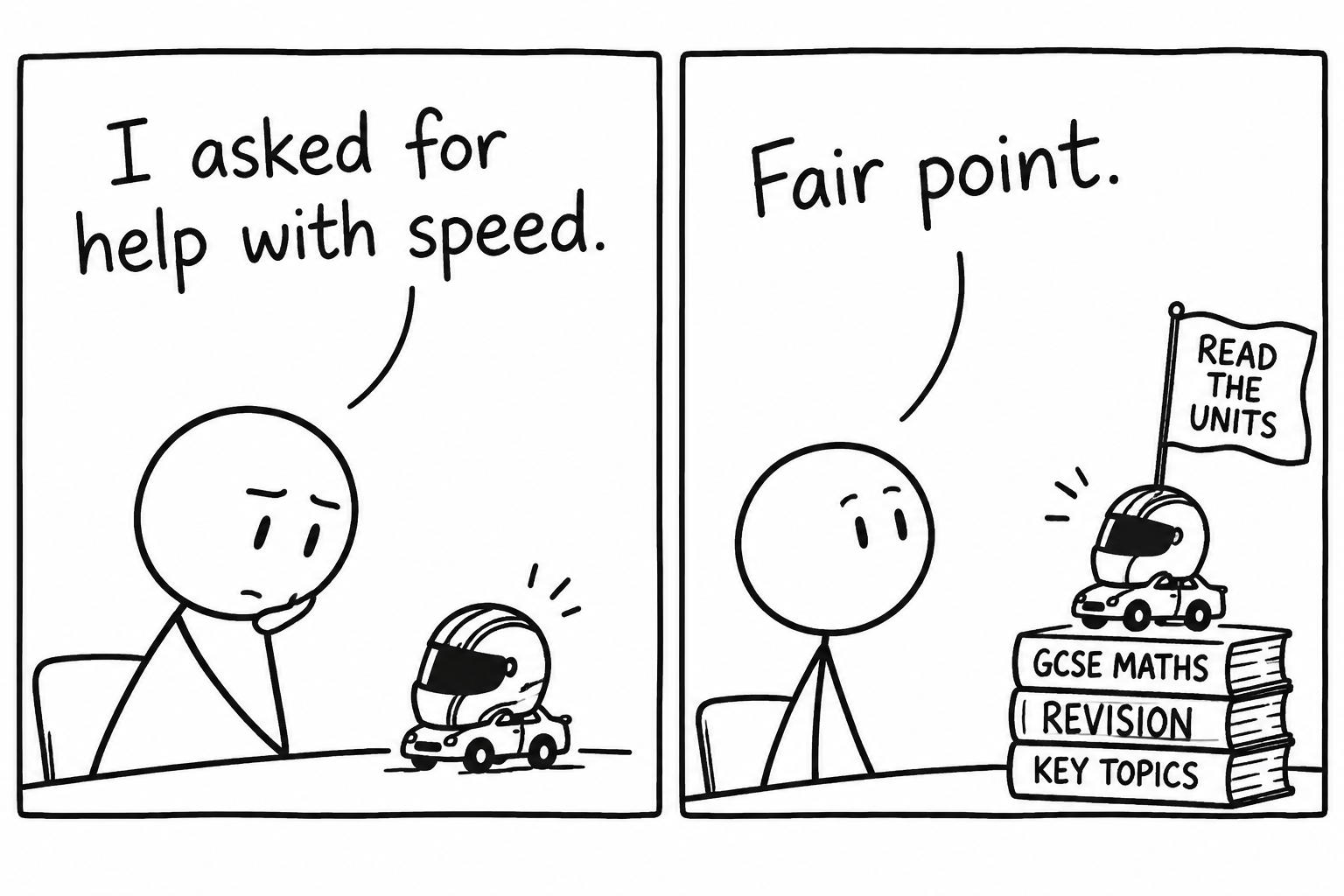 A stick figure student learns that reading the units is the real secret to speed questions
Speed distance time worked examples
Finding speed
A train travels 180 km180\text{ km}180 km in 2.5 hours2.5\text{ hours}2.5 hours. Find its average speed.
Start with the formula:
speed=distancetime\text{speed}=\frac{\text{distance}}{\text{time}}speed=timedistanceSubstitute the values:
speed=1802.5=72\text{speed}=\frac{180}{2.5}=72speed=2.5180=72The distance is measured in kilometres and the time in hours, so the answer is:
72 km/h72\text{ km/h}72 km/hNotice the phrase “average speed”. The train may not travel at exactly 72 km/h72\text{ km/h}72 km/h throughout the journey. Stops and changes in speed are absorbed into one overall rate.
Finding distance
A runner maintains an average speed of 3.2 m/s3.2\text{ m/s}3.2 m/s for 45 seconds45\text{ seconds}45 seconds. Find the distance travelled.
Use:
distance=speed×time\text{distance}=\text{speed}\times\text{time}distance=speed×timeThen calculate:
distance=3.2×45=144\text{distance}=3.2\times45=144distance=3.2×45=144The answer is:
144 m144\text{ m}144 mAlex now writes the formula before entering any numbers. That small pause prevents the common mistake of dividing simply because the previous question required division.
Finding time
A car travels 156 km156\text{ km}156 km at an average speed of 60 km/h60\text{ km/h}60 km/h. Find the journey time.
Use:
time=distancespeed\text{time}=\frac{\text{distance}}{\text{speed}}time=speeddistanceSo:
time=15660=2.6 hours\text{time}=\frac{156}{60}=2.6\text{ hours}time=60156=2.6 hoursA decimal hour is not written in minutes as though it were ordinary base-101010 notation. Convert the decimal part:
0.6×60=36 minutes0.6\times60=36\text{ minutes}0.6×60=36 minutesTherefore, the journey takes:
2 hours 36 minutes2\text{ hours }36\text{ minutes}2 hours 36 minutesIf setting up the method still feels slow, work through the Speed and Density Lessons and then apply it in the GCSE Maths Question Bank.
Why unit conversions decide so many answers
Speed is a compound unit because it combines distance and time. GCSE questions may use kilometres and hours, or metres and seconds. The method only works directly when the units match.
Suppose a cyclist travels 7.5 km7.5\text{ km}7.5 km in 25 minutes25\text{ minutes}25 minutes. To calculate speed in km/h\text{km/h}km/h, convert the time to hours:
25 minutes=2560 hours25\text{ minutes}=\frac{25}{60}\text{ hours}25 minutes=6025 hoursThen:
speed=7.52560=18 km/h\text{speed}=\frac{7.5}{\frac{25}{60}}=18\text{ km/h}speed=60257.5=18 km/hAlternatively, find the distance travelled in one minute and multiply by 606060:
7.525×60=18 km/h\frac{7.5}{25}\times60=18\text{ km/h}257.5×60=18 km/hBoth methods are valid. The important point is that the final unit must agree with the conversion used.
For travel in stages, average speed is always:
average speed=total distancetotal time\text{average speed}=\frac{\text{total distance}}{\text{total time}}average speed=total timetotal distanceDo not usually find the mean of two speeds. A vehicle travelling at 30 km/h30\text{ km/h}30 km/h for part of a journey and 50 km/h50\text{ km/h}50 km/h for another part does not automatically have an average speed of 40 km/h40\text{ km/h}40 km/h. The distances and times for each stage matter.
Distance-time graphs use the same idea visually. Their gradient represents speed, which you can explore in the Real Life and Distance-Time Graphs revision guide.
Speed distance time questions to practise
Try these without looking at the answers first. Write the formula, substitute carefully and include units.
Question one
A coach travels 224 km224\text{ km}224 km in 3.5 hours3.5\text{ hours}3.5 hours. Calculate its average speed.
Question two
A drone flies at 12 m/s12\text{ m/s}12 m/s for 35 seconds35\text{ seconds}35 seconds. Calculate the distance travelled.
Question three
A walker covers 9 km9\text{ km}9 km at an average speed of 4 km/h4\text{ km/h}4 km/h. Give the time in hours and minutes.
Question four
A van travels 42 km42\text{ km}42 km in 35 minutes35\text{ minutes}35 minutes. Calculate its average speed in km/h\text{km/h}km/h.
Answers
For question one:
2243.5=64 km/h\frac{224}{3.5}=64\text{ km/h}3.5224=64 km/hFor question two:
12×35=420 m12\times35=420\text{ m}12×35=420 mFor question three:
94=2.25 hours=2 hours 15 minutes\frac{9}{4}=2.25\text{ hours}=2\text{ hours }15\text{ minutes}49=2.25 hours=2 hours 15 minutesFor question four:
35 minutes=3560 hours35\text{ minutes}=\frac{35}{60}\text{ hours}35 minutes=6035 hours 423560=72 km/h\frac{42}{\frac{35}{60}}=72\text{ km/h}603542=72 km/hFor more structured practice, the Speed and Density exam booklet contains GCSE-style questions with answers. You can also use Speed and Density Question Rush when you want repeated retrieval practice.
Common mistakes in speed, distance and time
Using the wrong operation
Do not choose multiplication or division from memory alone. Write the relevant formula first and identify the quantity you need.
Ignoring incompatible units
If distance is in kilometres but time is in minutes, converting nothing will not produce km/h\text{km/h}km/h. Convert the time into hours before dividing.
Converting decimal hours incorrectly
An answer of 1.4 hours1.4\text{ hours}1.4 hours is not 1 hour 40 minutes1\text{ hour }40\text{ minutes}1 hour 40 minutes. The decimal part must be multiplied by 606060:
0.4×60=24 minutes0.4\times60=24\text{ minutes}0.4×60=24 minutesAveraging two speeds directly
For a multi-stage journey, add all distances and all times first. Then divide total distance by total time.
Leaving off the unit
A bare answer such as 656565 is incomplete when the question concerns speed. State whether it is km/h\text{km/h}km/h, m/s\text{m/s}m/s or another unit.
Make the method automatic
Alex does not improve because the formula suddenly becomes easier. The change comes from following the same order every time: identify, convert, choose, substitute and check. Knowing that routine is the first step; using it reliably under exam pressure takes focused practice.
Start the Speed and Density Lesson, then turn what you understand into marks with the GCSE Maths Question Bank.