Speed Distance Time Exam Questions for GCSE
Speed distance time exam questions explained through three GCSE examples, with method-mark guidance, common mistakes and practical revision advice.

A speed, distance and time question can look almost too simple. Then the units change, a journey has two stages, or the question asks for average speed. Suddenly, one familiar formula feels less dependable.
The reliable way to answer speed distance time exam questions is to identify what you know, convert every measurement into compatible units, choose the correct formula and show each stage clearly. That final habit matters because a correct method may earn marks even when an arithmetic slip changes your answer.
We will follow a hypothetical GCSE student, Sam, through three questions of rising difficulty. The precise allocation of marks varies between exam boards and papers, but the working shown here reflects the kind of evidence GCSE mark schemes commonly reward.
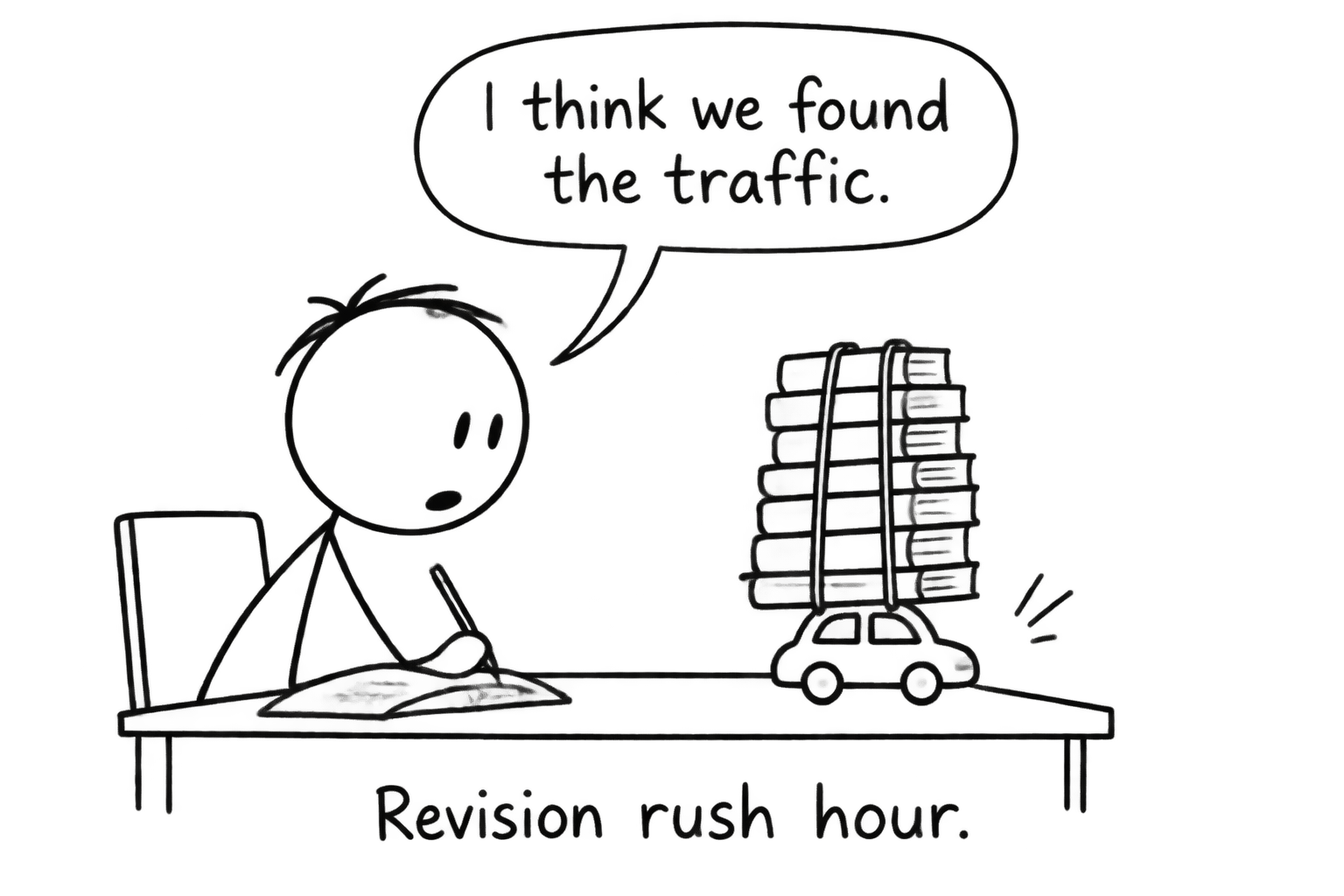 A student discovers revision rush hour
The speed, distance and time method
Begin with the relationship:
speed=distancetime\text{speed}=\frac{\text{distance}}{\text{time}}speed=timedistanceRearranging gives the other two forms:
distance=speed×time\text{distance}=\text{speed}\times\text{time}distance=speed×time time=distancespeed\text{time}=\frac{\text{distance}}{\text{speed}}time=speeddistanceA formula triangle can help you remember these relationships, but it cannot decide whether minutes need converting into hours. That judgement is where many GCSE questions become interesting.
Use this checklist:
- Identify the quantity the question asks you to find.
- Write down the relevant formula.
- Check that the units are compatible.
- Convert units before substituting values.
- Show the substitution and calculation.
- Include the correct unit in the final answer.
- Ask whether the answer is sensible in context.
For a focused explanation before attempting the examples, visit the Maths Genie speed, distance and time lesson.
Once you have this method in hand, use the Maths Genie Lessons and Question Bank to practise applying it without having to assemble your own set of questions.
Question one: finding speed directly
Sam starts with a question in which the units already match.
Exam-style question
A coach travels 150 km150\text{ km}150 km in 2.5 hours2.5\text{ hours}2.5 hours. Calculate its average speed.
Sam first identifies the required quantity: speed. The correct formula is:
speed=distancetime\text{speed}=\frac{\text{distance}}{\text{time}}speed=timedistanceSubstituting the values gives:
speed=1502.5\text{speed}=\frac{150}{2.5}speed=2.5150 speed=60 km/h\text{speed}=60\text{ km/h}speed=60 km/hThe answer is therefore 60 km/h60\text{ km/h}60 km/h.
Where the method marks may come from
A typical mark scheme may reward selecting or using the correct relationship before awarding the accuracy mark for 60 km/h60\text{ km/h}60 km/h. Writing only the answer hides the method. By showing 150÷2.5150\div2.5150÷2.5, Sam gives the examiner clear evidence of the intended calculation.
This is the simplest form of a speed distance time GCSE exam question. The calculation is short, but the unit still matters. An answer of 606060 is incomplete because it does not say what has been measured.
Question two: converting minutes into hours
The next question looks similar, but one detail changes everything.
Exam-style question
A cyclist travels at a constant speed of 72 km/h72\text{ km/h}72 km/h for 35 minutes35\text{ minutes}35 minutes. Work out the distance travelled.
The speed is measured per hour, while the time is given in minutes. Sam must convert the time into hours:
35 minutes=3560 hours35\text{ minutes}=\frac{35}{60}\text{ hours}35 minutes=6035 hoursThe required formula is:
distance=speed×time\text{distance}=\text{speed}\times\text{time}distance=speed×timeSubstituting gives:
distance=72×3560\text{distance}=72\times\frac{35}{60}distance=72×6035 distance=42 km\text{distance}=42\text{ km}distance=42 kmWhere the method marks may come from
The conversion 3560\frac{35}{60}6035 is an important piece of working. Depending on the question and mark scheme, credit may be available for a correct time conversion and for multiplying the speed by that converted time. The final accuracy mark would then depend on reaching 42 km42\text{ km}42 km.
Sam nearly treats 35 minutes35\text{ minutes}35 minutes as 0.35 hours0.35\text{ hours}0.35 hours. That is a common mistake because decimal notation can look like clock notation. In reality:
0.35 hours=0.35×60=21 minutes0.35\text{ hours}=0.35\times60=21\text{ minutes}0.35 hours=0.35×60=21 minutesMinutes are sixtieths of an hour, not hundredths. Writing the conversion as a fraction is often safer.
You can reinforce this skill through the broader GCSE Maths revision topics, particularly work on units, fractions and compound measures.
Question three: average speed over a whole journey
The final question requires more than substituting three values. Sam must build the journey one stage at a time.
Exam-style question
A van travels 24 km24\text{ km}24 km at 48 km/h48\text{ km/h}48 km/h. It stops for 15 minutes15\text{ minutes}15 minutes, then travels another 36 km36\text{ km}36 km at 72 km/h72\text{ km/h}72 km/h. Calculate its average speed for the complete journey, including the stop.
Average speed is not usually found by averaging the two speeds. It is calculated using total distance and total time:
average speed=total distancetotal time\text{average speed}=\frac{\text{total distance}}{\text{total time}}average speed=total timetotal distanceFor the first stage:
time=2448=0.5 hours\text{time}=\frac{24}{48}=0.5\text{ hours}time=4824=0.5 hoursThe stop lasts:
15 minutes=1560=0.25 hours15\text{ minutes}=\frac{15}{60}=0.25\text{ hours}15 minutes=6015=0.25 hoursFor the second stage:
time=3672=0.5 hours\text{time}=\frac{36}{72}=0.5\text{ hours}time=7236=0.5 hoursThe total time is therefore:
0.5+0.25+0.5=1.25 hours0.5+0.25+0.5=1.25\text{ hours}0.5+0.25+0.5=1.25 hoursThe total distance is:
24+36=60 km24+36=60\text{ km}24+36=60 kmSam can now calculate the average speed:
average speed=601.25=48 km/h\text{average speed}=\frac{60}{1.25}=48\text{ km/h}average speed=1.2560=48 km/hWhere the method marks may come from
This question contains several opportunities to demonstrate progress: finding each travel time, converting the stopping time, adding the total distance and total time, and using the average-speed formula. Even if Sam makes a minor arithmetic error, clearly structured working may allow follow-through credit where the mark scheme permits it.
The stop must be included because the question asks for the complete journey. It increases the elapsed time without increasing the distance, so it lowers the average speed.
This example also shows why averaging 48 km/h48\text{ km/h}48 km/h and 72 km/h72\text{ km/h}72 km/h would be wrong. The van does not spend equal proportions of the complete journey travelling at those speeds, and the stop has a speed of 0 km/h0\text{ km/h}0 km/h for part of the elapsed time.
Common mistakes in speed distance time exam questions
Mixing hours and minutes
If speed is in km/h\text{km/h}km/h, time must be in hours before multiplication or division. Convert minutes using:
hours=minutes60\text{hours}=\frac{\text{minutes}}{60}hours=60minutesUsing the formula backwards
If you are finding time, divide distance by speed. If you are finding distance, multiply speed by time. Writing the formula before entering numbers reduces avoidable errors.
Averaging two speeds directly
For a multi-stage journey, use:
average speed=total distancetotal time\text{average speed}=\frac{\text{total distance}}{\text{total time}}average speed=total timetotal distanceDo not automatically add the speeds and divide by two.
Ignoring stationary time
Read the wording carefully. If average speed is required for the entire journey, waiting or stopping time normally contributes to the total elapsed time.
Leaving out units
Finish with a unit such as m/s\text{m/s}m/s or km/h\text{km/h}km/h. Also check that your answer uses the unit requested in the question.
Hiding the method
A calculator display is not a complete solution. Show conversions, formulas and substitutions on separate lines. When revising with GCSE past papers, compare your working with the available mark schemes rather than checking only the final answer.
How to practise exam-style questions
Start with direct substitutions, then add unit conversions and multi-stage journeys. This order builds the decision-making skill that harder questions require.
A useful practice sequence is:
- find speed when distance and time are given;
- find distance when speed and time are given;
- find time when distance and speed are given;
- convert between minutes and hours;
- convert between m/s\text{m/s}m/s and km/h\text{km/h}km/h;
- calculate average speed across several stages;
- interpret journeys involving stops or waiting time.
Attempt each question without notes. Mark it, identify the first line where the method went wrong, then try a similar question. Maths Genie predicted papers can also help you practise moving between topics under timed conditions once individual skills feel secure.
Turn the method into marks
Sam’s progress comes from making every decision visible: choose the relationship, make the units compatible, calculate carefully and write the final unit. Knowing that sequence is useful, but following it across enough questions is what makes it dependable in an exam.
Your turn. Build that confidence by opening the Maths Genie Lessons and Question Bank, reviewing the matching lesson and answering a set of speed distance time exam questions.