Simultaneous Equations (Elimination) GCSE Maths
Simultaneous equations (elimination) GCSE maths explained with clear steps, worked examples, common mistakes and focused exam-style practice for revision.
A student can understand every line of a simultaneous equations solution and still get the next question wrong. That is what makes this topic frustrating. One missed sign, one term left unchanged, and the answer unravels.
The key to simultaneous equations (elimination) GCSE maths is simpler than it first appears: make the coefficient of one variable equal or opposite in both equations, eliminate that variable, then solve what remains. After that, substitute your answer back into either original equation.
Imagine a student called Alex. They keep trying to change several things at once, hoping an xxx or yyy will somehow disappear. The method clicks when they stop thinking of elimination as a trick and start seeing it as a controlled sequence.
The elimination method at a glance
For two linear equations involving xxx and yyy:
- line up like terms carefully
- choose the variable that is easiest to eliminate
- multiply one or both complete equations if necessary
- add equations with opposite coefficients
- subtract equations with equal coefficients
- solve the resulting equation
- substitute the value back to find the other variable
- check both values in both original equations
The goal is not merely to find an answer. It is to create a simpler equation containing only one unknown.
You can see the same method in the Maths Genie simultaneous equations lesson, alongside lesson resources and exam-style questions.
Why elimination works
Suppose two quantities are equal:
A=BA=BA=Band another two quantities are equal:
C=DC=DC=DYou may add the equations because equal amounts are being added to equal amounts:
A+C=B+DA+C=B+DA+C=B+DYou may also subtract one equation from the other. Elimination uses this principle to make one variable cancel.
For example:
3x+2y=163x+2y=163x+2y=16 5x+2y=245x+2y=245x+2y=24Both equations contain +2y+2y+2y. Subtracting the first equation from the second produces:
(5x+2y)−(3x+2y)=24−16(5x+2y)-(3x+2y)=24-16(5x+2y)−(3x+2y)=24−16The yyy terms cancel, leaving an equation in xxx only. Nothing mysterious has happened. The same operation has been applied consistently to the complete equations.
Simultaneous equations elimination worked examples
Equal coefficients mean subtract
Solve:
3x+2y=163x+2y=163x+2y=16 5x+2y=245x+2y=245x+2y=24The coefficients of yyy are equal and have the same sign, so subtract the first equation from the second:
(5x+2y)−(3x+2y)=24−16(5x+2y)-(3x+2y)=24-16(5x+2y)−(3x+2y)=24−16 2x=82x=82x=8 x=4x=4x=4Substitute x=4x=4x=4 into the first original equation:
3(4)+2y=163(4)+2y=163(4)+2y=16 12+2y=1612+2y=1612+2y=16 2y=42y=42y=4 y=2y=2y=2Therefore:
x=4,y=2x=4,\qquad y=2x=4,y=2Check the second equation:
5(4)+2(2)=20+4=245(4)+2(2)=20+4=245(4)+2(2)=20+4=24The values satisfy both equations.
Opposite coefficients mean add
Solve:
2x+3y=132x+3y=132x+3y=13 4x−y=54x-y=54x−y=5Alex’s old mistake would be to add immediately. That would not eliminate either variable. Instead, multiply the entire second equation by 333:
3(4x−y)=3(5)3(4x-y)=3(5)3(4x−y)=3(5) 12x−3y=1512x-3y=1512x−3y=15Now use the first equation:
2x+3y=132x+3y=132x+3y=13Add the equations because +3y+3y+3y and −3y-3y−3y are opposites:
14x=2814x=2814x=28 x=2x=2x=2Substitute x=2x=2x=2 into 4x−y=54x-y=54x−y=5:
4(2)−y=54(2)-y=54(2)−y=5 8−y=58-y=58−y=5 y=3y=3y=3Therefore:
x=2,y=3x=2,\qquad y=3x=2,y=3This is the moment the method begins to click: choose the operation from the signs. Same signs suggest subtraction; opposite signs suggest addition.
Once that decision process feels clear, use the Maths Genie lesson and practice resources to repeat it until choosing the operation becomes automatic.
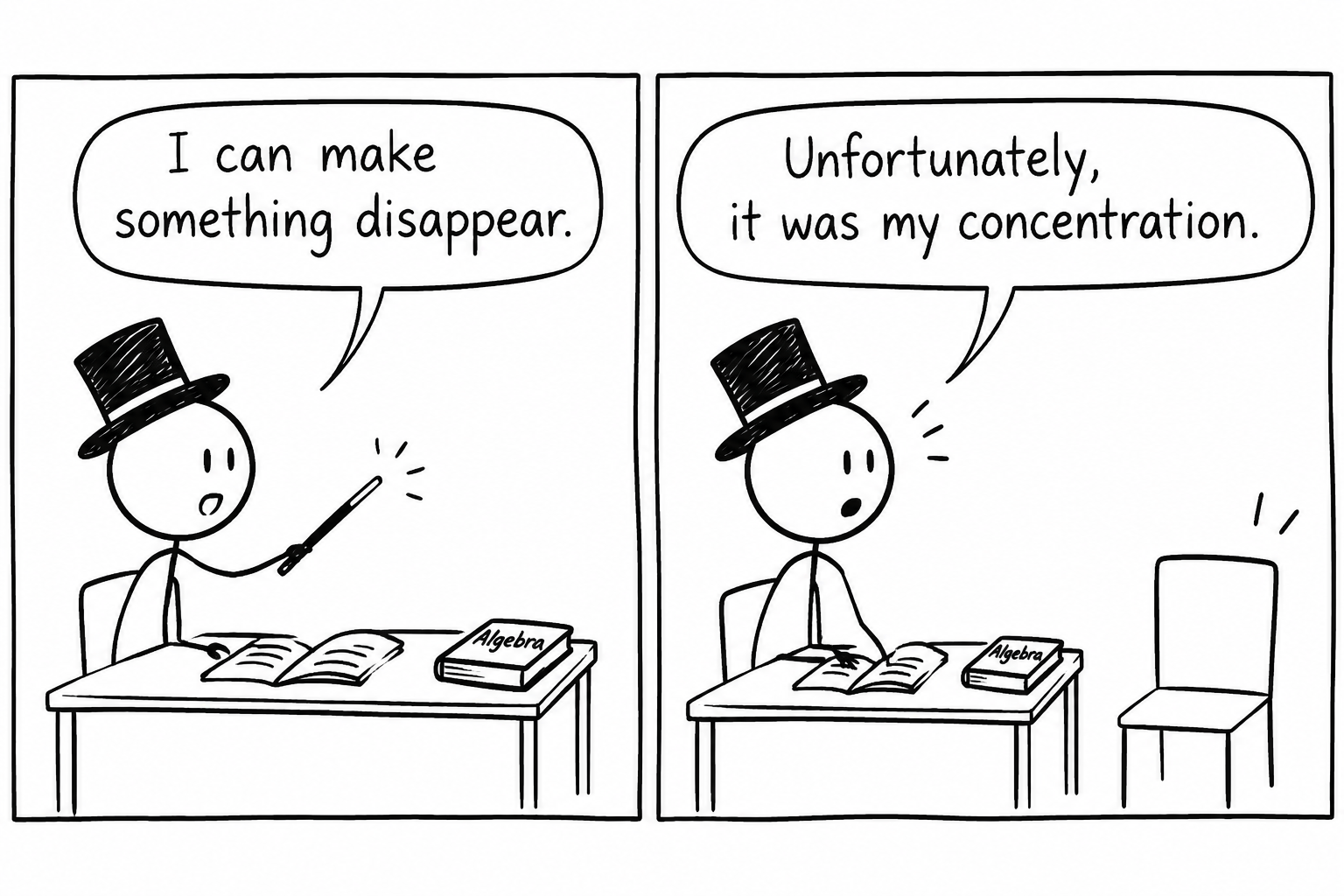 An XKCD-style student accidentally making their concentration disappear while revising algebra
When both equations need multiplying
Solve:
2x+3y=122x+3y=122x+3y=12 5x−2y=115x-2y=115x−2y=11Neither pair of coefficients matches. The lowest common multiple of 333 and 222 is 666, so multiply the first equation by 222:
4x+6y=244x+6y=244x+6y=24Multiply the second equation by 333:
15x−6y=3315x-6y=3315x−6y=33Add the new equations:
19x=5719x=5719x=57 x=3x=3x=3Substitute x=3x=3x=3 into the first original equation:
2(3)+3y=122(3)+3y=122(3)+3y=12 6+3y=126+3y=126+3y=12 y=2y=2y=2Therefore:
x=3,y=2x=3,\qquad y=2x=3,y=2The important phrase is multiply the entire equation. If one side is multiplied by 333, every term on both sides must be multiplied by 333.
For a compact summary before attempting questions, use the simultaneous equations revision guide.
How to approach exam-style questions
In a straightforward question, the equations are already given. In a problem-solving question, you may need to form them from information about prices, lengths or totals before using elimination.
Use this routine:
- define each unknown clearly, such as xxx for one price and yyy for another
- translate each statement into an equation
- write equations with the xxx terms, yyy terms and constants aligned
- decide what to eliminate before doing any multiplication
- show each transformed equation
- substitute to find the second value
- interpret the answer in its original context
Showing the transformed equations matters because it makes the logic visible. It also makes errors easier to locate when checking your work against a mark scheme.
After learning the process, complete the simultaneous equations exam booklet. Begin without timing yourself. Once your working is reliable, try another set under exam conditions.
Elimination is algebraic, but simultaneous equations can also be represented by two lines whose intersection gives the shared solution. The graphical simultaneous equations lesson helps connect the algebraic answer with that visual meaning.
Common mistakes with elimination
Multiplying only one term
From:
4x−y=54x-y=54x−y=5multiplying by 333 gives:
12x−3y=1512x-3y=1512x−3y=15It does not give 12x−y=512x-y=512x−y=5. Put brackets around the complete equation before multiplying if this mistake keeps happening.
Choosing the wrong operation
If the matching terms have the same sign, subtract. If they have opposite signs, add. Write the intended operation between the equations before calculating.
Losing a negative sign during subtraction
Subtracting a negative term changes its sign. Writing brackets around the complete second expression reduces the risk:
(5x+2y)−(3x+2y)(5x+2y)-(3x+2y)(5x+2y)−(3x+2y)Do not attempt to manage every sign mentally.
Substituting into a modified equation carelessly
Substitution works in an original equation or a correctly transformed equation, but the original is usually easier to read. Choose the equation with the simplest coefficients.
Stopping after finding one variable
A simultaneous equations question normally requires both values. Finding xxx is only part of the solution. Substitute it back to find yyy, then check the pair.
A focused practice plan
Alex’s progress does not come from completing many questions in one sitting. It comes from correcting the same small decision repeatedly: which variable should disappear, and should the equations be added or subtracted?
Try this practice sequence:
- begin with questions where coefficients already match
- move to questions requiring one equation to be multiplied
- practise questions where both equations need changing
- finish with contextual problems where you must form the equations
- check every incorrect answer and identify the first line that went wrong
Use the available worked solution or mark scheme only after making a full attempt. The Maths Genie simultaneous equations question bank can provide further exam-style practice, while the main lesson page offers resources for the matching topic.
Turn the method into marks
Knowing elimination is different from carrying it out accurately when the signs and coefficients change. Alex improves when each attempt follows the same structure rather than relying on a remembered trick. Your turn: start the Simultaneous Equations Lessons and Question Bank.