Simultaneous Equations (A-Level): A-Level Maths
Simultaneous equations (A-Level) A-Level Maths explained with clear methods, worked examples, common mistakes and focused exam-style practice questions.
Imagine a sixth-form student facing two equations on a page. Each equation is manageable alone, yet together they seem to create a maze of substitutions, signs and possible solutions. The real difficulty is rarely the algebra itself. It is knowing what to do first.
This simultaneous equations (A-Level) A-Level Maths guide gives you that first move. For two linear equations, use substitution or elimination. When one equation is quadratic, rearrange the linear equation, substitute it into the quadratic equation, solve the resulting quadratic, and then find every corresponding value of the other variable.
The method at a glance
Before working through the algebra, identify the type of system in front of you.
- Two linear equations: use elimination or substitution.
- One linear and one quadratic equation: rearrange the linear equation and substitute.
- A line and a circle: substitution will usually produce a quadratic equation.
- A repeated root: the graphs touch at exactly one point.
- Two distinct roots: there are normally two coordinate pairs to find.
- No real roots: the graphs do not intersect over the real numbers.
The important idea is simple: a solution must satisfy both equations at the same time. Graphically, the solutions are the coordinates where the two curves intersect.
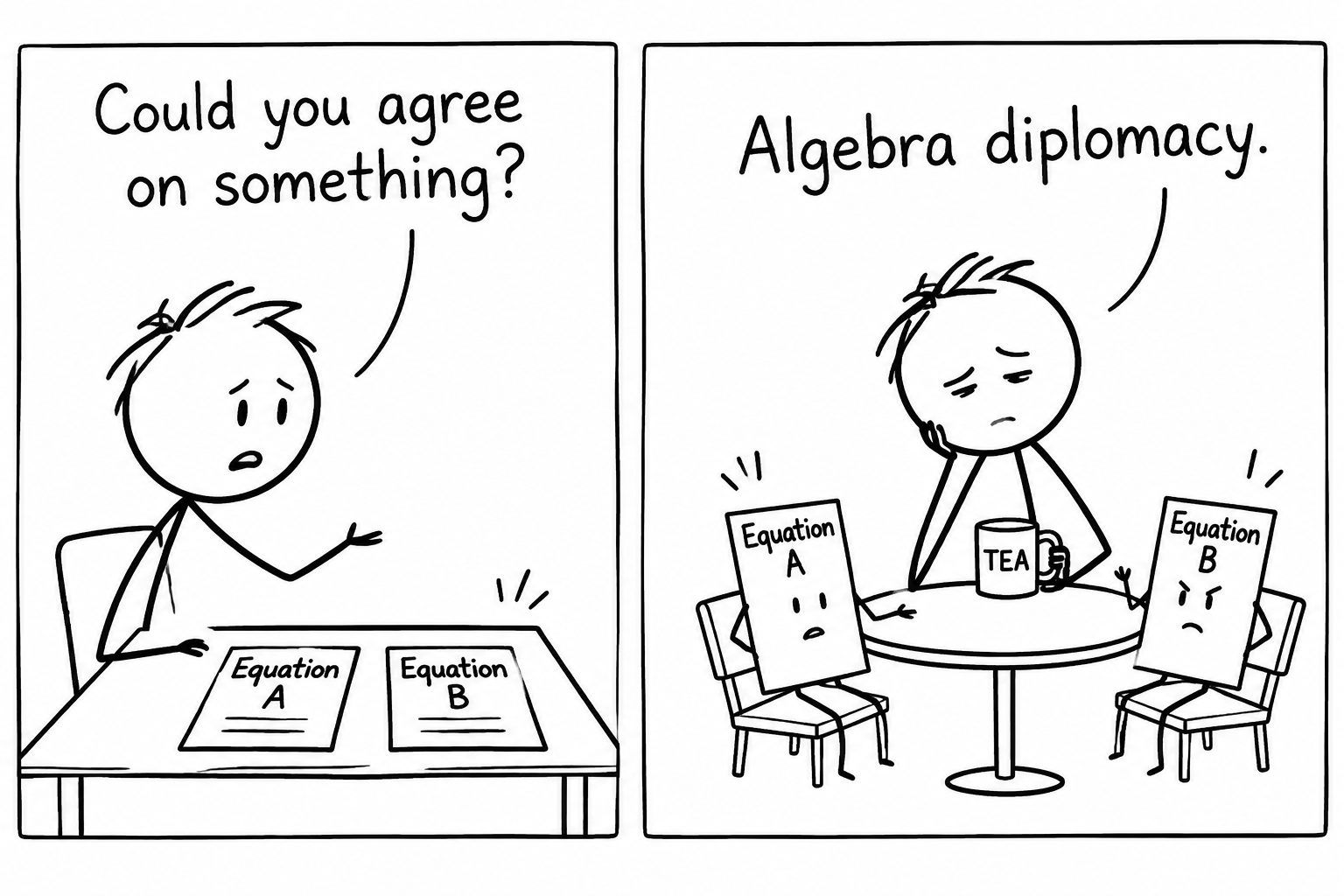 A student attempting algebra diplomacy between two equations
Solving linear simultaneous equations
Consider the equations
2x+3y=122x+3y=122x+3y=12and
x−y=1.x-y=1.x−y=1.The second equation is easy to rearrange:
x=y+1.x=y+1.x=y+1.Substitute this into the first equation:
2(y+1)+3y=12.2(y+1)+3y=12.2(y+1)+3y=12.Expand and simplify:
2y+2+3y=12,2y+2+3y=12,2y+2+3y=12, 5y=10,5y=10,5y=10, y=2.y=2.y=2.Now substitute y=2y=2y=2 into x=y+1x=y+1x=y+1:
x=2+1=3.x=2+1=3.x=2+1=3.Therefore, the solution is
(x,y)=(3,2).(x,y)=(3,2).(x,y)=(3,2).Elimination would also work here. The best method is generally the one that keeps the arithmetic shortest and clearest. If you need to rebuild this foundation, use the A-Level linear simultaneous equations lesson.
Elimination is especially useful when the coefficients already match or can be made to match with a simple multiplication. Multiply every term in an equation, including the constant, before adding or subtracting. Substitution is often cleaner when a variable already has coefficient 111 or −1-1−1, because rearranging then introduces no fractions.
Solving one linear and one quadratic equation
This is the step where the sixth-form student in our example slows down. That is sensible. A quadratic system can have two solutions, and it is easy to find one pair and stop too early.
Solve
y=x+1y=x+1y=x+1and
x2+y2=13.x^2+y^2=13.x2+y2=13.Substitute the linear equation
Because y=x+1y=x+1y=x+1, replace yyy in the quadratic equation:
x2+(x+1)2=13.x^2+(x+1)^2=13.x2+(x+1)2=13.Form and solve the quadratic
Expand carefully:
x2+x2+2x+1=13.x^2+x^2+2x+1=13.x2+x2+2x+1=13.Rearrange so that one side is zero:
2x2+2x−12=0.2x^2+2x-12=0.2x2+2x−12=0.Divide by 222:
x2+x−6=0.x^2+x-6=0.x2+x−6=0.Factorise:
(x+3)(x−2)=0.(x+3)(x-2)=0.(x+3)(x−2)=0.Therefore,
x=−3orx=2.x=-3 \quad \text{or} \quad x=2.x=−3orx=2.Keep the substituted equation in one variable until it is solved. Bringing the second variable back too early usually makes the working harder to follow. If factorising is not straightforward, use the quadratic formula instead; simultaneous equations do not require the quadratic to have neat integer roots. Leave exact values in surd form where appropriate.
Find the matching values of yyy
Use y=x+1y=x+1y=x+1 for each value of xxx.
When x=−3x=-3x=−3:
y=−3+1=−2.y=-3+1=-2.y=−3+1=−2.When x=2x=2x=2:
y=2+1=3.y=2+1=3.y=2+1=3.The two solutions are therefore
(x,y)=(−3,−2)and(x,y)=(2,3).(x,y)=(-3,-2) \quad \text{and} \quad (x,y)=(2,3).(x,y)=(−3,−2)and(x,y)=(2,3).Both pairs satisfy both original equations. This final check is quick, but it catches sign errors that can survive several lines of otherwise correct algebra.
Once the method makes sense, continue through the matching quadratic simultaneous equations lesson and its A-Level equations Question Bank while the sequence is still fresh.
What the discriminant tells you
Substitution often leaves you with a quadratic of the form
ax2+bx+c=0.ax^2+bx+c=0.ax2+bx+c=0.Its discriminant is
b2−4ac.b^2-4ac.b2−4ac.This connects the algebra to the graph:
- If b2−4ac>0b^2-4ac>0b2−4ac>0, there are two distinct real roots and usually two intersections.
- If b2−4ac=0b^2-4ac=0b2−4ac=0, there is one repeated root and the line is tangent to the curve.
- If b2−4ac<0b^2-4ac<0b2−4ac<0, there are no real intersections.
Suppose the line y=2x+ky=2x+ky=2x+k is tangent to the parabola y=x2y=x^2y=x2. At an intersection,
x2=2x+k,x^2=2x+k,x2=2x+k,so
x2−2x−k=0.x^2-2x-k=0.x2−2x−k=0.Tangency requires a repeated root, so
(−2)2−4(1)(−k)=0.(-2)^2-4(1)(-k)=0.(−2)2−4(1)(−k)=0.Hence
4+4k=0,4+4k=0,4+4k=0,and therefore
k=−1.k=-1.k=−1.This is a common A-Level extension: instead of merely finding intersections, you use the nature of the roots to determine an unknown parameter.
Simultaneous equations (A-Level) exam questions
Try these without looking at the answers first. Write every substitution and keep coordinate pairs together.
Question A
Solve
3x+2y=163x+2y=163x+2y=16and
x−y=2.x-y=2.x−y=2.Question B
Solve
x+y=5x+y=5x+y=5and
x2+y2=13.x^2+y^2=13.x2+y2=13.Question C
The line y=2x+ky=2x+ky=2x+k is tangent to the curve y=x2y=x^2y=x2. Find kkk and the coordinates of the point of contact.
Answers
For Question A:
(x,y)=(4,2).(x,y)=(4,2).(x,y)=(4,2).For Question B:
(x,y)=(2,3)or(x,y)=(3,2).(x,y)=(2,3) \quad \text{or} \quad (x,y)=(3,2).(x,y)=(2,3)or(x,y)=(3,2).For Question C:
k=−1k=-1k=−1and the point of contact is
(1,1).(1,1).(1,1).For further practice, work through the wider Equations and Inequalities Question Bank. Compare your method with the worked solutions and mark schemes, rather than checking only the final answer. If the quadratic stage is causing difficulty, the quadratic equations revision guide provides a focused recap.
Treat an incorrect answer as a diagnosis rather than a reason to restart everything. Find the first line where your working differs from a correct solution. Decide whether the problem was rearranging, expanding, solving or pairing values. Then attempt another question targeting that particular step before returning to mixed practice. This makes the next attempt more purposeful.
Common mistakes to avoid
Expanding a square incorrectly
Remember that
(x+1)2=x2+2x+1,(x+1)^2=x^2+2x+1,(x+1)2=x2+2x+1,not x2+1x^2+1x2+1. The middle term matters and can change every solution.
Losing the second root
A quadratic may produce two values of xxx. Each value must be substituted back into the linear equation to find its corresponding value of yyy.
Mixing coordinate pairs
If x=2x=2x=2 gives y=3y=3y=3, keep them together as (2,3)(2,3)(2,3). Do not accidentally pair that xxx-value with the yyy-value from the other root.
Substituting into the wrong expression
Write the rearranged equation clearly before substituting. If y=5−xy=5-xy=5−x, replace every occurrence of yyy with (5−x)(5-x)(5−x) and use brackets.
Giving roots instead of complete solutions
The solutions to simultaneous equations are coordinate pairs, not isolated values of xxx. Unless the question asks for only one variable, state both values.
Skipping the check
Substitute each pair into both original equations. A pair that satisfies only one equation is not a solution to the system.
Turn the method into exam confidence
The student who first saw a maze now has a repeatable route: identify the equations, substitute or eliminate, solve completely, pair the values and check. Knowing that route is useful; following it under exam pressure requires deliberate practice with different curves, parameters and forms.
Start the Maths Genie simultaneous equations lesson and Question Bank and practise the method until every solution pair has been found and checked.