Quadratic Inequalities GCSE Maths: Clear Guide
Quadratic inequalities GCSE maths explained clearly with worked examples, sign checks, common mistakes and focused exam-style practice for Higher students.
Quadratic inequalities often feel unfair at first. A student can factorise perfectly, find both roots and still lose the final mark. The algebra looks right, but the answer gives two boundary values instead of a range.
Imagine a student called Sam. This is hypothetical, but the mistake is familiar: whenever Sam sees a quadratic inequality, he solves it as though it were an equation. What eventually makes quadratic inequalities GCSE maths click is one simple idea. The roots are not usually the answer. They divide the number line into regions, and your job is to decide which regions satisfy the inequality.
This guide shows you the method through worked examples, common mistakes and exam-style practice.
The quadratic inequalities checklist
For a quadratic inequality such as x2+x−6<0x^2+x-6<0x2+x−6<0:
- rearrange so that one side is 000;
- factorise the quadratic where possible;
- find the roots by solving the related equation;
- use the roots to divide the number line into intervals;
- decide where the quadratic is positive or negative;
- include a boundary only if the inequality contains ≤\leq≤ or ≥\geq≥;
- write the final answer as a range, or as two ranges joined by the word or.
The crucial step is the fifth one. Solving the related equation tells you where the graph crosses the xxx-axis. Solving the inequality tells you where the graph is above or below it.
Why finding the roots is not enough
Suppose a quadratic has roots at x=−3x=-3x=−3 and x=2x=2x=2. These values create three intervals:
x<−3,−3<x<2,x>2.x<-3,\qquad -3<x<2,\qquad x>2.x<−3,−3<x<2,x>2.Within each interval, the quadratic keeps the same sign. It can only change between positive and negative when it passes through a root.
If the coefficient of x2x^2x2 is positive, the graph is a U-shaped parabola. It is normally:
- positive outside the roots;
- negative between the roots.
If the coefficient of x2x^2x2 is negative, the parabola is upside down, so this pattern reverses.
That visual connection matters. If quadratic graphs are still uncertain, review the Drawing Quadratic Graphs exam booklet before returning to inequalities. You can also revisit the relationship between factors and roots in the Quadratic Equations revision guide.
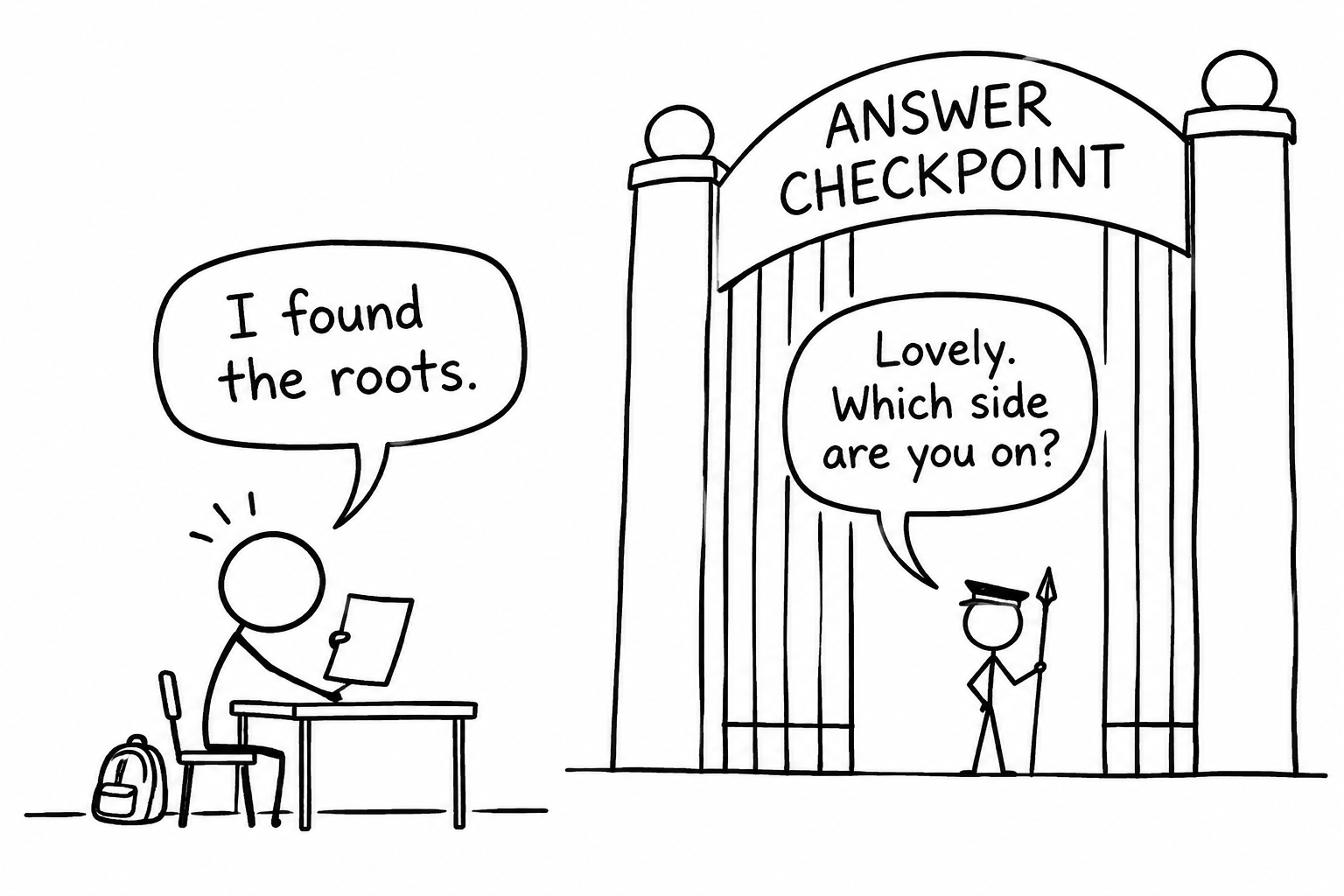 A student learns that finding the roots is only the answer checkpoint
Quadratic inequalities worked examples
A solution between the roots
Solve:
x2+x−6<0.x^2+x-6<0.x2+x−6<0.Factorise the quadratic:
(x+3)(x−2)<0.(x+3)(x-2)<0.(x+3)(x−2)<0.Find the boundary values by solving the related equation:
(x+3)(x−2)=0.(x+3)(x-2)=0.(x+3)(x−2)=0.Therefore:
x=−3orx=2.x=-3\qquad\text{or}\qquad x=2.x=−3orx=2.The coefficient of x2x^2x2 is positive, so the graph opens upwards. It is below the xxx-axis between the two roots. Because the question asks where the expression is less than 000, the answer is:
−3<x<2.-3<x<2.−3<x<2.The inequality is strict, so neither boundary is included.
This is where Sam's first breakthrough happens. The two roots are checkpoints. The actual answer is the interval between them.
A solution outside the roots
Solve:
x2−5x+6≥0.x^2-5x+6\geq 0.x2−5x+6≥0.Factorise:
(x−2)(x−3)≥0.(x-2)(x-3)\geq 0.(x−2)(x−3)≥0.The roots are:
x=2andx=3.x=2\qquad\text{and}\qquad x=3.x=2andx=3.The parabola opens upwards, so it is on or above the xxx-axis outside the roots. The answer is:
x≤2orx≥3.x\leq 2\qquad\text{or}\qquad x\geq 3.x≤2orx≥3.The word or is important because these are two separate regions. The boundary values are included because the original inequality contains ≥\geq≥.
You now have the full method; use the Quadratic Inequalities lesson and practice questions to repeat it until choosing the correct intervals feels routine.
A negative leading coefficient
Solve:
−x2+x+6>0.-x^2+x+6>0.−x2+x+6>0.You could reason from an upside-down graph. Alternatively, multiply both sides by −1-1−1. Remember that multiplying an inequality by a negative number reverses its sign:
x2−x−6<0.x^2-x-6<0.x2−x−6<0.Factorise:
(x−3)(x+2)<0.(x-3)(x+2)<0.(x−3)(x+2)<0.The roots are x=−2x=-2x=−2 and x=3x=3x=3. The new quadratic opens upwards and must be negative between its roots. Therefore:
−2<x<3.-2<x<3.−2<x<3.This example contains two decisions: reverse the inequality after multiplying by −1-1−1, then choose the interval between the roots.
A reliable way to check the intervals
The graph pattern is quick, but testing values is a dependable check. Return to:
(x+3)(x−2)<0.(x+3)(x-2)<0.(x+3)(x−2)<0.Choose one value from each interval. For the middle interval, use x=0x=0x=0:
(0+3)(0−2)=3×(−2)=−6.(0+3)(0-2)=3\times(-2)=-6.(0+3)(0−2)=3×(−2)=−6.This is negative, so the middle interval works.
For the right-hand interval, use x=3x=3x=3:
(3+3)(3−2)=6×1=6.(3+3)(3-2)=6\times1=6.(3+3)(3−2)=6×1=6.This is positive, so that interval does not satisfy the inequality. One test value per interval is enough because the sign cannot change without passing through a root.
If you prefer to watch the reasoning unfold, the quadratic inequalities video walkthroughs model the process visually. The OCR quadratic inequalities lesson provides another route through the topic.
Common mistakes with quadratic inequalities
Giving only the roots
Writing x=−3x=-3x=−3 or x=2x=2x=2 solves an equation, not the inequality. Use the roots to identify one or more intervals.
Choosing the wrong region
For an upward-opening quadratic, positive values are outside the roots and negative values are between them. Draw a quick U-shaped sketch or test a value if you are unsure.
Including the wrong boundaries
Use strict boundaries for <<< and >>>. Include equality for ≤\leq≤ and ≥\geq≥.
For example:
x2−4≤0x^2-4\leq 0x2−4≤0has the inclusive solution:
−2≤x≤2.-2\leq x\leq 2.−2≤x≤2.Forgetting to reverse the inequality
If you multiply or divide both sides by a negative number, reverse the inequality sign. This rule applies to linear and quadratic inequalities alike.
Joining separate intervals with and
An outside solution such as
x<−1orx>5x<-1\qquad\text{or}\qquad x>5x<−1orx>5needs or. A value cannot be less than −1-1−1 and greater than 555 simultaneously.
Exam-style quadratic inequalities questions
Try these without looking at the answers. Show the factorisation, roots and final interval or intervals.
Question A
x2−4x−5>0x^2-4x-5>0x2−4x−5>0Question B
x2+2x−8≤0x^2+2x-8\leq 0x2+2x−8≤0Question C
2x2−x−6<02x^2-x-6<02x2−x−6<0Question D
12−x−x2≤012-x-x^2\leq 012−x−x2≤0Answers:
A: x<−1 or x>5\text{A: }x<-1\text{ or }x>5A: x<−1 or x>5 B: −4≤x≤2\text{B: }-4\leq x\leq 2B: −4≤x≤2 C: −32<x<2\text{C: }-\frac{3}{2}<x<2C: −23<x<2 D: x≤−4 or x≥3\text{D: }x\leq-4\text{ or }x\geq3D: x≤−4 or x≥3Do not just mark each answer right or wrong. If yours differs, identify whether the error came from factorising, finding the roots, selecting the region or including the boundaries. That diagnosis tells you exactly what to practise next. For broader timed retrieval, the GCSE Maths Question Rush includes related algebra topics such as factorising and solving quadratics.
Make the method stick
Sam stops treating the roots as the finish line. Instead, every question follows the same route: rearrange, factorise, find the roots, choose the correct region and check the boundaries. Knowing that route is the first step; following it accurately under exam pressure takes deliberate practice.
Your turn. Build that routine with the Quadratic Inequalities lesson and Question Bank practice.