Simultaneous Equations (A-Level) Exam Questions
Simultaneous equations (A-Level) exam questions with three worked solutions, indicative method marks, common errors and focused A-Level Maths practice.
A simultaneous equations question can look deceptively short. Two equations, two unknowns, perhaps five marks. Yet one substitution creates a quadratic, two solutions appear, and suddenly it is easy to wonder whether either answer is right.
This guide works through three simultaneous equations (A-Level) exam questions for A-Level Maths, following a hypothetical student named Sam as the difficulty increases. You will see the algebra, the decisions behind it and the working that could earn method marks.
The mark allocations below are indicative rather than official. Exact marking varies between exam boards and questions, so always compare your work with the supplied mark scheme.
The method to use in an exam
Before calculating, Sam uses a short checklist:
- Decide whether elimination or substitution is more efficient.
- Make one variable disappear or express it in terms of the other.
- Simplify carefully before solving the resulting equation.
- Find every valid value of the first variable.
- Substitute each value back to find its matching partner.
- Present solutions as ordered pairs where appropriate.
- Check each pair in both original equations.
Elimination is usually efficient for two linear equations. Substitution is often necessary when one equation is linear and the other is quadratic. These are both part of the algebraic techniques assessed in A-Level Maths.
For a complete explanation before attempting the questions, use the matching quadratic simultaneous equations lesson. Students following other specifications can also use the AQA linear simultaneous equations lesson or the OCR simultaneous equations lesson.
Start with the Maths Genie Lessons and Question Bank when you want to turn this checklist into repeated, marked practice.
Question one: linear elimination
Sam begins with a familiar pair of linear equations.
Solve simultaneously:
2x+3y=132x+3y=132x+3y=13 5x−y=75x-y=75x−y=7The coefficient of yyy in the second equation is easy to change. Multiplying the whole equation by 333 gives:
15x−3y=2115x-3y=2115x−3y=21Adding this to the first equation eliminates yyy:
(2x+3y)+(15x−3y)=13+21(2x+3y)+(15x-3y)=13+21(2x+3y)+(15x−3y)=13+21 17x=3417x=3417x=34 x=2x=2x=2Sam substitutes x=2x=2x=2 into 5x−y=75x-y=75x−y=7:
5(2)−y=75(2)-y=75(2)−y=7 10−y=710-y=710−y=7 y=3y=3y=3Therefore:
(x,y)=(2,3)(x,y)=(2,3)(x,y)=(2,3)Indicative method marks
- M1: Multiply an equation appropriately to create equal or opposite coefficients.
- M1: Add or subtract the equations to eliminate one variable.
- A1: Obtain x=2x=2x=2 and y=3y=3y=3.
The important detail is that Sam multiplied every term in the second equation by 333. Multiplying only the yyy term would change the equation and lose the method.
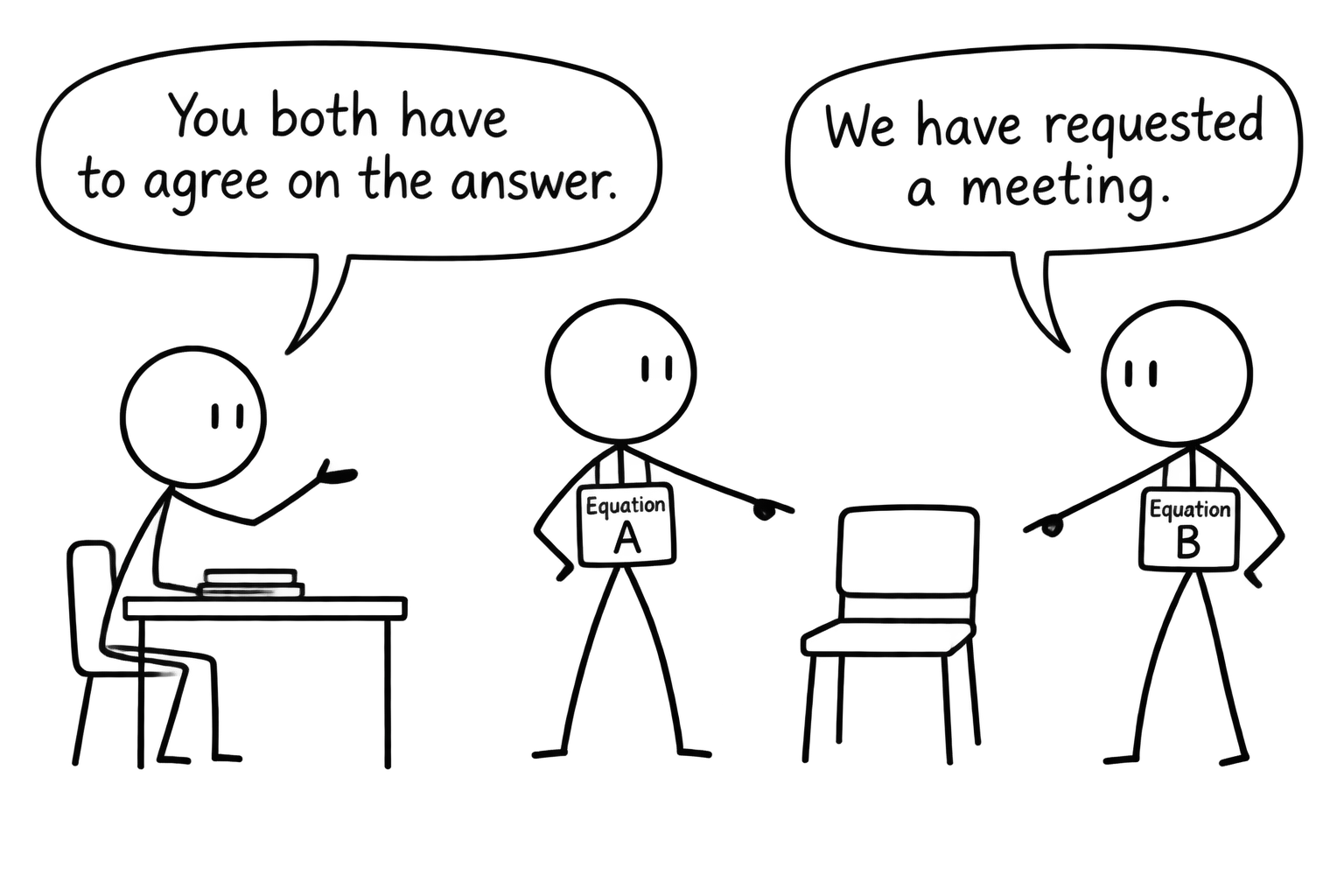 Two equations request a meeting because they must agree on one answer
Question two: one linear and one quadratic equation
The next question introduces the feature that makes A-Level simultaneous equations more demanding: there may be two pairs of solutions.
Solve simultaneously:
y=x+1y=x+1y=x+1 x2+y2=13x^2+y^2=13x2+y2=13Because yyy is already written in terms of xxx, Sam chooses substitution:
x2+(x+1)2=13x^2+(x+1)^2=13x2+(x+1)2=13Expanding the bracket gives:
x2+x2+2x+1=13x^2+x^2+2x+1=13x2+x2+2x+1=13 2x2+2x−12=02x^2+2x-12=02x2+2x−12=0Dividing by 222 makes the quadratic easier to factorise:
x2+x−6=0x^2+x-6=0x2+x−6=0 (x+3)(x−2)=0(x+3)(x-2)=0(x+3)(x−2)=0Therefore:
x=−3orx=2x=-3 \quad \text{or} \quad x=2x=−3orx=2Sam now returns to y=x+1y=x+1y=x+1. Each value of xxx needs its own corresponding value of yyy.
When x=−3x=-3x=−3:
y=−3+1=−2y=-3+1=-2y=−3+1=−2When x=2x=2x=2:
y=2+1=3y=2+1=3y=2+1=3The two solutions are:
(x,y)=(−3,−2)or(x,y)=(2,3)(x,y)=(-3,-2) \quad \text{or} \quad (x,y)=(2,3)(x,y)=(−3,−2)or(x,y)=(2,3)Indicative method marks
- M1: Substitute y=x+1y=x+1y=x+1 into the quadratic equation.
- A1: Reach a correct quadratic equivalent to x2+x−6=0x^2+x-6=0x2+x−6=0.
- M1: Attempt to solve the quadratic.
- A1: Obtain x=−3x=-3x=−3 and x=2x=2x=2.
- A1: Give both correct ordered pairs.
A method mark matters here. Even if Sam made a small arithmetic error after a correct substitution, the earlier valid method could still receive credit, depending on the mark scheme.
For more examples with notes and videos, the AQA simultaneous equations revision guide develops the same substitution process.
Question three: harder algebra and less friendly values
A harder question may lead to values that do not look reassuring. Sam must trust the algebra rather than expecting every answer to be a small integer.
Solve simultaneously:
2x−3y=62x-3y=62x−3y=6 x2−y2+3x=50x^2-y^2+3x=50x2−y2+3x=50Rearranging the linear equation for yyy gives:
3y=2x−63y=2x-63y=2x−6 y=2x−63y=\frac{2x-6}{3}y=32x−6Sam substitutes this expression into the second equation:
x2−(2x−63)2+3x=50x^2-\left(\frac{2x-6}{3}\right)^2+3x=50x2−(32x−6)2+3x=50Multiplying throughout by 999 removes the denominator:
9x2−(2x−6)2+27x=4509x^2-(2x-6)^2+27x=4509x2−(2x−6)2+27x=450Expanding carefully:
9x2−(4x2−24x+36)+27x=4509x^2-(4x^2-24x+36)+27x=4509x2−(4x2−24x+36)+27x=450 5x2+51x−486=05x^2+51x-486=05x2+51x−486=0The quadratic factorises as:
(x−6)(5x+81)=0(x-6)(5x+81)=0(x−6)(5x+81)=0Therefore:
x=6orx=−815x=6 \quad \text{or} \quad x=-\frac{81}{5}x=6orx=−581Using y=2x−63y=\frac{2x-6}{3}y=32x−6, when x=6x=6x=6:
y=12−63=2y=\frac{12-6}{3}=2y=312−6=2When x=−815x=-\frac{81}{5}x=−581:
y=−1625−63=−19253=−645y=\frac{-\frac{162}{5}-6}{3} =\frac{-\frac{192}{5}}{3} =-\frac{64}{5}y=3−5162−6=3−5192=−564Hence:
(x,y)=(6,2)or(−815,−645)(x,y)=(6,2) \quad \text{or} \quad \left(-\frac{81}{5},-\frac{64}{5}\right)(x,y)=(6,2)or(−581,−564)Indicative method marks
- M1: Rearrange the linear equation for one variable.
- M1: Substitute into the nonlinear equation.
- A1: Obtain the correct quadratic equation.
- M1: Solve the quadratic using a valid method.
- A1: Find both values of xxx.
- A1: Find both matching values of yyy.
This is where organised lines of working become valuable. They make sign errors visible and give an examiner clear evidence of the method used.
How to use a past paper and mark scheme
A simultaneous equations (A-Level) past paper question should be attempted without notes first. Give yourself enough room to expand brackets and keep the two solution branches separate.
Then compare your work with the simultaneous equations (A-Level) markscheme. Look beyond the final answer. Identify where the method marks are awarded and whether later accuracy marks depend on earlier correct working.
The A-Level Maths Question Bank lets you move from lessons into focused questions. Edexcel students can also explore the Edexcel A-Level Question Bank, including individual equations and inequalities exam-style questions.
A useful practice cycle is:
- Attempt one question without help.
- Mark each line, not only the final answer.
- Correct the first point where the method went wrong.
- Repeat a similar question without copying the correction.
Common mistakes in simultaneous equations
Forgetting to multiply every term
If an equation is multiplied by a constant, both sides and every term must be multiplied. Write the transformed equation on a new line rather than trying to do it mentally.
Losing the negative before a squared bracket
In an expression such as
x2−(2x−63)2,x^2-\left(\frac{2x-6}{3}\right)^2,x2−(32x−6)2,the subtraction applies to the entire squared expression. Expand the square first, then apply the negative sign.
Giving only one solution
A quadratic can produce two values of xxx. Unless a solution is invalid in the original equations or excluded by the question's context, both must be carried through to corresponding values of yyy.
Pairing values incorrectly
If x=−3x=-3x=−3 produces y=−2y=-2y=−2, do not accidentally pair x=−3x=-3x=−3 with the value of yyy obtained from the other root. Keep each substitution on a separate line.
Checking only one original equation
A pair must satisfy both equations. Substitution back into both originals is especially worthwhile when fractions or squared terms are involved.
Turn the method into exam marks
Sam's approach is not complicated: choose a method, preserve every algebraic step and follow every root to its matching value. The harder part is repeating that process consistently under exam conditions, especially when the numbers become less friendly.
Your turn. Build that consistency with the Maths Genie Lessons and Question Bank, working from the matching simultaneous equations lesson into marked exam-style practice.