

What you'll learn
- What it means to solve two equations simultaneously.
- How to use elimination and substitution for two linear equations.
- How to solve a system containing one linear and one quadratic equation.
- How the number of solutions relates to intersections on a graph.
Prerequisites
Before starting, you should be comfortable with:
- expanding brackets;
- collecting like terms;
- rearranging equations;
- factorising and solving quadratic equations;
- substituting a value into an expression.
For example, solving x2−5x+6=0x^2-5x+6=0x2−5x+6=0 by factorising gives
(x−2)(x−3)=0,(x-2)(x-3)=0,(x−2)(x−3)=0,so x=2x=2x=2 or x=3x=3x=3.
You will use these algebra skills while finding values that satisfy more than one equation.
What are simultaneous equations?
Simultaneous equations are two or more equations involving the same unknowns. Their solution must satisfy every equation at the same time.
For two equations in the variables xxx and yyy, a solution is normally written as an ordered pair (x,y)(x,y)(x,y).
Solution of simultaneous equations
A solution is a set of values that makes all the equations true when the values are substituted into them.
For two linear equations, each equation represents a straight line. The simultaneous solution is the point where the two lines intersect.
Checking a simultaneous solution
Show that (x,y)=(3,4)(x,y)=(3,4)(x,y)=(3,4) solves
x+y=7,2x−y=2.\begin{aligned} x+y&=7,\\ 2x-y&=2. \end{aligned}x+y2x−y=7,=2.-
Substitute x=3x=3x=3 and y=4y=4y=4 into the first equation:
3+4=7,3+4=7,3+4=7,so the first equation is satisfied.
-
Substitute the same values into the second equation:
2(3)−4=2,2(3)-4=2,2(3)−4=2,so the second equation is also satisfied.
-
Since both equations are true, (3,4)(3,4)(3,4) is the simultaneous solution.
Solving by elimination
The elimination method combines the equations so that one variable disappears. You can then solve an equation involving only the remaining variable.
Elimination
To eliminate a variable means to add or subtract equations so that the terms containing that variable cancel.
When the coefficients already match
If one variable has equal coefficients with the same sign, subtract the equations. If the coefficients have opposite signs, add the equations.
Eliminating a variable directly
Solve
2x+3y=19,2x−y=7.\begin{aligned} 2x+3y&=19,\\ 2x-y&=7. \end{aligned}2x+3y2x−y=19,=7.-
The coefficients of xxx are both 222, so subtract the second equation from the first:
(2x+3y)−(2x−y)=19−7.(2x+3y)-(2x-y)=19-7.(2x+3y)−(2x−y)=19−7.This gives
4y=12,4y=12,4y=12,so y=3y=3y=3.
-
Substitute y=3y=3y=3 into 2x−y=72x-y=72x−y=7:
2x−3=7,2x-3=7,2x−3=7,giving 2x=102x=102x=10 and therefore x=5x=5x=5.
-
Check the values in the other equation:
2(5)+3(3)=10+9=19.2(5)+3(3)=10+9=19.2(5)+3(3)=10+9=19.Therefore, the solution is (x,y)=(5,3)(x,y)=(5,3)(x,y)=(5,3).
Subtracting negative terms
When subtracting an entire equation, every term changes sign. For example, 3y−(−y)=4y3y-(-y)=4y3y−(−y)=4y, not 2y2y2y.
When the coefficients do not match
You may need to multiply one or both equations by suitable numbers before adding or subtracting them.
Creating matching coefficients
Solve
3x+2y=16,2x−3y=−5.\begin{aligned} 3x+2y&=16,\\ 2x-3y&=-5. \end{aligned}3x+2y2x−3y=16,=−5.-
To eliminate yyy, create coefficients of 6y6y6y. Multiply the first equation by 3 and the second by 2:
9x+6y=48,4x−6y=−10.\begin{aligned} 9x+6y&=48,\\ 4x-6y&=-10. \end{aligned}9x+6y4x−6y=48,=−10. -
Add the equations because 6y6y6y and −6y-6y−6y have opposite signs:
13x=38,13x=38,13x=38,so
x=3813.x=\frac{38}{13}.x=1338. -
Substitute into 3x+2y=163x+2y=163x+2y=16:
3(3813)+2y=16.3\left(\frac{38}{13}\right)+2y=16.3(1338)+2y=16.Hence
2y=20813−11413=9413,\begin{aligned} 2y&=\frac{208}{13}-\frac{114}{13}\\ &=\frac{94}{13}, \end{aligned}2y=13208−13114=1394,so
y=4713.y=\frac{47}{13}.y=1347.The solution is
(x,y)=(3813,4713).(x,y)=\left(\frac{38}{13},\frac{47}{13}\right).(x,y)=(1338,1347).
Choosing what to eliminate
Look for the pair of coefficients whose lowest common multiple is easiest to create. This usually reduces the amount of arithmetic.
Solving by substitution
In the substitution method, you rearrange one equation to make one variable the subject, then replace that variable in the other equation.
Substitution
Substitution means replacing a variable with an equivalent expression or value.
This method is particularly convenient if one equation already has the form y=…y=\ldotsy=… or x=…x=\ldotsx=….
Substituting a linear expression
Solve
y=2x+1,3x+y=16.\begin{aligned} y&=2x+1,\\ 3x+y&=16. \end{aligned}y3x+y=2x+1,=16.-
Since y=2x+1y=2x+1y=2x+1, substitute 2x+12x+12x+1 for yyy in the second equation:
3x+(2x+1)=16.3x+(2x+1)=16.3x+(2x+1)=16. -
Solve the resulting equation:
5x+1=16,5x=15,\begin{aligned} 5x+1&=16,\\ 5x&=15, \end{aligned}5x+15x=16,=15,so x=3x=3x=3.
-
Use y=2x+1y=2x+1y=2x+1 to find yyy:
y=2(3)+1=7.y=2(3)+1=7.y=2(3)+1=7.Therefore, the solution is (x,y)=(3,7)(x,y)=(3,7)(x,y)=(3,7).
Substituting without brackets
When replacing a variable, use brackets around the substituted expression. For example, if y=2x−3y=2x-3y=2x−3, then −4y=−4(2x−3)-4y=-4(2x-3)−4y=−4(2x−3).
One linear and one quadratic equation
A linear equation contains variables only to the first power and represents a straight line.
A quadratic equation contains a squared variable, such as x2x^2x2, and may represent a parabola.
To solve one linear and one quadratic equation simultaneously:
- Rearrange the linear equation to make one variable the subject.
- Substitute this expression into the quadratic equation.
- Solve the resulting quadratic.
- Find the corresponding value of the other variable for each solution.
Expecting two solutions
A straight line can intersect a parabola twice, so a linear-quadratic system will often produce two ordered pairs. Do not stop after finding the first value.
Solving a linear-quadratic system
Solve
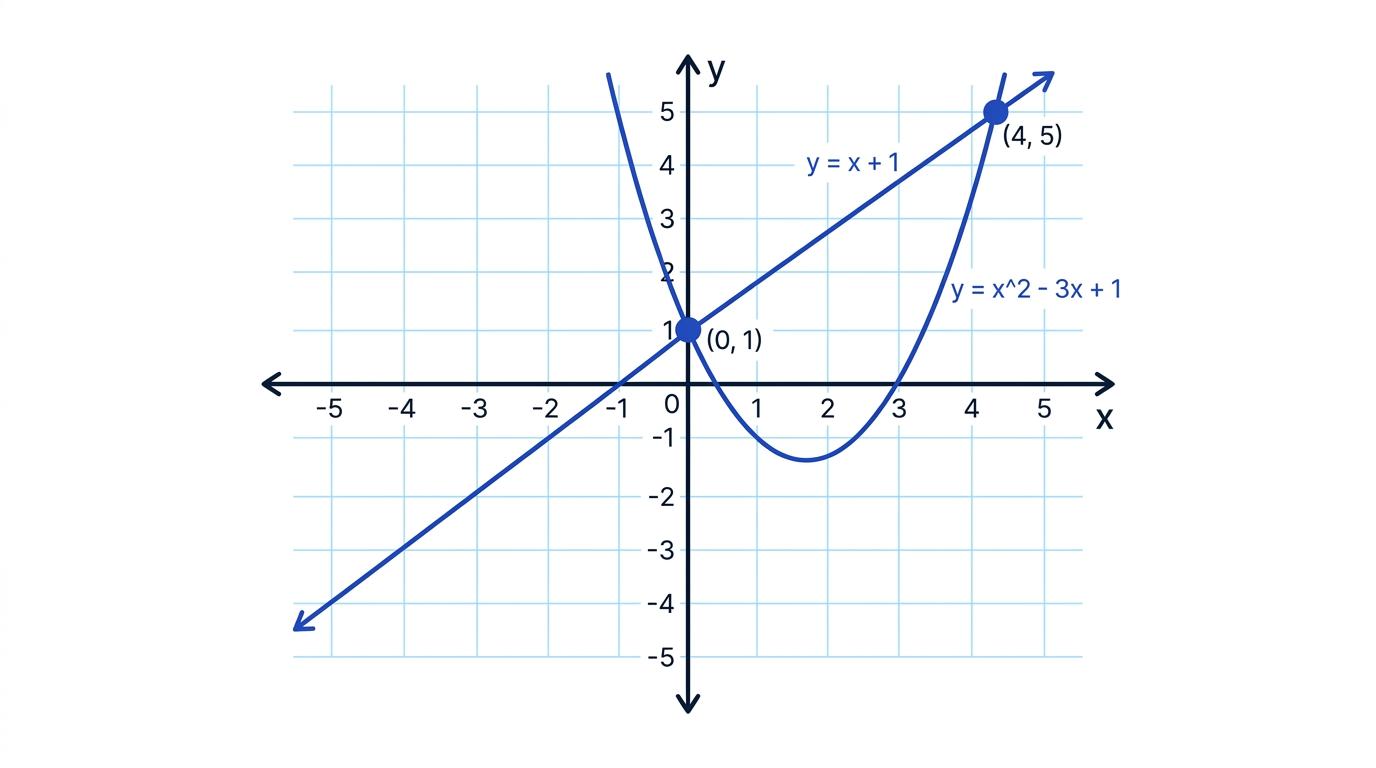
y=x+1,y=x2−3x+1.\begin{aligned} y&=x+1,\\ y&=x^2-3x+1. \end{aligned}yy=x+1,=x2−3x+1.-
Both expressions equal yyy, so set them equal:
x+1=x2−3x+1.x+1=x^2-3x+1.x+1=x2−3x+1. -
Rearrange to form a quadratic equation:
0=x2−4x,0=x(x−4).\begin{aligned} 0&=x^2-4x,\\ 0&=x(x-4). \end{aligned}00=x2−4x,=x(x−4).Therefore, x=0x=0x=0 or x=4x=4x=4.
-
Substitute each value into y=x+1y=x+1y=x+1:
x=0⇒y=1,x=4⇒y=5.\begin{aligned} x=0&\Rightarrow y=1,\\ x=4&\Rightarrow y=5. \end{aligned}x=0x=4⇒y=1,⇒y=5. -
The two solutions are
(x,y)=(0,1)or(x,y)=(4,5).(x,y)=(0,1)\quad\text{or}\quad(x,y)=(4,5).(x,y)=(0,1)or(x,y)=(4,5).
The solutions are exactly the intersection points of the line and the parabola.
The possible numbers of solutions
A line and a parabola can have:
- two solutions if they intersect twice;
- one repeated solution if the line is tangent to the parabola;
- no real solutions if they do not intersect.
After substitution, these possibilities appear in the resulting quadratic equation. If it has the form ax2+bx+c=0ax^2+bx+c=0ax2+bx+c=0, its discriminant is b2−4acb^2-4acb2−4ac.
- If b2−4ac>0b^2-4ac>0b2−4ac>0, there are two distinct real solutions.
- If b2−4ac=0b^2-4ac=0b2−4ac=0, there is one repeated real solution.
- If b2−4ac<0b^2-4ac<0b2−4ac<0, there are no real solutions.
No real solutions
A negative discriminant does not mean your algebra must be wrong. It can mean that the line and quadratic curve do not meet anywhere on a real coordinate graph.
Checking your answers
Substitute every ordered pair into both original equations. This catches sign errors and confirms that you have matched each xxx-value with the correct yyy-value.
Mixing corresponding values
If there are two solutions, calculate the value of yyy separately for each value of xxx. Do not combine an xxx-value from one solution with the yyy-value from the other.
In the exam
- Label equations if you are using elimination, and show clearly what each equation is multiplied by.
- After substitution, rearrange into the standard quadratic form ax2+bx+c=0ax^2+bx+c=0ax2+bx+c=0 before factorising or using the quadratic formula.
- Continue until you have complete ordered pairs, and check each pair in both original equations.
- Keep answers exact unless the question asks for a decimal approximation.
Check yourself
- How would you decide whether elimination or substitution is the more efficient method?
- Can you solve 2x+y=82x+y=82x+y=8 and 3x−y=73x-y=73x−y=7?
- How many real solutions are possible when solving one linear and one quadratic equation simultaneously?
