Simplifying Algebraic Fractions GCSE Maths
Simplifying algebraic fractions GCSE maths made clear with factorising steps, worked examples, common mistakes and focused exam-style practice questions.
Imagine a student seeing an algebraic fraction, noticing the same letter above and below the fraction line, and starting to cancel. A few lines later, the answer is wrong. Again.
If that feels familiar, the central rule of simplifying algebraic fractions GCSE maths is this: factorise first, then cancel common factors. You may cancel factors that multiply the whole numerator and denominator. You cannot cancel individual terms joined by addition or subtraction.
That distinction is where the topic usually clicks. Algebraic fractions are not asking you to learn a strange new rule. They are testing whether you can recognise the structure already hidden inside an expression.
The simplifying checklist
Use this process whenever you are asked to simplify an algebraic fraction:
- Factorise the numerator fully.
- Factorise the denominator fully.
- Identify factors that are identical above and below the fraction line.
- Cancel only those common factors.
- State excluded values if the question requires them.
- Check that the final expression cannot be simplified further.
The method is short, but each step matters. In our opening scenario, the student is looking for something to cancel before looking for something to factorise. Reversing that order is the useful change.
What cancelling really means
Consider an ordinary numerical fraction:
1218=2×63×6=23.\frac{12}{18}=\frac{2\times 6}{3\times 6}=\frac{2}{3}.1812=3×62×6=32.The 666 cancels because it is a factor of the entire numerator and the entire denominator. Algebraic cancellation works in exactly the same way.
For example:
12x2y18xy2.\frac{12x^2y}{18xy^2}.18xy212x2y.Write the coefficients and powers as factors:
2×6×x×x×y3×6×x×y×y.\frac{2\times 6\times x\times x\times y}{3\times 6\times x\times y\times y}.3×6×x×y×y2×6×x×x×y.Cancel the common factors 666, xxx and yyy:
12x2y18xy2=2x3y.\frac{12x^2y}{18xy^2}=\frac{2x}{3y}.18xy212x2y=3y2x.The original denominator is zero when x=0x=0x=0 or y=0y=0y=0, so those values are excluded from the original expression.
Once you have this method in hand, the Maths Genie algebraic fractions lesson lets you practise the same factorise-then-cancel process with guided questions.
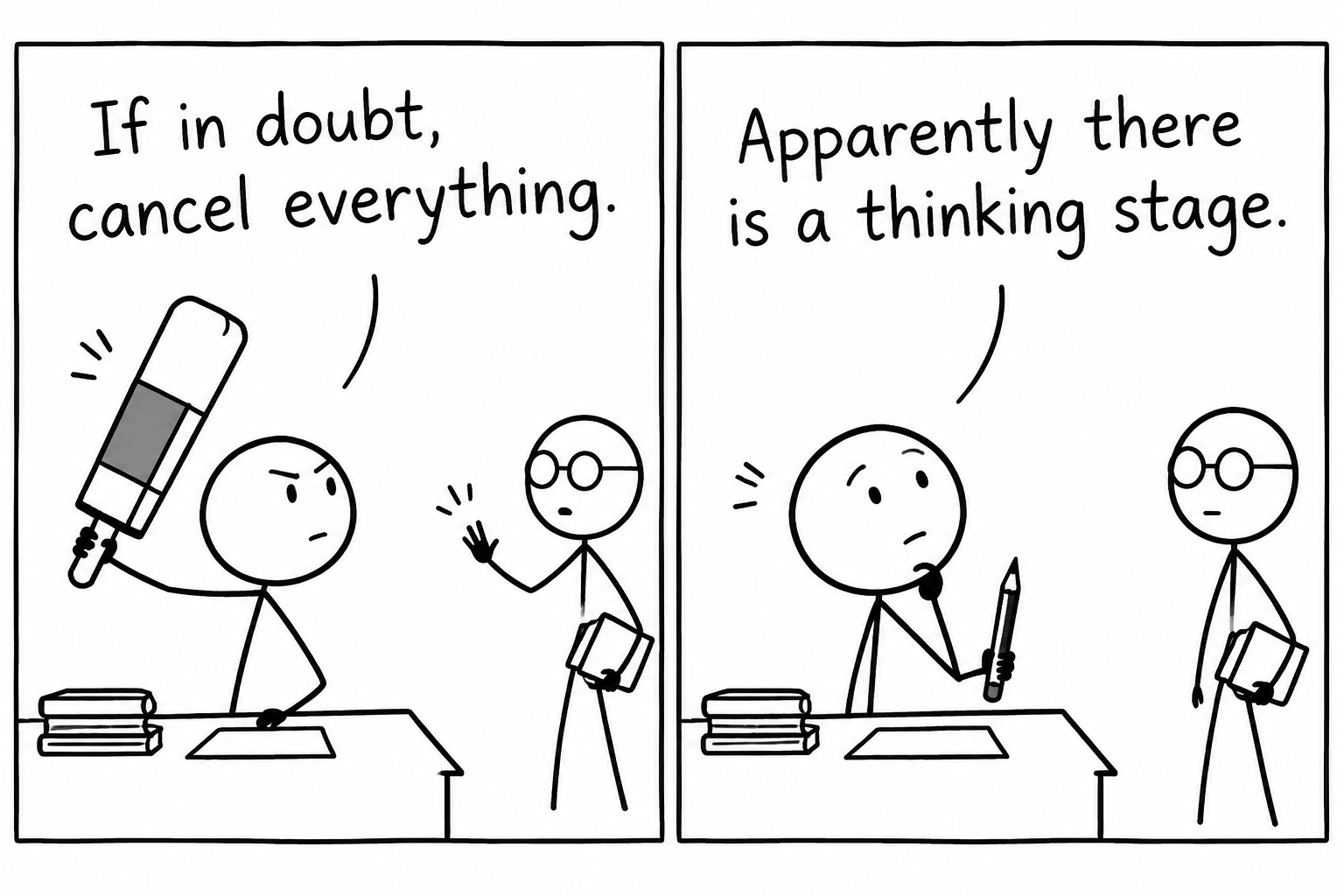 A student discovers that cancelling algebra needs a thinking stage
Simplifying algebraic fractions worked examples
Example with two quadratics
Simplify:
x2−9x2+x−6.\frac{x^2-9}{x^2+x-6}.x2+x−6x2−9.Do not cancel the x2x^2x2 terms. They are parts of expressions joined by addition and subtraction, not separate factors.
Factorise the numerator using the difference of two squares:
x2−9=(x−3)(x+3).x^2-9=(x-3)(x+3).x2−9=(x−3)(x+3).Factorise the denominator:
x2+x−6=(x+3)(x−2).x^2+x-6=(x+3)(x-2).x2+x−6=(x+3)(x−2).The fraction becomes:
(x−3)(x+3)(x+3)(x−2).\frac{(x-3)(x+3)}{(x+3)(x-2)}.(x+3)(x−2)(x−3)(x+3).Now (x+3)(x+3)(x+3) is a common factor, so it can be cancelled:
x2−9x2+x−6=x−3x−2.\frac{x^2-9}{x^2+x-6}=\frac{x-3}{x-2}.x2+x−6x2−9=x−2x−3.From the original denominator, x≠−3x\neq -3x=−3 and x≠2x\neq 2x=2. The restriction x≠−3x\neq -3x=−3 still matters even though (x+3)(x+3)(x+3) disappeared during simplification. Simplifying changes the appearance of the expression, but it does not make an originally undefined value valid.
If quadratic factorising is the sticking point, revisit the expanding and factorising revision lesson before attempting a longer set of fractions.
Example with a coefficient of x2x^2x2
Simplify:
2x2+7x+32x2+3x+1.\frac{2x^2+7x+3}{2x^2+3x+1}.2x2+3x+12x2+7x+3.Factorise the numerator:
2x2+7x+3=(2x+1)(x+3).2x^2+7x+3=(2x+1)(x+3).2x2+7x+3=(2x+1)(x+3).Factorise the denominator:
2x2+3x+1=(2x+1)(x+1).2x^2+3x+1=(2x+1)(x+1).2x2+3x+1=(2x+1)(x+1).Substitute these forms into the fraction:
(2x+1)(x+3)(2x+1)(x+1).\frac{(2x+1)(x+3)}{(2x+1)(x+1)}.(2x+1)(x+1)(2x+1)(x+3).Cancel the common factor (2x+1)(2x+1)(2x+1):
2x2+7x+32x2+3x+1=x+3x+1.\frac{2x^2+7x+3}{2x^2+3x+1}=\frac{x+3}{x+1}.2x2+3x+12x2+7x+3=x+1x+3.The original expression requires:
x≠−12andx≠−1.x\neq -\frac{1}{2}\quad\text{and}\quad x\neq -1.x=−21andx=−1.This is the stage at which the student in our scenario can stop seeing a crowded quadratic fraction and start seeing a matching pair of brackets. The algebra has not become easier by luck. Its structure has become visible.
Why some parts cannot be cancelled
A common incorrect step is:
x+3x=3.\frac{x+3}{x}=3.xx+3=3.This is not valid. The numerator is a sum, and xxx is not a factor of the whole numerator. One quick check is to substitute a permitted value. If x=1x=1x=1, then:
x+3x=1+31=4,\frac{x+3}{x}=\frac{1+3}{1}=4,xx+3=11+3=4,not 333.
You could only cancel xxx if it multiplied every part of the numerator. For example:
x(x+3)x=x+3,\frac{x(x+3)}{x}=x+3,xx(x+3)=x+3,provided x≠0x\neq 0x=0.
A useful question to ask is: does the proposed factor multiply the whole numerator and the whole denominator? If not, you cannot cancel it.
Common mistakes with algebraic fractions
Cancelling terms instead of factors
In an expression such as:
x2−16x2−2x−8,\frac{x^2-16}{x^2-2x-8},x2−2x−8x2−16,you cannot cancel x2x^2x2. Factorise instead:
(x−4)(x+4)(x−4)(x+2)=x+4x+2.\frac{(x-4)(x+4)}{(x-4)(x+2)}=\frac{x+4}{x+2}.(x−4)(x+2)(x−4)(x+4)=x+2x+4.The original expression excludes x=4x=4x=4 and x=−2x=-2x=−2.
Factorising only one part
Students sometimes factorise the numerator and leave the denominator expanded. That makes a common factor difficult to see. Factorise both parts fully before cancelling anything.
Losing a negative sign
Expressions such as (x−5)(x-5)(x−5) and (5−x)(5-x)(5−x) are not identical. In fact:
5−x=−(x−5).5-x=-(x-5).5−x=−(x−5).If the brackets appear in opposite orders, deal with the negative sign explicitly rather than cancelling them as though they were equal.
Forgetting excluded values
The denominator of a fraction cannot equal zero. Find restrictions from the original denominator, not only from the simplified answer. A cancelled factor still creates an excluded value in the original expression.
Stopping before the answer is fully simplified
After cancelling one factor, inspect the result again. There may be a numerical common factor, a power of a variable or another factor that can still be removed.
Check your working before moving on
A reliable check starts before cancellation. Expand each pair of brackets mentally or on a spare line and compare it with the original expression. This separates a factorising error from a cancellation error, so you know which skill needs attention.
Next, choose a small permitted value and substitute it into both the original fraction and your simplified answer. Different results prove something has gone wrong. Matching results are reassuring, but one successful substitution does not prove that two expressions are equivalent for every permitted value.
When marking practice, record the first incorrect line rather than copying only the final answer. Label the issue: factorising, signs, cancellation or restrictions. Your next revision session can then target that specific weakness instead of repeating an entire topic you mostly understand. Keep the original working visible so that a correct answer reached through an invalid cancellation does not disguise a misconception.
Simplifying algebraic fractions questions
Try these without looking at the answers first. Show the factorisation clearly, because exam marks may be awarded for a correct method even when a later arithmetic slip occurs.
Question one
Simplify:
15a2b20ab2.\frac{15a^2b}{20ab^2}.20ab215a2b.Question two
Simplify fully:
x2−25x2+x−20.\frac{x^2-25}{x^2+x-20}.x2+x−20x2−25.Question three
Simplify fully:
3x2+8x+43x2+5x+2.\frac{3x^2+8x+4}{3x^2+5x+2}.3x2+5x+23x2+8x+4.Answers
For question one:
15a2b20ab2=3a4b.\frac{15a^2b}{20ab^2}=\frac{3a}{4b}.20ab215a2b=4b3a.The original expression requires a≠0a\neq 0a=0 and b≠0b\neq 0b=0.
For question two:
x2−25x2+x−20=(x−5)(x+5)(x+5)(x−4)=x−5x−4.\frac{x^2-25}{x^2+x-20} =\frac{(x-5)(x+5)}{(x+5)(x-4)} =\frac{x-5}{x-4}.x2+x−20x2−25=(x+5)(x−4)(x−5)(x+5)=x−4x−5.The excluded values are x≠−5x\neq -5x=−5 and x≠4x\neq 4x=4.
For question three:
3x2+8x+43x2+5x+2=(3x+2)(x+2)(3x+2)(x+1)=x+2x+1.\frac{3x^2+8x+4}{3x^2+5x+2} =\frac{(3x+2)(x+2)}{(3x+2)(x+1)} =\frac{x+2}{x+1}.3x2+5x+23x2+8x+4=(3x+2)(x+1)(3x+2)(x+2)=x+1x+2.The excluded values are x≠−23x\neq -\frac{2}{3}x=−32 and x≠−1x\neq -1x=−1.
Use the algebraic fractions exam booklet for a longer set, then compare your working with the algebraic fractions worked solutions. You can also choose targeted problems from the GCSE Maths Question Bank or build fluency with the GCSE Maths Question Rush.
Lessons and Question Bank
Knowing the rule is only the first step; following it reliably under exam pressure takes deliberate practice. The student who used to cancel first now has a better routine: factorise, then cancel. Your turn: start the algebraic fractions lessons and Question Bank.