Revision Planning for Students Taking 11 GCSEs
Revision planning for students taking 11 GCSEs: build a balanced weekly timetable, prioritise weak topics and revise actively without burnout or guilt.
Eleven GCSEs can make every revision decision feel like neglecting something else. Maths needs work, English Literature has quotations to remember, and science seems to contain an entire library. Effective revision planning for students taking 11 GCSEs starts with a manageable weekly schedule: cover each qualification, then give extra attention to weak topics and approaching papers.
Imagine a student, Maya, trying to divide every available hour equally. Her plan looks fair, but it ignores what she actually needs. A better approach is baseline coverage, flexible extra sessions and a weekly review, with room for homework, sleep and rest.
Your revision-planning checklist
Before drawing a timetable:
- List every qualification, exam board and paper.
- Mark subjects red, amber or green using recent work.
- Give each qualification a realistic place in your week.
- Allocate extra sessions to weak or urgent topics.
- Review mistakes and adjust priorities each weekend.
The GCSE revision timetable guide explores sustainable scheduling. With eleven GCSEs, a realistic timetable you follow is more useful than an ambitious one you abandon.
Start with an honest subject audit
Maya initially labels maths as “bad”. That expresses frustration without identifying a task. Looking closer, she might find that number work is secure while algebraic graphs need attention.
Use three categories:
- Red: significant knowledge gaps or repeated errors.
- Amber: partly secure but inconsistent under exam conditions.
- Green: generally secure, needing maintenance and exam practice.
Base these decisions on marked questions and mock feedback, rather than confidence alone. For each red topic, write down the next action: revisit an explanation, attempt questions or ask a teacher.
Check your school's specifications and paper arrangements. Combined Science represents two GCSE qualifications, but still needs separate attention to biology, chemistry and physics content.
For maths, the GCSE maths revision resources help turn broad worries into individual topics. Choose material appropriate to your foundation or higher tier.
Build a weekly plan for eleven GCSEs
You do not need every subject every day. Plan across the week to allow focused work without constant switching.
One possible starting structure is:
- two sessions on each of four school evenings;
- one school evening free from scheduled revision;
- three sessions on Saturday;
- three sessions on Sunday.
This provides fourteen sessions: eleven for baseline coverage and three for your highest priorities. It is a starting framework, not a required workload. Substantial homework, caring responsibilities, sport or paid work may mean you need fewer sessions or a longer planning cycle.
Distribute the extra sessions deliberately. Giving every red subject several sessions may exceed your available time, so choose the most important gaps first. A secure subject can receive a shorter maintenance session.
Use the MathsGenie Revision Planner to organise these priorities. Leave some flexibility within the week so an unfinished task does not automatically consume your rest time.
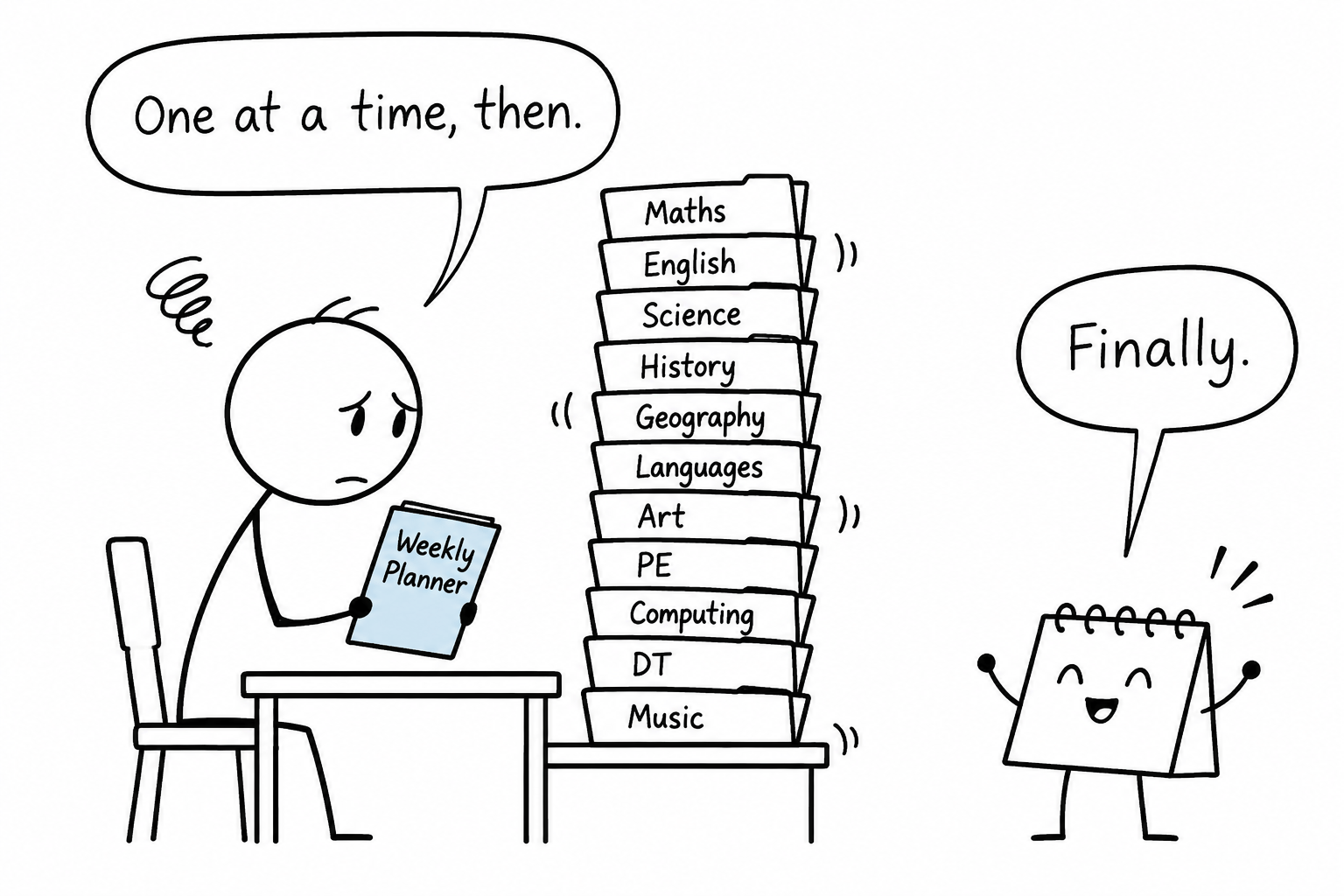 A GCSE student facing eleven subject folders with a weekly planner
Give every session a clear outcome
“Revise biology” leaves too many decisions until the moment you sit down. Specify a topic, a task and a way to check your understanding.
A focused session can include:
- recalling facts or methods without notes;
- answering questions independently;
- checking answers against a mark scheme;
- recording errors and deciding what to revisit.
Adjust the balance to the task. New material may need more explanation; familiar material may need timed practice. End with evidence of what you can do, rather than a page count.
Match techniques to subjects. Flashcards can support factual recall, essay plans can develop extended responses, and exam questions test application. Rereading is useful for clarifying a gap, followed by an attempt without notes.
For maths, topic-focused mini tests can reveal weaknesses. Use revision lessons, practice questions, mark schemes and video solutions to repair the method, then attempt a fresh question independently.
Revisit topics across separate sessions
Spending an entire Sunday on geography can feel productive, but leaving it untouched for weeks makes the next session harder. Schedule brief returns to important material.
First, learn or repair a topic. Retrieve it again several days later, then include it in mixed questions the following week. Later, check whether you recognise the method within a timed paper.
Mixed practice also makes you choose an approach without a topic heading giving it away. Use it once the individual methods are sufficiently secure.
The GCSE papers collection provides access to paper practice resources. Past papers test coverage and timing; predicted papers offer additional practice but cannot guarantee exam content. The guide to when to start GCSE past papers helps you balance diagnostic questions with complete papers.
Review priorities each weekend
Keep the review brief. Check what you completed, which errors remain and which exams are approaching. Then choose the next week's extra sessions.
If work repeatedly goes unfinished, reduce the load or make tasks smaller. Move the most important missed task and remove something less urgent. Carrying everything forward creates a growing backlog.
As papers approach, consider their dates alongside your weaknesses. After completing a subject's final paper, redistribute its sessions among remaining exams.
Common revision-planning mistakes
Giving every subject equal time
Secure subjects need maintenance, while weaker topics may need explanation, practice and feedback. Allocate time using evidence.
Counting hours instead of outcomes
A completed session should reveal something: a corrected misconception, stronger recall or improved timing. Record that outcome.
Avoiding difficult subjects
Place a demanding topic early in the week, when you have the energy to tackle it.
Filling every available evening
Keep spare capacity for unexpected homework and tasks that take longer. Rest belongs in a workable schedule.
Make the next week manageable
Eleven GCSEs become easier to organise when each session has a specific purpose. Start with your subject audit, choose realistic tasks and schedule a review. Build your week in the MathsGenie Revision Planner, then use free lessons and practice resources to turn those decisions into completed revision.