

Revision Order GCSE Dance: Does It Matter?
Revision order GCSE Dance advice: learn when subject sequence matters, how to balance Dance with maths, and build a practical weekly timetable.
The first subject on a revision timetable can feel strangely important. Put maths first and you may worry that Dance will be neglected. Start with Dance and the unanswered algebra questions can sit in the back of your mind. Yet the truth about revision order GCSE Dance students need is reassuring: there is no universally perfect sequence.
Order matters indirectly. It affects your concentration, energy and likelihood of returning to a subject. What matters more is that every subject receives repeated, purposeful attention before its assessment. For GCSE Dance, that means treating practical preparation and written Dance Appreciation as different kinds of work, then fitting each around subjects such as maths at sensible times.
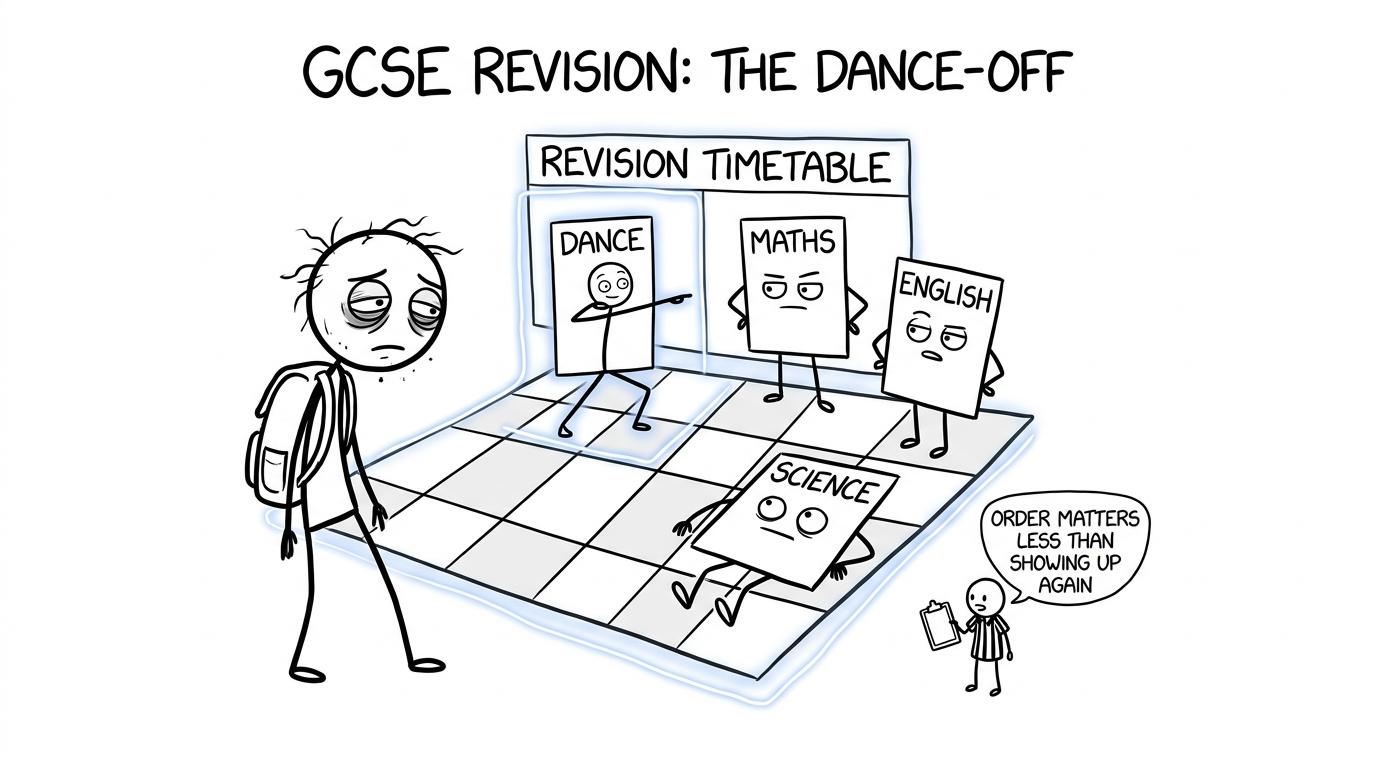 A GCSE student arranging subjects on a revision dance floor
The short answer: does revision order matter?
It matters, but not because your brain has a hidden rule saying Dance must come before maths or science.
A useful revision order should:
- place demanding work when you are most alert;
- reflect the dates and format of upcoming assessments;
- revisit subjects across several days rather than concentrating them into one block;
- separate physical Dance practice from written Dance revision;
- avoid leaving a difficult or disliked subject until the end every time;
- include breaks, sleep and realistic recovery time.
If two subjects are equally urgent, begin with the one requiring greater concentration. For many students, that might be a set of unfamiliar higher-tier maths questions. On another day, recalling Dance terminology or planning an analytical response may be the more demanding task. The right order can change.
Why GCSE Dance needs more than one kind of revision
For AQA GCSE Dance, assessment includes performance, choreography and Dance Appreciation. Performance and choreography are practical components, while Dance Appreciation is assessed through a written examination lasting 111 hour 303030 minutes. In the specification, performance contributes 30%30\%30%, choreography contributes 30%30\%30%, and Dance Appreciation contributes 40%40\%40%.
This matters because the word “revision” can hide several different activities.
Practical preparation
Performance and choreography require physical rehearsal, feedback, refinement and secure knowledge of movement material. They cannot be prepared effectively through reading alone. Practical work should normally follow your teacher's schedule because schools manage rehearsal arrangements, recordings, moderation requirements and internal deadlines.
Physical practice also needs appropriate space, preparation and supervision where required. A cramped late-night bedroom session is not automatically useful simply because Dance appeared last on the timetable.
Written Dance revision
Dance Appreciation involves knowledge, recall, analysis and evaluation. Revision may include terminology, choreographic processes, performance skills, production features and the prescribed professional works specified by AQA.
This work resembles revision for other written subjects. You need to retrieve information without notes, interpret command words, organise explanations and complete questions under time pressure. It can therefore sit alongside a focused session using MathsGenie's GCSE revision lessons.
The distinction is important: you are not deciding where one subject called Dance belongs. You are deciding when different Dance tasks belong.
Choose order by energy, urgency and task type
A timetable works best when it responds to three practical questions.
When is your concentration strongest?
Some students think most clearly soon after school. Others need food and a short break before tackling demanding work. Rather than copying somebody else's schedule, notice when you can complete questions carefully without repeatedly checking your phone or rereading the same sentence.
Use that period for active, high-concentration tasks. These might include:
- answering a Dance Appreciation question from memory;
- checking gaps exposed by a maths mini test;
- completing unfamiliar problem-solving questions;
- planning an evaluative Dance response;
- correcting errors from a past paper.
Lower-energy periods are better suited to organising notes, reviewing previously corrected questions or preparing materials for the next session. They should not become an excuse to avoid retrieval practice indefinitely.
Which assessment comes first?
Exam dates and school deadlines should influence the order. A choreography deadline may arrive before the written examination, while a maths paper might fall earlier in the summer timetable than another written subject.
Urgency deserves attention, but it should not erase everything else. Giving every available evening to the nearest assessment can create a second crisis immediately afterwards. Keep shorter maintenance sessions for later subjects while temporarily increasing the time given to the nearest priority.
For maths, use the section matching your exam board, such as Edexcel GCSE Maths papers, AQA GCSE Maths papers or OCR GCSE Maths papers. Always follow the specification and advice supplied by your school for Dance.
Are you changing the type of work?
Switching subjects can help when it also changes the mental or physical demand. Moving from Dance rehearsal to a maths paper is a clearer change than moving from highlighting Dance notes to highlighting biology notes.
However, constant switching is disruptive. Give each session enough time to settle into the task, attempt meaningful work and review it. A timetable containing many tiny subject blocks may look balanced while producing very little completed practice.
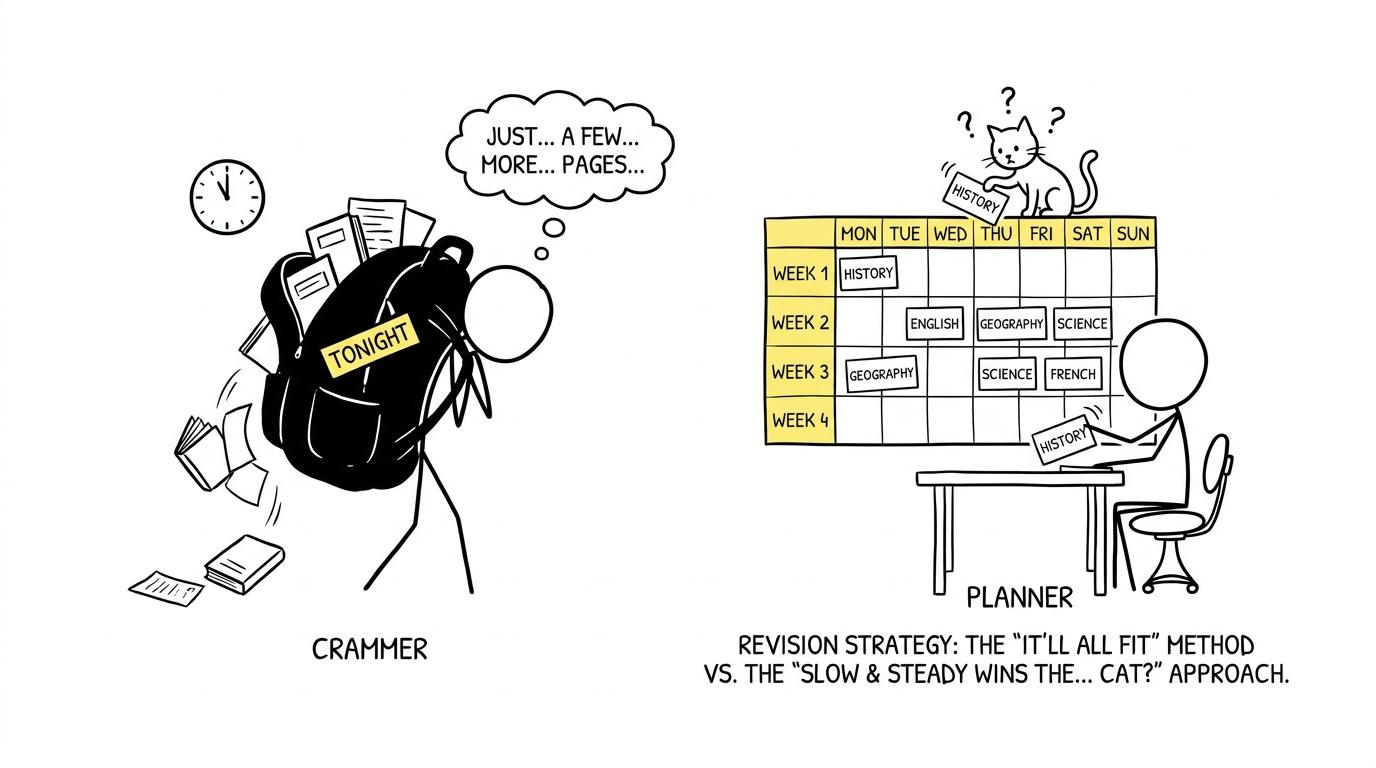 A revision backpack overloaded by last-minute subject cramming
A sensible revision order for Dance and maths
You do not need a fixed rule saying maths must always come first. Use a flexible sequence built around the work required.
On a day containing physical Dance rehearsal, the order might be:
- prepare for rehearsal and complete the planned practical work;
- take a genuine break, eat and recover;
- complete one focused maths task;
- mark it and record the topics needing another visit;
- finish with brief retrieval of Dance Appreciation knowledge if concentration remains.
On a day without rehearsal, you might begin with whichever written task is hardest, switch after a break, and reserve the final period for corrections or recall.
The key is rotation. If maths always occupies your best period and Dance always receives whatever energy remains, the imbalance will eventually show. Reverse the order on selected days or reserve separate high-energy sessions for both.
MathsGenie's GCSE predicted papers can support timed practice close to the exam season, but predicted papers should complement rather than replace topic revision and official past papers. The same principle applies to Dance: broad specification coverage is safer than trying to guess exactly what will appear.
Spacing matters more than winning the first slot
A subject does not gain much simply by appearing first once. It benefits from being revisited.
Evidence on learning consistently supports retrieving knowledge and spacing practice over time rather than relying entirely on one long period of rereading. For Dance Appreciation, that means recalling ideas about performance, choreography and professional works on several occasions. For maths, it means returning to topics after a gap and checking whether you can still answer questions without prompts.
A weekly plan should therefore contain:
- several short encounters with written Dance content;
- practical rehearsals arranged around school guidance;
- repeated maths practice across different topics;
- time to mark answers and act on mistakes;
- at least one flexible block for unfinished or unexpectedly difficult work.
MathsGenie's GCSE maths mini tests are useful for these shorter checkpoints. A mini test can reveal whether a topic is secure without requiring a full paper every evening.
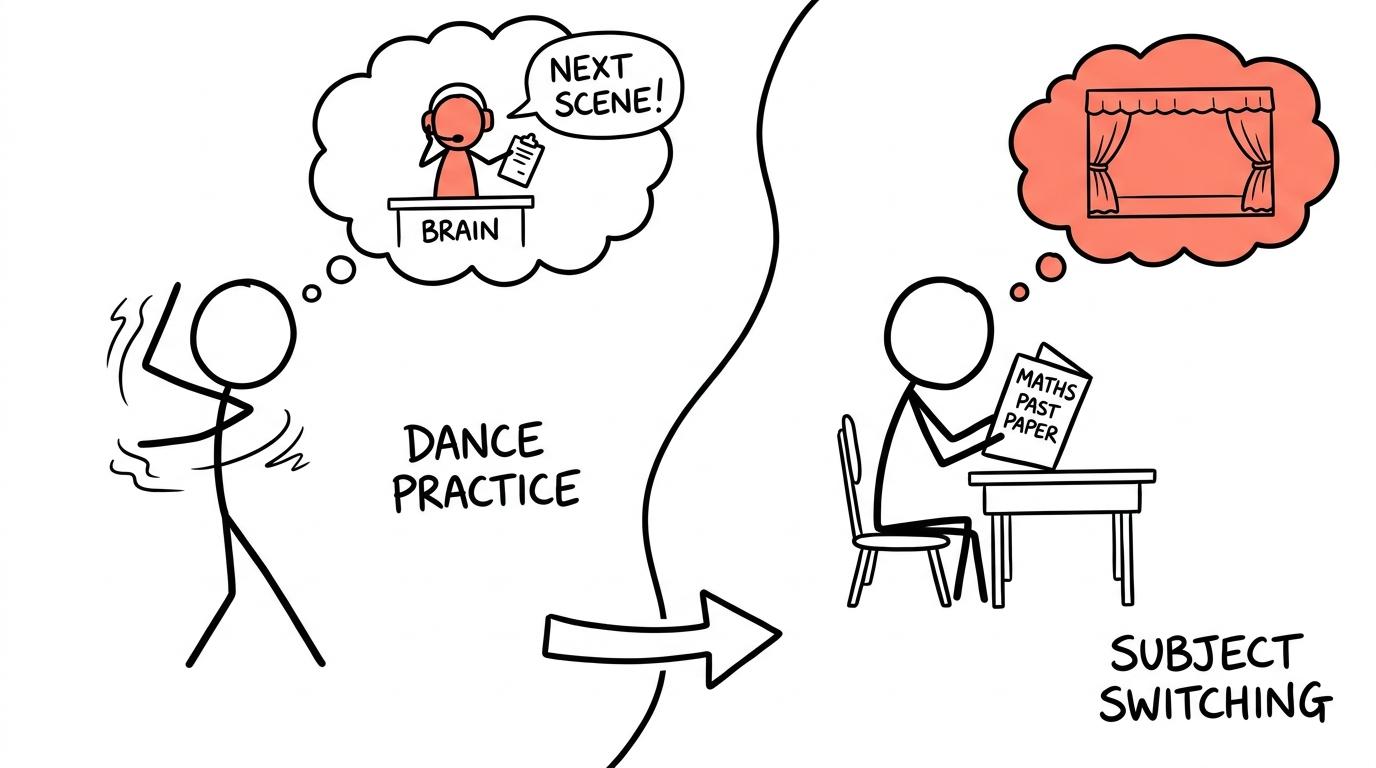 A tiny brain acting as stage manager between Dance and maths revision
Let mistakes determine what comes next
The strongest timetable is not merely a calendar. It is a feedback system.
After a maths session, use the mark scheme or video solution to identify why marks were lost. Separate slips from genuine gaps in understanding. If algebraic fractions remain uncertain, the next step should be targeted practice rather than another random paper.
After written Dance practice, compare your response with your teacher's guidance and the assessment criteria. Ask whether you used accurate knowledge, answered the command word, supported the point and referred clearly to relevant features of the work.
This changes revision order from a habit into a decision. The next subject or topic is chosen because evidence says it needs attention, not because it happens to be the next coloured box.
MathsGenie's topic pages combine revision lessons, practice questions and video solutions, allowing you to move from diagnosis to focused improvement. Once weaknesses have been addressed, return to GCSE maths past papers and mark schemes to test the skills in an exam-style context.
Common mistakes when ordering GCSE revision
Always starting with your favourite subject
Starting feels easier when the subject is comfortable, but weaker areas are then repeatedly pushed into low-energy periods. Enjoyable subjects can still appear early sometimes; they simply should not own every prime session.
Always starting with the subject you fear most
The opposite extreme can make revision feel punishing. If every session begins with your most stressful topic, starting at all becomes harder. Alternate demanding sessions with achievable tasks that build momentum.
Treating practical Dance as a break
Rehearsal demands concentration, physical effort and reflection. It should not automatically be placed between two demanding written sessions as if it requires no energy.
Revising only the written component
Dance Appreciation is important, but it does not replace preparation for performance and choreography. Follow your teacher's practical timetable and use feedback while there is still time to refine the work.
Completing papers without reviewing them
A finished paper is evidence, not the final destination. Mark schemes and video solutions show what should shape the next revision session. Track recurring errors and revisit the relevant lesson or practice questions.
Building an inflexible timetable
Rehearsals change, homework takes longer than expected and some topics expose larger gaps. Leave room to adjust. Missing one block should lead to rescheduling, not abandoning the week.
The order matters less than the return
There is no special revision order that guarantees success in GCSE Dance, and Dance does not always need to come before or after maths. Sequence matters when it helps you protect concentration, meet deadlines, vary task demands and stop weaker subjects being postponed.
Build the timetable around what each assessment actually requires. Rehearse practical Dance safely and in line with school guidance. Revisit Dance Appreciation through active recall and exam questions. For maths, diagnose gaps, practise the relevant skills, mark the work and return later to check that the learning has lasted.
Start with MathsGenie's free GCSE maths revision resources, then use past papers, predicted papers, mini tests, practice questions, mark schemes and video solutions to turn your timetable into steady progress. The first subject matters a little. Coming back with a clear purpose matters much more.











