

Revising for a Resit With a Busy Schedule
Revising for the resit with a busy schedule? Build a realistic GCSE maths plan around college, work and life with focused practice that counts.

Revising for the resit with a busy schedule can feel like trying to fit one more passenger onto an already crowded bus. College has its own deadlines. Work takes the evening you meant to use. Travel, family responsibilities and tiredness consume the gaps.
The answer is not to recreate a Year 11 revision timetable. It is to build a smaller, sharper system: diagnose the topics costing you marks, practise them in short sessions, check your work and return to weaknesses regularly. For a post-16 student, consistency matters more than pretending every evening is free.
Your busy-schedule checklist
- Confirm your exam board, tier and exam dates with your college or exam centre.
- Identify a small number of priority topics from marked papers.
- Protect three short revision sessions each week.
- Give every session one specific outcome.
- Mark questions immediately and record why marks were lost.
- Complete timed paper practice as the exam approaches.
- Use the MathsGenie GCSE revision hub for free lessons, questions and video support.
A resit timetable must fit your actual week
Imagine a student who attends college four days a week, works one evening and has a long journey home. A plan demanding two hours of maths every night is not ambitious. It is fictional.
Start with the commitments that cannot move. Add lessons, shifts, travel and family responsibilities to your calendar. Then look for repeatable spaces rather than heroic bursts of spare time.
A realistic week might contain:
| Session | Time | Purpose |
|---|---|---|
| Tuesday | 252525 minutes | Relearn one weak skill and answer focused questions |
| Thursday | 303030 minutes | Mixed practice from recent topics |
| Saturday | 454545 minutes | Timed exam questions and marking |
| Sunday | 101010 minutes | Review errors and choose next week's topics |
That gives you 110110110 minutes of deliberate revision. It may look modest, but it is more valuable than a five-hour plan repeatedly postponed.
Use the GCSE maths revision timetable guide to turn those available spaces into a sustainable routine. Keep a backup session too. If a work shift changes, you already know where the missed practice will go.
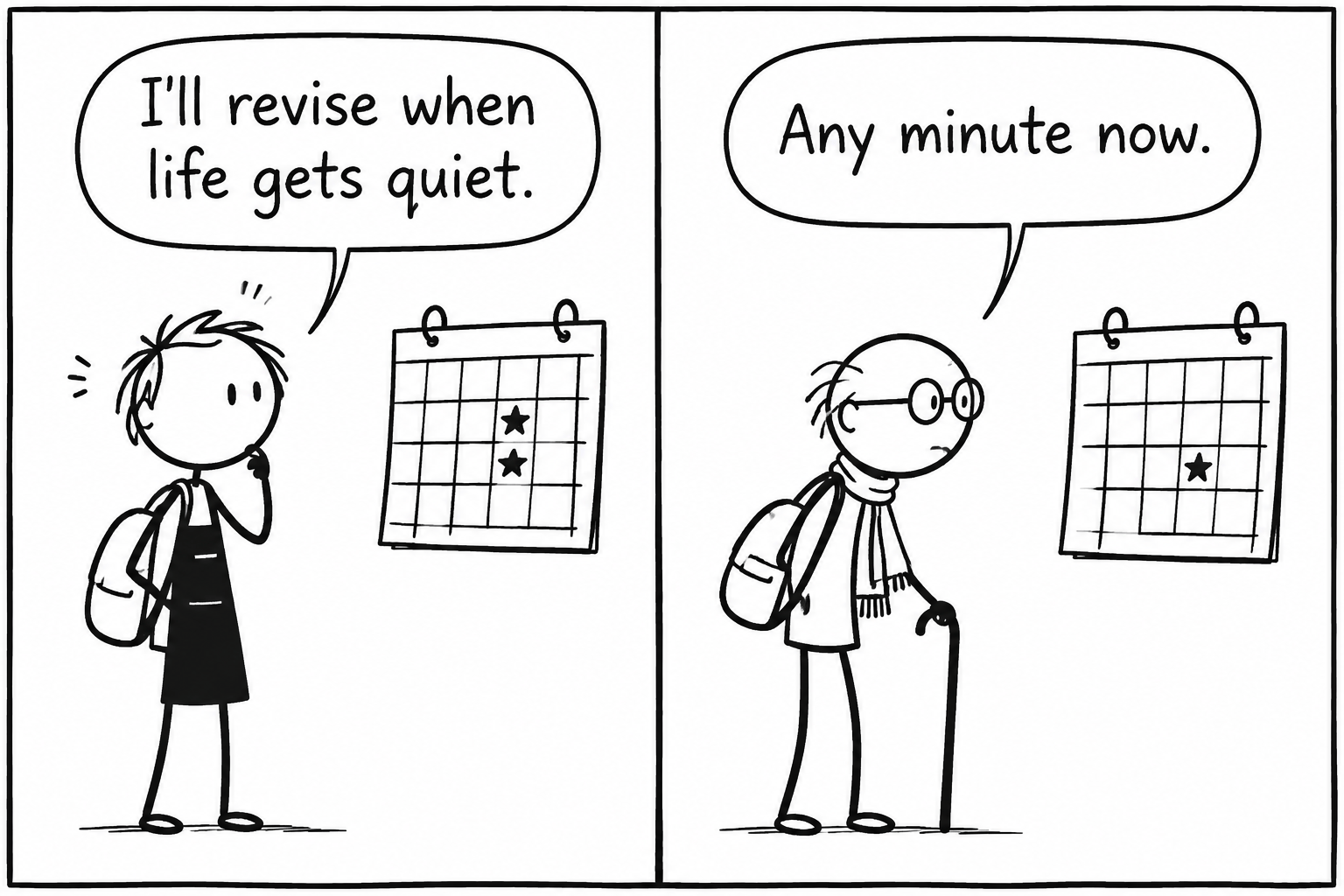 A student waits for life to become quiet before revising
Revise from evidence, not from the first page
A resit is different from learning the course for the first time. You have already encountered much of the specification, although some topics may feel distant. Your previous result and marked practice can now guide the work.
Complete a manageable set of mixed questions or part of a paper under timed conditions. Use the mark scheme, then classify each lost mark:
- Knowledge gap: you did not know the method.
- Recognition gap: you knew the method but did not recognise when to use it.
- Accuracy error: arithmetic, signs or calculator input caused the mistake.
- Exam technique: working was unclear, the question was misread or time ran out.
This distinction matters. Watching another video may help a knowledge gap, but it will not necessarily fix rushed calculator entry. Likewise, completing dozens of easy questions will not solve a recognition gap.
The MathsGenie GCSE maths resit plan can help you turn feedback into priorities. Choose perhaps three weak areas at a time. Finish those before expanding the list.
Give each short session a clear job
“Revise maths” is too vague for a busy evening. By the time you decide what to do, much of the available energy has gone.
A useful short session has four parts:
- Retrieve: spend a few minutes recalling the method without notes.
- Practise: answer questions focused on that skill.
- Check: mark the work while your reasoning is still fresh.
- Record: write down the precise error and the next action.
For example, the outcome might be: “Complete and mark six higher-tier ratio questions, then redo every incorrect question without notes.” That is specific enough to begin immediately and small enough to finish.
MathsGenie brings together revision lessons, practice questions, mark schemes and video solutions on the free maths revision website. Use the explanation when you need it, but spend most of the session answering questions yourself. Recognition can feel like understanding until the notes disappear.
Prepare properly for the November resit
GCSE mathematics is available in the November exam series for students who are aged 161616 or over on 313131 August of that year. Your college or exam centre should confirm your entry, exam board, tier, venue and exact timetable. Do not rely on a date remembered from social media or from another student, because arrangements can differ.
A November resit creates a compressed revision window. That makes selection important. Early sessions should repair high-priority weaknesses. Later sessions should increasingly mix topics and reproduce exam conditions.
A sensible progression is:
- First phase: focused topic repair using lessons and practice questions.
- Middle phase: mixed mini tests and groups of exam questions.
- Final phase: timed papers, careful marking and targeted follow-up.
Use GCSE past papers to practise timing and switching between topics. Predicted papers can provide fresh practice, but they cannot tell you exactly what will appear. Cover the specification rather than trying to guess the paper.
If you are sitting a later series instead, the same method applies. Confirm the relevant dates and work backwards from them.
Make marking part of revision
Completing a paper is only the first half of the task. The improvement happens when you investigate the marks that disappeared.
Keep an error log with four short columns: topic, what happened, correct approach and revisit date. Avoid entries such as “careless”. Write something actionable, such as “rounded halfway through” or “used circumference instead of area”.
Redo an incorrect question after checking the solution. Return to a similar question several days later. If you can now complete it independently, the correction is beginning to stick.
This process also protects a busy schedule. Your error log tells you what to revise next, so each session begins with a decision already made.
Common mistakes when time is limited
Saving everything for a free weekend
Weekends often acquire shifts, assignments and family plans. Short weekday sessions reduce the amount resting on one uncertain block of time.
Revising only comfortable topics
Success on familiar questions feels productive, but your marked work should influence the plan. Keep some confidence-building practice while directing most attention towards recoverable marks.
Watching without practising
A video solution can make a method look obvious. Close it and attempt a fresh question. Independent work is the real test.
Ignoring the correct tier
Foundation and higher tier papers have different grade ranges and demands. Confirm your entry with your college before choosing resources, rather than assuming it matches your previous entry.
Completing papers without analysing them
A total mark tells you where you are. Individual errors tell you what to do next. Use both.
Build practice around the marks you need
The most useful plan is not the one with the most colour or the longest sessions. It is the one that repeatedly puts the right questions in front of you.
Begin with three protected sessions this week. Mark everything, keep the error log short and specific, and adjust the following week from evidence. When you are ready for mixed exam practice, use MathsGenie's Mock Exam Builder to build a targeted practice paper around the topics that need attention.
A resit does not require you to put the rest of life on pause. It requires a routine that survives real life. Start small, practise deliberately and let each marked question decide the next step.















