Revise GCSE History With No Quiet Space
Revise GCSE history with no quiet space using realistic routines, portable resources and focused exam practice designed to work in a busy home each day.
A quiet desk, an empty room and two uninterrupted hours sound ideal. They are also unrealistic for many students. If your search is “revise GCSE history no quiet space”, the practical answer is this: make revision portable, divide work into short tasks and match each task to the level of noise around you.
You do not need perfect silence to learn dates, retrieve key facts or plan an answer. You may need a calmer place for demanding timed writing, but that place does not always have to be at home. The aim is not to defeat every distraction. It is to build a revision system that still works when family life continues around you.
Your quiet-space revision checklist
Start with a small, repeatable system:
- Identify the quietest times available, even if they last only 15 minutes.
- Prepare one portable revision kit.
- Use noisy periods for short retrieval tasks.
- Save extended writing for calmer periods or another suitable location.
- Revise the exact topics and question styles on your exam board's specification.
- Ask your school about supervised revision spaces or other support.
- Protect time for GCSE maths alongside history.
- Judge a session by completed tasks, not hours spent at a desk.
This changes the question from “Where can I find perfect silence?” to “What useful task can I complete here?” That is a much easier problem to solve.
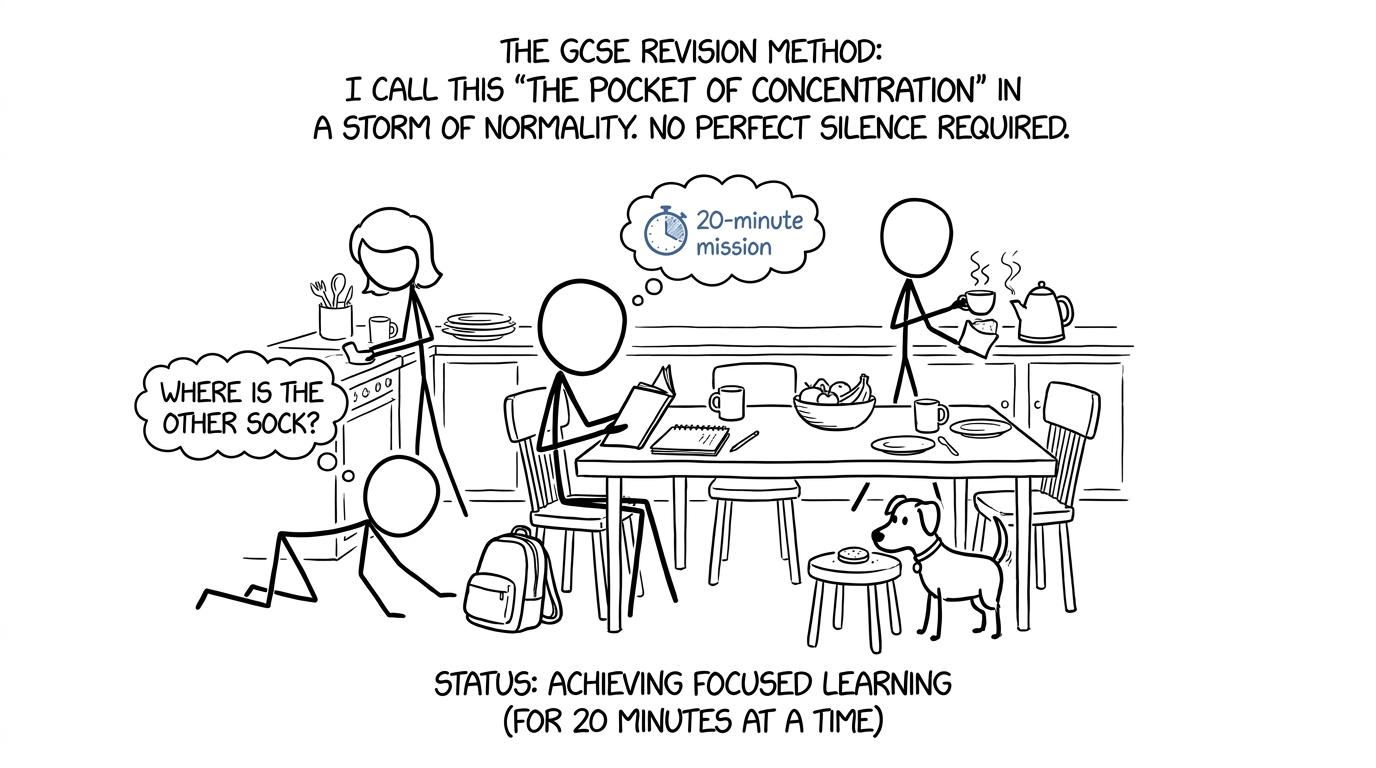 A student completing a short revision mission at a busy kitchen table
Build revision around the noise you actually have
Noise is not constant. A home might be busy after school, calmer before breakfast and unpredictable at weekends. Instead of creating a timetable based on an imaginary quiet house, observe your real week.
For several days, note when conditions are relatively calm, moderately distracting or very noisy. Then give each kind of period an appropriate job.
Tasks for noisy periods
Use busy periods for work that can survive interruption:
- recalling facts from flashcards;
- sorting events into chronological order;
- matching people, policies and consequences;
- reciting a timeline from memory;
- labelling a blank topic map;
- checking answers against notes;
- listening to a teacher-approved recording through headphones at a safe volume;
- reading one short section of a textbook.
These tasks still require thought, but you can return to them quickly after an interruption.
Tasks for moderately quiet periods
When the room is calmer, move to work requiring stronger concentration:
- planning an essay or interpretation answer;
- grouping evidence by theme;
- explaining causes and consequences;
- comparing two interpretations;
- analysing the provenance and content of a source;
- reviewing an answer against a mark scheme.
Tasks for your quietest periods
Protect the best conditions for the hardest work:
- timed exam questions;
- full paragraphs written from memory;
- unfamiliar source or interpretation questions;
- correcting weaknesses revealed by past-paper practice.
This is revision triage. Your quietest minutes are limited, so spend them on tasks that genuinely need them rather than copying notes or highlighting pages.
Create a portable GCSE History revision kit
A permanent study room is helpful, but a portable routine can be almost as valuable. Keep the essentials together in a folder, small box or bag:
- your exam board's topic list;
- a small set of flashcards;
- blank paper or a notebook;
- pens and highlighters;
- printed questions and mark schemes supplied by your school;
- headphones or simple earplugs, where appropriate;
- a timer;
- water.
Remove anything that creates another decision. If your materials are ready, you can use an unexpected 20-minute window rather than spending half of it looking for notes.
The same principle helps across your GCSE subjects. Bookmark the MathsGenie GCSE revision hub so that a short maths session can begin without searching through different websites. A reliable starting point matters when time and space are both limited.
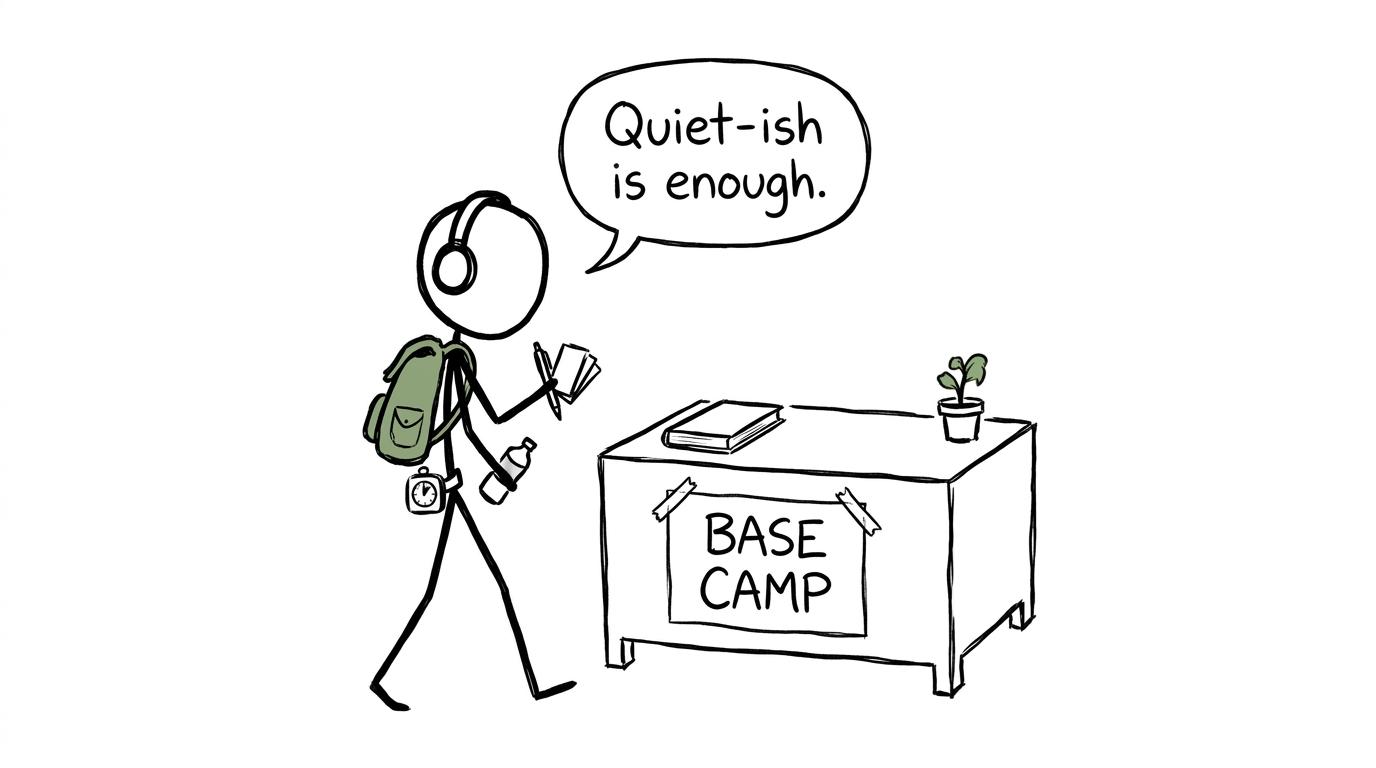 A student carrying a portable revision kit towards a library base camp
Use short sessions that produce visible evidence
“Revise history” is too large to be useful. It gives your attention nowhere specific to land. Replace it with a task that has a clear finish line:
- recall five causes without notes;
- reconstruct one timeline;
- plan one question;
- write one analytical paragraph;
- check one answer with the mark scheme;
- correct three missing facts.
A short session should leave evidence behind: completed flashcards, a plan, a paragraph, corrections or a list of gaps. Simply rereading a page can feel productive while revealing little about what you could recall in an exam.
Try beginning with a 15- or 20-minute block. Put your phone out of reach unless you genuinely need it for the task. At the end, record what you completed and choose the next action. If conditions remain manageable, continue. If the room becomes chaotic, stop without treating the session as a failure.
Short sessions are not a lesser form of revision. They are often the most realistic way to build repeated contact with a topic.
Make active recall work in a crowded room
Active recall means attempting to retrieve information before checking your notes. For GCSE History, that might involve closing the book and listing the reasons for an event, reconstructing a sequence or explaining why one factor mattered.
A simple cycle is:
- choose a narrow topic;
- recall everything relevant without notes;
- check your specification, textbook or class materials;
- add missing information in another colour;
- return to the same material later.
Spread those returns across several days rather than completing every repetition in one evening. The first attempt may feel uncomfortable. That discomfort is useful because it exposes the difference between recognising information and being able to retrieve it independently.
Do not turn flashcards into miniature textbooks. One focused prompt is easier to use when people are talking nearby. Questions such as “Why was this policy significant?” also demand more thought than prompts asking only for a date.
Revise for your exam board, not for history in general
Edexcel, AQA, OCR and Eduqas specifications do not all use identical topics, paper structures or question wording. Your school can confirm your exam board and exact specification. Keep that information at the front of your folder.
Your revision should cover three connected areas:
Knowledge
Learn accurate events, people, dates and developments from the content your course requires. Dates matter when they establish chronology or support an explanation, but isolated facts are rarely the whole answer.
Historical thinking
Practise explaining causation, consequence, change, continuity, significance and similarity or difference where these concepts appear in your course.
Exam execution
Learn what each question asks you to do. Pay close attention to command words, available marks and the guidance your teacher has given for your specification. Use official questions and mark schemes where available rather than assuming every essay should follow one universal template.
Find quieter spaces without assuming they are available
A library, school classroom or supervised revision session may provide better conditions, but opening hours, access rules and travel arrangements vary. Ask rather than assume.
Useful questions include:
- Is there a room open before school, at lunch or after lessons?
- Does the school run supervised revision sessions?
- Can the history department suggest a suitable workspace?
- Is your local library accessible at a safe and practical time?
- Could a trusted relative offer a table for one planned session each week?
Explain the problem plainly to a teacher, tutor or pastoral member of staff. “I cannot revise” sounds broad; “I need somewhere suitable to complete one timed answer each week” gives them a specific need they may be able to address.
If headphones help, keep the volume sensible and remain aware of your surroundings. Brown noise, instrumental music or ear defenders suit some students but distract others. Test them during practice, not for the first time when completing important work.
Keep history and maths revision in balance
A noisy environment affects every subject, but different tasks tolerate different conditions. History retrieval may work at a busy table, while a demanding algebra topic may require your calmer window.
Use the MathsGenie revision planner to organise maths alongside your other GCSE commitments. The free revision pages combine videos and practice questions, allowing you to choose one precise topic rather than vaguely deciding to “do maths”.
As exams approach, the GCSE maths past papers help you practise sustained exam work during your quietest available sessions. MathsGenie predicted papers can provide additional maths practice, although no predicted paper can guarantee what will appear in the real examination.
For shorter windows, MathsGenie mini tests are easier to fit around a busy household. If you are also preparing for post-GCSE study, the A Level maths revision resources provide the same kind of structured starting point.
The broader lesson is simple: match the resource to the time and attention available.
Common mistakes when revising without quiet space
Waiting for ideal conditions
Perfect conditions may never arrive. Begin with one small task that can survive the current level of noise.
Using every quiet minute for easy work
Copying titles and organising stationery can wait. Reserve calmer periods for exam questions, planning and correction.
Trying to block out everything with loud audio
More volume is not the same as more concentration. Use headphones carefully and choose the least distracting option that works.
Revising everything at once
A broad target creates friction. Select one period, theme, person or question type before the session begins.
Ignoring the mark scheme
Knowledge matters, but GCSE History also rewards answering the particular question effectively. Review marked work, teacher feedback and relevant mark schemes to understand what your course expects.
Treating interruptions as personal failure
An interruption is an event, not a judgement about your discipline. Mark your place, deal with what is necessary and restart with the next small action.
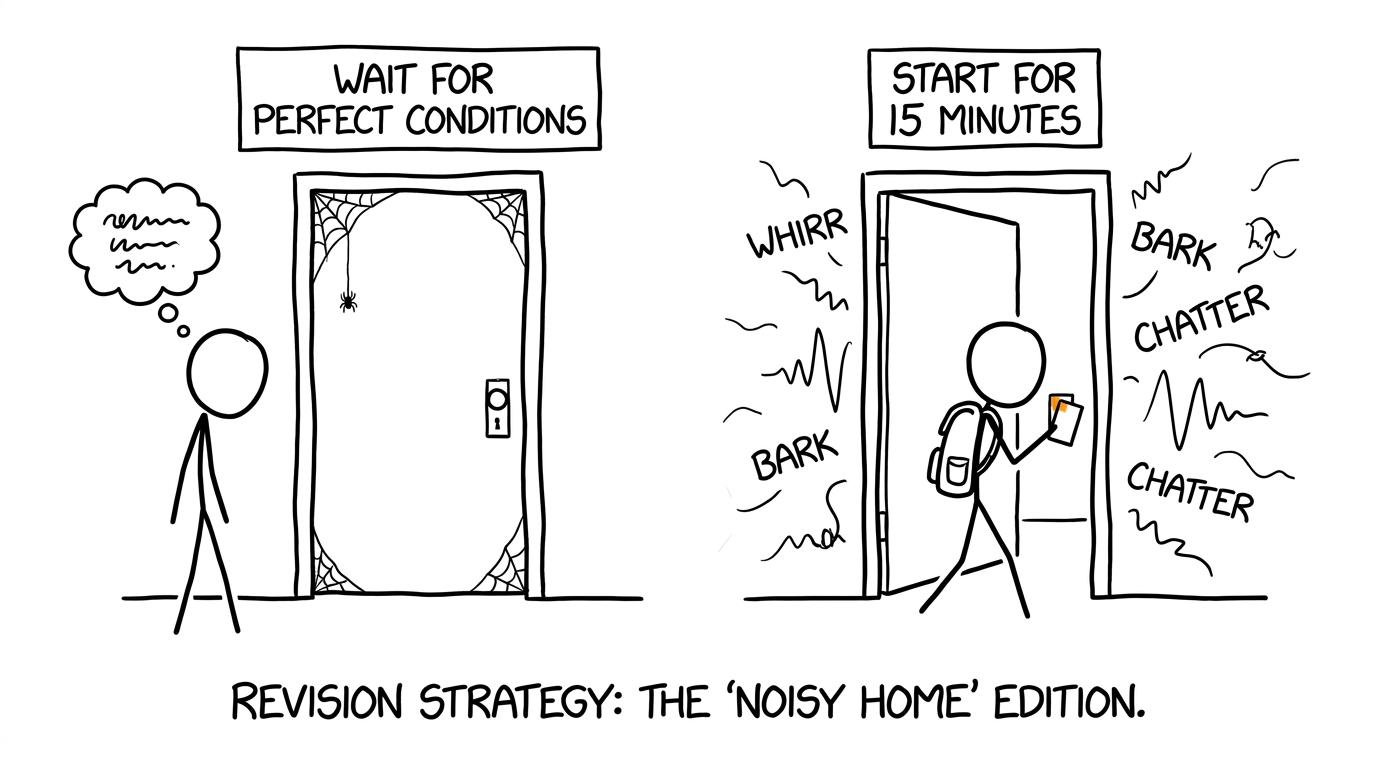 A student chooses a short start instead of waiting for perfect revision conditions
Quiet is helpful, but a system matters more
When home is busy, revision needs to bend without breaking. Build portable resources, use noisy time for retrieval and protect calmer moments for demanding exam practice. Where home cannot provide those moments, ask your school about realistic alternatives.
Most importantly, do not measure yourself against an imaginary student with a silent bedroom and an empty calendar. Measure whether today's plan produced something useful.
Start with one 20-minute history task. Then organise the rest of your GCSE workload through MathsGenie's free GCSE revision resources, using revision lessons, video solutions, practice questions, mini tests, past papers and predicted papers to make each available session count.