Revise GCSE English Literature With a Sibling?
Revise GCSE English Literature with a sibling effectively: discover which advice still helps, what may be outdated and how to plan useful sessions.
The strange thing about asking an older sibling for GCSE advice is that they can sound both reassuring and alarmingly certain. They remember the exam hall, the essays and the quotations they repeated for weeks. Yet the paper you will sit may not be the paper they remember.
So, does it help to revise GCSE English Literature with a sibling who has already completed the course? Yes, provided you use them as a practice partner rather than as your unofficial exam board. They can test recall, listen to interpretations, challenge vague arguments and help you rehearse under pressure. What they cannot safely confirm from memory is your current set-text list, paper structure, anthology, mark allocation or precise assessment requirements.
That distinction changes everything. Experience is useful. Current information is essential.
The quick sibling revision checklist
Before arranging a session, check the following:
- Do you study the same texts your sibling studied?
- Did they take the same exam board: AQA, Edexcel, OCR or Eduqas?
- Are you using the current specification and current school guidance?
- Does the session involve you recalling and explaining, rather than listening passively?
- Will you check any marking advice against an up-to-date mark scheme?
- Have you chosen one clear task and an end time?
- Does the session fit alongside your GCSE maths revision rather than replacing it?
If most answers are yes, a sibling can be genuinely helpful. If not, their stories may still calm your nerves, but they should not shape your exam strategy.
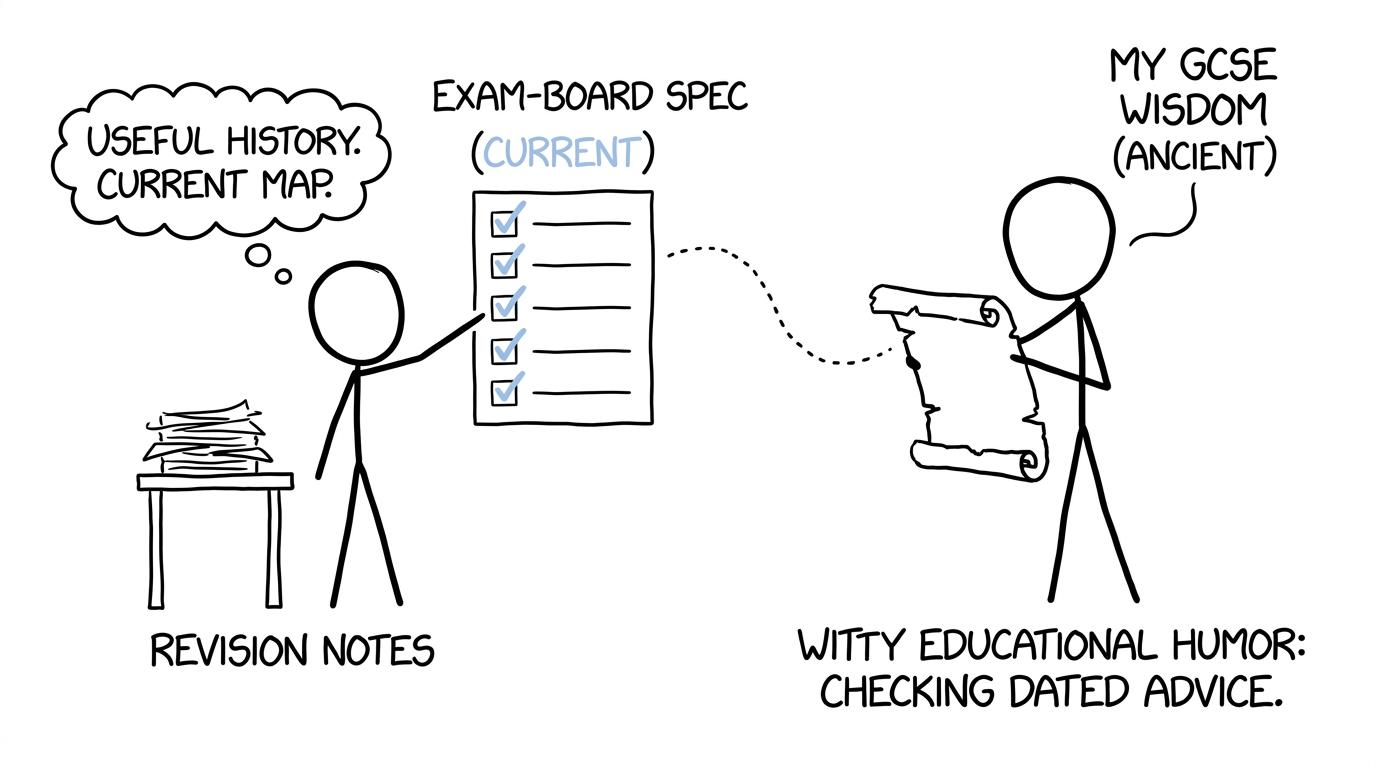 An older sibling offers ancient GCSE wisdom while the younger student checks the current specification
What an older sibling can genuinely help with
The greatest advantage is not that your sibling once knew Macbeth or An Inspector Calls. It is that they can create the resistance that effective revision needs.
Reading notes feels comfortable because every answer is visible. Examinations are different: you must retrieve ideas, select evidence and organise a response without someone pointing to the next line. A sibling can close that gap.
Testing quotations and textual references
Give your sibling a list of quotations, themes, characters and scenes. They can provide a prompt while you retrieve the relevant evidence and explain why it matters.
The explanation is more important than simply completing a quotation. GCSE English Literature rewards understanding and analysis, not a recital detached from the question. After recalling evidence, explain:
- what it suggests;
- how the writer's language, form or structure shapes meaning;
- where it appears in the text;
- which themes or characters it could support;
- how it might answer more than one possible question.
Your sibling does not need to be an English expert to notice when your explanation becomes uncertain. A useful prompt is simply: “Why?” Another is: “How does that answer the question?”
Listening to your argument
A strong literature response is an argument, not a storage box for everything you remember. Explain your interpretation aloud before writing. If your sibling cannot identify your main point, the idea may still be too broad.
Ask them to listen for three things:
- Is there a clear answer to the question?
- Does each point use relevant textual evidence?
- Does the analysis explain the writer's choices and their effects?
They should not decide whether your interpretation is the only correct one. Literature permits different informed responses. Their role is to test whether your view is supported and coherent.
Creating mild exam pressure
A sibling can run a short, distraction-free rehearsal. They can give you a question, keep time and prevent the familiar ritual of checking notes every few minutes.
This is also useful preparation for maths. Whether you are analysing a poem or solving an unfamiliar problem, you need to begin without perfect certainty, choose relevant information and keep moving. MathsGenie's guide to the best order for learning GCSE maths topics applies the same principle: secure knowledge first, then practise using it under increasingly realistic conditions.
Making revision easier to start
Sometimes the hardest part is beginning. A pre-arranged session removes a decision: at a set time, both of you sit down and complete one defined task.
Keep the commitment small and specific. “Test me on the major themes in my nineteenth-century novel” is better than “help me revise English”. A clear task reduces negotiation, drifting and sibling arguments about what counts as revision.
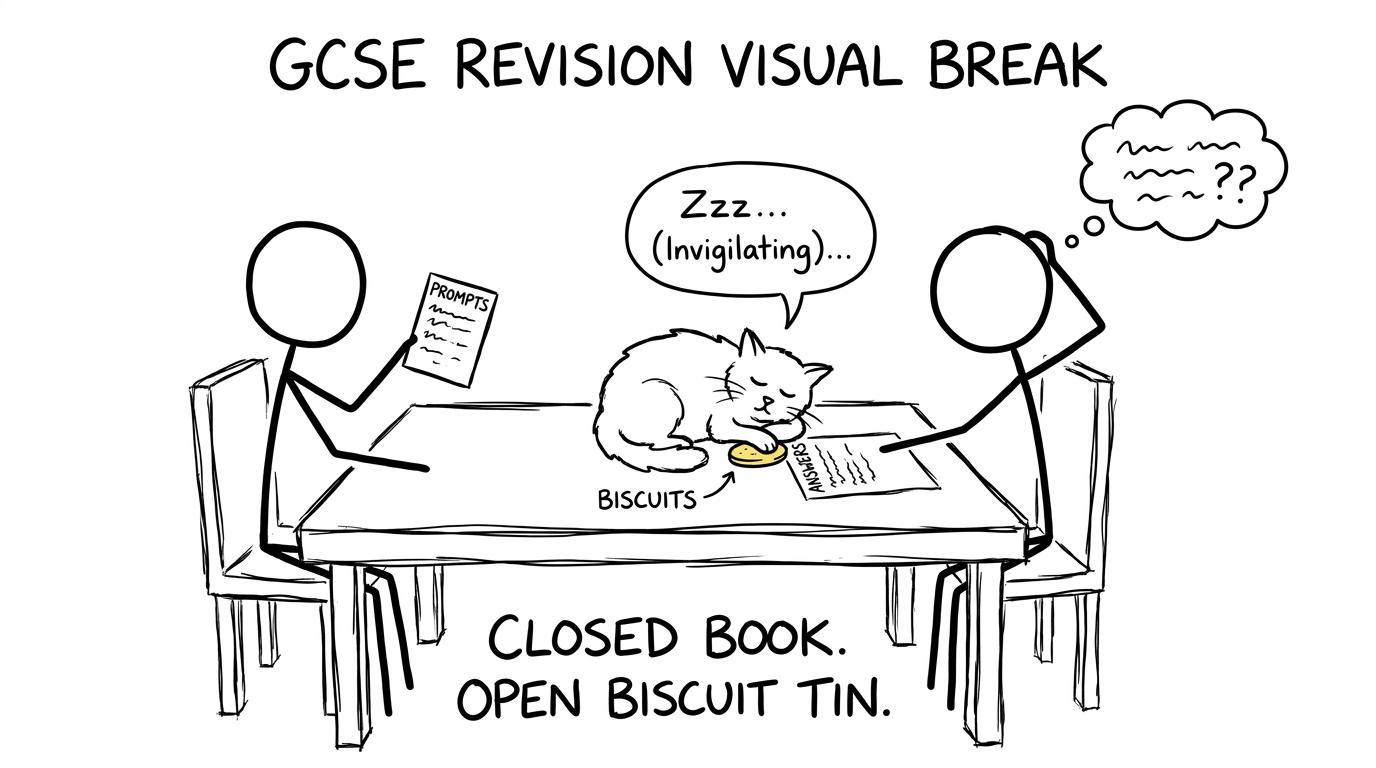 Two siblings practise closed-book quotation recall while a cat guards the answers
What may be outdated in your sibling's advice
Memory preserves the atmosphere of an exam better than its administrative details. Your sibling may accurately remember feeling rushed while misremembering which question was compulsory.
Their texts or anthology may have changed
Exam boards maintain approved text lists and poetry anthologies, and these can change. Even where the title of a qualification remains familiar, your school may select a different Shakespeare play, nineteenth-century novel or modern text.
Never learn quotations merely because your sibling learned them. Begin with the texts and anthology confirmed by your teacher and the current specification for your exam board.
Their paper structure may not match yours
AQA, Edexcel, OCR and Eduqas all assess the national subject content, including understanding texts, supporting interpretations, analysing writers' methods, considering context where relevant and writing accurately. However, boards organise papers and distribute requirements differently.
The number and type of questions, use of extracts, paper timings and location of comparison tasks can vary. A sibling who took another board can help you discuss literature, but their recollection of the paper should not be treated as instructions.
Their favourite essay formula is not an official rule
Older students often remember acronyms for paragraph structure. Such frameworks can help a response stay organised, but no mnemonic can replace answering the actual question.
A rigid formula becomes harmful when it produces repeated, mechanical paragraphs or forces context into every point without relevance. Use your teacher's guidance and current mark schemes to understand what is rewarded. The official assessment objectives concern the quality of your reading, analysis and response, not loyalty to a particular classroom acronym.
Their pandemic-era experience may have been unusual
Students who sat qualifications during or soon after pandemic-related disruption may remember adaptations that do not apply to your examination series. Do not assume that advance information, altered content or other temporary arrangements remain available.
For anything affecting your current exam, check your teacher, school and exam board documentation. “That is how it worked for me” is a useful memory, not verification.
Their grade boundary is not your target score
Grade boundaries can vary between exam series because awarding takes account of the demand of the papers. A raw mark remembered from a previous year does not guarantee the same grade in yours.
Instead of chasing an old boundary, improve the features that mark schemes reward: a focused response, well-selected references, developed analysis and accurate writing.
How to run a useful sibling revision session
A good session has a narrow purpose. It should produce evidence of what you know and expose what needs attention next.
Agree on roles
You are the candidate. Your sibling is the questioner, listener or timekeeper. They should not write paragraphs for you, supply every quotation or turn the session into a lecture about their own GCSE experience.
Give them the material they need: your current text list, teacher-approved prompts and, where appropriate, a current mark scheme. This makes the session safer and more focused.
Choose one high-value activity
Useful activities include:
- closed-book quotation retrieval;
- explaining how one theme develops across a whole text;
- matching flexible evidence to several possible questions;
- verbally planning an essay;
- comparing two anthology poems from your current cluster;
- discussing an unseen poem before writing independently;
- reviewing a completed response against current criteria.
Avoid trying to cover every text in one sitting. Breadth can feel productive while leaving every idea shallow.
Finish with a written next step
At the end, record one secure area and one weakness. The weakness should become a specific future task, such as reviewing the development of a character or practising conclusions that answer the question directly.
This feedback loop is equally valuable in maths. The GCSE Maths revision hub lets you move from revision lessons to focused questions, mark schemes, mini tests and full papers. The aim in both subjects is not simply to complete work. It is to let mistakes decide what happens next.
Balancing English Literature with GCSE maths
Students preparing for maths exams cannot afford to let one anxious subject consume the entire revision timetable. English Literature benefits from short retrieval sessions and regular writing practice; maths requires repeated problem-solving across number, algebra, ratio, geometry, statistics and probability.
Treat both subjects as a sequence of deliberate sessions. Use your sibling for activities that genuinely require another person, such as oral questioning or listening to an argument. Save independent time for essay writing and maths practice.
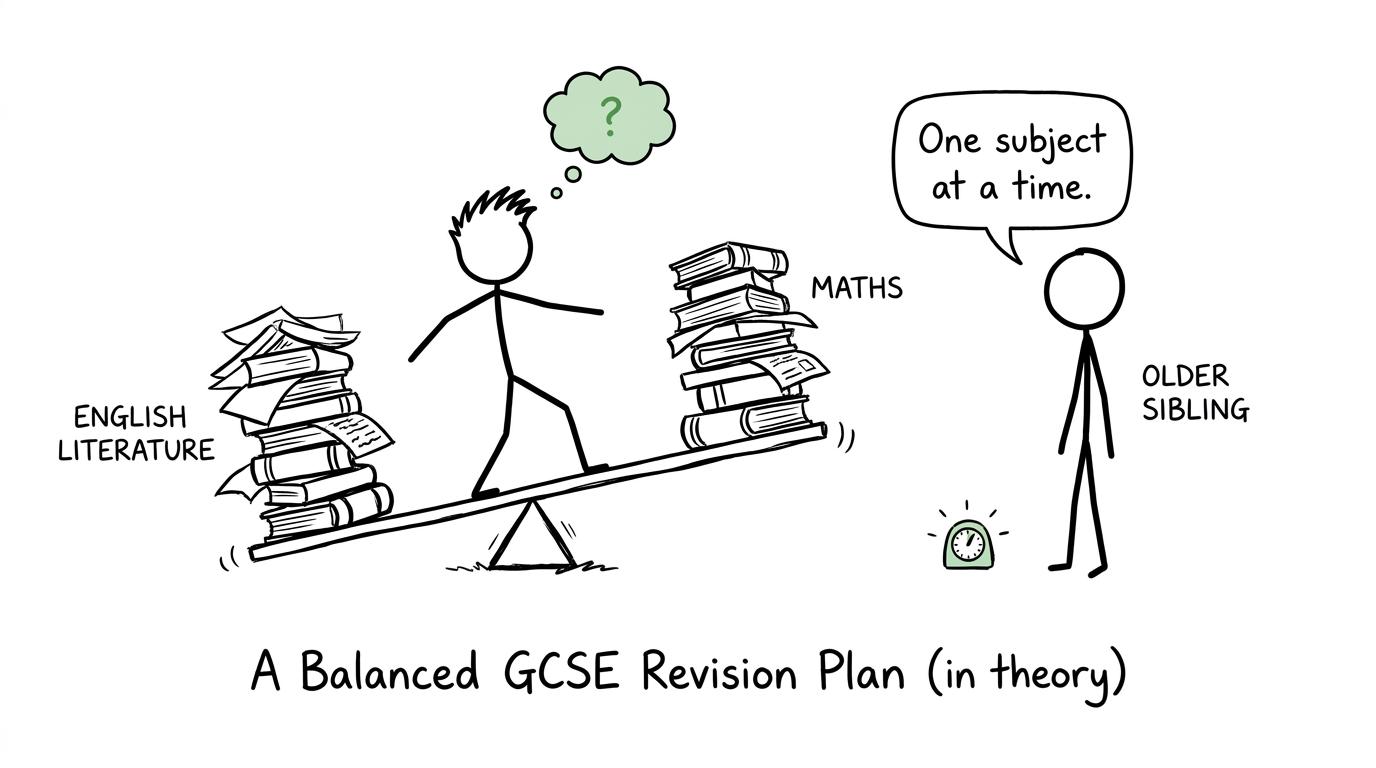 A student balances English Literature and maths revision while a sibling operates a timer
If choosing what to revise in maths feels harder than doing it, use the GCSE maths topics by exam board and tier to identify the content relevant to foundation or higher. Edexcel students can also follow the focused routine in how to revise Edexcel GCSE Maths without wasting time.
A sibling can help protect this balance by asking what you intend to finish before you begin. They are most useful as an accountability partner when the plan is yours.
Common mistakes when revising with a sibling
Treating memory as a current specification
Your sibling's recollection may be sincere and still be outdated. Check texts, paper formats and assessment details using current official information supplied by your teacher or exam board.
Letting them do the thinking
If they complete quotations, suggest every interpretation and restructure every paragraph, they are practising more than you are. Ask for prompts, not answers.
Copying their interpretation
An inherited essay can sound polished but leave you unable to adapt when the question changes. Develop your own informed response and support it with relevant textual references.
Arguing about one “correct” reading
A productive discussion tests evidence and reasoning. It does not require both siblings to agree. Different interpretations can be valuable when they remain grounded in the text.
Revising only comfortable material
It is tempting to repeat familiar quotations because success feels good. Ask your sibling to mix secure prompts with weaker themes, characters and poems.
Ignoring independent exam practice
Conversation cannot replace writing. After oral rehearsal, complete responses independently and under suitable time pressure. The same rule applies to maths: topic confidence must eventually be tested through mixed questions and papers. MathsGenie's overview of GCSE maths topics that recur regularly explains how to move from topic work towards paper practice without relying on predictions alone.
Turn useful support into independent confidence
Revising with an older sibling can help because another person makes your knowledge visible. They hear the hesitation behind a half-learned quotation. They notice when an argument wanders. They can also remind you that an exam is survivable because, for them, it is already in the past.
But the best sibling support leads towards independence. Use their experience for questioning, accountability and calm perspective. Check their technical advice against your current specification, teacher guidance and mark schemes. Then practise writing on your own.
For the maths part of your GCSE preparation, make MathsGenie your free revision base. Choose your board and tier, rebuild weak topics with revision lessons and video solutions, answer practice questions, mark them honestly, and then move to mini tests, past papers and predicted papers. Your sibling can help you begin. Consistent, current practice is what carries you into the exam.