

Revise GCSE English Language and Literature No Quiet Space
Revise GCSE English Language and Literature with no quiet space using short sessions, portable resources, active recall, timed writing and practical support.
A quiet bedroom, an empty desk and several uninterrupted hours make a convincing revision picture. They are not, however, the reality in every home. You may share a room, revise at the kitchen table or live with conversations, televisions and younger siblings in the background.
If you need to revise GCSE English Language and Literature with no quiet space, the answer is not to wait for perfect silence. Build a portable routine around short tasks, use quieter places for demanding writing, and match each activity to the level of concentration available. Your environment matters, but it does not have to decide your preparation.
This guide offers realistic strategies for English revision while you are also preparing for GCSE maths and other exams.
Your practical revision checklist
Start with five decisions:
- identify the quietest times and places available to you;
- divide English revision into small, clearly defined tasks;
- keep a portable revision kit ready;
- save full essays and timed papers for your best concentration window;
- ask your school about supervised revision rooms or library access.
The goal is not to recreate a silent study room. It is to reduce the number of decisions and distractions between you and the next useful task.
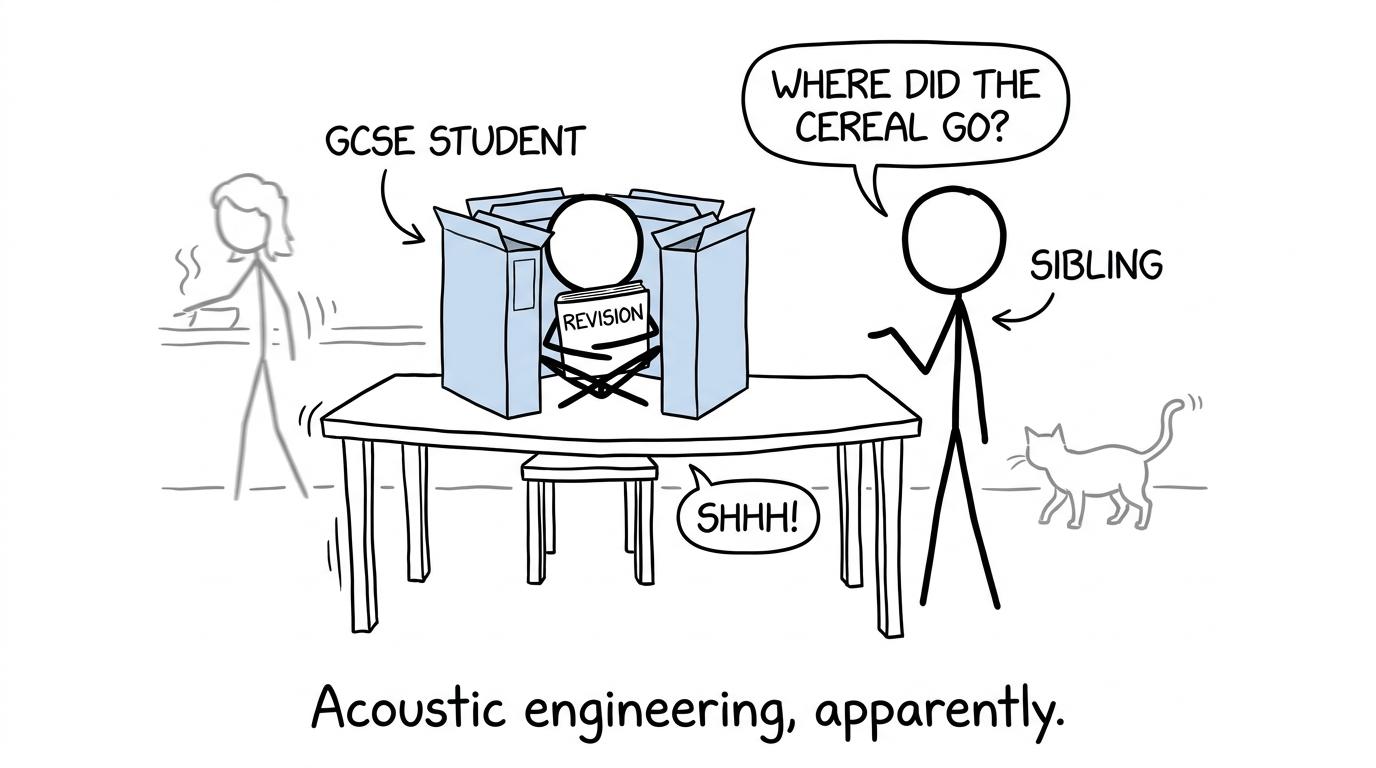 A student builds a cereal-box revision fortress at a busy kitchen table
Stop treating every English task as equally demanding
Noise affects tasks differently. Learning one quotation from a flashcard is not the same as planning an extended comparison. Instead of labelling an evening simply as "English revision", prepare tasks for different conditions.
Low-concentration tasks
These can often survive ordinary background noise:
- testing yourself on short quotations;
- matching characters to themes;
- sorting poems into comparison groups;
- checking spelling and punctuation errors;
- reviewing vocabulary for persuasive or descriptive writing;
- listening to your own recorded notes through headphones;
- reading teacher feedback and highlighting one repeated issue.
Keep several of these tasks in an envelope, folder or notes app. When the house becomes noisy, you can begin immediately rather than spending the available time deciding what to do.
Medium-concentration tasks
Use a relatively settled period for:
- planning an essay without writing it in full;
- annotating a short unseen extract;
- selecting evidence for a theme or character;
- comparing the viewpoints in two texts;
- writing one analytical paragraph;
- improving the structure of an earlier response.
These activities create meaningful practice without demanding a completely uninterrupted hour.
High-concentration tasks
Reserve your quietest location or time for:
- timed English Language responses;
- complete Literature essays;
- unseen poetry comparisons;
- careful marking against assessment objectives;
- practising an entire paper or substantial paper section.
This is revision triage. You are spending scarce quiet time where it has the greatest value.
Find quiet beyond your bedroom
A lack of quiet at home is not something you have to solve entirely by yourself. Ask a teacher, form tutor or pastoral lead whether your school offers lunchtime, after-school or holiday revision spaces. Some schools can also direct students towards local services or suitable community facilities.
A public library may provide individual desks or quiet zones, although opening hours, membership arrangements and rules for younger users vary. Check before relying on it. A trusted relative's home may also be an option if your parent or carer agrees.
When you find a usable place, arrive with a precise task. "Revise English" is too broad. "Plan two possible arguments about responsibility in my set text" gives the session a finish line.
Do not assume that every important session must happen away from home. A useful pattern is to complete preparation in the noisy space, then use the quieter location for performance. At home, retrieve quotations and create an essay plan. At school or the library, turn that plan into a timed response.
Build a revision kit that can move with you
Your revision system should fit inside one bag. Include:
- your exam board's current specification or a teacher-approved checklist;
- the names of your exact Literature texts and poetry cluster;
- quotation cards or a small notebook;
- printed extracts and practice questions;
- pens, highlighters and earphones;
- an error log for feedback from marked responses;
- a simple list of tasks organised by concentration level.
A portable kit makes small opportunities usable. Ten focused minutes before an after-school club can become quotation retrieval. A free lunchtime can become an essay plan. Neither replaces sustained writing practice, but both move it forward.
Keep your English materials separate from your maths work so that each session starts cleanly. For maths, the GCSE Maths revision hub lets you choose your exam board and move between lessons, questions and papers without rebuilding your plan each time.
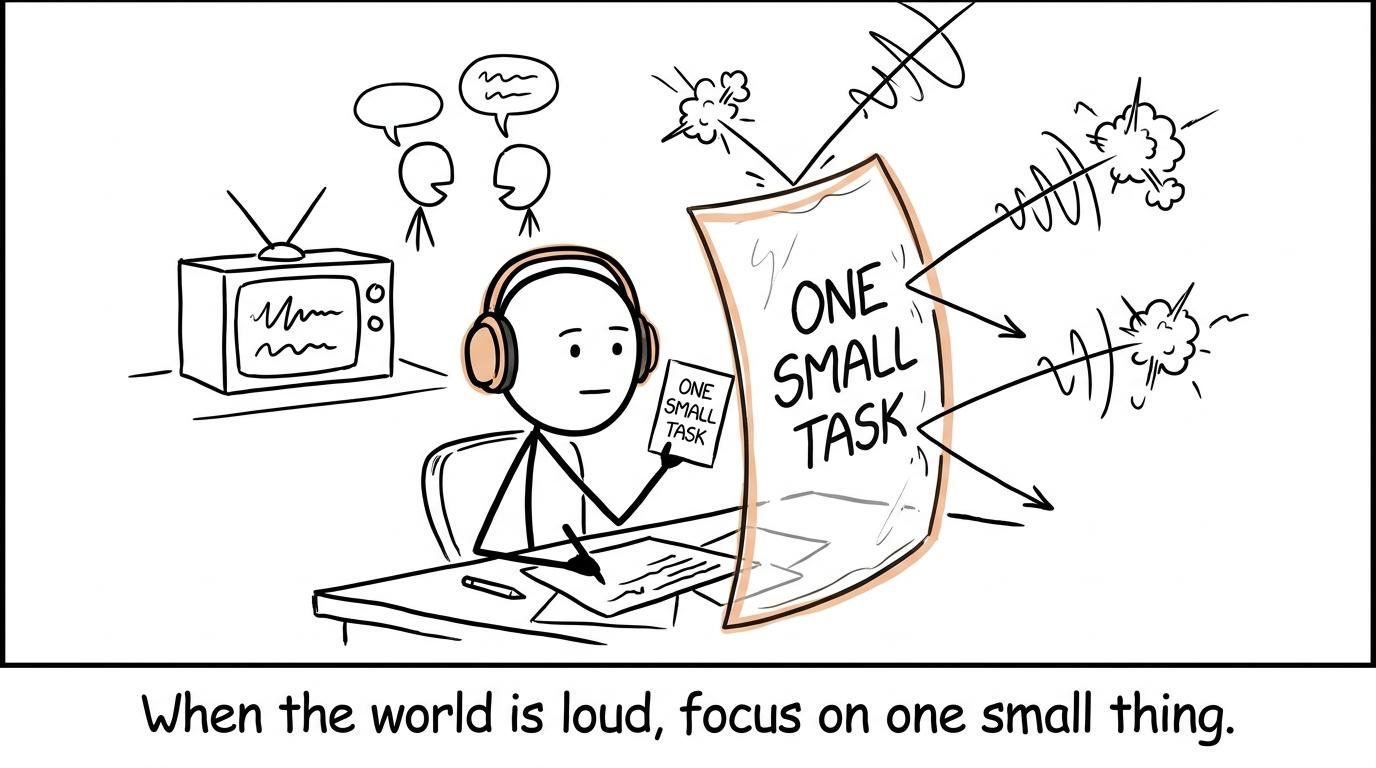 A calm student protects one small task from noisy household distractions
Revise GCSE English Language actively
GCSE English Language rewards reading and writing skills rather than memorised set-text content. Across regulated specifications, reading involves understanding explicit and implicit ideas, analysing writers' methods, comparing or evaluating where required, and supporting responses with evidence. Writing rewards effective communication, organisation, vocabulary, sentence control, spelling and punctuation.
The exact papers, question order and timings differ between AQA, Edexcel, OCR and Eduqas. Use the specification and materials for your board rather than borrowing a routine designed around another paper.
Use short extracts instead of endless notes
Choose a manageable extract and give yourself one purpose: identify a shift in tone, select evidence for an inference or explain the effect of a structural choice. Write the answer, then check whether every claim is supported by the text.
For transactional or creative writing, practise components separately when noise is high. You might plan an opening, improve paragraph transitions or proofread an old answer for sentence-boundary errors. Later, combine those skills in a complete timed task.
Separate planning from writing
Planning is easier to pause and restart than a full response. In a busy home, create the argument, paragraph order and evidence choices first. When a quieter window appears, write without wasting it on deciding what you think.
This same separation works in maths: understand the topic first, then test whether the method survives exam conditions. MathsGenie's guide to building a realistic GCSE revision timetable can help you balance both subjects without scheduling every evening as one long session.
Revise GCSE English Literature without passive rereading
Official subject content requires the detailed study of substantial texts, including Shakespeare, a nineteenth-century novel, poetry and modern prose or drama. Your precise set texts and assessment format depend on your exam board and school.
Rereading can support understanding, but it should not become your entire revision method. Close the book and retrieve:
- the sequence of major events;
- how a character changes;
- three or four flexible quotations for a theme;
- where a quotation appears and why that moment matters;
- a possible interpretation of language, form or structure;
- relevant context that genuinely informs the text.
Then check what you missed. Retrieval reveals gaps that familiar-looking pages can hide.
For poetry, organise comparisons around ideas rather than memorising isolated essays. Group poems by conflict, power, memory, identity, nature or another theme relevant to your anthology. For each pairing, know one meaningful similarity, one difference and evidence you can analyse.
Because assessment details can change, confirm whether materials are supplied and what must be recalled for your board and exam series. Do not rely on assumptions from a friend taking a different specification.
Use sound deliberately, not automatically
Headphones can reduce distraction, but audio with lyrics may compete with reading and writing. Try silence through ear defenders, low-level neutral sound or unobtrusive instrumental audio, then judge the result by the quality of your work rather than by how productive it feels.
Keep the volume at a safe, comfortable level and remain aware of your surroundings. If headphones are unsuitable or unavailable, face away from the busiest part of the room, clear the immediate surface and place a simple visual reminder nearby that you are completing a short task.
You can also agree on a specific protected period with the people at home. Make the request limited and practical: explain when you need reduced noise, how long the session will last and what you are trying to complete. A request for one defined writing block is often clearer than asking everyone to remain quiet throughout exam season.
Practise in imperfect conditions, then simulate the exam
You do not need silence for every revision activity. Some background disturbance can even make ordinary retrieval practice more realistic. But you should complete several substantial responses under controlled, timed conditions before the exam.
Use school, a library or another agreed space for these simulations. Follow your board's current timing, use only permitted materials and finish without pausing the clock. Afterwards, review the response against the relevant assessment objectives and your teacher's guidance.
Apply the same principle to maths. Start with manageable Edexcel GCSE Maths mini tests, then progress to board-specific papers such as AQA GCSE Maths past papers or the OCR GCSE Maths revision hub. If you take Edexcel, predicted papers with mark schemes can add fresh practice after you have used official past papers.
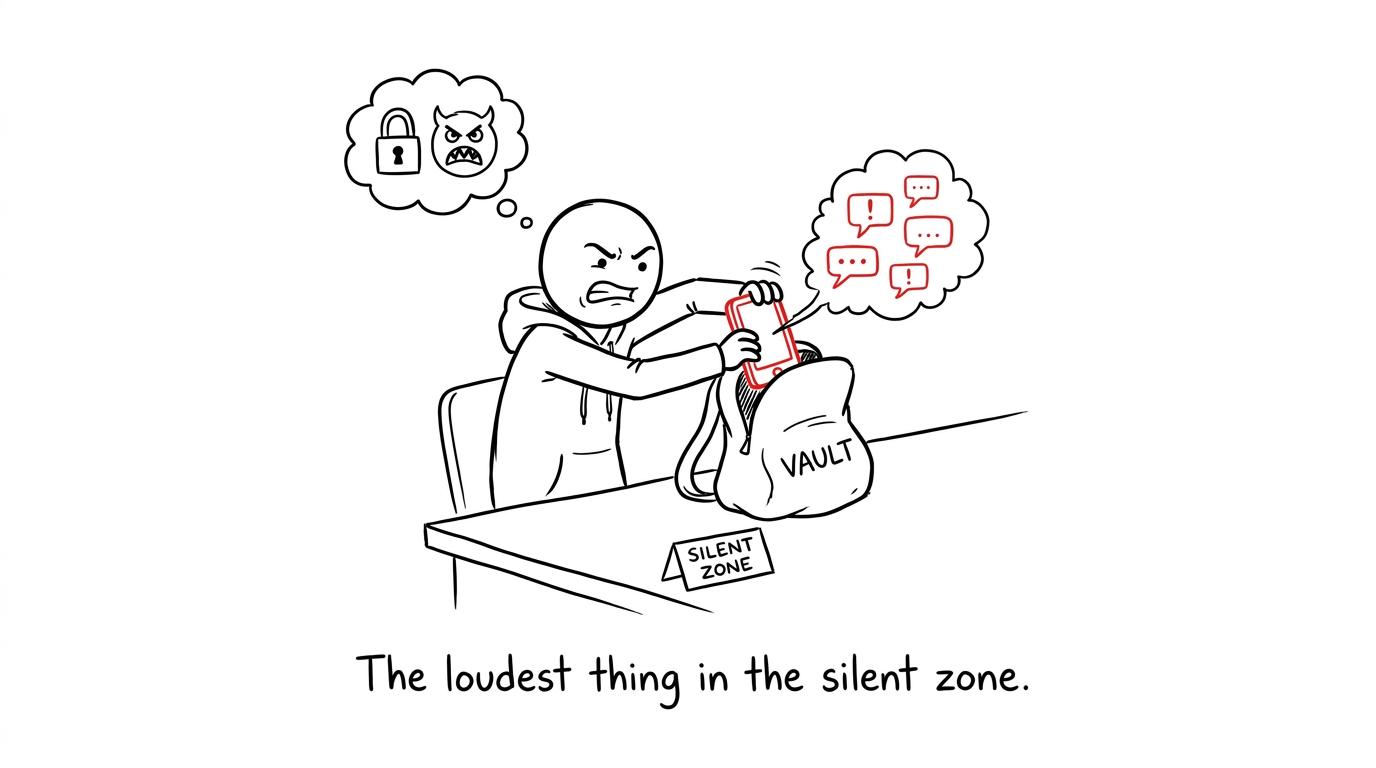 A student seals a distracting phone inside a backpack in the silent zone
Protect attention as carefully as quiet
Sometimes the loudest distraction is not the room. It is the phone beside the paper.
Download or print what you need before starting. Turn off non-essential notifications, place the phone out of reach and use a separate timer where possible. If you need the phone for an audio note or digital text, open that resource first and avoid switching between apps.
Short sessions still need feedback. End each one by recording what you completed, one mistake and the next action. MathsGenie's one-month GCSE revision plan uses the same useful rhythm: diagnose, practise, mark and revisit. It works because the next session begins with evidence rather than guesswork.
Common mistakes when revising without quiet
Waiting for perfect conditions
If you postpone every task until the house is silent, revision becomes dependent on something you cannot control. Keep low- and medium-concentration tasks available for ordinary days.
Doing only comfortable recall
Quotation cards feel manageable, but English exams require extended reading and writing. Build towards complete responses in a suitable space.
Copying notes instead of retrieving
Neat notes can disguise weak recall. Close the text, produce what you know, then check and correct it.
Using the wrong exam-board advice
AQA, Edexcel, OCR and Eduqas do not use identical papers. Check your board, set texts, anthology, timings and current specification with your teacher.
Filling every quiet moment with revision
Rest is not wasted time. Protect sleep, meals and breaks rather than turning an unsuitable environment into an exhausting timetable.
Keeping the problem private
If you cannot find any safe or workable place to revise, tell a teacher or pastoral member of staff early. Asking for access to a supervised space is a practical request, not an excuse.
Quiet helps, but a reliable system matters more
A noisy home may change how you revise, but it does not make useful revision impossible. Prepare portable tasks, match them to the concentration available, use school or library spaces strategically, and reserve your best windows for timed writing.
Then keep the rest of your exam preparation equally simple. Open MathsGenie's GCSE Maths revision hub, choose your board and tier, and use free revision lessons, practice questions, mini tests, past papers, mark schemes, video solutions and predicted papers. One clear task at a time is not a compromise. In an imperfect space, it is how steady progress is built.










