Revise GCSE English Language Alone or With Others?
Revise GCSE English Language alone or with others? Compare both methods, choose by task and build a balanced revision plan that protects maths time.
The frustrating thing about English Language revision is that it can feel productive long before it becomes useful. A group may spend an hour discussing a text without anyone writing an answer. Alone, you may highlight every interesting phrase but never test whether you can explain its effect under time pressure.
So, is it better to revise GCSE English Language alone or with others? The short answer is both, but for different tasks. Revise alone when you need concentration, timed writing and an honest measure of your ability. Work with others when you need alternative interpretations, verbal explanations and focused feedback.
The best plan is not to choose a permanent side. It is to match the revision method to the skill being practised, while protecting enough independent time for GCSE maths and your other subjects.
A quick decision checklist
Choose solo revision when you need to:
- complete a timed reading or writing response;
- memorise terminology or question structures;
- diagnose your own weaknesses;
- improve concentration and writing stamina;
- compare an answer carefully with a mark scheme.
Choose revision with others when you need to:
- explore different interpretations of a text;
- explain why a quotation or structural choice matters;
- exchange specific feedback on written work;
- test vocabulary, terminology or exam knowledge;
- practise speaking clearly about an unfamiliar passage.
Use a hybrid session when you want to discuss a task briefly, write independently and then review the finished responses together. For many students, this is the most reliable arrangement because discussion supports thinking without replacing the writing required in the examination.
Why revising alone works
English Language is assessed through what you can independently read, select, interpret and write. Whatever your exam board, AQA, Edexcel, OCR or Eduqas; nobody can generate the final response for you in the exam hall.
Solo revision therefore gives you something valuable: an honest rehearsal.
You discover what you can actually do
Recognition is not the same as recall. A teacher's explanation can seem obvious when it is in front of you, and a friend's interpretation can sound convincing once they have said it. The more important question is whether you could produce a relevant idea yourself.
Closing your notes, reading an unfamiliar passage and planning a response independently exposes the gaps that passive revision can hide. This principle also matters in maths. Watching a method is only the beginning; attempting questions independently is what reveals whether the method is secure. MathsGenie's GCSE maths revision resources are organised around that movement from explanation to practice.
Timed writing needs quiet concentration
English Language papers require decisions under pressure: which evidence to select, how much to write and when to move on. Those decisions are difficult to practise in a conversation.
A quiet timed attempt helps you develop writing stamina and experience the cost of spending too long on one paragraph. It also produces evidence you can review. Instead of thinking, “I am bad at timing”, you can identify whether the problem was planning, slow quotation selection, excessive detail or an unfinished final section.
You can target your own weaknesses
Group revision naturally drifts towards shared tasks. Your weakest area, however, may not be the group's weakest area. If you struggle to evaluate a writer's method while your friends need help with creative writing, an entirely shared plan will not serve everyone equally.
Independent sessions let you allocate time according to need. The same logic should guide maths revision: use topic practice for gaps, then test whether those topics hold together in complete Edexcel GCSE Maths past papers, AQA GCSE Maths past papers or OCR GCSE Maths past papers, depending on your specification.
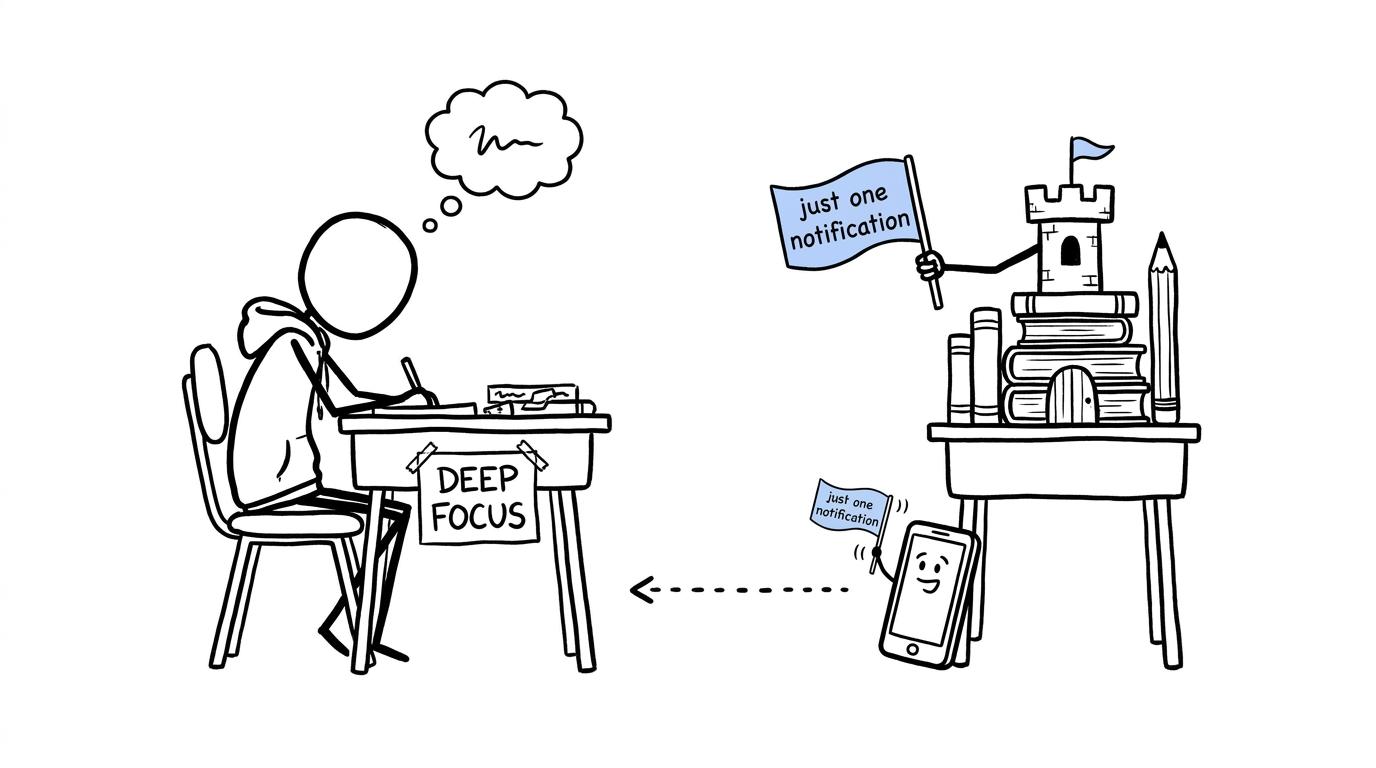 A student protects deep-focus revision from a determined phone notification
Where solo English revision becomes weaker
Working alone is not automatically focused. It can turn into rereading, decorating notes or repeating familiar tasks because they feel comfortable.
English responses also benefit from interpretive range. If you always read alone, you may keep returning to the first plausible idea rather than considering a more precise alternative. Self-marking has limits too. You know what you intended to say, which makes it easy to overlook an unclear explanation that another reader would notice immediately.
Solo revision works best when it leaves a visible result: a plan, a paragraph, a complete response, a list recalled without notes or corrections made from a mark scheme. “Read over English” is too vague to be a useful session goal.
Why revising with others can improve English Language
A well-run revision group is not simply several people working in the same room. It is a structured exchange in which everyone must think, explain and produce something.
Research on collaborative learning generally finds that it can support progress when tasks are carefully designed and every participant contributes. The structure matters. A group with a precise question and individual accountability is very different from a group that hopes useful revision will emerge from conversation.
Discussion broadens interpretation
A passage can support more than one defensible reading. Hearing another student explain how tone, imagery, sentence structure or narrative perspective shapes meaning can reveal details you missed.
The purpose is not to collect impressive-sounding interpretations. It is to test whether each idea is supported by the text and answers the question. Useful group prompts include:
- Which detail most strongly supports that interpretation?
- Is this analysing a method or only retelling the content?
- Could the writer's choice create another effect?
- Which explanation is most relevant to the wording of the question?
These prompts make talk more analytical and less dependent on personal preference.
Explaining an idea tests understanding
An idea often feels secure until you try to explain it clearly. Speaking forces you to organise the chain between evidence, method and effect. If that chain becomes vague, you have found something worth revising.
This is also a powerful maths habit. Explaining why a method works can reveal a misconception that copying steps conceals. After practising the explanation, students can consolidate independently with MathsGenie's free maths revision lessons and exam-style questions.
Feedback gives you a real reader
Peer feedback can be useful when it is narrow and evidence-based. “This is good” offers little direction. A better feedback task might ask a partner to identify:
- the clearest analytical sentence;
- one claim needing stronger textual support;
- a place where expression becomes difficult to follow;
- whether the response remains focused on the question;
- one specific improvement to make next.
Your teacher's guidance and the official materials for your exam board should remain authoritative. Peer comments are most useful as another reader's reaction, not as a substitute for a mark scheme or professional assessment.
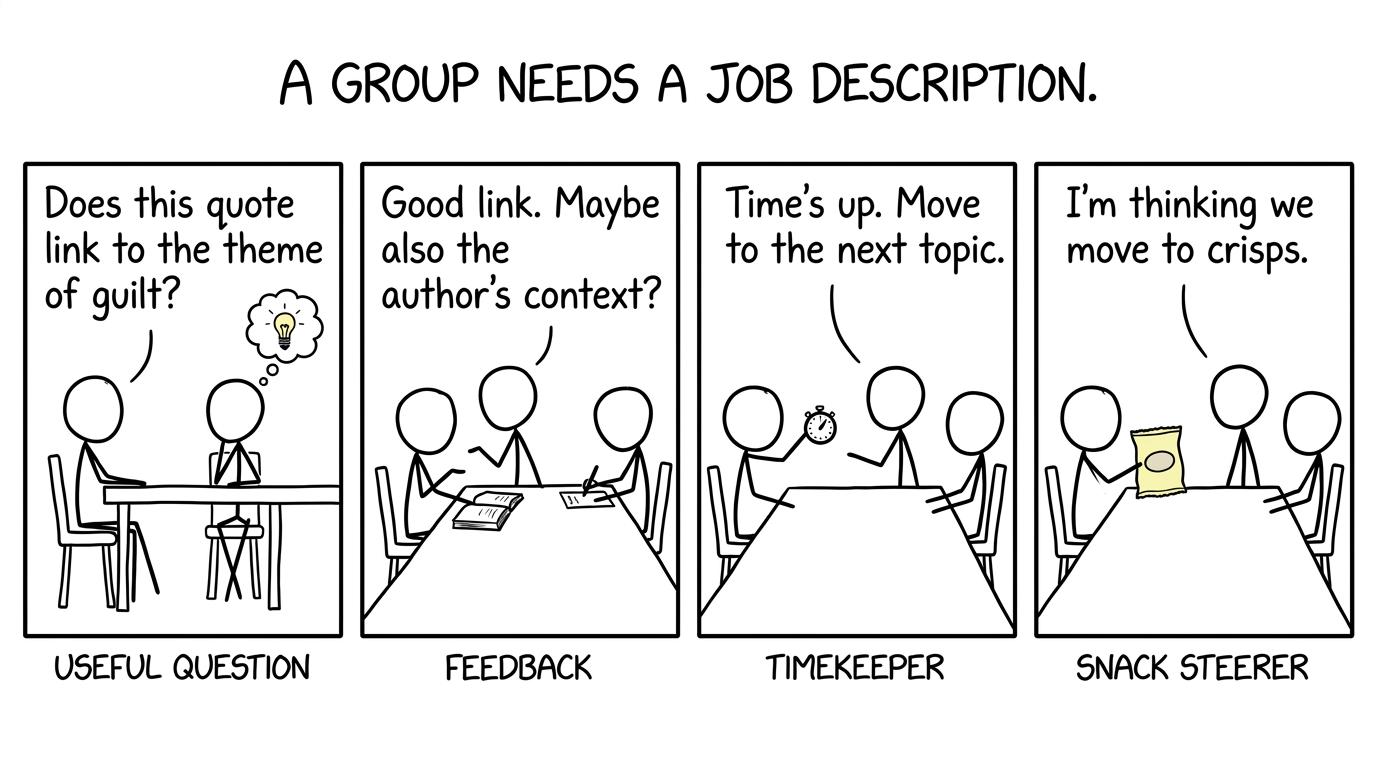 A revision group discovers that useful collaboration needs clearly assigned roles
Where group revision can go wrong
Group revision has an obvious risk: company feels like progress. One confident student may supply every idea while everyone else agrees. Discussion may continue because it is easier than writing. Friends may also repeat inaccurate advice with complete confidence.
To prevent this, give every session a simple structure:
- Set one outcome. Name the question, skill or response you will complete.
- Think alone first. Everyone annotates or plans before discussion begins.
- Take turns. Each person must contribute an interpretation or question.
- Write independently. Convert the discussion into individual exam practice.
- Review the evidence. Use your specification, teacher guidance or mark scheme.
Roles can help: one person keeps time, another reads the task, another challenges unsupported claims and another records questions to check later. Rotate the roles so that nobody becomes the permanent teacher or passenger.
Which method suits each English Language topic?
Reading comprehension and information retrieval
Start alone. These tasks depend on accurate reading and independent selection. Afterwards, compare choices with a partner and discuss why irrelevant details were tempting.
Language and structural analysis
Use a hybrid approach. Annotate independently first, then compare interpretations. Finish by writing your own response without borrowing another student's wording.
Comparing texts or viewpoints
Group discussion can help you notice contrasts in attitude, tone and method. However, complete the comparison independently so that you practise selecting the strongest connections under exam conditions.
Evaluation questions
A partner is valuable because evaluation requires a judgement supported by evidence. Ask each other whether the judgement is clear, qualified and sustained rather than merely asserted.
Creative or transactional writing
Plan and draft alone, because the examination requires independent control of structure, vocabulary, tone and technical accuracy. Use a partner afterwards as a real reader. Ask what impression the writing created and where its clarity or pace weakened.
Terminology and exam knowledge
Short group quizzes can make recall more active, but every person should answer before hearing the solution. Always check paper formats and assessment requirements against the current specification for your exam board, as question wording and paper organisation are not identical across boards.
Build a hybrid revision routine
A practical English session can move through three phases:
- Independent attempt: plan or answer a question under controlled conditions.
- Focused collaboration: compare approaches and request specific feedback.
- Independent improvement: rewrite a section or record one action for the next attempt.
The final phase matters most. Discussion should lead to a change in what you can do, not simply a longer page of notes.
Your wider timetable should also reflect the demands of each subject. English Language benefits from sustained reading and writing, while maths requires repeated problem-solving across topics. Alternate substantial English tasks with focused maths practice rather than allowing one subject to consume an entire week.
MathsGenie's predicted GCSE maths papers can support realistic exam practice, while past papers help you identify topics to revisit. If you are preparing beyond GCSE, the same independent-attempt-and-review cycle applies to A Level maths revision and A Level maths past papers.
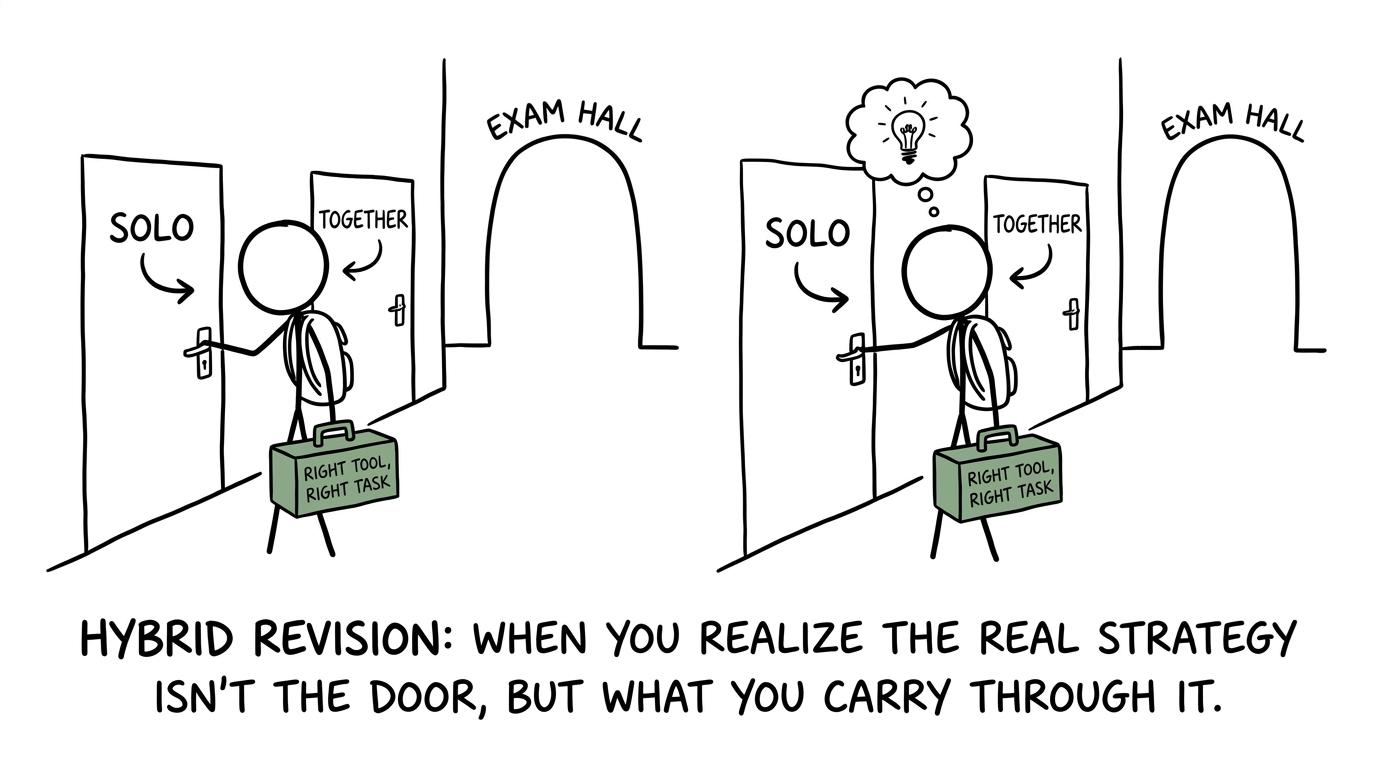 A student chooses between solo and shared revision using the right tool for each task
Common mistakes when choosing how to revise
Treating group revision as the reward
If the session's main appeal is social, decide the task before meeting. Conversation is not a problem; conversation without an academic outcome is.
Letting the strongest person do the thinking
Listen only after everyone has attempted the task. Otherwise, recognition can create the illusion that you would have generated the same idea independently.
Avoiding timed work
Untimed discussion can strengthen understanding, but it cannot replace complete responses under realistic conditions. Include regular independent writing.
Giving vague peer feedback
Comments such as “add detail” or “use better vocabulary” are difficult to act upon. Tie feedback to a sentence, assessment objective or specific reader response.
Using one method for every topic
Flashcards, discussion and timed papers solve different problems. Choose the method after naming the skill, not before.
Allowing English revision to displace maths
Both subjects reward practice, but their practice looks different. Schedule maths explicitly and use MathsGenie's free GCSE revision platform for lessons, practice questions, mini tests, video solutions and mark schemes rather than relying on passive note-reading.
Choose the method that makes you produce
The real choice is not between solitude and company. It is between revision that exposes your thinking and revision that lets you hide from it.
Work alone for timed responses, diagnosis and concentration. Work with others for interpretation, explanation and focused feedback. Then combine the two: think independently, discuss precisely and improve independently.
As your English plan becomes clearer, give GCSE maths the same disciplined attention. Start with a MathsGenie revision lesson, attempt the practice questions without help, use video solutions and mark schemes to correct errors, then move towards mini tests, past papers and predicted papers. The right revision method is the one that leaves you able to do more when the notes and the group are no longer beside you.