Can You Redo GCSE Astronomy Coursework?
Redo GCSE Astronomy coursework rules explained: when observations can be repeated, what resubmission means, and how the current Edexcel GCSE is assessed.
There is a particular kind of frustration in spending several cold evenings recording the sky, only to look at your report and think: I could do that much better now. If you want to redo GCSE Astronomy coursework, the short answer is that you may be able to repeat or improve an observation before your centre certifies completion, but you must agree this with your teacher, tutor or examination centre first.
There is also an important correction to make. Under the current Pearson Edexcel GCSE Astronomy specification, the observational tasks are mandatory but are not coursework carrying marks towards your grade. Your final grade comes from the two written examination papers. Repeating an observation can help you meet the completion requirement and prepare for observational-skills questions, but it does not replace a low coursework mark because there is no separate coursework mark in the current qualification.
The answer at a glance
- Current GCSE Astronomy students must complete at least one unaided observation and one aided observation.
- The observations are not given marks that contribute directly to the final GCSE grade.
- Your centre must certify that you completed the required observational work.
- If an observation is incomplete or does not satisfy your centre's requirements, the centre may require you to repeat or improve it.
- You cannot decide independently that a replacement has been formally accepted. Ask your teacher, tutor or examination officer.
- A private learning provider may impose its own submission deadlines, resubmission process or administrative fee.
- Improving an observation record is useful because observational knowledge and skills are tested in the written papers.
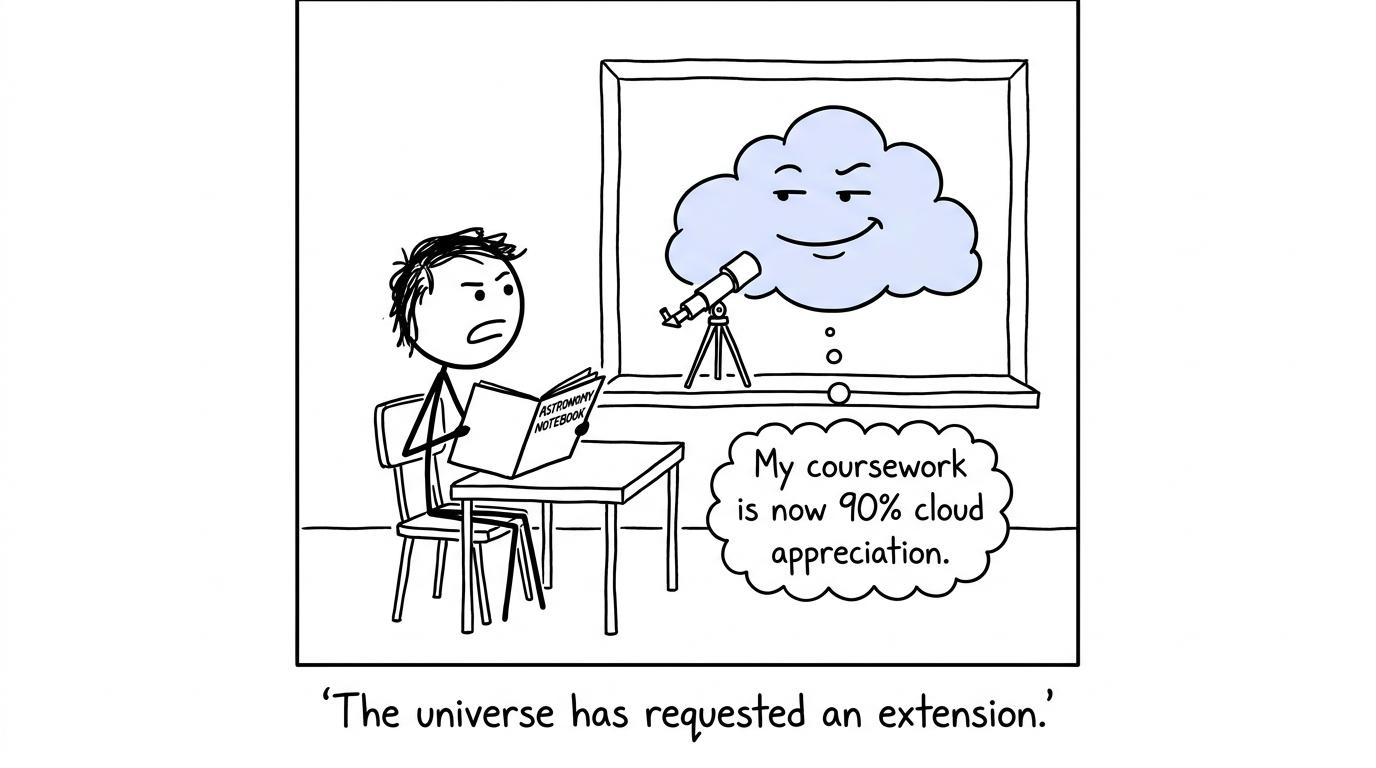 A student discovers that clouds also have deadlines
Is GCSE Astronomy coursework still part of the grade?
This is where much of the confusion begins. Online advice about GCSE Astronomy often mixes two different versions of the qualification.
The older Edexcel specification included controlled assessment. Students completed aided and unaided tasks that were marked by teachers and moderated by the exam board. Those marks contributed to the qualification. That specification is no longer the current GCSE.
The current Pearson Edexcel GCSE Astronomy, qualification code 1AS0, is externally assessed through:
- Paper 1: Naked-eye Astronomy
- Paper 2: Telescopic Astronomy
Each paper lasts 1 hour 45 minutes and is worth 100100100 marks, giving 200200200 marks in total. The qualification is untiered, so there is no foundation or higher paper choice.
The observations remain compulsory, but they are now a practical course requirement rather than a separately marked coursework component. Pearson states that students must undertake at least one unaided and one aided observation. Centres then submit an Observation Statement confirming completion by 15 April in the year students sit the examinations.
Ofqual's current requirements also state that at least 15%15\%15% of the available examination marks must assess knowledge, understanding and application of observational skills. At least 20%20\%20% of the qualification's marks assess mathematical skills. The practical work therefore matters, just not in the way the word “coursework” usually suggests.
When can you redo GCSE Astronomy coursework?
Whether you can repeat an observational task depends on its status and your centre's procedures.
Before your observation has been accepted
If your teacher or tutor says that the work is incomplete, lacks sufficient evidence or does not meet the specification's completion requirements, you may be asked to improve the record or undertake the observation again.
Reasons might include:
- missing dates, times or locations
- no record of weather or seeing conditions
- insufficient evidence that you made the observation
- missing equipment details for an aided task
- analysis that does not relate to the collected information
- failure to evaluate limitations or possible improvements
- selecting an aided and unaided task from the same numbered row, such as A1 and B1
At this stage, contact your centre before changing anything. It must be able to authenticate your work and decide whether the revised evidence is satisfactory.
After your centre has certified completion
Once the centre has accepted and certified the observations, redoing them normally offers no direct grade advantage. The reports themselves do not receive a mark contributing to your final result.
You can still repeat observations for learning, especially if your first attempt exposed weaknesses in planning, data handling or evaluation. Treat that as revision rather than a formal resubmission unless your centre tells you otherwise.
If you are learning privately
Private candidates and distance learners need to follow the rules of the centre responsible for their entry. A course provider may set an earlier internal deadline so that reports can be checked before Pearson's deadline. It may also have its own resubmission conditions or fees.
A policy used by one provider is not automatically an Edexcel rule for every student. Ask your own centre these precise questions:
- Has my task been accepted as complete?
- Do I need to repeat the observation or only add missing evidence?
- What is the internal deadline?
- Will the centre authenticate and certify the revised task?
- Is there a resubmission charge?
What the observational rules actually require
The current specification requires two different types of practical experience.
Unaided observation
An unaided task is carried out with the naked eye or rudimentary equipment such as a shadow stick. It might involve recording lunar features, estimating light pollution or assessing a sundial.
Aided observation
An aided task uses equipment such as binoculars, a telescope, a camera or a robotic telescope. Students might use photographs or telescopic drawings to investigate an astronomical feature.
The aided and unaided tasks cannot come from the same numbered row in Pearson's task table. In other words, pairing A1 with B1 is not permitted, even though one is unaided and the other aided.
Pearson describes observational work as a cycle involving design, observation, analysis and evaluation. Records should include the date, time, location, seeing conditions and full details of any optical instrument used. Safety takes priority throughout. Never attempt solar observation without approved procedures, suitable equipment and responsible supervision.
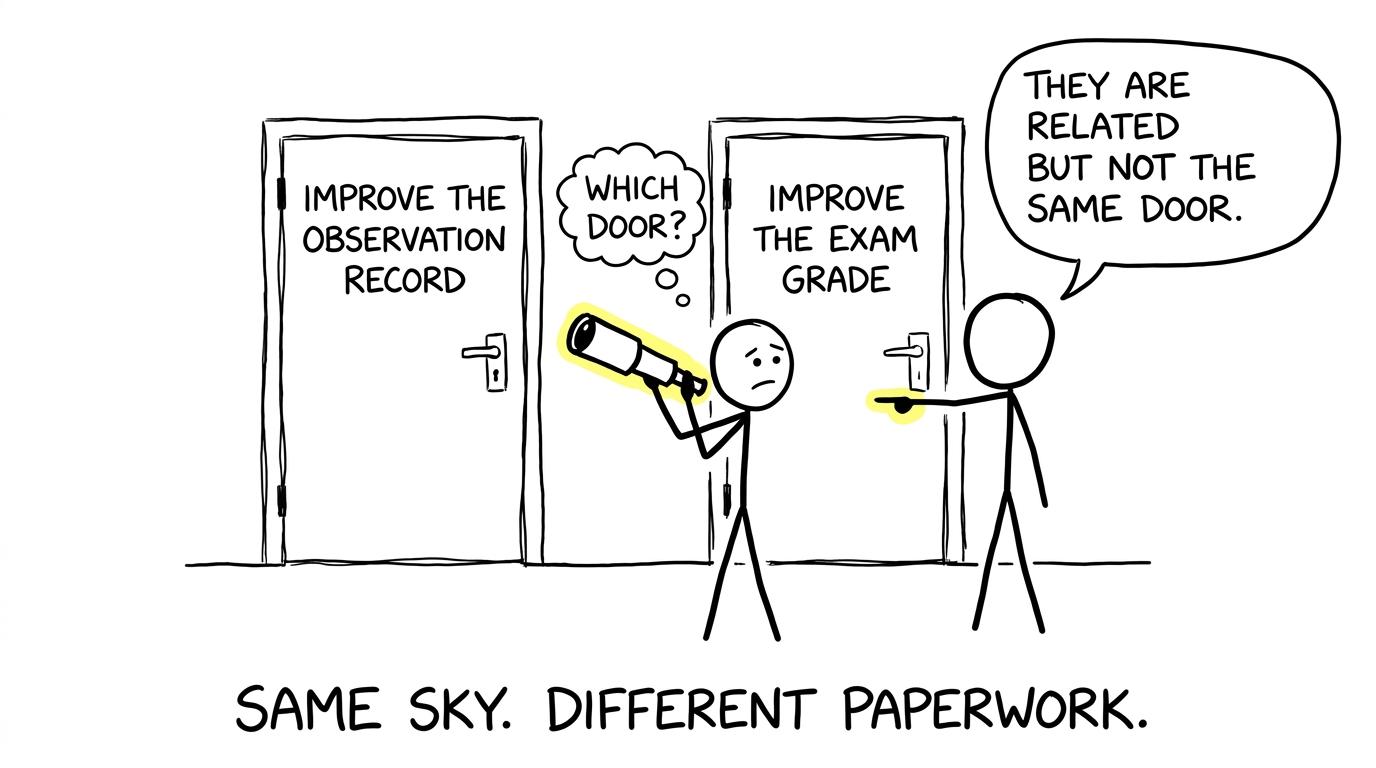 A student chooses between improving a record and improving an exam grade
Redoing the task versus challenging a mark
These are different processes.
A review of centre-assessed marking is relevant when internally assessed work receives a mark that contributes to a qualification. The current GCSE Astronomy observations are not marked components, so there is no coursework score to appeal simply because you dislike the quality of your report.
If you believe your centre has incorrectly decided that you did not complete the requirement, raise the issue promptly with your teacher and examination officer. Ask for the centre's written procedure and the precise reason the evidence was rejected. Keep the conversation focused on specification requirements and authentication rather than on whether the report “feels good enough”.
General JCQ rules about redrafting marked coursework should not be mistaken for the subject-specific structure of current GCSE Astronomy. The Pearson specification and your centre's instructions are the decisive documents for these observational activities.
How observations can strengthen your maths revision
Astronomy has a habit of turning abstract maths into something visible. Scale, angle, time, error and graphical patterns stop being isolated topics and become ways of describing what happened in the sky.
If your report reveals weak mathematical skills, use that information to shape your GCSE maths revision. Useful areas include:
- standard form revision for extremely large distances and quantities
- SOHCAHTOA and trigonometry for angles and indirect measurements
- scatter graph revision for identifying trends and judging correlation
The strongest revision loop is simple: identify the weak skill, revisit the method, complete practice questions and check the solution. The GCSE Maths revision hub lets you choose resources for Edexcel, AQA, OCR, Eduqas and other boards.
Remember that GCSE Maths and GCSE Astronomy have different assessment structures. Foundation and higher tier apply to the main GCSE Maths qualifications, while Edexcel GCSE Astronomy is untiered. Always revise from the correct specification.
What to do if the weather ruins your planned observation
Poor weather is not a moral failure, although it can feel personal when clouds arrive at exactly the wrong time.
Do not fabricate conditions, results or images. Instead:
- tell your teacher or tutor immediately
- preserve your original plan and contemporaneous notes
- ask whether the observation can be rearranged
- check whether another permitted task is practical within the remaining time
- confirm what alternative evidence the specification and centre allow
Begin early enough to leave room for cloud, equipment problems and observations that depend on particular dates or celestial events. A MathsGenie revision planner can help you protect time for maths alongside astronomy deadlines rather than allowing one subject to consume the other.
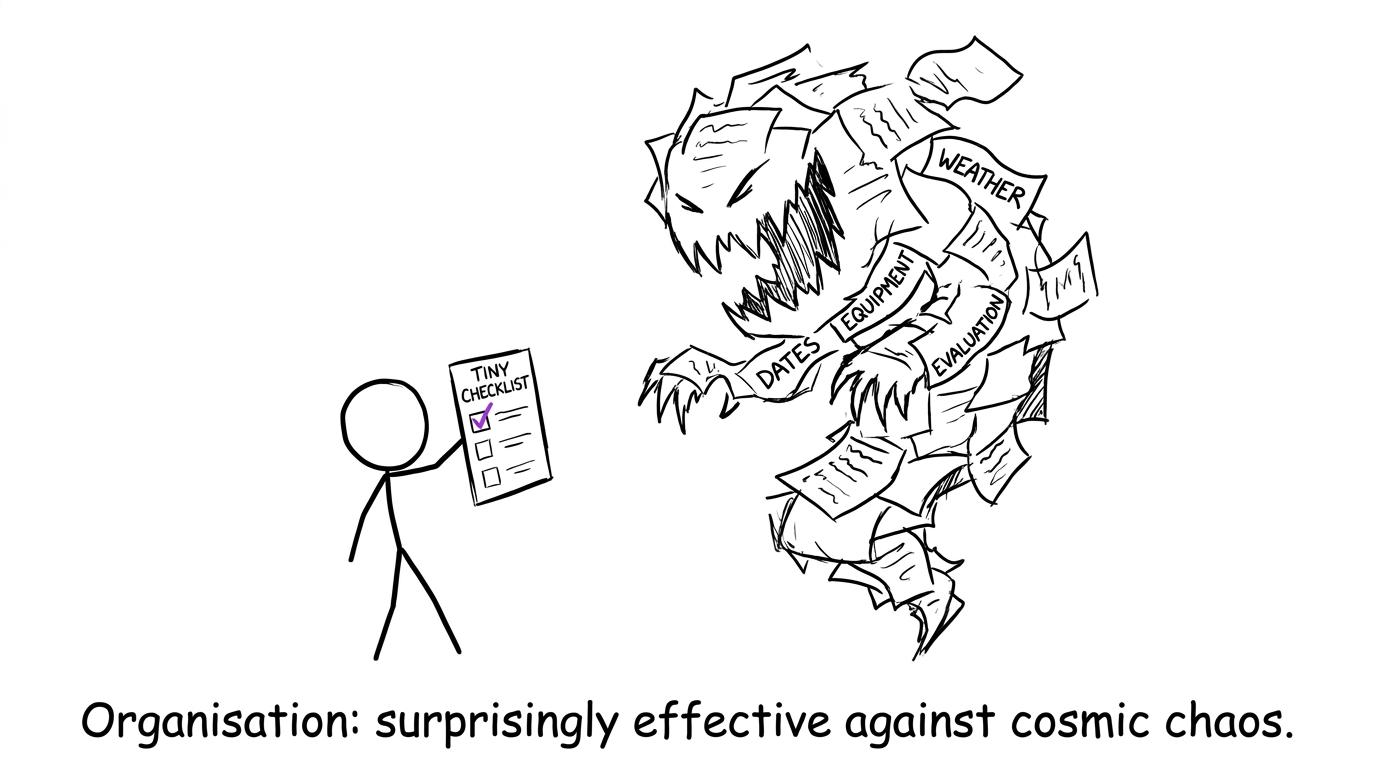 A checklist protects a student from cosmic paperwork
Common mistakes when trying to resubmit an observation
Assuming the old coursework rules still apply
Advice discussing a marked controlled-assessment component may refer to the previous specification. Check that guidance names the current 1AS0 qualification.
Rewriting everything before speaking to the centre
Your centre decides what evidence it can authenticate and accept. Ask what is missing before repeating hours of work unnecessarily.
Believing a better report directly raises the final grade
The observations support examination learning, but the current reports do not contribute a separate mark. To raise your grade, you must also improve your written-paper performance.
Altering or inventing observational evidence
Your records must reflect work you genuinely completed. If equipment failed or clouds prevented a measurement, report the limitation honestly and seek guidance.
Ignoring the mathematical weaknesses revealed by the task
A practical can expose uncertainty with graphs, percentages, units or scale. Turn those gaps into a focused revision list, then test them using Edexcel GCSE Maths past papers and mark schemes.
Leaving the decision too late
The external Observation Statement deadline is not a sensible personal target. Your centre will need time to inspect the work, resolve problems and complete its administration. Follow its earlier internal deadline.
Turn disappointment into useful evidence
Being unhappy with a first attempt can be productive. It means you can now see details that were invisible when you began. The important step is to respond accurately.
First, ask your centre whether the observation is incomplete, formally accepted or already certified. If it needs correcting, follow the centre's instructions and keep the evidence authentic. If it is already complete, use what you learned to prepare for the written examinations rather than chasing a coursework mark that does not exist in the current specification.
Then return to the parts you can still improve. Use MathsGenie's free revision lessons and practice questions to repair individual maths skills. Build timing with GCSE predicted papers, then use past papers, mark schemes and video solutions to understand where marks are won or lost.
The sky will not always cooperate. Your revision plan can.