Recover From Bad GCSE Astronomy Mock Results
Recover from bad GCSE Astronomy mock results with a calm plan to diagnose lost marks, repair weak skills and improve your next paper confidently.
A disappointing mock result can feel strangely final. The number sits at the top of the paper as though it has measured your ability, rather than one performance on one day. But a mock is not a verdict. It is a map of where marks were lost while there is still time to recover them.
To recover from bad GCSE Astronomy mock results, first mark the paper carefully, classify every lost mark, choose the two or three weaknesses with the greatest impact, and then follow a cycle of targeted revision, practice and retesting. The goal is not to feel better immediately. It is to turn disappointment into useful evidence.
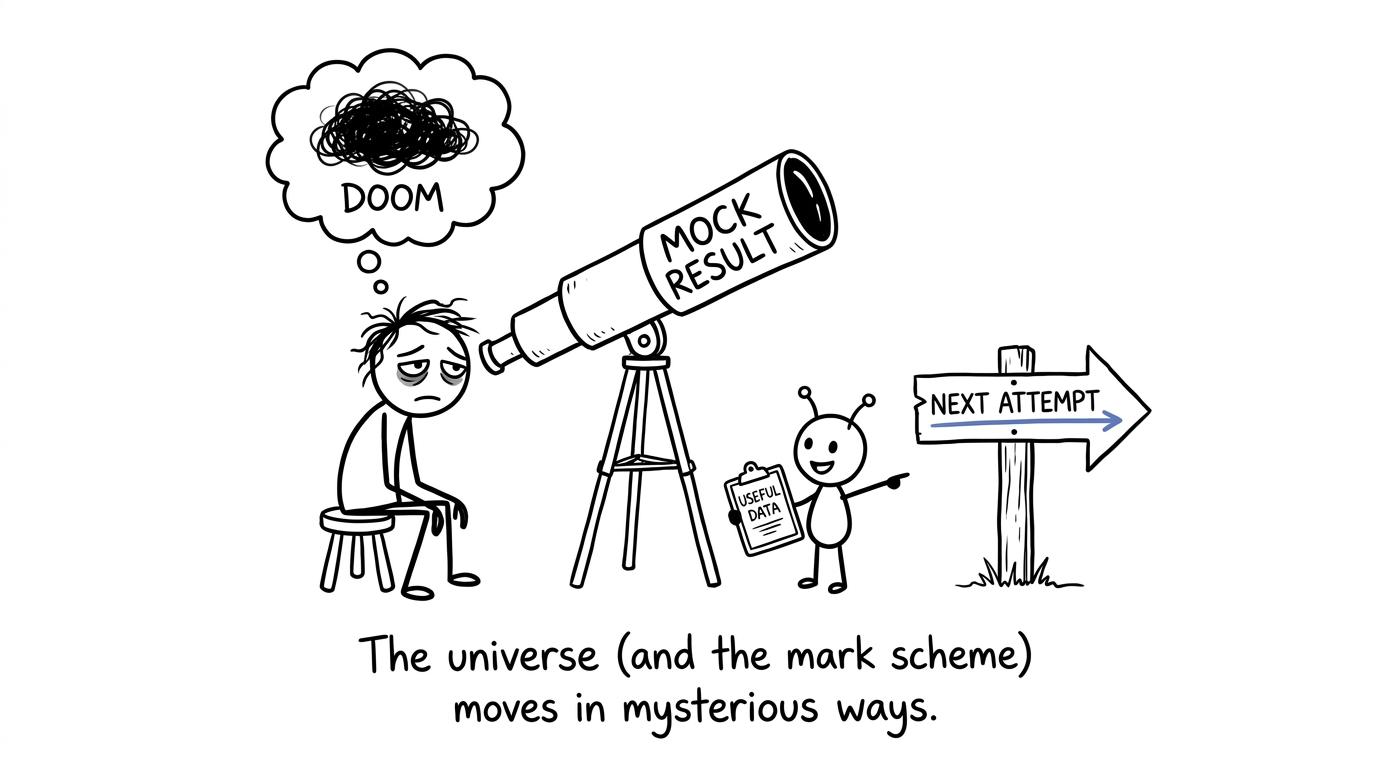 A student discovers that a disappointing astronomy mock is useful data rather than doom
Your recovery checklist
Use this sequence before doing more general revision:
- Wait until the initial disappointment has settled.
- Read your paper alongside the mark scheme.
- Record why each mark was lost, not merely the topic.
- Separate knowledge, application, analysis, maths and exam-technique errors.
- Prioritise the two or three weaknesses worth the most marks.
- Repair each weakness with focused questions.
- Retest it without notes after a short gap.
- Complete another timed section and compare the evidence.
This is similar to the approach in MathsGenie's guide to finding your weakest GCSE topics. A result becomes valuable only when it changes what you do next.
Understand what the mock was testing
GCSE Astronomy in England is currently offered by Pearson Edexcel. Unlike GCSE Maths, it is not divided into foundation and higher tiers. The qualification has two externally examined papers: Paper 1, Naked-eye Astronomy, and Paper 2, Telescopic Astronomy. Each lasts 111 hour 454545 minutes, carries 100100100 marks and contributes 50%50\%50% of the qualification.
Your school's mock may use a complete past paper, selected questions or a paper assembled by teachers. Check what you actually sat before drawing conclusions from the result. A mock covering only part of the specification cannot provide a complete prediction of your final grade.
The official assessment objectives also explain why simply memorising more facts may not solve the problem:
- AO1, knowledge and understanding: 40%40\%40%
- AO2, applying knowledge and understanding: 40%40\%40%
- AO3, analysing information, observations, data and methods: 20%20\%20%
This means 60%60\%60% of the assessment goes beyond straightforward recall. If you knew the facts but struggled to apply them to an unfamiliar diagram, analyse data or evaluate an observational method, rereading notes alone is unlikely to repair the weakness.
Observational work matters too. Students must undertake at least one unaided and one aided observation, while knowledge and understanding of observational skills are assessed in the written examinations. Questions can ask you to plan, analyse or evaluate an observation, including its safety, accuracy, reliability and possible improvements.
Turn the paper into a marks-leak audit
Do not begin by writing vague labels such as “stars” or “telescopes”. Those labels describe content, not the reason the mark disappeared.
Go through every lost mark and assign it to one of these categories:
| Error category | What it may look like | Appropriate repair |
|---|---|---|
| Knowledge | A fact, definition or process was missing | Relearn the precise specification content, then use retrieval questions |
| Application | You knew the idea but could not use it in a new context | Practise unfamiliar exam-style questions |
| Analysis | You misread evidence, a graph or observational data | Practise interpreting and comparing data |
| Maths | The astronomy was understood, but the calculation failed | Repair the exact mathematical skill |
| Communication | Working, units, significant figures or reasoning were incomplete | Compare your response closely with the mark scheme |
| Timing | Questions were unfinished or rushed | Practise timed sections and improve question selection |
You can calculate the proportion of your lost marks caused by a category using:
Proportion of lost marks=marks lost in the categorytotal marks lost\text{Proportion of lost marks}=\frac{\text{marks lost in the category}}{\text{total marks lost}}Proportion of lost marks=total marks lostmarks lost in the categoryThis is not a worked example or a prediction of your grade. It is simply a way to stop one memorable mistake from distracting you from a larger pattern.
Suppose your audit shows that most losses came from applying equations and interpreting graphs. Your plan should focus there, even if revising planets feels more comfortable. Revision often fails because students practise what feels familiar rather than what the paper has shown to be weak.
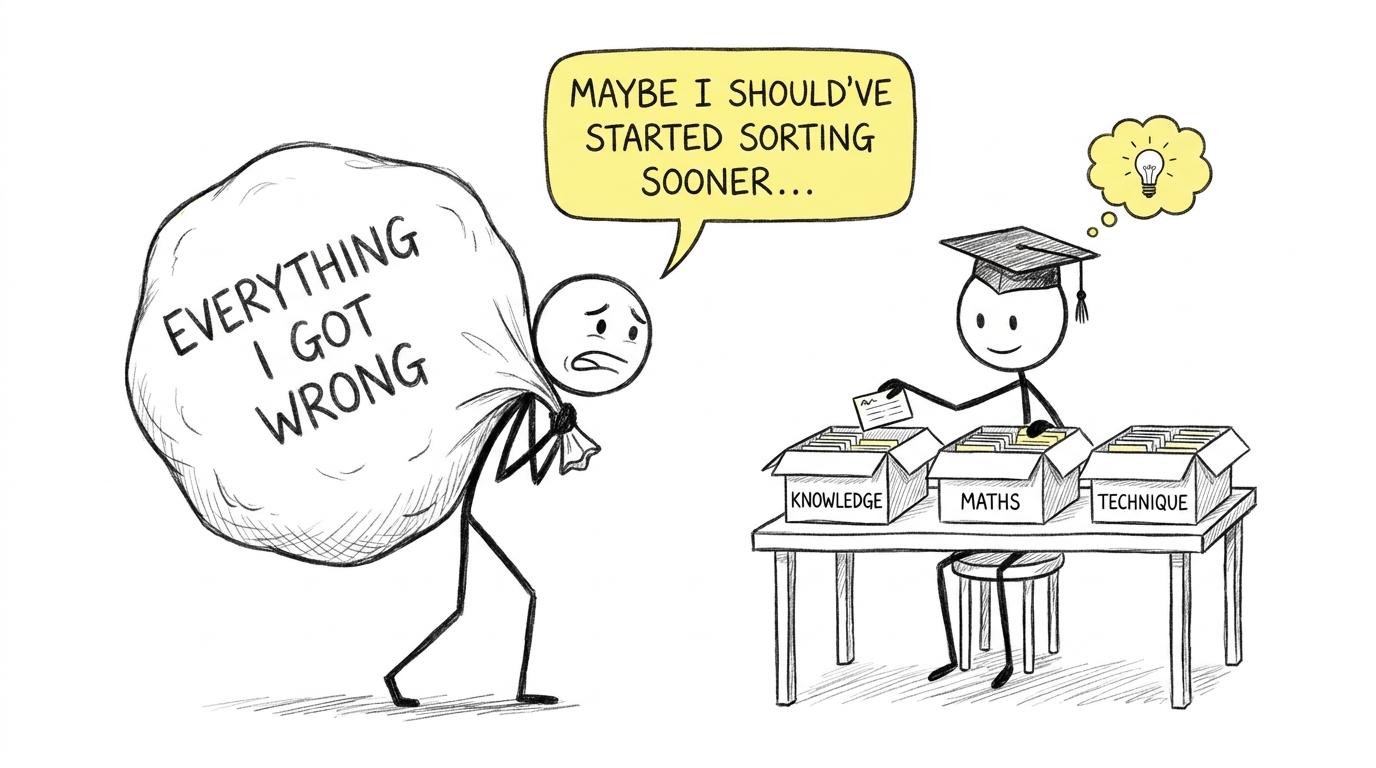 Revision mistakes are sorted into useful categories instead of carried as one enormous burden
Repair the maths inside GCSE Astronomy
Astronomy moves between enormous distances, small angles, observational measurements and unfamiliar units. The underlying maths is therefore a significant part of successful revision.
The relevant skills include standard form, ratios, fractions, percentages, inverse-square relationships, significant figures, means, unit conversion, logarithms, substitution, rearranging equations and interpreting graphs. You do not need to repair all of them at once. Let the mock identify which ones currently cost you marks.
Standard form and calculator accuracy
Distances and masses are often expressed in the form
a×10n,1≤a<10a\times 10^n,\qquad 1\leq a<10a×10n,1≤a<10If powers of 101010, calculator entry or converting between ordinary numbers and standard form caused mistakes, use MathsGenie's standard form revision resources. Practise until entering the calculation correctly becomes routine rather than an extra source of pressure.
Substitution and rearranging formulae
Pearson's specification states that students are not required to recall the listed astronomical equations because the relevant formulae and data are supplied in the examination paper. That does not remove the need to recognise variables, select the correct relationship, substitute accurately and rearrange when necessary.
If algebra was the problem, revisit the changing the subject of a formula revision guide, then complete the accompanying formula rearrangement practice questions.
Graphs, units and significant figures
When a graph question goes wrong, identify the exact failure. Did you misread the scale? Swap the variables? Draw an unsuitable line? Extract a value inaccurately? Fail to connect the pattern to the astronomy?
Likewise, a numerically correct value can still lose marks if it has inappropriate units or precision. Build a final check into every calculation:
- Have I used consistent units?
- Is the calculator entry correct?
- Does the size of the answer seem reasonable?
- Have I followed the requested number of significant figures?
- Have I written enough working to show the method?
These habits transfer directly into GCSE Maths. The GCSE Maths revision hub lets you choose your exam board and practise the underlying number, algebra and graph skills separately.
Build a short recovery plan
A useful plan is specific enough to follow on a tired weekday. “Revise astronomy” is not an action. “Complete a timed set of graph questions, mark it and correct every scale error” is.
First session: diagnose
Use your mock and mark scheme to create the marks-leak audit. Choose no more than three priorities. Ask your teacher about any mark you cannot explain, especially on extended responses or observational questions.
Next three sessions: repair
Give each priority one focused session:
- briefly relearn the relevant idea;
- answer questions without copying a model response;
- mark them immediately;
- write one sentence explaining each correction;
- finish by answering a similar question unaided.
For mathematical weaknesses, MathsGenie's free revision lessons and question banks make this loop easy. Short GCSE Maths mini tests can also check whether a repaired skill holds up when the question is timed.
Final session: retest
Return to the original questions or use a fresh set covering the same skill. Do not look at your corrected response first. You need evidence that the method can now be retrieved independently.
Track progress with something simple:
Retest improvement=new mark−original mark\text{Retest improvement}=\text{new mark}-\text{original mark}Retest improvement=new mark−original markA higher retest mark is useful, but also check whether the improvement came from stronger knowledge, clearer working or better timing. That tells you what is changing.
Use papers without turning them into punishment
After a bad mock, sitting another full paper immediately can feel productive. Often it merely reproduces the same weaknesses under pressure.
Use the order diagnose, repair, retest, then complete another paper. MathsGenie's guide to using GCSE past papers properly explains how to turn papers into a feedback loop rather than a sequence of scores.
Although MathsGenie focuses on GCSE and A Level maths rather than Astronomy papers, its GCSE predicted papers, mark schemes and video solutions are valuable for strengthening calculation technique, accuracy and timed decision-making. Use Astronomy papers supplied by your school or Pearson for subject-specific practice, and MathsGenie to repair the mathematical machinery underneath.
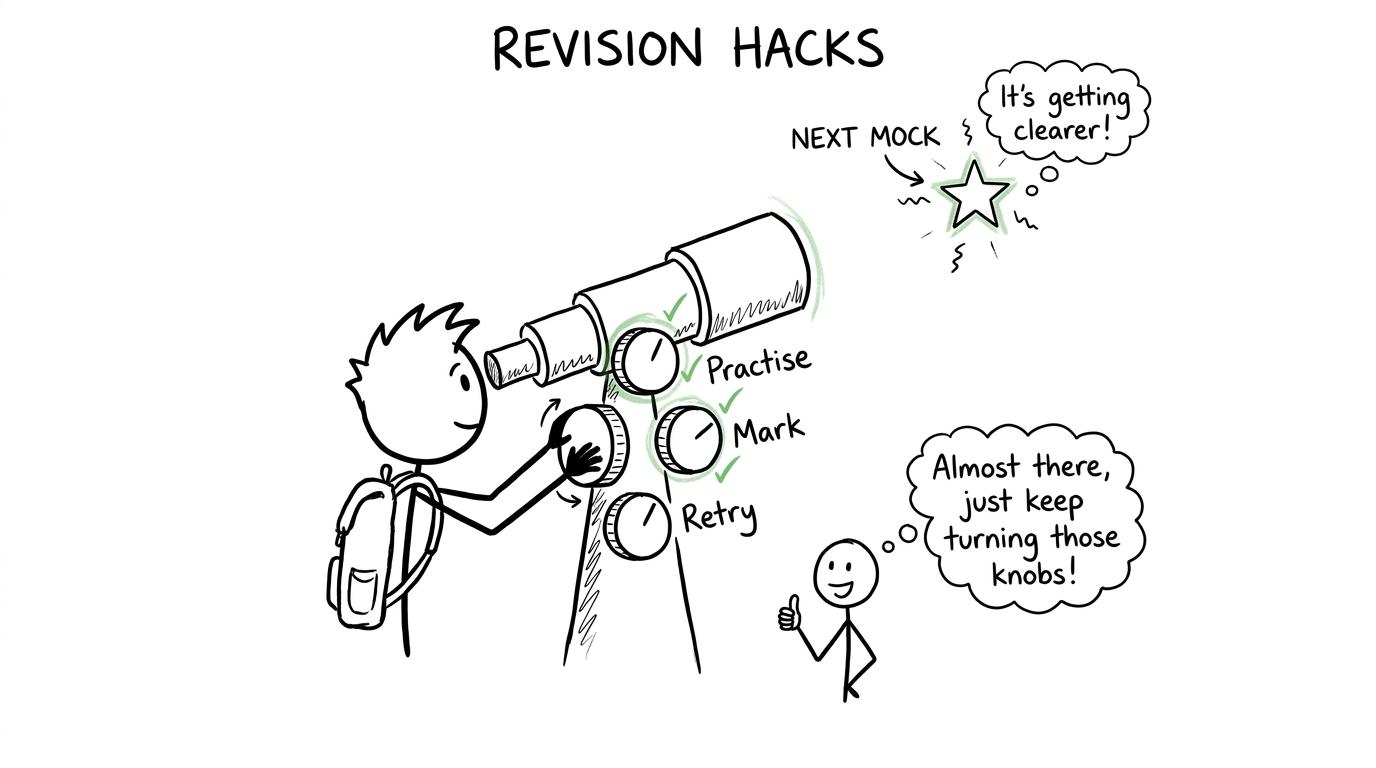 A student's next mock comes into focus after adjusting the practise, mark and retry controls
Common mistakes when recovering from a bad mock
Revising everything equally
Equal revision feels organised but ignores the evidence. Concentrate first on weaknesses that appeared repeatedly or cost several marks.
Looking only at the total score
Two students with the same result may need entirely different plans. One may lack subject knowledge; another may understand the astronomy but lose marks through calculations, incomplete explanations or timing.
Copying corrections without retesting
A copied answer can look perfect while teaching very little. Close the mark scheme and reproduce the reasoning independently.
Treating the formula sheet as a substitute for practice
Having an equation available does not guarantee that you can select it, rearrange it, substitute values or manage units. Practise using the sheet before the real examination.
Ignoring observational questions
Observational skills are assessed in the written papers. Revise how to plan observations, identify variables and hazards, analyse results, judge reliability and suggest specific improvements.
Predicting a final grade from one mock
Mock boundaries and coverage can vary between schools. Treat the result as evidence about current performance, not a guarantee of your eventual grade.
Make the next result a consequence of the plan
A bad GCSE Astronomy mock hurts because the result is visible while future improvement is not. Yet the useful part of the paper is not the number at the top. It is the trail of decisions underneath it: the formula chosen, the graph misread, the observation not evaluated and the question left too late.
Turn those details into a short list. Repair them one at a time. Then retest them.
Start today by auditing your mock and choosing one mathematical weakness. Open the MathsGenie GCSE revision hub, use a revision lesson to rebuild the skill, complete practice questions, check the mark scheme and test yourself again. As your exams approach, add mini tests, past papers and predicted papers with video solutions.
You do not need to undo the mock. You need to use it. That is how a disappointing result becomes the beginning of a better one.