Rearranging Formulae GCSE Maths: Examples and Practice
Rearranging formulae GCSE maths explained with clear worked examples, common mistakes and exam-style questions to help you change the subject confidently.
Rearranging formulae GCSE maths: making it click
You recognise every symbol, but the moment a question says “make the subject”, the algebra seems to come apart. Rearranging formulae GCSE maths questions become easier when you stop thinking about moving letters and start thinking about undoing operations equally on both sides.
Imagine a student who keeps losing marks because they remember fragments of rules: move something across, change a sign, flip a fraction. Their breakthrough is not a new shortcut. It is understanding why each step preserves the equality.
This guide follows that hypothetical student from those unreliable shortcuts to a method you can use yourself, with worked examples and exam-style practice.
The method at a glance
To change the subject of a formula:
- Identify the letter you need to isolate.
- Notice what operations surround it.
- Undo those operations in reverse order, applying each operation to both sides.
- If the target letter appears in separate terms, collect those terms and factorise.
- Check that the target letter is alone and the formula still makes sense.
The subject is the letter isolated on one side. In A=lwA = lwA=lw, the subject is AAA. Making www the subject gives:
w=Alw = \frac{A}{l}w=lAThe relationship has not changed. We have simply written it so a different quantity can be calculated directly.
Changing the subject is part of GCSE algebra, including foundation content. More demanding questions combine the same idea with fractions, powers or factorising.
Why “move it across” causes trouble
Our imagined student starts with:
y=3x+5y = 3x + 5y=3x+5They know something must happen to the 555 and the 333, but cannot explain what. That uncertainty makes every new formula feel like a different puzzle.
Instead, read the formula as a sequence: take xxx, multiply by 333, then add 555. To recover xxx, undo the addition first, then undo the multiplication.
This is why “move it across” is a risky explanation. A term does not change sign because it crosses the equals sign. The expression changes because you have added, subtracted, multiplied or divided both sides by the same quantity.
Once the student starts naming those operations, their working becomes something they can check rather than something they must trust.
Rearranging formulae worked examples
A formula with two operations
Make xxx the subject of:
y=3x+5y = 3x + 5y=3x+5Subtract 555 from both sides:
y−5=3xy - 5 = 3xy−5=3xDivide both sides by 333:
x=y−53x = \frac{y - 5}{3}x=3y−5The whole expression y−5y - 5y−5 must be divided by 333. The fraction bar groups that entire numerator.
For another explanation alongside these steps, use MathsGenie's Changing the Subject of a Formula lesson page.
A formula containing a fraction
Make ttt the subject of:
v=dtv = \frac{d}{t}v=tdHere, ttt is in the denominator. Multiply both sides by ttt:
vt=dvt = dvt=dNow divide both sides by vvv:
t=dvt = \frac{d}{v}t=vdThis rearrangement assumes the denominators are non-zero. You do not need a special “swap the letters” rule: ordinary multiplication and division explain every step.
A formula containing a square
Make rrr the subject of the circle-area formula:
A=πr2A = \pi r^2A=πr2Divide both sides by π\piπ:
Aπ=r2\frac{A}{\pi} = r^2πA=r2Then take the square root:
r=Aπr = \sqrt{\frac{A}{\pi}}r=πABecause rrr represents a radius, we use the non-negative root. In an unrestricted algebraic equation, square-rooting may require both positive and negative possibilities. Context matters.
The student now has a useful habit: before writing anything, they ask, “What happened last to the letter I want?”
Start with the matching topic in MathsGenie's Lessons, then use its Question Bank to practise choosing those inverse operations yourself.
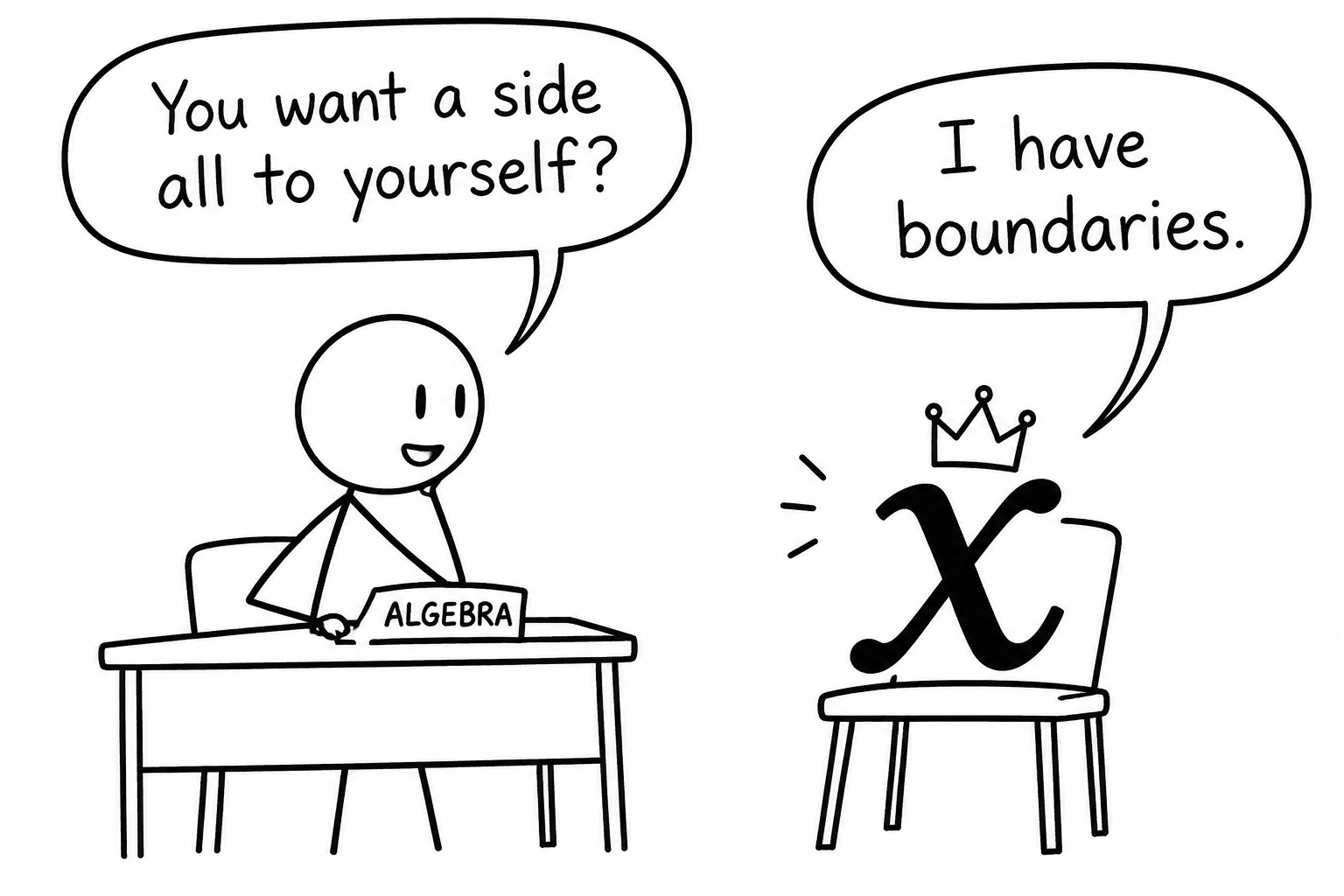 Stick-figure student negotiating with a letter that wants a side of the equation to itself
When the subject appears twice
Now make xxx the subject of:
y=ax+bxy = ax + bxy=ax+bxDividing by aaa immediately would leave another term containing xxx. First, factorise the right-hand side:
y=x(a+b)y = x(a + b)y=x(a+b)Then divide by the whole bracket:
x=ya+bx = \frac{y}{a + b}x=a+byThis assumes a+b≠0a + b \ne 0a+b=0.
If the target letter appears on both sides, collect its terms on one side before factorising. The goal is to turn several appearances of the letter into one multiplied factor.
The changing-the-subject revision guide offers another way to revisit the topic when you need a reminder.
Common mistakes and how to catch them
Dividing only part of an expression
From 3x=y−53x = y - 53x=y−5, writing x=y−53x = y - \frac{5}{3}x=y−35 is incorrect. Division applies to the entire side:
x=y−53x = \frac{y - 5}{3}x=3y−5Use a clear fraction bar or brackets to show exactly what is being divided.
Undoing operations in the wrong order
In y=3(x+2)y = 3(x + 2)y=3(x+2), multiplication by 333 happens after the addition inside the bracket. Divide by 333 first, then subtract 222:
x=y3−2x = \frac{y}{3} - 2x=3y−2You could expand first, but it creates extra work here.
Confusing a square root with division
If x2=kx^2 = kx2=k, dividing by 222 does not undo squaring. Taking a square root does. Ask yourself whether the original operation was multiplication by 222 or raising to a power.
Stopping before the letter is isolated
An answer with the target letter still inside a bracket, denominator or square root has not necessarily finished the job. Check that your final expression gives the requested letter directly in terms of the other quantities.
Exam-style rearranging formulae questions
Try these without looking back at the examples. Show an operation on each line, especially where fractions or brackets are involved.
| Formula | Task |
|---|---|
| p=4q−7p = 4q - 7p=4q−7 | Make qqq the subject. |
| m=n+35m = \frac{n + 3}{5}m=5n+3 | Make nnn the subject. |
| s=a+bcs = \frac{a + b}{c}s=ca+b | Make bbb the subject. |
| P=2l+2wP = 2l + 2wP=2l+2w | Make www the subject. |
| y=ax−bxy = ax - bxy=ax−bx | Make xxx the subject. |
Check your answers
- First question: q=p+74q = \frac{p + 7}{4}q=4p+7.
- Second question: n=5m−3n = 5m - 3n=5m−3.
- Third question: b=sc−ab = sc - ab=sc−a.
- Fourth question: w=P−2l2w = \frac{P - 2l}{2}w=2P−2l, equivalently w=P2−lw = \frac{P}{2} - lw=2P−l.
- Fifth question: x=ya−bx = \frac{y}{a - b}x=a−by, assuming a−b≠0a - b \ne 0a−b=0.
If an answer differs, find the first line where your operation stopped applying to the whole side. That diagnosis is more useful than copying the correct final expression.
For further practice, the topic Question Bank with worked solutions and mark schemes lets you compare your method with a complete solution.
Turn understanding into a reliable method
For our hypothetical student, the change is modest but important: instead of guessing where a letter goes, they can explain each operation. Your goal is the same, and the remaining gap is practising until that reasoning holds up without an example beside you. Start your own rearranging-formulae practice in MathsGenie's Lessons and Question Bank using the links above.