Rearranging Formulae Exam Questions: GCSE Guide
Rearranging formulae exam questions explained through three GCSE examples, method-mark guidance, common mistakes and focused practice for exam success.
A formula can look harmless: a few letters, perhaps a fraction. Yet without a number to calculate, it is easy to hesitate. The reliable approach to rearranging formulae exam questions is to keep both sides balanced, use inverse operations and show each important step.
Your aim is to make one chosen letter the subject while preserving an equivalent relationship. Clear working may also earn available method marks when an error prevents the correct answer.
We will follow a hypothetical student, Maya, through three GCSE questions. Each introduces a decision you can reuse, rather than a trick to memorise.
The rearranging formulae checklist
Before starting, Maya uses this routine:
- Identify the required subject.
- Find the operations attached to that letter.
- Undo those operations in reverse order.
- Apply each operation to both sides.
- Collect and factorise terms when the subject appears twice.
- Check that the required letter is alone.
The subject is the letter isolated on one side. In y=3x+5y=3x+5y=3x+5, the subject is yyy. Making xxx the subject means finding an equivalent formula beginning x=x=x=.
Rearranging is not about changing the formula's meaning. It is about expressing the same relationship from a different point of view. Think of the equals sign as a balance, not a barrier. If you multiply, divide, add or subtract on one side, perform the same operation on the other side unless you are simplifying within one side.
An equals sign should connect two genuinely equivalent expressions at every line. Reading your working from top to bottom should reveal a chain of balanced statements.
Review the Changing the Subject of a Formula lesson, or use the AQA changing the subject resources for further practice.
Question one: reversing two operations
Question: Make xxx the subject of
y=4x+7y=4x+7y=4x+7Maya sees that xxx has been multiplied by 444, then 777 has been added. She reverses those operations in the opposite order.
Subtract 777 from both sides:
y−7=4xy-7=4xy−7=4xDivide both sides by 444 and write the requested subject first:
x=y−74x=\frac{y-7}{4}x=4y−7For a question worth two marks, an indicative allocation could reward the subtraction step and the correct final answer. Exact marking depends on the question and its mark scheme.
Maya avoids saying that 777 simply “moves across and changes sign”. The sign changes because she subtracts 777 from both sides. That explanation remains reliable when the formula becomes more complicated.
Use the Changing the Subject Question Bank to practise recognising which operation to undo first.
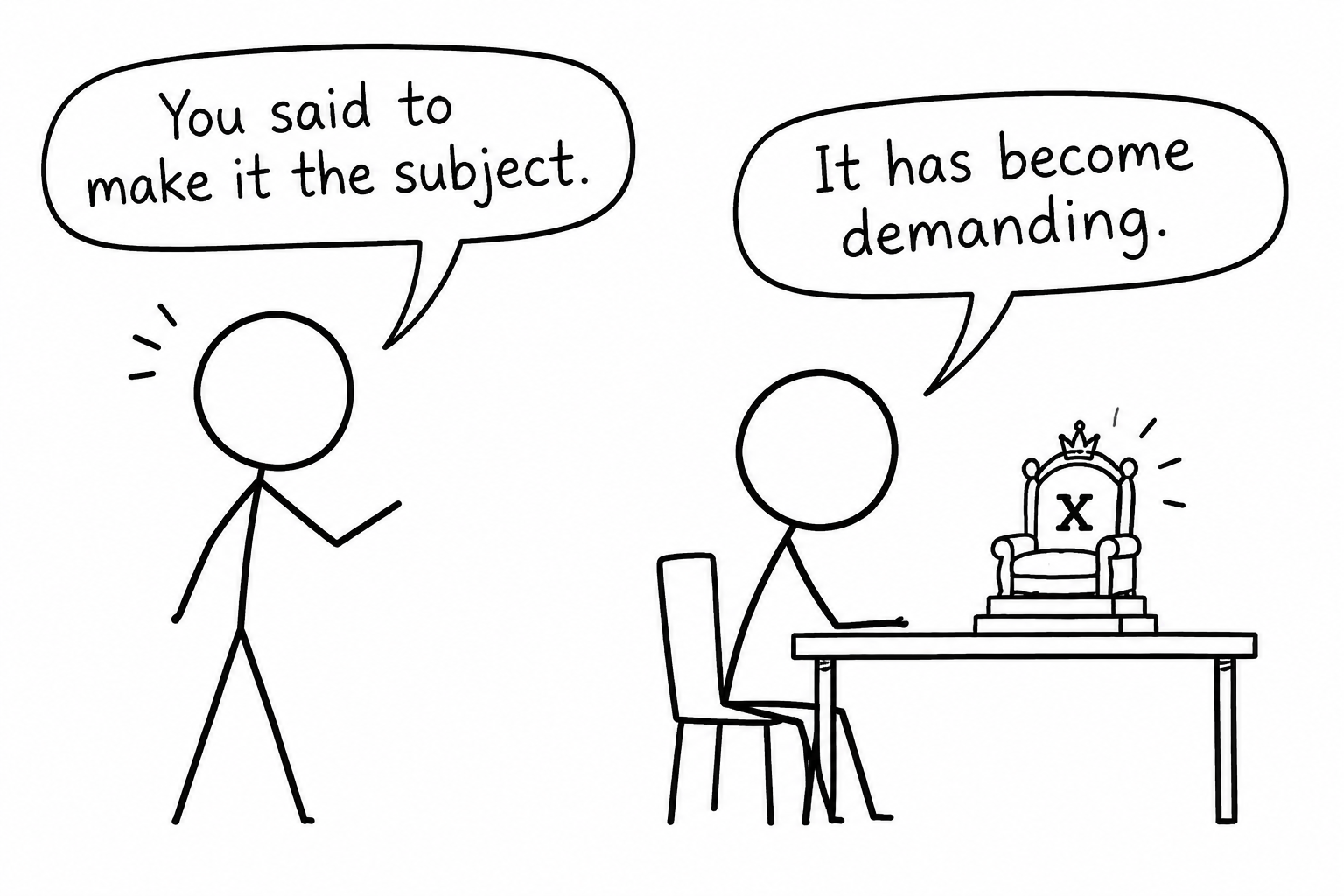 A stick-figure student gives the subject of a formula its own tiny throne
Question two: dealing with a fraction
Question: Make aaa the subject of
p=3a−b5p=\frac{3a-b}{5}p=53a−bThe entire numerator is divided by 555. Maya removes that outer operation first, multiplying both sides by 555:
5p=3a−b5p=3a-b5p=3a−bAdd bbb to both sides:
5p+b=3a5p+b=3a5p+b=3aDivide the complete left-hand side by 333:
a=5p+b3a=\frac{5p+b}{3}a=35p+bAnother valid route may look slightly different, but it must preserve equality at every stage. Clearing the denominator first is usually efficient because it removes the fraction and makes the remaining inverse operations easier to see. Efficiency matters less than accuracy, although a short, orderly method is easier to check under exam pressure.
An indicative three-mark route might reward clearing the denominator, isolating 3a3a3a and obtaining the final expression. These are illustrative allocations, not a promise about a particular paper.
Maya checks her answer by substituting it into the original right-hand side:
3(5p+b3)−b5=5p+b−b5=p\frac{3\left(\frac{5p+b}{3}\right)-b}{5} =\frac{5p+b-b}{5}=p53(35p+b)−b=55p+b−b=pThe original relationship is recovered. This check tests the rearrangement rather than merely repeating the same working.
Question three: the subject appears twice
Question: Make xxx the subject of
y=ax+bx−cy=ax+bx-cy=ax+bx−cAdding ccc to both sides gives
y+c=ax+bxy+c=ax+bxy+c=ax+bxNow xxx appears in two terms. Maya factorises before dividing:
y+c=x(a+b)y+c=x(a+b)y+c=x(a+b)Therefore,
x=y+ca+bx=\frac{y+c}{a+b}x=a+by+cThis division requires a+b≠0a+b\ne0a+b=0. If a+b=0a+b=0a+b=0, the original equation reduces to y=−cy=-cy=−c and does not determine a unique value of xxx.
The decisive step is factorising. Whenever the subject occurs more than once, ask whether you can collect its terms on one side and take it outside a bracket.
For higher-tier practice, explore the Rearranging Harder Formulae lesson and harder formulae exam questions.
How to protect method marks
Mark schemes vary between Edexcel, AQA, OCR and Eduqas. No specific mark can be promised without the particular question, but clear algebra gives an examiner evidence of your method.
Write one meaningful transformation per line. Keep fractions legible, preserve brackets and avoid unexplained jumps. A correct intermediate line can demonstrate understanding even when a later step goes wrong.
When attempting rearranging formulae past paper questions, mark the working as well as the answer. Use the harder formulae exam booklet for focused practice, then compare your approach with the available marking guidance.
Common rearranging mistakes
Changing a sign without an operation
A term does not simply cross the equals sign. Explain the addition or subtraction applied to both sides instead.
Dividing only one term
From 5p+b=3a5p+b=3a5p+b=3a, division by 333 gives a=5p+b3a=\frac{5p+b}{3}a=35p+b. Both terms in the numerator are divided, not just the nearest one.
Forgetting to factorise
When xxx appears in ax+bxax+bxax+bx, first rewrite this as x(a+b)x(a+b)x(a+b). Dividing before collecting the subject can leave it scattered across the equation.
Stopping too early
The line 3a=5p+b3a=5p+b3a=5p+b is equivalent to the original relationship, but aaa is not yet the subject. Complete the final division.
Cancelling across addition
Cancel common factors, not separate terms joined by addition or subtraction. Brackets help you keep a complete expression together.
A focused exam-style practice routine
Start with questions where the subject appears once, then introduce fractions and brackets. Finish with repeated subjects, powers and roots.
Work in short sets rather than mixing every difficulty immediately. Once a method feels secure, answer a similar question without notes and then complete one in exam conditions. This progression separates genuine recall from familiarity with a solution that is still visible.
After each attempt, identify the first incorrect line. Was the inverse operation wrong, was only part of a side changed, or was factorising needed? This diagnosis tells you what to practise next.
Reattempt missed questions without looking at the solution. Recognising somebody else's method is useful, but producing it independently is the skill the exam requires.
Turn the method into marks
Maya's progress comes from replacing “move the letters” with a repeatable process: balance, simplify and isolate.
Start with MathsGenie's free Changing the Subject lesson, then tackle its linked practice questions. Check your working carefully and revisit the step that caused difficulty. Familiarity grows through purposeful practice, one correct transformation at a time.