Ready for GCSE Arabic Early Sitting? A Checklist
Ready for GCSE Arabic early sitting? Test all four language skills, exam timing, tier choice and the effect on your wider GCSE revision plan.
Sitting a GCSE early can feel like getting ahead. Sometimes it is. But enthusiasm and readiness are not the same thing. If you are asking whether you are ready for GCSE Arabic early sitting, the short answer is this: you should have consistent evidence across listening, speaking, reading and writing, not simply confidence in everyday conversation.
You also need to perform under timed conditions, understand the specification and have enough capacity left for maths, English, science and your other subjects. An early entry is sensible when it removes pressure later without creating avoidable pressure now.
This guide will help you distinguish genuine exam readiness from understandable eagerness.
The early-entry readiness checklist
Before discussing an entry with your school, you should be able to answer yes to most of these statements:
- I know which Arabic qualification and specification I will sit.
- I have tested all four assessed skills under realistic conditions.
- My results are consistently near or above my target grade.
- I can understand standard spoken Arabic, not only familiar speakers.
- I can write accurately without relying on a dictionary.
- I can speak spontaneously rather than reciting memorised paragraphs.
- I understand whether foundation or higher tier is appropriate.
- My Arabic preparation is not weakening my maths or other GCSE subjects.
- My teacher or another suitably experienced assessor agrees that the evidence supports early entry.
- My school or examination centre can make the entry and conduct the speaking assessment correctly.
A few uncertain answers do not mean you should give up. They tell you what must be tested before a decision is made.
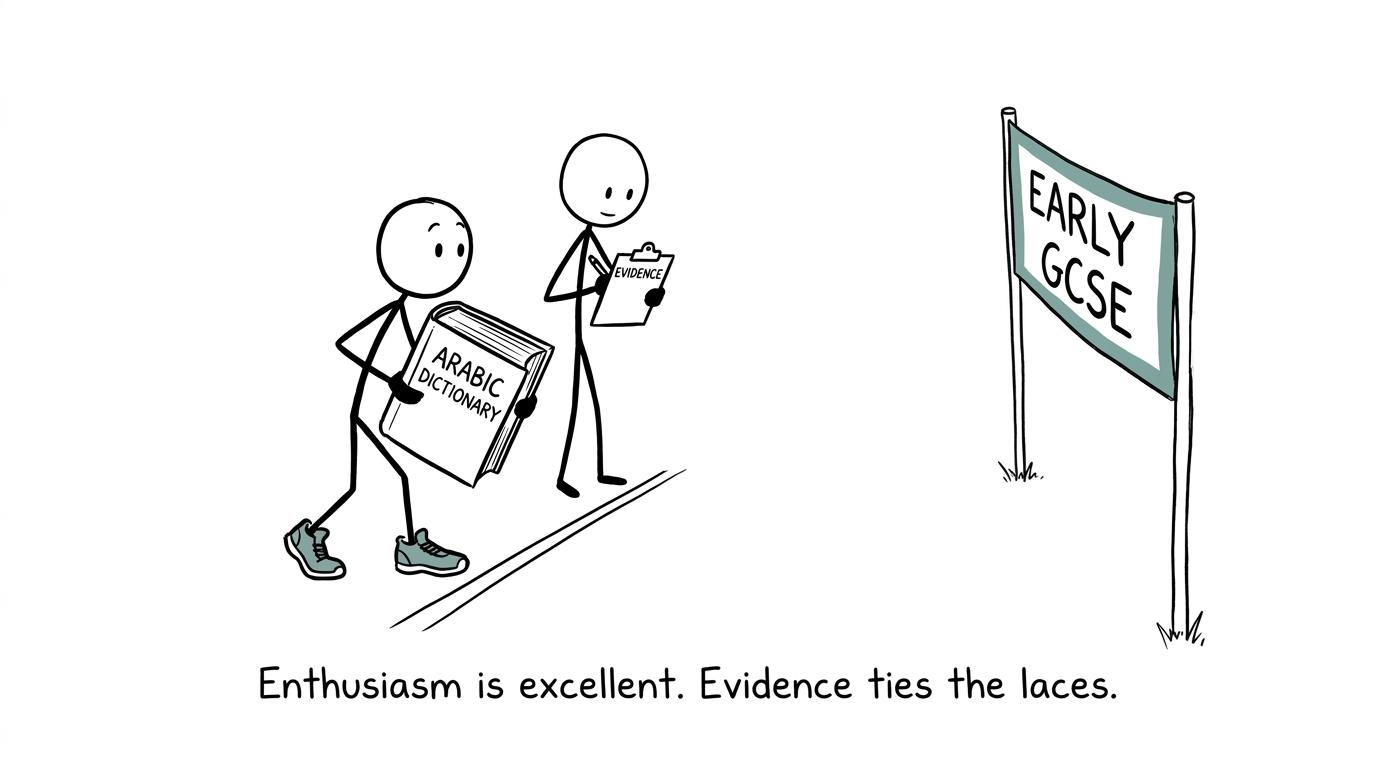 A keen student at an early GCSE starting line while a teacher checks the evidence
Know what GCSE Arabic actually assesses
For students taking the current Pearson Edexcel GCSE Arabic qualification, specification code 1AA0, assessment is divided equally between four skills:
- listening: 25%25\%25%
- speaking: 25%25\%25%
- reading: 25%25\%25%
- writing: 25%25\%25%
The four papers contribute to one overall grade. Being exceptionally strong in one skill does not make the other three optional.
The qualification is tiered. Foundation tier makes grades 111 to 555 available. Higher tier normally makes grades 444 to 999 available, with a grade 333 possible when a candidate falls narrowly below the grade 444 boundary. Students must enter the same tier for every paper, so you cannot take higher reading and foundation listening.
The speaking assessment takes place in the designated spring window, while the remaining assessments are taken in the same examination series. Dictionaries are not permitted. Exact arrangements and deadlines can change between series, so your school must check the latest Pearson information before entering you.
This structure matters because early entry is not an informal test of whether you can speak Arabic. It is a complete GCSE examination.
Genuine readiness appears in all four skills
Your listening survives unfamiliar voices
Home-language experience can be a major advantage, but GCSE listening uses standard spoken Arabic in different settings and with different speakers. Familiarity with one family member's voice, speed or regional variety does not automatically transfer to an examination recording.
A ready student can identify overall meaning, details, opinions and time references while the recording continues. They do not need every word to be familiar. They can recover after missing a phrase instead of mentally abandoning the rest of the question.
Use complete listening assessments rather than judging yourself from short clips. Your marks should remain stable when the topic, speaker and question style change.
Your speaking is flexible, not memorised
Memorised answers can sound impressive until the question changes slightly. Genuine readiness means you can answer follow-up questions, justify an opinion, refer to different time frames and repair an answer when you hesitate.
You should be able to communicate entirely in Arabic during the assessment. Fluency matters, but so do accurate grammar, suitable vocabulary, pronunciation and interaction. Ask a teacher who understands the specification to conduct realistic speaking rehearsals. Casual conversation alone cannot reproduce the pressure or format of the assessed tasks.
Your reading includes precision
A strong reader can move beyond recognising the general subject. You should be able to distinguish positive and negative statements, identify who did what, follow references across a passage and interpret less familiar vocabulary from context.
Translation also exposes gaps that silent reading can hide. If you understand the broad idea but repeatedly lose tense, person or detail, your reading is not yet as secure as it feels.
Your writing remains accurate under time pressure
Writing is often the clearest dividing line between being conversationally confident and being examination-ready. You need control of spelling, grammar, sentence structure, register and the conventions of written Arabic.
A ready student can address every bullet point, develop ideas and use past, present and future references where required. They can check their work independently because a dictionary is not available. Most importantly, their accuracy survives the clock.
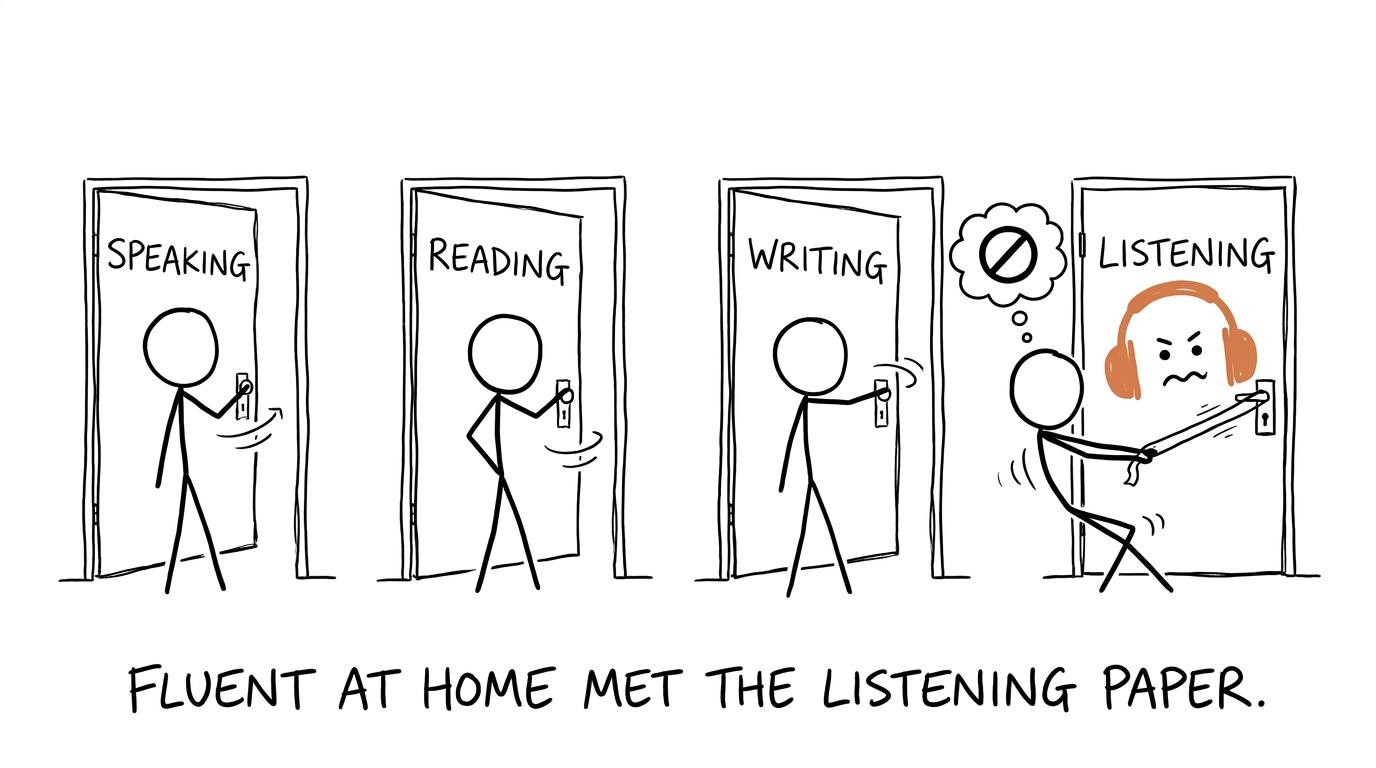 A student discovers that the listening door is less cooperative than the other language skills
Use evidence rather than one encouraging result
One good mock is promising. It is not a trend.
A stronger decision uses several pieces of evidence collected over time:
- complete papers or substantial paper sections
- realistic time limits
- official mark schemes where available
- speaking practice assessed against the specification
- results from more than one examination series
- a record of recurring errors
- teacher judgement alongside your own view
Grade boundaries vary by series because papers vary in difficulty. Avoid deciding that one fixed raw mark guarantees a particular grade every year. Compare your work with the relevant published boundary when it becomes available, but focus primarily on whether performance is consistently secure.
Aim to have a buffer above your minimum target. A result that depends on the paper suiting you perfectly is not robust readiness.
Maths revision offers a useful model here. A student would not infer complete algebra mastery from one correct question. They would use GCSE Maths mini tests, mark their work and test the skill again later. Apply that same discipline to Arabic: attempt, mark, diagnose, practise and retest.
Keen versus ready
Eagerness usually sounds like this:
- “I speak Arabic at home.”
- “I want another GCSE on my record.”
- “I did well on one reading paper.”
- “I would rather finish it now.”
Readiness sounds different:
- “My timed results are consistent across all four components.”
- “I know my weakest skill and have evidence that it is improving.”
- “I can cope with unfamiliar language without losing control of the task.”
- “My teacher has assessed my speaking against the correct criteria.”
- “I have protected enough time for my other GCSEs.”
The difference is not motivation. Both students may be highly motivated. The difference is that one has measured performance under the conditions that matter.
Check the effect on maths and your wider timetable
An early Arabic entry does not happen in isolation. The speaking window and final preparation may overlap with important teaching or revision in other subjects.
Create a realistic weekly plan containing Arabic, schoolwork, rest and your core subjects. Maths, in particular, benefits from regular practice rather than long gaps. The MathsGenie GCSE Maths revision hub brings together lessons, questions, revision guides and paper practice for Edexcel, AQA, OCR and Eduqas students.
If Arabic preparation causes you to postpone every maths session, the early entry may be poorly timed even when your Arabic is strong. Use a GCSE maths revision timetable or a simple revision planner to reserve short, repeatable sessions.
A 20-minute maths revision routine can protect momentum during a busy language-assessment week. The aim is not to revise everything every evening. It is to prevent one qualification from silently displacing another.
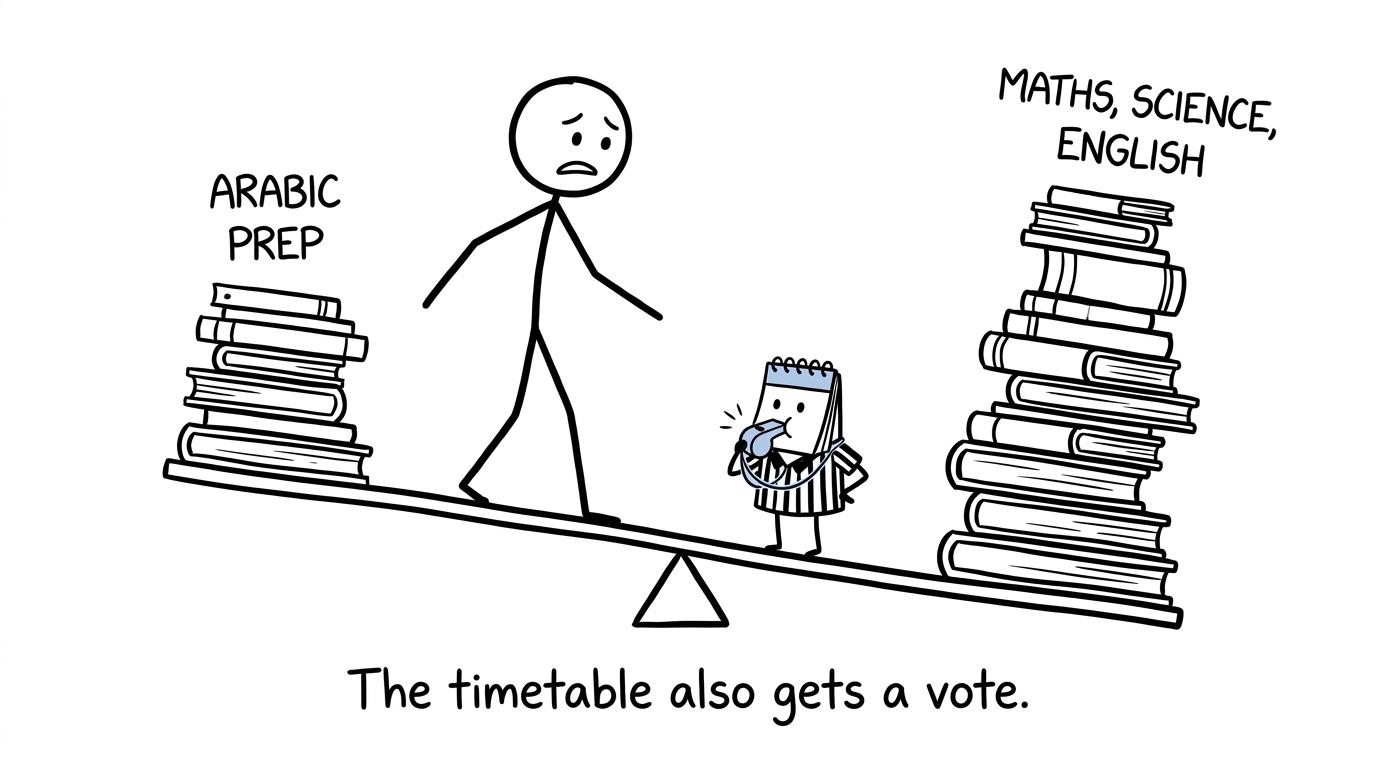 A calendar referees a revision timetable balancing Arabic with core GCSE subjects
Discuss tier, entry and consequences with your school
There is no general requirement in the Pearson specification for prior learning before taking GCSE Arabic. That does not mean a student can simply decide to arrive and sit it. An approved centre must enter the candidate, organise the papers and conduct and record the speaking assessment according to the examination rules.
Ask your school or centre:
- whether it offers Pearson Edexcel GCSE Arabic
- who will assess your speaking readiness
- which tier it recommends
- what internal deadline applies
- whether suitable past and specimen materials are available
- how an early result could affect later re-entry decisions
In England, early-entry rules can affect which result counts in school performance measures when a student takes more than one qualification in the same subject. The details depend on the student's circumstances and whether a later re-entry occurs. This is primarily a school accountability matter, but it is another reason to make the first attempt purposeful rather than experimental.
Do not assume a resit makes timing irrelevant. A second entry costs time, may involve further preparation and can collide with Year 11 revision.
Common mistakes when deciding to sit early
Treating spoken fluency as complete readiness
Speaking Arabic naturally is valuable, but the GCSE also tests formal reading, extended writing and examination listening. Test every component separately.
Choosing higher tier for status
Higher tier is not automatically the more ambitious decision. It is appropriate when performance across all four papers supports it. Discuss the available grade range and risks with your teacher.
Practising without timing
Untimed work shows what you can eventually do. Timed work shows what you can produce in the examination. You need evidence from both.
Ignoring the specification
General language ability and specification coverage overlap, but they are not identical. Check the prescribed themes, grammar, task formats and assessment objectives.
Using predicted performance as proof
A teacher estimate or encouraging practice result is useful, but it should be supported by repeated exam-style evidence. In maths, Edexcel GCSE predicted papers are best used alongside, not instead of, Edexcel GCSE past papers. The same principle applies to any subject: prediction helps direct preparation, while past assessment reveals performance.
Letting Arabic consume every revision slot
Monitor your other subjects. AQA students can use AQA GCSE Maths past papers, while OCR students can keep practice focused through the OCR GCSE Maths revision hub. Early entry should simplify your overall GCSE journey, not destabilise it.
Make the decision calmly
You are genuinely ready to sit GCSE Arabic early when your confidence is supported by repeated, timed and independently assessed evidence across listening, speaking, reading and writing. You should also understand the tier, examination arrangements and effect on your wider workload.
If the evidence is incomplete, waiting is not failure. Another year can strengthen formal writing, broaden vocabulary and make the eventual result more secure. If the evidence is strong, an early sitting may free space later and recognise knowledge you already command.
Whichever route you take, protect your core revision. Use MathsGenie's free revision lessons and practice questions to repair individual maths topics, mini tests to check recall, and past papers and predicted papers to build examination stamina. Mark carefully, use the mark schemes and video solutions, then let evidence, rather than urgency, decide your next step.