Should You Read GCSE English Language Specification?
Read GCSE English Language specification documents wisely: learn what exam boards assess, what guides simplify and how to turn official detail into revision.
Revision guides are designed to feel approachable. Specifications are not. One has coloured headings and model paragraphs; the other can look like a contract written for teachers. Yet if you read GCSE English Language specification material selectively, you can discover something a guide may blur: exactly what your exam board assesses.
So, is reading the full document worth it? Yes, once, but you do not need to study every page. Read the sections covering assessment structure, assessment objectives, question requirements and prescribed content. Then use revision guides, past papers and mark schemes to learn how to apply that information.
For students balancing English with GCSE maths revision, this distinction matters. A specification tells you the boundaries of the game. Practice teaches you how to play it.
The short answer and your reading checklist
The official specification is the qualification's rulebook. It is more authoritative than a general revision guide, but less useful for day-to-day skill building.
Read these parts:
- the qualification overview and specification code
- the assessment structure for each paper
- the reading and writing assessment objectives
- the weighting of each component
- the kinds and periods of unseen texts assessed
- the Spoken Language endorsement requirements
- any appendices that define terminology or content
Skim or leave these parts for your teacher:
- centre administration
- moderation procedures
- entry arrangements
- malpractice rules
- detailed teacher guidance that does not affect your responses
Allow roughly one focused session. Your goal is not to memorise the PDF. It is to create a one-page map of what earns marks.
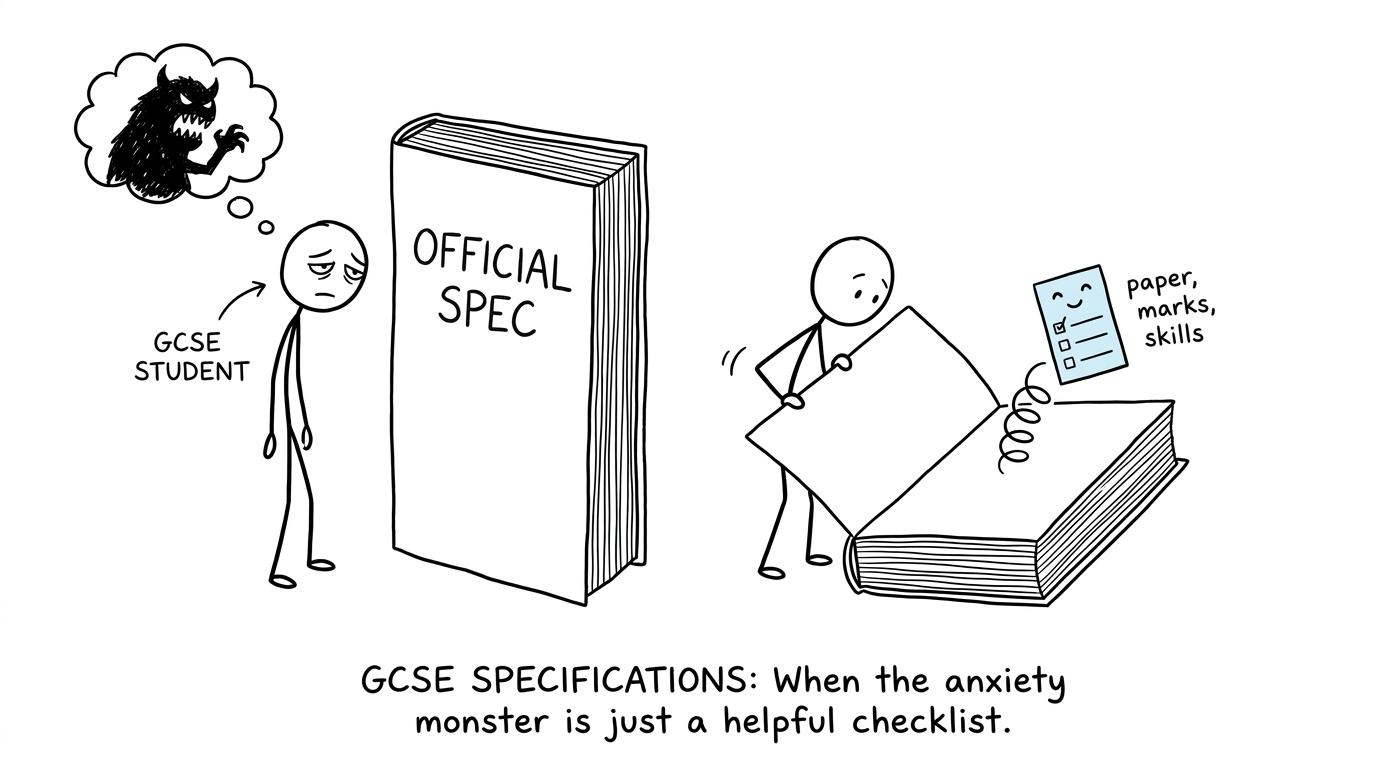 A student discovers that the intimidating official specification contains a manageable checklist
What the official specification gives you that a guide may not
A good guide translates the course into manageable advice. That translation is useful, but every summary involves choices. The official document lets you check what the exam board itself requires rather than relying on someone else's emphasis.
The exact assessment objectives
Across GCSE English Language specifications in England, the official assessment objectives are set at national level. AO1 to AO4 cover reading, AO5 and AO6 cover writing, and AO7 to AO9 relate to Spoken Language.
The wording matters. For example, the objectives distinguish between identifying information, analysing language and structure, comparing perspectives, and evaluating a text. Those are connected skills, but they are not interchangeable. A paragraph full of language terminology will not automatically answer a comparison or evaluation task.
The national subject requirements divide the written qualification equally between reading and writing. Writing accuracy under AO6 accounts for 20%20\%20% of the qualification as a whole. That is a useful corrective if revision has become entirely focused on ambitious vocabulary while punctuation, spelling and sentence control are being neglected.
A guide may turn the objectives into memorable labels. The specification shows the complete wording behind those labels.
Your board's actual paper structure
AQA, Pearson Edexcel, OCR and Eduqas all assess the national subject content, but they organise their papers differently. Paper lengths, component weightings, source combinations and writing tasks are not identical.
For example, the current AQA course has two written papers, each worth 50%50\%50%, while Eduqas divides its written components differently. OCR's two examined components are each worth 50%50\%50% and last two hours. This is why advice created for one board should not be assumed to fit another.
The specification helps you confirm:
- how many written papers you sit
- how long each paper lasts
- which reading and writing skills appear in each component
- how many marks are available
- whether tasks are compulsory or offer a choice
- what the source material can include
Check the specification code on your school's documents before reading. A beautifully annotated PDF for the wrong board is still the wrong rulebook.
The distinction between examined and separately reported work
GCSE English Language is untiered, unlike GCSE maths, where students are entered for foundation or higher tier. The written English Language grade is based on external examinations.
Spoken Language remains a compulsory part of the course, but it is reported separately as Pass, Merit, Distinction or Not Classified and does not contribute to the final grades 9-1 result. Reading the official document makes this relationship clear. It prevents two opposite mistakes: treating the presentation as part of the written mark, or assuming that a separately reported component can simply be ignored.
Protection against revision myths
Revision myths often begin with a useful idea stretched too far: always use a certain number of quotations, always write a fixed number of paragraphs, or always include a particular technique.
The specification helps you separate official requirements from classroom strategies. A paragraph structure may be an excellent scaffold, but it is not necessarily an exam-board rule. Likewise, impressive terminology cannot replace a relevant explanation supported by textual evidence.
That habit of checking the source is valuable in maths too. The MathsGenie GCSE maths revision hub separates resources by board so that students can practise material suited to the qualification they are taking.
What you will not gain from reading it
The specification defines the destination, not every step towards it. Reading it will not, by itself, make you quicker at analysing an unseen extract or more controlled when writing under time pressure.
It usually will not provide:
- a complete revision timetable
- enough annotated responses to teach essay construction
- detailed feedback on your own writing
- sustained timed practice
- a reliable prediction of the exact exam content
- a substitute for teaching or marking
This is similar to reading a GCSE maths content list. Knowing that algebraic fractions are assessable does not create fluency. You still need explanation, questions, correction and repetition. Maths students can see that process in the one-month GCSE revision plan, where diagnosis leads to focused practice rather than more passive reading.
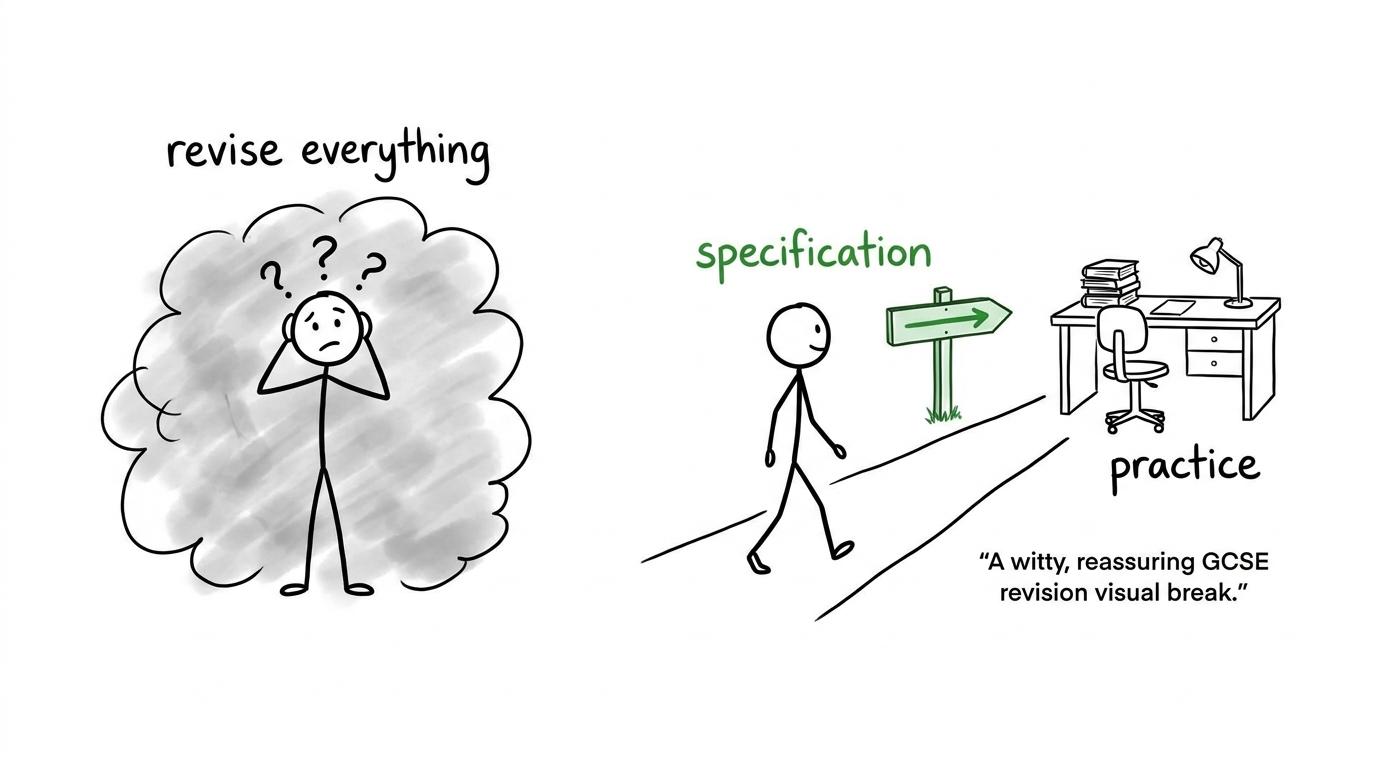 One student follows a specification signpost while another wanders through the fog of revising everything
The best way to use the document
Treat the specification as one layer in a small evidence stack. Each resource answers a different question.
Start with the latest official version
Download the document from your exam board and check its title, qualification code and version information. Exam boards may amend documents, so avoid relying on an old file saved by someone else. Ask your teacher if you are uncertain which specification applies to your entry.
Make a one-page exam map
For each paper, record its duration, total marks, source types, reading focus and writing task. Add the relevant assessment objectives beside each section.
Keep the summary factual. Do not fill it with generic instructions such as “write more”. A useful note tells you what the task assesses and what evidence your response must demonstrate.
Compare it with a real paper
Open a past paper beside your summary and locate each requirement in an actual question. Then consult the mark scheme. The specification identifies the skill; the question demands it; the mark scheme shows how examiners reward it.
This three-part method is equally effective in maths. Students can combine the course outline with Edexcel GCSE maths past papers or AQA GCSE maths past papers, then use the available mark schemes and worked solutions to identify precise gaps.
Turn information into practice
After reading, choose an action. If the weighting reminds you that accuracy matters, practise proofreading under a short time limit. If comparison is weak, complete a comparison question using two unseen sources. If you misunderstood a paper's structure, rehearse navigating the correct paper.
The same principle applies when maths revision competes for your time. Choose resources matching your board, such as the OCR GCSE maths revision page, rather than revising from an undifferentiated topic pile.
Why specifications matter to maths students too
The broader lesson is not really about reading long PDFs. It is about revising from evidence.
In English, the specification prevents you from preparing for an imagined paper. In maths, board and tier determine which materials you should use. A foundation paper is not simply an easier version of every higher-tier question, and resources from different boards should not be mixed carelessly when practising paper format.
A sensible cross-subject system is:
- confirm the board, qualification and tier where applicable
- identify the assessed content and objectives
- use a paper to diagnose weaknesses
- revise one precise skill
- complete relevant practice questions
- mark the work and record the reason for each lost mark
- retest the skill later
If you feel behind, the GCSE revision catch-up strategy applies this cycle without pretending that every topic deserves equal time. Nearer the maths exams, GCSE predicted papers can provide fresh practice, but they should supplement official past papers rather than replace them.
Common mistakes when reading a GCSE specification
Reading every page with equal attention
Administrative details and assessment objectives do not have equal revision value. Start with the contents page and select the sections that affect what you do in an exam.
Using the wrong exam board or specification
AQA advice cannot automatically be transferred to Edexcel, OCR or Eduqas. Confirm the board and specification code with your teacher or examination paperwork.
Mistaking knowledge for performance
Recognising AO2 does not mean you can analyse language effectively. Follow reading with a relevant question, timed attempt and mark-scheme review.
Treating unofficial rules as official requirements
Useful classroom frameworks are strategies, not necessarily qualification rules. Check claims against the specification, sample assessment materials and mark schemes.
Replacing revision with document research
There is a point where another hour of organising becomes avoidance. Once your one-page map is accurate, close the specification and practise.
A rulebook is useful when it changes what you do
It is worth reading the GCSE English Language specification yourself, but not from beginning to end as if it were a textbook. Use it to verify your paper structure, understand the assessment objectives, check weightings and recognise what your guide has simplified. Then move quickly from official information to actual responses.
That is the quiet advantage of specifications: they remove uncertainty. They do not earn the marks for you, but they stop you preparing for the wrong task.
For maths, begin at the free GCSE maths revision hub. Choose your exam board and tier, learn through revision lessons and videos, build fluency with practice questions and mini tests, and then test your progress with past papers, predicted papers, mark schemes and video solutions. Read the rulebook once. Spend the rest of your time learning how to perform within it.