Read GCSE Astronomy Specification: Is It Worth It?
Read GCSE Astronomy specification documents wisely: discover what the official Edexcel PDF reveals, what guides miss and how to turn it into revision.
Revision guides are designed to feel approachable. Specifications are not. One offers explanations and reassurance; the other can look like a long administrative document written for teachers. So, should you read GCSE Astronomy specification material yourself?
Yes, but not as if it were a textbook. Reading the current Pearson Edexcel specification is worthwhile because it tells you precisely what is examinable, how the two papers are organised, which mathematical and observational skills matter, and what the examiners may ask you to do. A guide makes that content easier to learn, but it cannot replace the official boundary around the course.
The useful approach is simple: scan the full document once, extract the parts that affect your revision, then return to lessons, questions and papers. The specification is your map. It is not the journey.
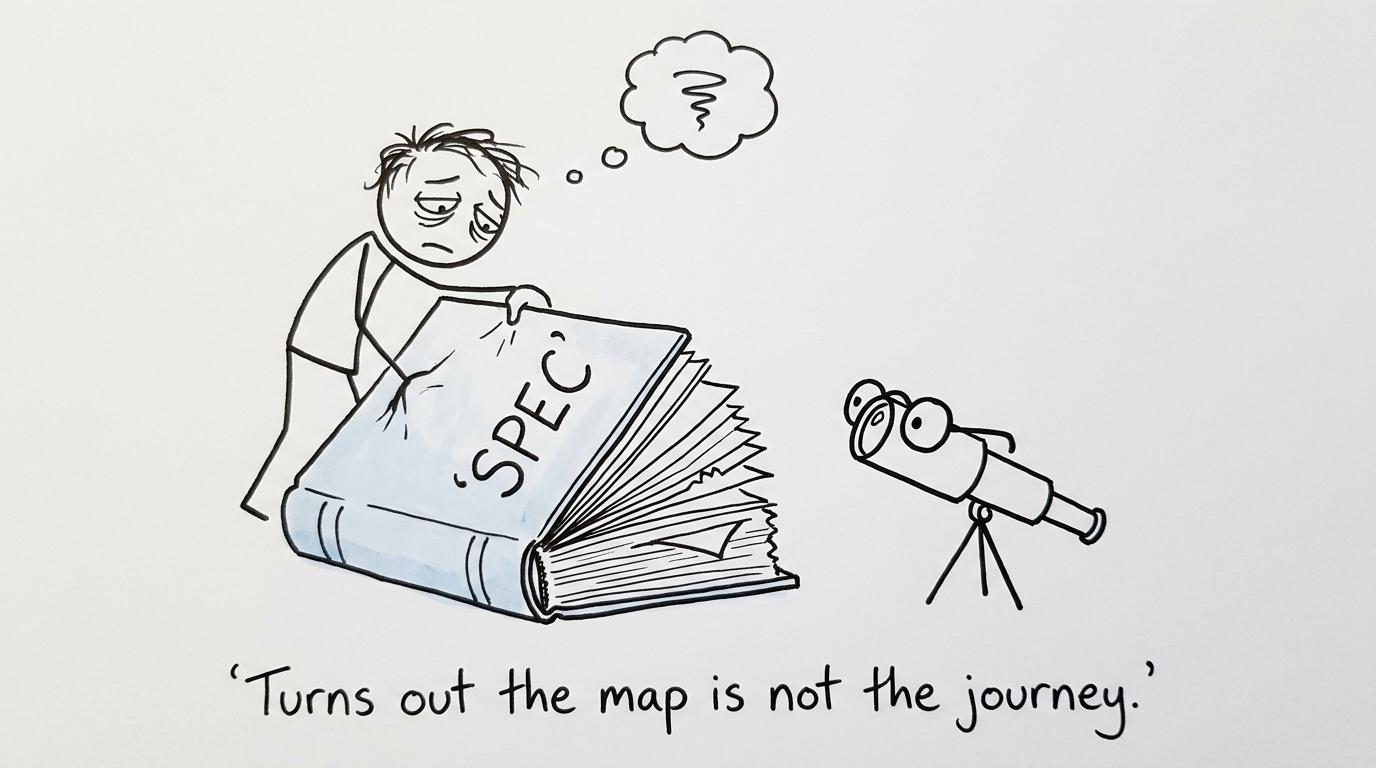 A student discovers that the specification is a map rather than the whole revision journey
The short answer and your reading checklist
At the time of writing, Pearson Edexcel is the exam board offering GCSE Astronomy in England. The current qualification code is 1AS0, and it is untiered. Unlike GCSE Maths, there is no foundation or higher paper: every candidate follows the same specification and sits the same assessments.
If you open the official specification, focus on these sections:
- the qualification and assessment overview;
- the content statements for Topics 1 to 16;
- the command words and assessment objectives;
- observational skills and compulsory observations;
- the mathematical skills appendix;
- the formulae and data information;
- any issue notes showing changes to the document.
You do not need to memorise administrative material intended for centres. Nor should you spend hours colouring every line. Read with a question in mind: What does this document change about what I will revise or practise?
For an accessible starting point alongside the official document, use the Edexcel GCSE Astronomy revision hub. It brings lessons, questions and available past-paper material into one place.
What the official specification gives you that a guide may not
A good revision guide translates the course. The specification defines it. That difference matters most when your time is limited and you need to decide what deserves attention.
The exact scope of each topic
The Edexcel course contains 16 numbered topics. Topics 1 to 8 belong principally to Paper 1, Naked-eye Astronomy, while Topics 9 to 16 belong principally to Paper 2, Telescopic Astronomy.
A revision guide might have a broad chapter called “the Solar System”. The specification breaks that idea into assessable statements. It distinguishes between facts you must recall, relationships you must explain, calculations you must perform and evidence you must evaluate.
That detail prevents two opposite mistakes. The first is revising interesting astronomy that lies beyond the GCSE. The second is assuming that a familiar heading means you have covered every examinable statement beneath it.
Turn each content statement into one of three labels:
- Secure: you could answer a question without notes.
- Developing: you recognise it but could not explain or apply it confidently.
- Unfamiliar: you need a lesson before attempting questions.
This produces a more honest revision list than simply ticking whole chapters.
The real assessment structure
The qualification has two externally examined papers. Each lasts 1 hour 45 minutes, carries 100 marks and contributes 50% of the GCSE. Both papers can include multiple-choice, short-answer, calculation, graphical and extended open-response questions. A calculator is permitted, and Pearson supplies a Formulae and Data Sheet.
Those facts influence how you revise. If you only learn definitions, you are preparing for one part of the demand. You must also interpret data, connect ideas, explain observations and carry out calculations accurately.
The official assessment objectives make this visible. Across the qualification, AO1 accounts for 40%, AO2 for 40% and AO3 for 20%. In broad terms, that means knowledge is important, but applying knowledge and analysing evidence matter just as much. A student who can recite a page may still struggle when the same idea appears in an unfamiliar observational setting.
The mathematical demand hidden inside astronomy
Official requirements state that at least 20% of the marks in the written assessments must reward mathematical skills used in an astronomical context. This is one of the strongest reasons for a maths-focused student to inspect the specification personally.
The mathematical appendix identifies skills including:
- decimal and standard form notation such as a×10na \times 10^na×10n, where 1≤a<101 \leq a < 101≤a<10;
- ratios, fractions and percentages;
- inverse-square relationships;
- rearranging and substituting into equations;
- logarithms to base 101010 in equations, scales and graphs;
- interpreting tables, charts and graphs;
- gradients and areas under graphs where specified;
- geometry, angles and trigonometric relationships;
- units, significant figures and sensible rounding.
The specification tells you which tools may appear, but it does not teach those tools. That is where the GCSE Maths revision hub becomes useful. Choose your own maths exam board: Edexcel, AQA, OCR, Eduqas, WJEC or CCEA; then and strengthen the underlying skills with lessons and practice questions.
Astronomical distances and sizes make standard form particularly important. If this notation feels fragile, use MathsGenie's standard form revision resources for focused practice, while checking that the level matches your own maths specification.
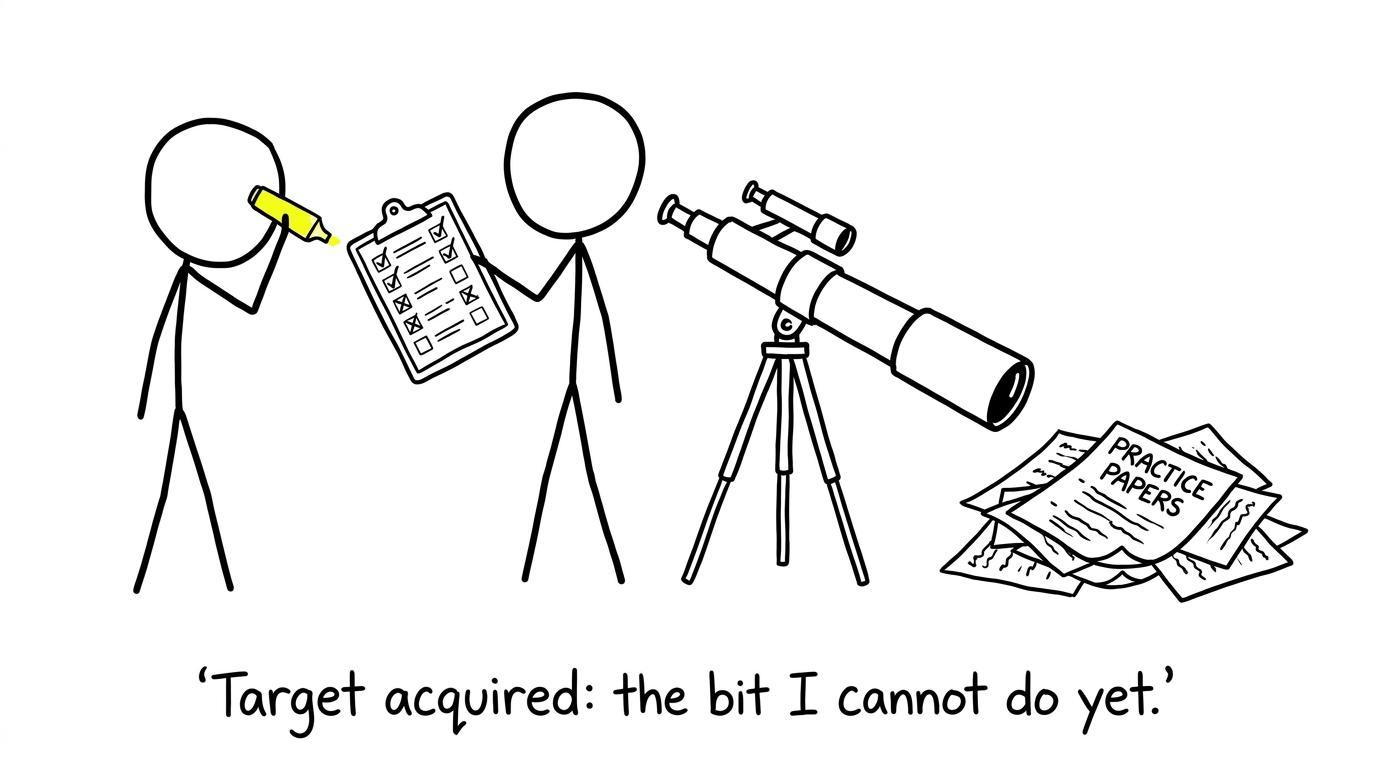 A student uses a highlighter like a telescope to find a genuine revision target
Why observational skills deserve careful reading
Astronomy is unusual because observation is central to the subject, yet the GCSE is assessed through written examinations. Students must undertake at least one unaided and one aided observation during the course. The written papers then assess the knowledge, reasoning and evaluation developed through observational work.
Official requirements reserve at least 15% of the qualification's marks for observational knowledge, skills and understanding. The specification describes an observational cycle involving four broad stages:
- designing an observation;
- making and recording observations;
- analysing the resulting information;
- evaluating the method and evidence.
Reading this section yourself reveals that an observation is not merely a night spent looking through a telescope. You may need to consider variables, equipment, safety, accuracy, reliability, limitations and possible improvements. You also need to understand unaided techniques and the use of equipment such as binoculars, telescopes or cameras.
This is exactly the kind of detail a short guide may compress. Your teacher remains responsible for organising and confirming the required work, so follow your centre's instructions. However, knowing the assessed cycle helps you treat those sessions as preparation for written questions rather than as activities detached from the exam.
How to read the document without wasting an evening
The phrase “read the full specification” can suggest starting at the first page and pushing through every line. That is rarely the best use of revision time. Use three passes instead.
First pass: understand the course
Spend a short session scanning the contents page, assessment overview, paper structure and topic headings. Your aim is orientation, not memorisation.
Confirm that you have the current Pearson Edexcel 1AS0 document. Older Astronomy qualifications may have different unit codes, coursework arrangements or paper structures. A polished PDF found through a search is not automatically current.
Second pass: audit the content
Read the individual content statements and mark only genuine gaps. Be cautious with statements that feel familiar. Recognition is not the same as being able to explain, calculate or evaluate under exam conditions.
Create a concise checklist, perhaps one page per paper. Keep the wording close enough to the official statement that you do not accidentally narrow its meaning.
If you need help deciding which foundations to repair first, the best order for learning GCSE maths topics provides a sensible sequence from number fluency through algebra, graphs, geometry and exam technique.
Third pass: connect statements to questions
A specification becomes useful when it changes your actions. For every weak statement, choose one next step:
- learn it through a revision lesson;
- retrieve it from memory;
- answer topic questions;
- inspect how it has appeared in a past paper;
- mark your response and record the correction.
Reading alone cannot prove that you can earn marks. The process described in how to use GCSE past papers properly applies here too: attempt, mark, diagnose, repair and retest.
How the specification and a revision guide should work together
You do not need to choose between the official document and a clear guide. They perform different jobs.
Use the specification to answer:
- Is this content examinable?
- What depth or action does the wording require?
- Which paper principally covers it?
- Which mathematical or observational skills accompany it?
Use a lesson or guide to answer:
- What does this idea mean?
- How are its parts connected?
- What terminology should I use?
- How can I approach a question about it?
Then use questions and mark schemes to answer the only test that finally matters: Can I produce a mark-worthy response independently?
The same principle supports maths revision. GCSE maths topics that commonly recur can help you prioritise broad mathematical foundations, but your own specification, tier and paper performance should decide your final plan.
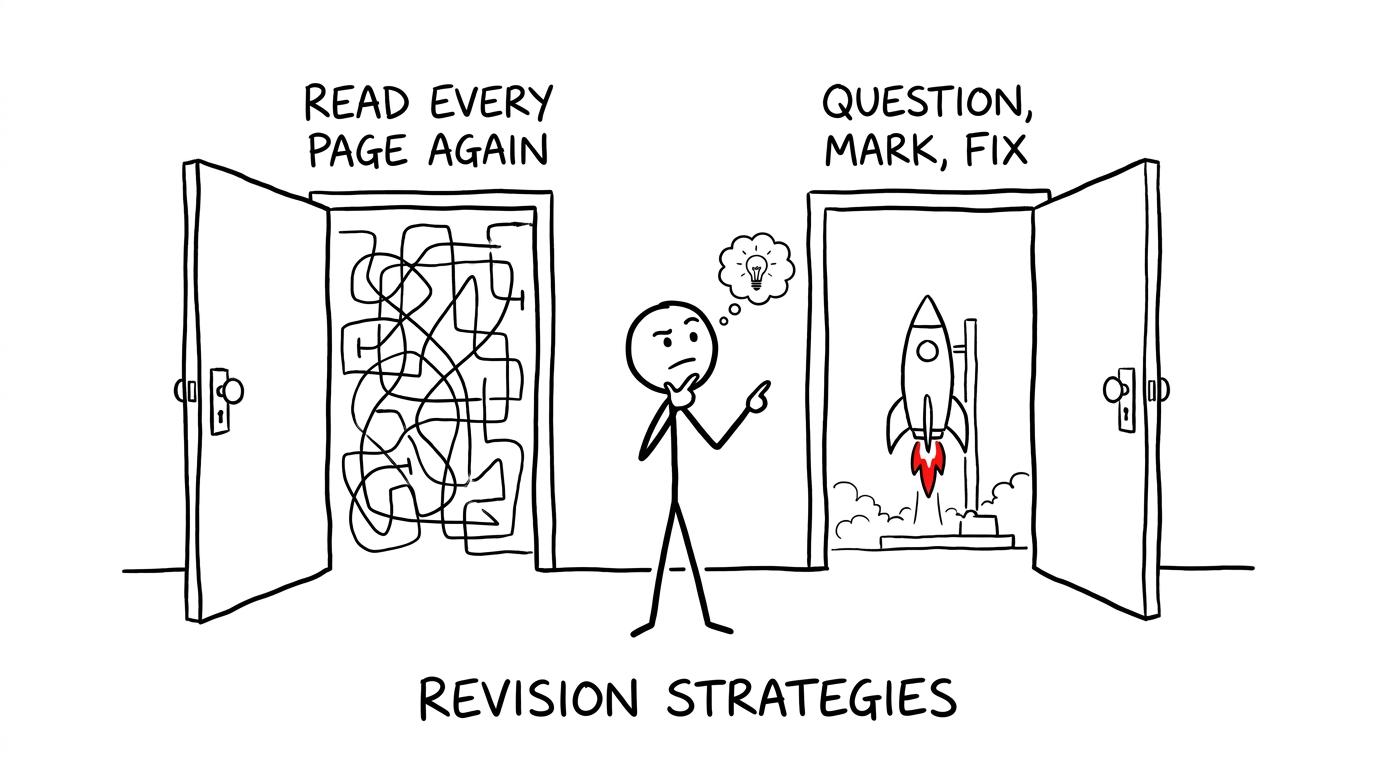 A revision maze is avoided by choosing the question, mark and fix route
Common mistakes when reading a GCSE Astronomy specification
Treating it like a revision book
The document defines content but usually does not explain it in a student-friendly teaching sequence. If a statement is unclear, move to a lesson rather than rereading the same formal sentence repeatedly.
Reading the wrong version
Old specifications can contain obsolete assessment arrangements. Check the qualification code, issue information and current course details. GCSE Astronomy is currently Pearson Edexcel 1AS0; AQA, OCR and Eduqas are familiar GCSE Maths boards, but they do not currently provide equivalent GCSE Astronomy specifications in England.
Highlighting almost everything
When every sentence is highlighted, nothing has been prioritised. Mark only unfamiliar content, command words, mathematical demands and details that alter your revision.
Ignoring small words in content statements
Words such as “describe”, “explain”, “calculate”, “compare” and “evaluate” signal different tasks. Knowing a definition does not automatically prepare you to assess the reliability of an observation or interpret unfamiliar data.
Assuming the formula sheet removes the need for maths practice
Having an equation available is not the same as knowing when to use it, how to rearrange it or how to handle units. Strengthen weak techniques through targeted questions, then test them under time pressure.
Stopping after making a checklist
A checklist records coverage; it does not create recall. Follow it with active practice. MathsGenie's Edexcel predicted maths papers demonstrate how timed papers, mark schemes and worked solutions can turn a content list into an actionable feedback cycle. For Astronomy itself, prioritise official past questions available through the Astronomy hub.
A specification is a boundary, not a revision method
It is worth reading the full GCSE Astronomy specification yourself once. You gain an accurate picture of the content, assessment structure, mathematical demand and observational expectations. You also become less dependent on somebody else's summary of what matters.
But the document cannot replace teaching or practice. Once you have extracted your gaps, close it. Learn the idea, answer questions, check the mark scheme and return later to confirm coverage.
Start with the MathsGenie Edexcel GCSE Astronomy resources, then use the wider GCSE maths revision lessons to strengthen standard form, ratio, algebra, graphs, geometry and calculator skills. Build towards past papers and mark schemes, and use mini tests, video solutions and predicted papers for your maths exams when you need focused feedback.
Read the map once. Then spend most of your time moving.