Quadratic Discriminant A-Level Maths: A Clear Guide
Quadratic discriminant A-Level Maths explained with clear root conditions, step-by-step worked examples and exam-style practice to build your confidence.

Quadratic discriminant A-Level Maths: what it tells you
Imagine a sixth-form student looking at a quadratic containing an unknown constant. Factorising seems impossible. The quadratic formula looks messy. Yet the question only asks whether real roots exist.
The quadratic discriminant A-Level Maths students need is b2−4acb^2-4acb2−4ac. For ax2+bx+c=0ax^2+bx+c=0ax2+bx+c=0, where a≠0a\ne0a=0, its sign tells you whether there are two distinct real roots, one repeated real root or no real roots. You can answer that question without finding the roots themselves.
That changes the task. Instead of asking, “How do I solve this?”, you ask, “What must be true about its solutions?”
Your discriminant checklist
For a quadratic written as ax2+bx+c=0ax^2+bx+c=0ax2+bx+c=0, define:
Δ=b2−4ac.\Delta=b^2-4ac.Δ=b2−4ac.- If Δ>0\Delta>0Δ>0, there are two distinct real roots.
- If Δ=0\Delta=0Δ=0, there is one repeated real root.
- If Δ<0\Delta<0Δ<0, there are no real roots.
The wording matters. “Real roots” includes a repeated root, so the condition is Δ≥0\Delta\ge0Δ≥0. “Two distinct real roots” requires Δ>0\Delta>0Δ>0.
MathsGenie's discriminant topic overview brings the lesson and practice resources together.
Why the discriminant works
The discriminant comes from the quadratic formula:
x=−b±b2−4ac2a.x=\frac{-b\pm\sqrt{b^2-4ac}}{2a}.x=2a−b±b2−4ac.When the expression under the square root is positive, the plus and minus choices produce different real answers. When it is zero, both choices give the same answer. When it is negative, the square root has no real value.
There is also a graphical interpretation. The roots are the horizontal-axis intersections of y=ax2+bx+cy=ax^2+bx+cy=ax2+bx+c. Two distinct roots mean two crossings. A repeated root means the parabola touches the axis at its turning point. No real roots means no intersection.
The direction in which the parabola opens does not change these root conditions. An upward-opening curve and a downward-opening curve can each cross the axis twice, touch it once or miss it entirely. The leading coefficient controls the direction of opening; the discriminant controls the number of real intersections. Keeping those roles separate helps when a question combines algebra with a sketch.
If the connection between equations and graphs feels uncertain, MathsGenie's quadratic equations revision guide provides broader context.
A method you can repeat
First, rearrange the equation so that one side is zero. Next, identify aaa, bbb and ccc, including their signs. Calculate b2−4acb^2-4acb2−4ac, then interpret the result using the question's exact wording.
When a parameter appears, the calculation produces an expression rather than a number. Set that expression greater than, equal to or less than zero, then solve the resulting condition.
Keep the unknown parameter distinct from the variable you are solving for. The coefficients may contain letters without changing the method. After finding boundary values, check which intervals satisfy your inequality rather than assuming the answer lies between them. A quick sign check in each interval is often enough. Finally, decide whether the boundary values belong in your answer by returning to the original wording.
Turn this method into a practice routine with MathsGenie's discriminant lessons and Quadratics Question Bank.
Quadratic discriminant worked examples
Identify the number of real roots
Determine the nature of the roots of:
2x2−7x+3=0.2x^2-7x+3=0.2x2−7x+3=0.Identify the coefficients:
a=2,b=−7,c=3.a=2,\qquad b=-7,\qquad c=3.a=2,b=−7,c=3.Substitute carefully:
Δ=(−7)2−4(2)(3)=49−24=25.\Delta=(-7)^2-4(2)(3)=49-24=25.Δ=(−7)2−4(2)(3)=49−24=25.Since 25>025>025>0, the equation has two distinct real roots. That is a complete answer to the question. Finding their values would be unnecessary extra work.
Find a condition on a parameter
Find the values of kkk for which this equation has two distinct real roots:
x2+kx+9=0.x^2+kx+9=0.x2+kx+9=0.Here, a=1a=1a=1, b=kb=kb=k and c=9c=9c=9, giving:
Δ=k2−36.\Delta=k^2-36.Δ=k2−36.Two distinct real roots require:
k2−36>0.k^2-36>0.k2−36>0.Factorise:
(k−6)(k+6)>0.(k-6)(k+6)>0.(k−6)(k+6)>0.The product is positive outside the two boundary values, so:
k<−6ork>6.k<-6\quad\text{or}\quad k>6.k<−6ork>6.At k=−6k=-6k=−6 or k=6k=6k=6, the discriminant is zero. Those boundary values give repeated roots, so they are excluded.
Use the discriminant for tangency
Find ccc if the line y=2x+cy=2x+cy=2x+c is tangent to the curve y=x2−4x+7y=x^2-4x+7y=x2−4x+7.
At an intersection, the two expressions for yyy are equal:
x2−4x+7=2x+c.x^2-4x+7=2x+c.x2−4x+7=2x+c.Rearrange:
x2−6x+7−c=0.x^2-6x+7-c=0.x2−6x+7−c=0.Tangency means this intersection equation has a repeated root. Therefore:
Δ=(−6)2−4(1)(7−c)=8+4c=0.\Delta=(-6)^2-4(1)(7-c)=8+4c=0.Δ=(−6)2−4(1)(7−c)=8+4c=0.Hence:
c=−2.c=-2.c=−2.The important step was forming the intersection equation. Its discriminant describes where the line meets the curve; the original curve's discriminant describes where it meets the horizontal axis.
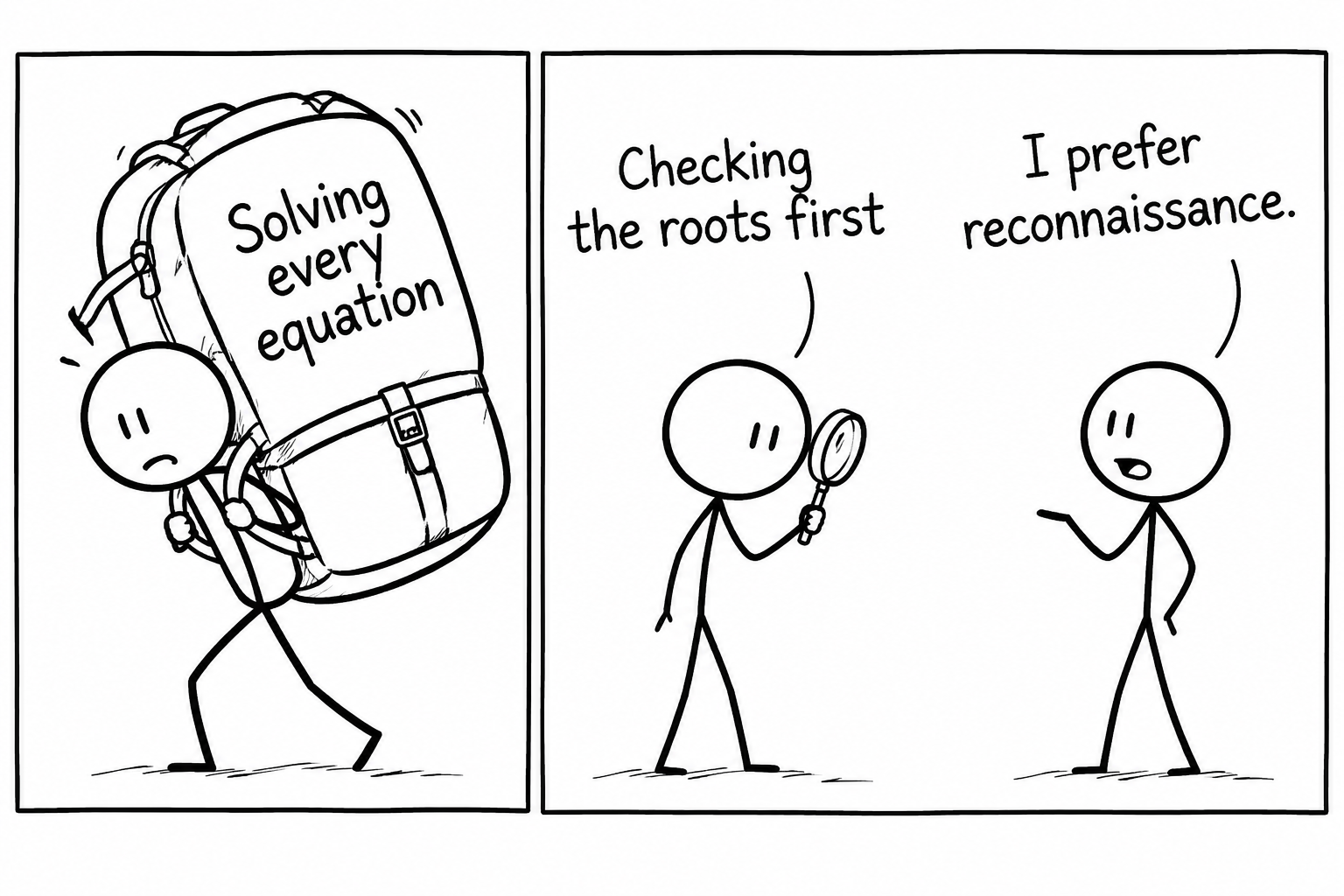 Stick-figure comic comparing a heavy backpack labelled Solving every equation with a small magnifying glass labelled Checking the roots first
Common mistakes to catch
Losing a negative sign
If b=−7b=-7b=−7, then b2=(−7)2=49b^2=(-7)^2=49b2=(−7)2=49. Write brackets around negative coefficients when substituting. This small habit prevents an otherwise correct method from producing the wrong conclusion.
Choosing the wrong inequality
“No real roots” means Δ<0\Delta<0Δ<0. “Real roots” means Δ≥0\Delta\ge0Δ≥0. Before calculating, translate the wording into a condition. That keeps the purpose of the algebra visible.
Forgetting whether the equation is quadratic
The leading coefficient must be non-zero. If a parameter can make a=0a=0a=0, check that case separately: the equation is then linear or constant, and the quadratic discriminant test no longer applies.
Confusing positive roots with a positive discriminant
A positive discriminant tells you that two distinct real roots exist. It does not tell you that both roots are positive. Their signs require additional reasoning.
Quadratic discriminant exam questions
Try these original exam-style questions before checking the answers. For each one, write the required discriminant condition first.
- Determine the nature of the roots of 3x2+2x+5=03x^2+2x+5=03x2+2x+5=0.
- Find kkk if x2−6x+k=0x^2-6x+k=0x2−6x+k=0 has a repeated root.
- Find all values of ppp for which x2+px+4=0x^2+px+4=0x2+px+4=0 has real roots.
Check your answers
For the first question, Δ=22−4(3)(5)=−56\Delta=2^2-4(3)(5)=-56Δ=22−4(3)(5)=−56, so there are no real roots.
For the second, Δ=36−4k=0\Delta=36-4k=0Δ=36−4k=0, giving k=9k=9k=9.
For the third, Δ=p2−16≥0\Delta=p^2-16\ge0Δ=p2−16≥0, giving p≤−4p\le-4p≤−4 or p≥4p\ge4p≥4. Equality is included because repeated roots are real.
MathsGenie's A Level topic question booklets include discriminant practice. When reviewing an answer, identify whether the difficulty was substitution, interpreting the wording or solving the final inequality.
For effective revision, revisit an incorrect question without looking at its solution. Explain aloud why you chose the discriminant condition, then complete the algebra independently. On a later attempt, mix root questions with tangency questions so that you practise recognising the method rather than following a familiar sequence. Compare your working with the mark scheme, paying attention to the mathematical justification as well as the final answer. This makes your review more diagnostic than simply counting correct responses.
Make the method yours
Our imagined student now has a useful first question: what does the problem say about the roots? Your next step is to recognise that condition independently, especially when it is hidden inside a tangency problem. Start with MathsGenie's discriminant lessons, then apply the method in the Quadratics Question Bank.