Pressure Force Area Exam Questions: GCSE Guide
Pressure force area exam questions explained through three GCSE examples, with method marks, unit checks, common mistakes and targeted practice.

Pressure questions often look easier than they feel. The formula is short, yet a student can still lose marks by dividing the wrong way, using the whole surface area or overlooking a conversion from centimetres to metres.
The reliable way to answer pressure force area exam questions is to identify the unknown, choose the correct form of the formula, check that the units agree and show every stage of the calculation. That process matters because a correct method can earn marks even when the final answer goes wrong.
Imagine a GCSE student called Maya working through three questions. The first asks directly for pressure. The second reverses the formula. The third combines pressure with area and metric conversion. Together, they cover the decisions that make these questions manageable.
The pressure, force and area checklist
Start with the relationship:
P=FAP=\frac{F}{A}P=AFHere, PPP is pressure, FFF is force and AAA is area. You can rearrange it into three useful forms:
P=FA,F=P×A,A=FPP=\frac{F}{A}, \qquad F=P\times A, \qquad A=\frac{F}{P}P=AF,F=P×A,A=PFBefore touching the calculator, use this checklist:
- Underline what the question asks you to find.
- Write the appropriate formula.
- Convert measurements if the units do not match.
- Substitute the values with their units.
- Calculate without rounding too early.
- Give the final answer with the correct pressure, force or area unit.
When force is measured in newtons and area in square metres, pressure is measured in newtons per square metre:
N/m2\text{N/m}^2N/m2This is equivalent to pascals:
1 Pa=1 N/m21\text{ Pa}=1\text{ N/m}^21 Pa=1 N/m2The Maths Genie Speed and Density lesson places these compound-measure skills into an exam-style GCSE Maths context.
Build confidence with the Maths Genie Lessons and Question Bank when you want to repeat this exact identify, rearrange, convert and calculate method without organising the questions yourself.
Question one: calculating pressure directly
Maya begins with a question in which every value is already in a compatible unit.
Exam-style question
A machine exerts a force of 600 N600\text{ N}600 N on a floor. Its base has an area of 12 m212\text{ m}^212 m2. Work out the pressure on the floor.
Step-by-step solution
The question asks for pressure, so Maya selects:
P=FAP=\frac{F}{A}P=AFShe substitutes the force and area:
P=60012P=\frac{600}{12}P=12600Then she calculates:
P=50P=50P=50The area was measured in square metres and the force in newtons, so her final answer is:
50 N/m2\boxed{50\text{ N/m}^2}50 N/m2Where the method marks come from
An indicative three-mark structure would be:
- one mark for using P=FAP=\frac{F}{A}P=AF;
- one mark for substituting 600600600 and 121212 correctly;
- one mark for the correct answer, usually with an acceptable unit where required.
Exact mark schemes vary, but this shows why written working matters. If Maya accidentally evaluates 600÷12600\div12600÷12 incorrectly, the formula and substitution may still demonstrate valid method.
You can compare this example with a similar machine press pressure question in the Maths Genie question collection.
Question two: finding force by rearranging
The next question contains the same three quantities, but pressure is no longer the unknown. That small change is where many rushed answers fail.
Exam-style question
A block produces a pressure of 60 N/m260\text{ N/m}^260 N/m2 over an area of 2.5 m22.5\text{ m}^22.5 m2. Work out the force exerted by the block.
Step-by-step solution
Maya writes the original relationship first:
P=FAP=\frac{F}{A}P=AFShe needs force, so she multiplies both sides by AAA:
F=P×AF=P\times AF=P×ANow she substitutes:
F=60×2.5F=60\times2.5F=60×2.5Therefore:
F=150 N\boxed{F=150\text{ N}}F=150 NA useful sense check is that pressure multiplied by area gives force:
Nm2×m2=N\frac{\text{N}}{\text{m}^2}\times\text{m}^2=\text{N}m2N×m2=NThe square-metre units cancel, leaving newtons.
Where the method marks come from
A typical three-mark pathway could reward:
- rearranging to F=P×AF=P\times AF=P×A;
- substituting 606060 and 2.52.52.5;
- reaching 150 N150\text{ N}150 N.
Writing only 150150150 hides the reasoning and risks losing method marks. Writing the formula makes the route visible to the examiner. Practise the same rearrangement with this GCSE question on calculating force.
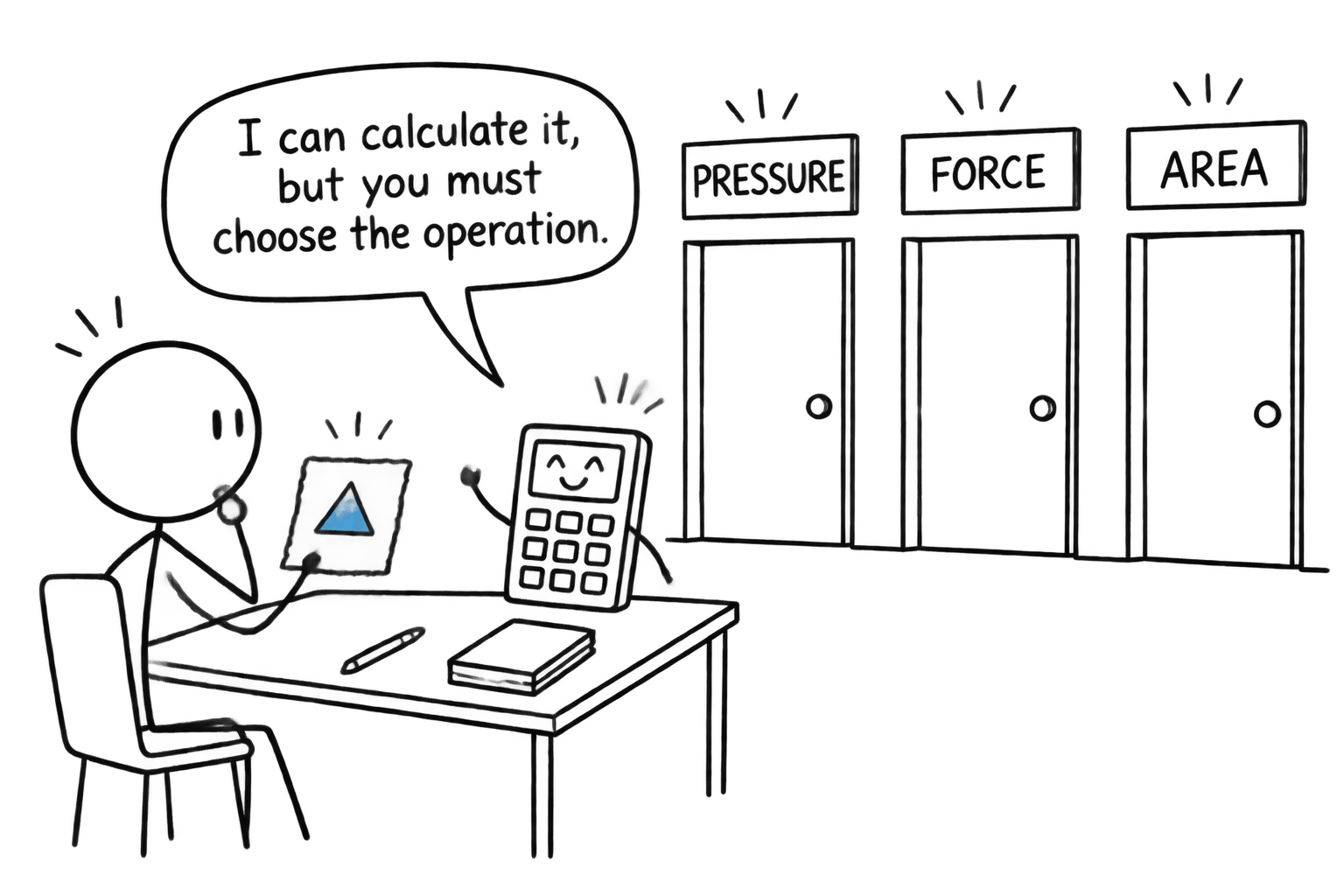 A student uses a formula map while a calculator reminds them to choose the operation
Question three: finding a missing dimension
The hardest pressure force area past paper questions often hide an extra stage. You may need to find the contact area and then connect that area to the dimensions of a shape.
Exam-style question
A rectangular crate exerts a force of 960 N960\text{ N}960 N. The pressure on the floor is 24,000 N/m224{,}000\text{ N/m}^224,000 N/m2. The crate's base is 50 cm50\text{ cm}50 cm long. Work out the width of its base in centimetres.
Step-by-step solution
Maya first finds the contact area. From
P=FA,P=\frac{F}{A},P=AF,she rearranges to obtain:
A=FPA=\frac{F}{P}A=PFSubstituting gives:
A=96024,000=0.04 m2A=\frac{960}{24{,}000}=0.04\text{ m}^2A=24,000960=0.04 m2The base is rectangular, so:
A=l×wA=l\times wA=l×wThe area is in square metres. Maya must therefore convert the length into metres before using it:
50 cm=0.5 m50\text{ cm}=0.5\text{ m}50 cm=0.5 mShe substitutes the area and length:
0.04=0.5×w0.04=0.5\times w0.04=0.5×wDividing by 0.50.50.5 gives:
w=0.040.5=0.08 mw=\frac{0.04}{0.5}=0.08\text{ m}w=0.50.04=0.08 mThe question requests centimetres:
0.08 m=8 cm0.08\text{ m}=8\text{ cm}0.08 m=8 cmTherefore, the width is:
8 cm\boxed{8\text{ cm}}8 cmWhere the method marks come from
An indicative five-mark structure could credit:
- rearranging the pressure formula correctly;
- calculating 0.04 m20.04\text{ m}^20.04 m2;
- converting 50 cm50\text{ cm}50 cm to 0.5 m0.5\text{ m}0.5 m;
- using A=l×wA=l\times wA=l×w and solving for www;
- converting the answer to 8 cm8\text{ cm}8 cm.
This question rewards a chain of connected steps. An error near the end does not necessarily erase the valid pressure calculation at the beginning. If conversions are the weak link, review the Maths Genie metric conversions resources before returning to compound measures. You can also try a pressure question requiring contact area.
Common mistakes in the pressure force area GCSE exam
Multiplying when you should divide
Pressure is force divided by area, not force multiplied by area:
P=FAP=\frac{F}{A}P=AFA quick sense check helps. If the same force acts over a larger area, the pressure should become smaller.
Using the wrong area
Use the area in contact with the surface. For a box resting on its base, you usually need the base area, not its total surface area.
Treating length conversion like area conversion
Since
1 m=100 cm,1\text{ m}=100\text{ cm},1 m=100 cm,it follows that
1 m2=10,000 cm2.1\text{ m}^2=10{,}000\text{ cm}^2.1 m2=10,000 cm2.The conversion factor is squared for area. Where possible, convert the individual lengths before calculating the area.
Omitting the unit
A pressure answer may need N/m2\text{N/m}^2N/m2, a force answer needs N\text{N}N and an area answer needs a squared unit such as m2\text{m}^2m2. The requested unit in the question should guide your final line.
Hiding every step
A calculator-only answer gives an examiner little evidence of your method. Write the formula, substitution and result on separate lines, particularly in a multi-stage question.
Exam-style practice to try next
Use the same checklist on these questions before checking the answers.
- A force of 420 N420\text{ N}420 N acts over an area of 6 m26\text{ m}^26 m2. Find the pressure.
- A platform produces a pressure of 800 N/m2800\text{ N/m}^2800 N/m2 over an area of 3.5 m23.5\text{ m}^23.5 m2. Find the force.
- A box exerts a force of 1,500 N1{,}500\text{ N}1,500 N and produces a pressure of 5,000 N/m25{,}000\text{ N/m}^25,000 N/m2. Find its contact area.
The answers are:
70 N/m2,2,800 N,0.3 m270\text{ N/m}^2, \qquad 2{,}800\text{ N}, \qquad 0.3\text{ m}^270 N/m2,2,800 N,0.3 m2For a larger set, the Edexcel GCSE Maths Question Bank lets you move from straightforward substitution to more demanding exam-style problems and check your working against mark schemes.
Turn the method into marks
Maya's three questions changed in difficulty, but her routine did not: identify the unknown, select or rearrange the formula, align the units and show the calculation. Knowing that routine is the first step; following it consistently under exam pressure takes deliberate practice.
Start the matching Maths Genie Lessons, then use the Question Bank to practise pressure force area exam questions until each line of working feels familiar.