Podcasts and Audiobooks for GCSE English Revision
Podcasts audiobooks GCSE English Language and Literature advice: learn when listening helps, why writing still matters and how to revise actively.
Revision often begins with an attractive promise: perhaps you can put on your headphones, press play and let the knowledge settle in. If you have searched for podcasts audiobooks GCSE English Language and Literature advice, the short answer is yes, listening can help, but it works best as a supplement, not as your entire revision method.
Audiobooks can strengthen your knowledge of a Literature text, while podcasts can clarify themes, context and interpretations. Yet GCSE English exams still require you to read precisely, select evidence, plan arguments and write under timed conditions. Listening supports those skills; it does not replace practising them.
For students balancing English with GCSE maths, this distinction matters. Audio is useful in moments when written revision is impractical. Your focused desk time, however, should remain protected for the activities that most closely resemble the exam.
The quick listening-based revision checklist
Use podcasts and audiobooks when you want to:
- revisit the plot, characters or atmosphere of a Literature text;
- hear unfamiliar vocabulary and sentence rhythms;
- encounter alternative interpretations;
- review ideas while travelling, walking or doing a routine task;
- make a difficult text feel more accessible before reading it closely.
Do not rely on listening alone when you need to:
- analyse the precise wording of a quotation;
- annotate an unseen extract;
- compare writers' viewpoints or poems;
- plan and write an extended answer;
- practise spelling, punctuation and grammar;
- build the speed and stamina required in an exam.
The principle is simple: listen to understand, then retrieve, read and write to prepare for assessment.
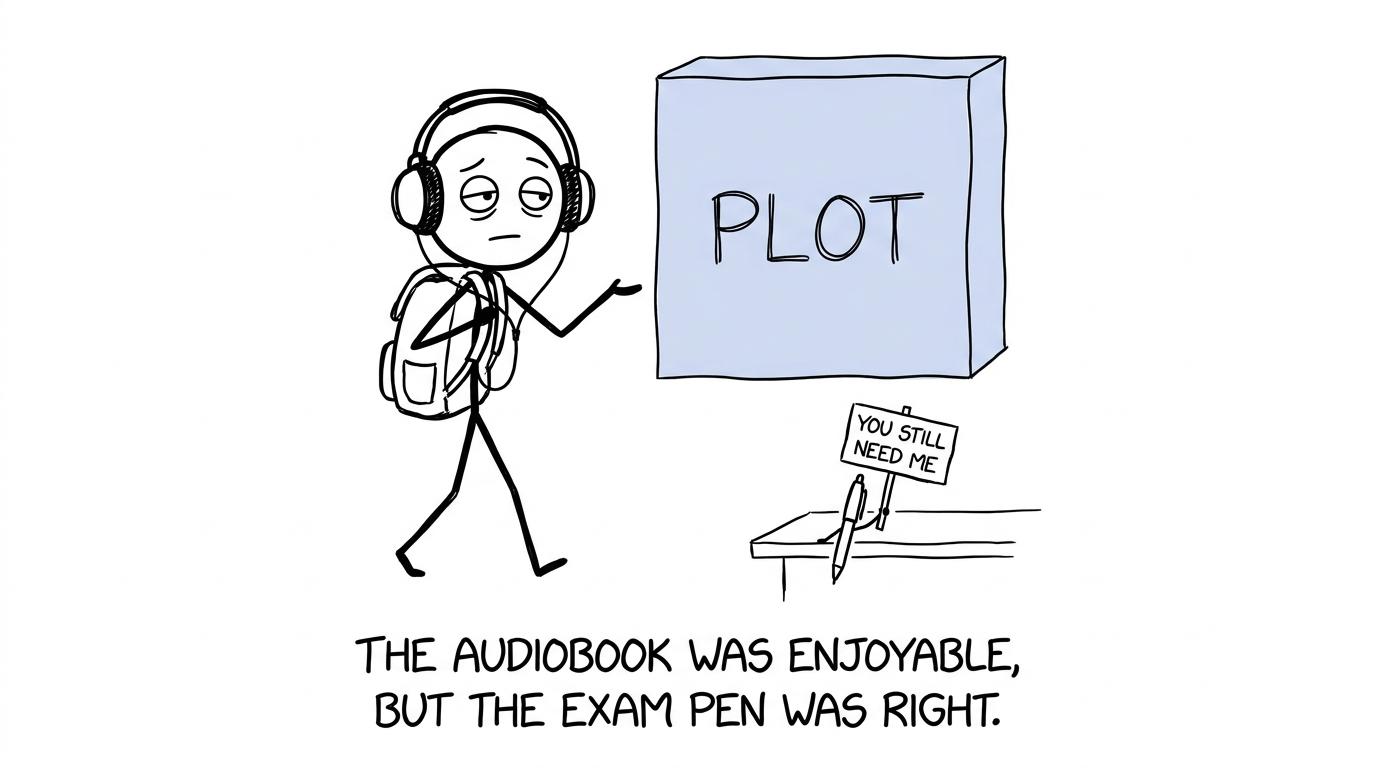 A GCSE student listens while an exam pen protests that written practice still matters
Do podcasts and audiobooks genuinely improve revision?
They can improve revision when they make you think. Merely hearing information is less dependable because familiarity can feel like knowledge. A familiar explanation may seem obvious while it is playing, but the real test comes when the audio stops and you have to reconstruct the idea independently.
This is why active listening is more valuable than passive listening. After a short section, pause and ask yourself:
- What were the three most important ideas?
- Which interpretation could I use in an essay?
- What evidence from the text supports it?
- Can I explain the point without replaying the episode?
- What would I challenge or qualify?
Trying to recall an idea makes your understanding visible. If nothing comes to mind, the audio may have created recognition without secure recall. That is useful feedback, not failure: replay the relevant part, make a brief note and test yourself again later.
Listening also reduces some barriers to starting. A complete novel or play can feel intimidating on the page, particularly when the language is unfamiliar. An audio performance gives voices to the characters and makes changes in mood easier to notice. The danger is stopping there. English Literature rewards close attention to the writer's choices, so the printed text must eventually return to the centre of your revision.
How audiobooks help with GCSE English Literature
An audiobook is particularly valuable for understanding a text as a complete work. Hearing a play performed can clarify conflict, interruption and tone. Hearing a novel can reveal recurring images or shifts in narrative voice that are easy to miss when reading slowly across several weeks.
Plot, character and sequence
Audiobooks can refresh what happens, when it happens and how characters change. This provides the broad map you need before analysing individual passages. It may also help you connect an early decision with its later consequences.
However, plot knowledge is only the beginning. A strong Literature response does not simply retell events. It develops an argument about how the writer presents an idea, using well-chosen textual evidence and analysis.
Tone and dramatic voice
Performance can make irony, tension and hesitation more noticeable. Treat the narrator's or actor's delivery as a possible interpretation rather than the only correct one. Return to the text and ask which words support that delivery. You might also consider whether another reading is possible.
Quotations and close analysis
Audio may help memorable lines stick, but learning a quotation by sound does not guarantee that you can spell it accurately or analyse its language. Read important passages alongside the recording. Pause to notice imagery, structure, punctuation and changes in tone.
For poetry, listening can reveal rhythm and emphasis, but visual features still matter. Line breaks, stanza shape and punctuation are seen on the page. Your revision therefore needs both sound and sight.
How podcasts help with GCSE English Language
GCSE English Language is not mainly a test of remembered content. Across Edexcel, AQA, OCR and Eduqas specifications, the exact paper structures differ, but students are expected to respond to unfamiliar material and communicate effectively in writing.
A podcast cannot predict the unseen extract in front of you. It can, however, help you understand what a question demands, hear how an expert develops an interpretation and expand the range of ideas available for creative or transactional writing.
Useful episodes might explore:
- how writers create viewpoints;
- structural choices across a text;
- comparison and synthesis;
- persuasive techniques;
- planning a narrative or description;
- editing for clarity and accuracy.
After listening, convert the explanation into an action. Create a short checklist, annotate a fresh extract or plan a response. If the podcast remains only an interesting conversation, it has not yet become exam preparation.
This is similar to maths revision. Watching someone explain algebra can make the method seem clear, but improvement depends on attempting questions independently. MathsGenie's GCSE revision lessons and practice questions deliberately connect explanation with practice. English needs the same movement from input to output.
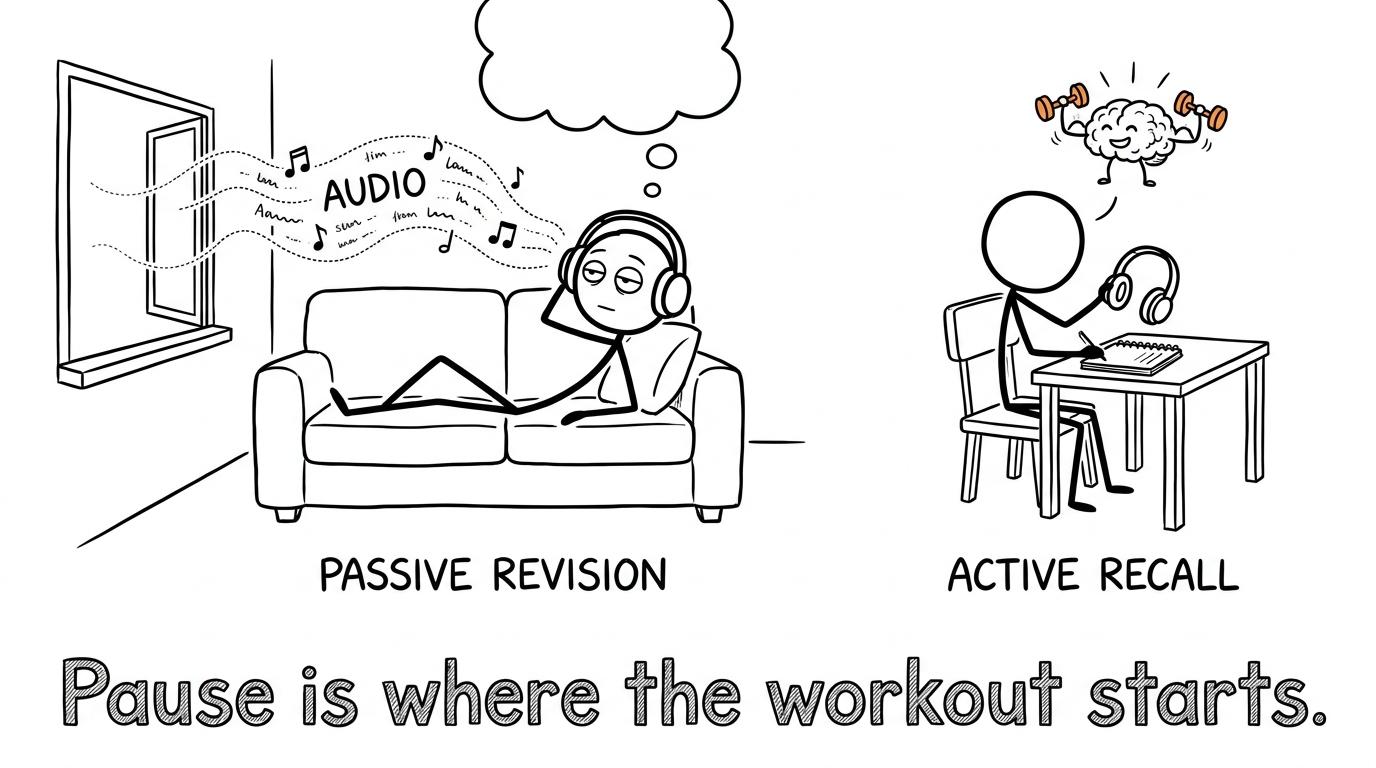 A student pauses their headphones while a tiny brain begins its revision workout
A practical way to use audio actively
A simple listen-pause-retrieve-apply routine prevents audio revision from becoming background noise.
Listen with one purpose
Choose a narrow question before pressing play. You might listen for how a character changes, how context informs an interpretation or how a writer creates tension. One purpose directs your attention better than the vague aim of learning everything.
Pause and retrieve
Stop after a manageable section. Without checking notes, say or write what you remember. Keep it brief. The aim is to expose gaps while the material is still easy to revisit.
Check against the text
For Literature, find the relevant scene, chapter or poem. Confirm quotations and inspect the writer's exact language. For Language, compare the podcast's advice with the wording of your exam board's question and mark scheme.
Apply the idea in writing
Write a paragraph, plan an argument or annotate a new passage. This is the stage that turns listening into usable knowledge. Complete responses under timed conditions as the exam approaches, because the ability to think while writing is itself a skill.
Review later
Return to your notes after a gap and test what remains. Replaying everything from the beginning is rarely the most efficient response. Target the material you could not retrieve.
When audio fits into a mixed GCSE revision plan
Audio works best in lower-intensity periods: a journey, a walk or the final part of a revision session. It can also offer a useful change of subject after demanding written work. It should not consume every available revision slot simply because it feels easier.
Plan focused sessions around exam output. For English, that means reading, planning, writing and checking. For maths, it means solving questions and correcting errors. You can organise the maths side through MathsGenie's free GCSE maths resources, then use GCSE past papers to build exam stamina.
Choose papers that match your specification. MathsGenie provides dedicated collections for Edexcel GCSE maths papers, AQA GCSE maths papers and OCR GCSE maths papers. Your English paper structure and prescribed Literature texts also depend on your exam board, so always check your school's current specification rather than following generic advice blindly.
As exams approach, GCSE predicted papers can support maths practice alongside official past papers. Predicted content is practice rather than a guarantee of what will appear. The same caution applies to English podcasts claiming to identify likely questions: revise the full required course.
Common mistakes with podcast and audiobook revision
Listening while doing something mentally demanding
Audio revision can accompany walking or a simple routine, but it competes for attention if you are answering maths questions, messaging friends or reading another text. Multitasking often leaves both tasks poorly completed.
Treating completion as progress
Finishing a long audiobook feels satisfying. Yet hours listened are not the same as ideas remembered. Judge the session by what you can explain, locate in the text and use in writing afterwards.
Replacing the original text with a summary
A podcast summary may organise the plot neatly, but your Literature response concerns the writer's work, not the presenter's summary. Keep your set text open when revising important scenes and quotations.
Accepting every interpretation
Podcast hosts make choices about emphasis. Ask whether the interpretation is supported by the text and whether an alternative reading is plausible. Thoughtful disagreement can produce stronger analysis than memorising somebody else's paragraph.
Avoiding timed writing
Listening is comfortable because it removes the risk of a blank page. The exam does not. Gradually introduce timed plans, paragraphs and complete answers, then use your teacher's feedback and official mark schemes to identify the next improvement.
Ignoring maths because English audio feels productive
Students preparing for several GCSEs need balance. Do not play an English podcast during the time allocated to independent maths practice. Use MathsGenie's topic resources, video solutions and questions to address specific gaps, then move towards full papers. Students continuing beyond GCSE can use the same active-practice principle with the A Level maths revision resources.
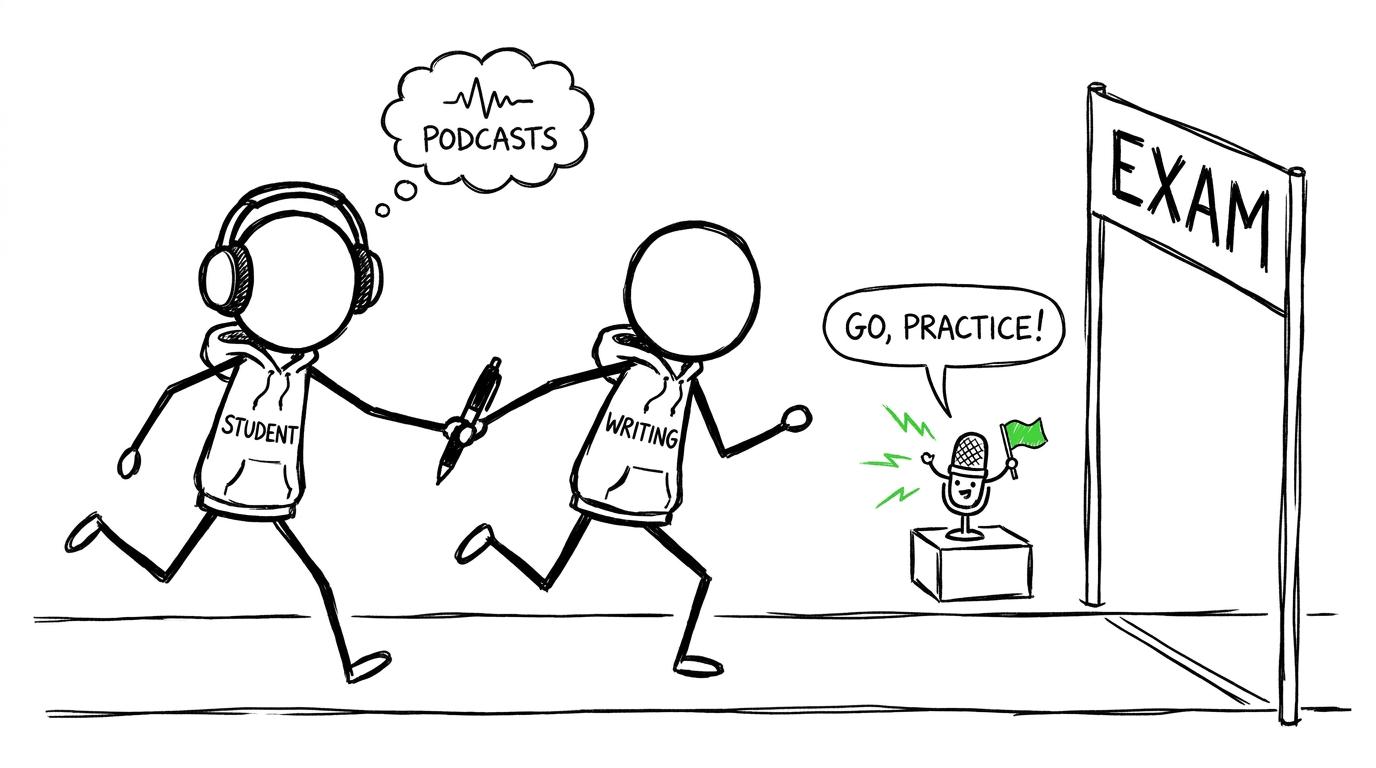 A student passes the revision baton from headphones to a pen before the exam finish line
The verdict: useful supplement, incomplete method
Podcasts and audiobooks can make GCSE English Language and Literature revision more accessible, varied and memorable. They are especially useful for revisiting plot, hearing tone, encountering interpretations and using moments when reading is impractical.
But the strongest answer is also the least glamorous: listening alone is not enough. English examinations reward close reading and controlled writing. Successful audio revision therefore ends with the headphones coming off. You retrieve the idea, check the text and apply what you know.
Use the same standard across your subjects. Explanations create understanding; independent practice reveals whether that understanding is secure. Start with MathsGenie's GCSE maths revision lessons, practise the relevant questions, check the video solutions and mark schemes, then build towards past and predicted papers. Let audio fill the spare moments, and let focused practice prepare you for the marks that matter.