Physical Flashcards vs App for GCSE Astronomy
Physical flashcards vs app GCSE astronomy: compare focus, spacing, diagrams and convenience, then build a revision system that works for your final exams.
Revision can look productive long before it becomes useful. A neat stack of cards feels reassuring. So does an app showing a growing streak. But neither guarantees that you can retrieve the right fact, interpret a diagram or complete a calculation under exam pressure.
For physical flashcards vs app GCSE astronomy, the practical answer is simple: neither format is automatically better. Paper cards usually offer fewer distractions and more freedom for sketches; apps offer portability, quick editing and, in some cases, automated review schedules. The strongest choice is the one that makes you answer from memory, revisit weak material over time and move beyond facts into exam questions. For many students, that means a hybrid system.
The quick decision checklist
Choose physical flashcards if you:
- concentrate better away from a screen;
- remember information through handwriting;
- want space for labelled sketches and observational diagrams;
- enjoy sorting cards physically into confident and uncertain piles;
- are easily pulled from revision by phone notifications.
Choose a flashcard app if you:
- revise during short gaps in the day;
- want cards available without carrying a box;
- need to edit or reorganise information frequently;
- will genuinely use any built-in spaced-review system;
- can put your device into focus mode and answer before revealing the card.
Choose a hybrid approach if you want paper for difficult diagrams and calculations, but digital cards for short factual recall. Start by checking the topics and resources in the Edexcel GCSE Astronomy revision hub, rather than building cards from an unstructured textbook chapter.
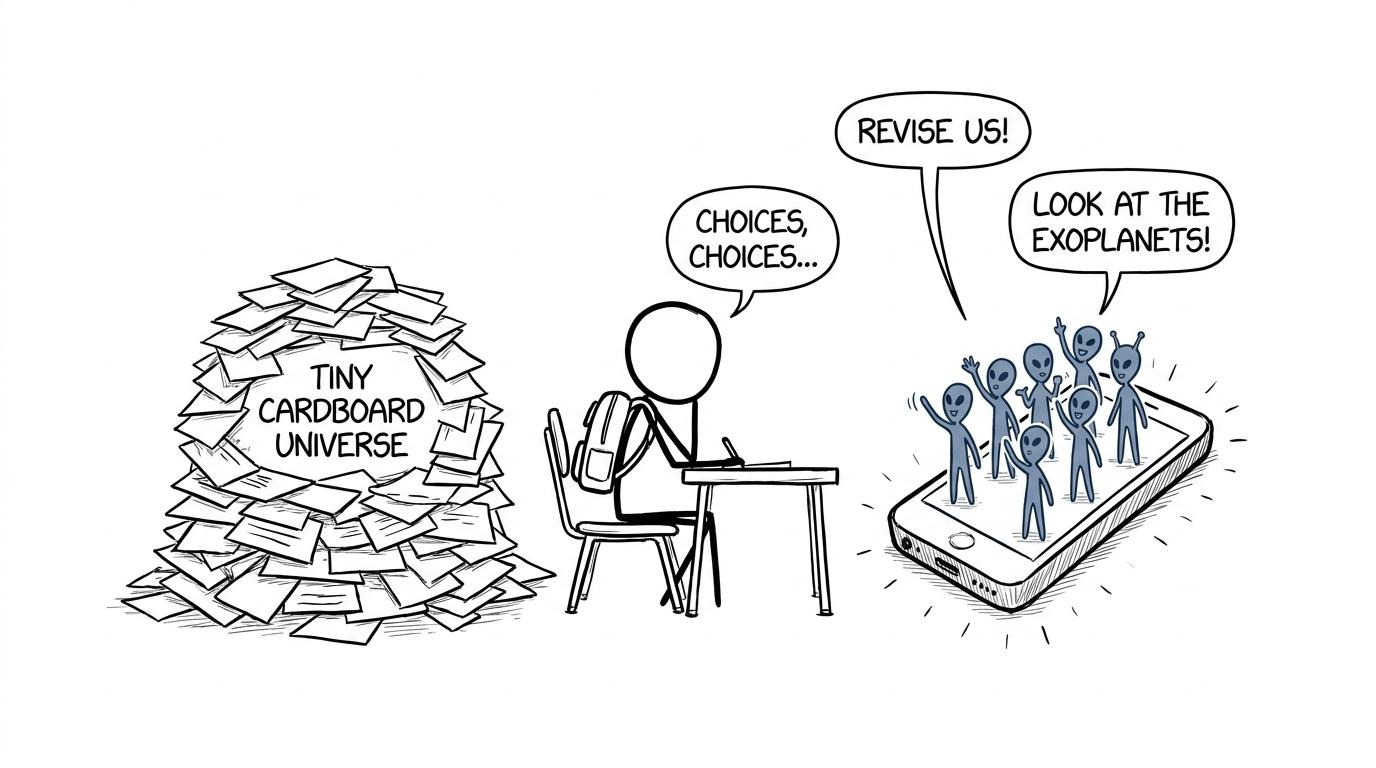 A student choosing between a tiny cardboard universe and a phone surrounded by notification aliens
What actually makes a flashcard effective?
The material matters less than the behaviour it creates. A flashcard works when it prompts retrieval practice: you see a question, attempt to recall the answer without help, then check your response and correct it.
Simply turning cards over and thinking, “Yes, I knew that”, is closer to rereading than testing. Familiarity can feel like knowledge, yet recognition is easier than producing an answer independently.
Research reviews in cognitive science consistently support retrieval practice and spacing learning across several sessions. Both paper and digital cards can provide those conditions. The key difference is that an app may schedule reviews automatically, while a paper system requires you to organise the spacing yourself.
Useful GCSE Astronomy cards should therefore:
- ask one precise question;
- require a short answer, explanation or labelled feature;
- be answerable without seeing the reverse;
- include enough detail to check accuracy;
- separate ideas that are easily confused;
- be revised again after a gap, not merely repeated immediately.
MathsGenie's GCSE Astronomy flashcards can help you begin active recall without spending every revision session creating resources.
The real advantages of physical flashcards
Paper creates a clear boundary around revision
A phone contains your revision app, but it also contains messages, videos and everything else competing for attention. Government guidance and recent research discussions identify mobile phones as a potential source of distraction, although broader claims about screen use and wellbeing remain more mixed.
Paper removes that particular decision. There is no notification to resist and no neighbouring app to open. If digital distractions repeatedly break your concentration, this advantage may matter more than sophisticated app features.
Handwriting forces useful compression
A small card cannot hold an entire page of notes. That limitation can be helpful because you must decide what the question is really testing and how to express the answer concisely.
However, handwriting is not automatically learning. Copying a paragraph word for word is still copying. The benefit comes from selecting, organising and later retrieving the information.
Diagrams are easier to personalise
GCSE Astronomy includes spatial and observational ideas. Physical cards give you freedom to draw a horizon, mark a direction, sketch an instrument or create a simplified sequence. You can cover the labels and reproduce them from memory.
Paper also allows cards with different shapes or sizes. A larger card can hold a diagram, while a smaller card can test one definition. That flexibility is useful when the content does not fit a standard front-and-back template.
Physical piles make progress visible
A simple box can have sections such as “new”, “nearly secure” and “secure”. Cards move backwards whenever you hesitate or give an incomplete answer. This is less clever than an algorithm, but its honesty is valuable: difficult cards remain visible.
Where app-based flashcards are stronger
An app reduces friction
The best revision system is often the one you can restart easily. Digital cards can be reviewed on the bus, before a lesson or during a short break. Small sessions accumulate without requiring you to carry several topic packs.
Apps are also searchable. If terminology changes in your notes or you discover an inaccurate card, you can correct it quickly rather than rewriting a whole set.
Scheduling can support spaced practice
Some flashcard apps adjust when a card returns according to how confidently you answered it. This can reduce repeated practice of easy material and bring weaker knowledge back sooner.
The feature only helps if you use it honestly. Marking a hesitant answer as “easy” protects a streak, not a grade. Conversely, reviewing every card every day wastes time and creates familiarity without enough challenge.
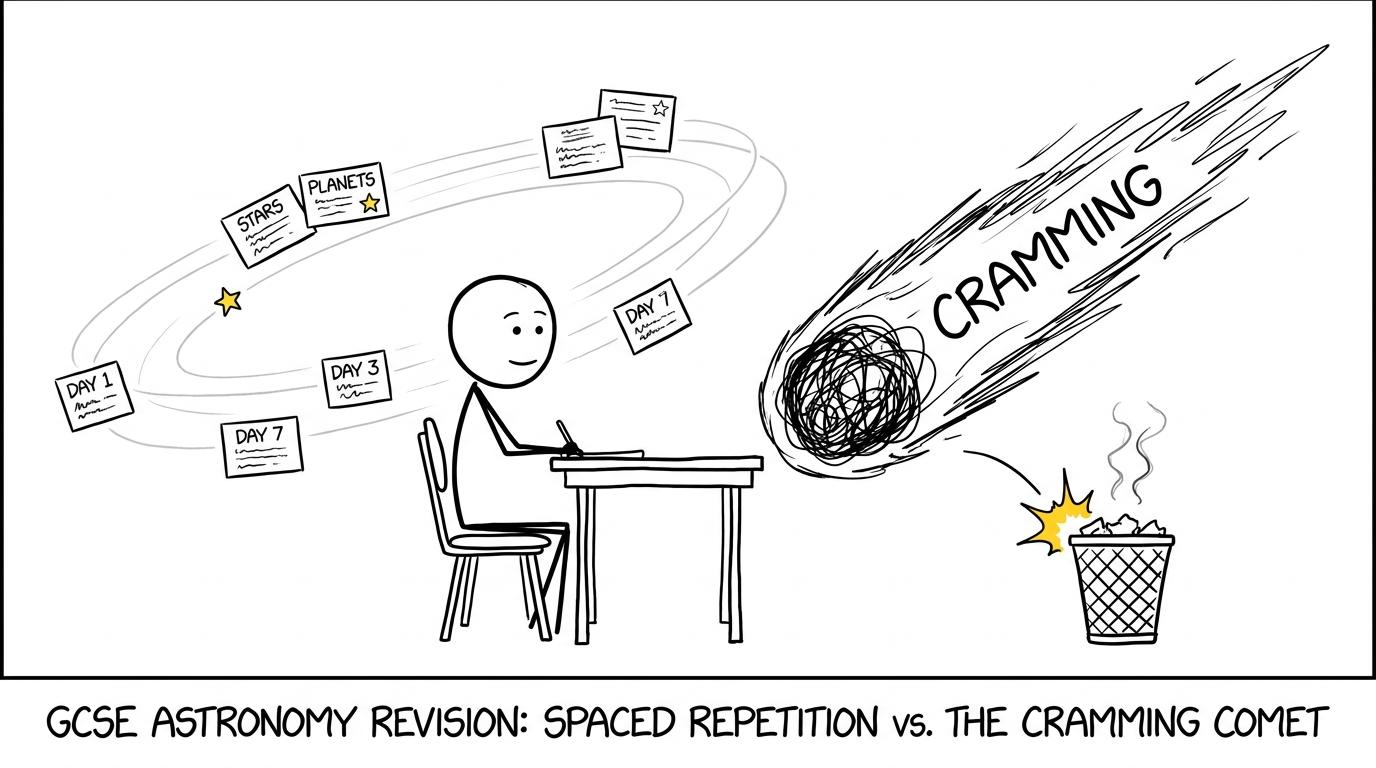 Flashcards orbiting a calm student while a cramming comet lands in a wastepaper basket
Multimedia can help, but it can also decorate
Digital cards may support images, audio or typed responses. Images can be valuable for identifying features or testing the interpretation of astronomical information. Yet an elaborate card can become a miniature revision poster: pleasant to view, but too crowded to test one clear idea.
Use multimedia only when it changes what you must recall. Decoration is not retrieval.
Why GCSE Astronomy needs more than flashcards
The current Pearson Edexcel GCSE Astronomy specification is assessed through two externally examined papers. Paper 1 covers naked-eye astronomy and Paper 2 covers telescopic astronomy; each contributes 50%50\%50% of the qualification. The assessment includes short answers, calculations, graphical work and extended responses, alongside the course's observational requirements.
That breadth explains why flashcards cannot be your complete revision method. They are particularly useful for:
- definitions and technical vocabulary;
- properties, stages and comparisons;
- instrument components and functions;
- observational advantages and limitations;
- relationships that must be recalled before applying them.
They are less suitable as the main tool for:
- multi-step calculations;
- interpreting unfamiliar data;
- drawing or analysing graphs;
- planning and evaluating observations;
- extended explanations;
- managing time across a complete paper.
Astronomy calculations draw on mathematical fluency, including rearranging formulae, proportional reasoning, units, angles and standard form. Use the GCSE Maths revision area to repair those underlying skills. If your course overlaps with space physics, the Edexcel GCSE Physics question bank also includes questions on the Solar System, red-shift, stellar evolution and observing the Universe.
The lesson is broader than astronomy: memory supplies the ingredients, but exam practice teaches you how to cook with them.
A hybrid system that earns its place
Use digital cards for short factual prompts that benefit from frequent, portable review. Keep physical cards for content that needs handwriting, a sketch or more deliberate concentration.
Then connect both formats to this revision loop:
- Check the specification: identify the exact topic rather than revising “space” generally.
- Learn the idea: use a lesson, class notes or a revision guide.
- Retrieve it: answer a small set of cards without looking.
- Apply it: complete relevant exam-style questions.
- Mark it: use the mark scheme to identify missing language or method.
- Return later: retest weak cards and reattempt difficult questions after a gap.
If planning several subjects is becoming chaotic, build these sessions into a realistic GCSE maths revision timetable. A short, repeatable routine is more dependable than a beautiful system you abandon after a week.
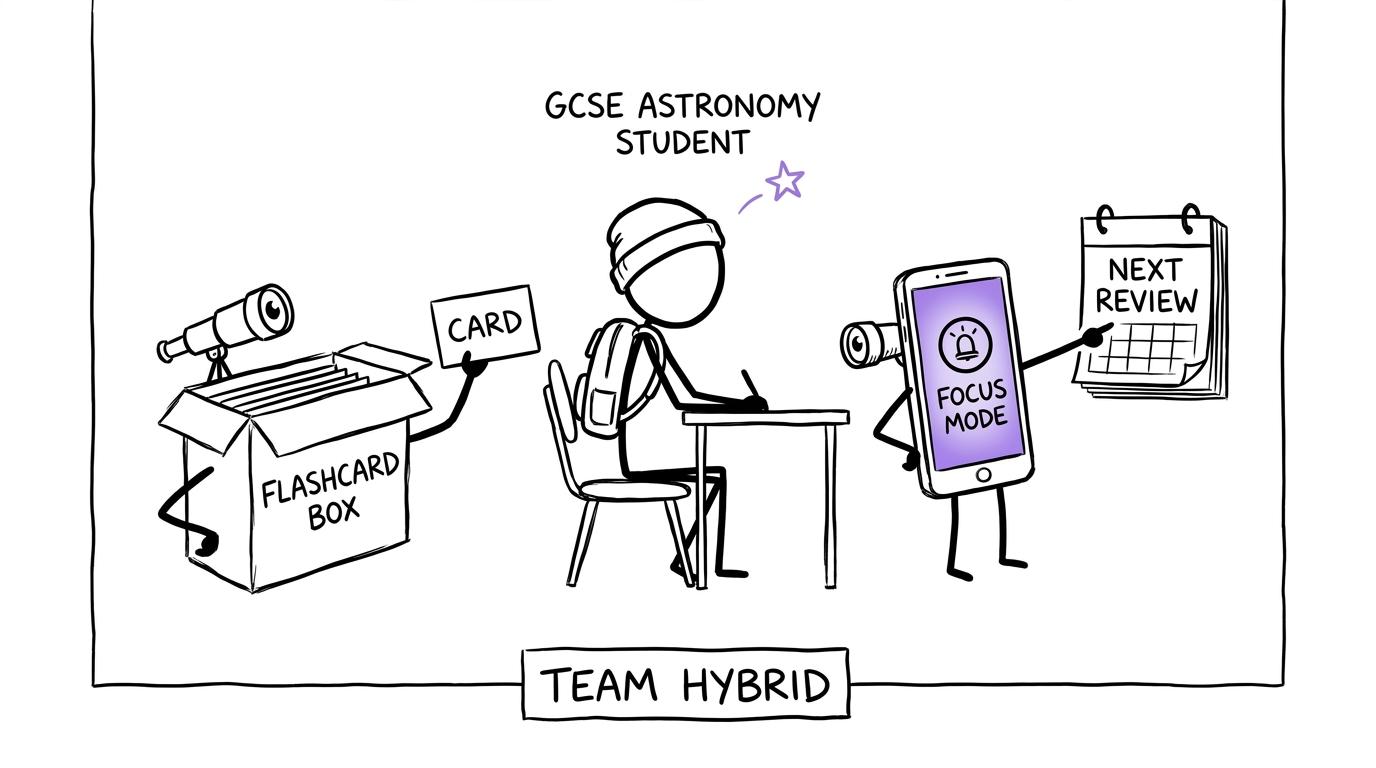 A paper flashcard box and a phone in focus mode working together as Team Hybrid
How to test whether your system is working
Do not judge flashcards by the number you own or the length of your app streak. Judge them by what happens when the cards disappear.
After several revision sessions, close the deck and try to write everything you can recall about one topic. Then answer unfamiliar questions. If you know isolated facts but cannot apply them, reduce card-making time and increase question practice.
The same principle applies to maths revision. MathsGenie's guide to using Edexcel GCSE Maths past papers properly explains how marking, diagnosing errors and reattempting questions turn a completed paper into learning. You can also use the Edexcel GCSE Maths past-paper collection to practise the calculation skills that support astronomy.
Common mistakes with paper and digital cards
Making cards instead of revising them
Resource creation feels controlled, especially when the subject feels uncertain. Set a time limit for making cards, then spend more time retrieving and applying the content.
Putting several questions on one card
If a card asks for a definition, three examples and two advantages, it becomes difficult to judge. Split it into focused prompts so that an incomplete answer cannot hide inside a partly correct one.
Revealing the answer too quickly
Retrieval should require effort. Pause, say or write your answer, and only then turn the card or tap the screen.
Treating every topic equally
Weak and frequently forgotten material should return more often. Secure cards need occasional checks, not constant attention. Use mistakes from past papers and exam practice to decide which cards deserve priority.
Memorising wording without understanding
Exact terminology matters, but a memorised sentence can collapse when a question is phrased differently. Ask yourself whether you can explain the idea, recognise it in a diagram and use it in context.
Using flashcards for every calculation
A card can test a formula or the meaning of a quantity. It cannot replace sustained practice in selecting a method, substituting values, handling units and showing working.
The best choice is the one that survives contact with revision
The physical flashcards vs app GCSE astronomy decision is not really about cardboard against software. It is about attention, retrieval, spacing and application.
Choose paper if it helps you think without interruption. Choose an app if portability and scheduling make revision more consistent. Combine them if different topics need different tools. Then test the knowledge through questions, because an exam never rewards the elegance of your flashcard system.
Start with MathsGenie's free Edexcel GCSE Astronomy revision hub, build recall with focused flashcards, and strengthen the necessary maths through revision lessons and practice questions. As your exams approach, use past papers, predicted papers, mini tests, mark schemes and video solutions to reveal what you can genuinely do without support. That is where revision stops looking productive and starts becoming productive.