Peaking Too Early in GCSE English Literature Revision
Peaking too early GCSE English Literature revision is normal. Use spaced recall, essay practice and a balanced GCSE plan to stay ready until May.
There is a peculiar moment in GCSE revision when being prepared starts to feel like a problem. You knew the quotations in January. Your mock essay went well. Now May is approaching, other subjects need attention, and the knowledge that once felt secure seems less immediate.
If you are worried about peaking too early GCSE English Literature revision, the short answer is reassuring: yes, that feeling is normal. It does not mean your best performance is behind you. Early confidence usually shows that you built a strong first layer of knowledge. Your task now is not to keep revising at maximum intensity. It is to retrieve, refresh and apply that knowledge often enough that it remains available in the exam.
This matters particularly when English Literature competes with GCSE maths. Both subjects reward knowledge that can be used under pressure, but they require different forms of practice. A balanced plan protects your English recall without allowing algebra, geometry or statistics to disappear from view.
A quick checklist for staying ready until May
Use this as your maintenance plan:
- Retrieve quotations and ideas without looking at notes.
- Revisit each text briefly across several weeks.
- Practise planning unfamiliar questions, not memorising complete essays.
- Write occasional timed paragraphs or essays.
- Check your work against your teacher's guidance and exam-board materials.
- Reduce English revision when recall is secure, but do not stop completely.
- Keep maths active through questions, mini tests and timed papers.
- Increase exam-condition practice gradually as May approaches.
The aim is not to feel permanently at your peak. It is to make your knowledge dependable when the paper opens.
Why students feel they have peaked too early
Confidence is highly sensitive to familiarity. After several lessons on one text, its characters, themes and quotations feel close at hand. You recognise every page of your notes. Essay questions look predictable. That ease can feel like mastery.
Then the timetable moves on. Biology introduces another topic. Maths mocks expose a weakness in ratio or graphs. A few weeks pass without revisiting the play, novel or poetry anthology. Recall becomes slower, and the contrast with your earlier fluency creates the impression that you have declined.
But slower recall is not evidence that the original revision was wasted. It is evidence that memory needs to be used. Research into learning consistently distinguishes active retrieval from passive rereading: trying to bring information to mind, followed by feedback, generally produces more durable recall than repeatedly looking over the same material. Spacing those retrieval attempts across time also supports long-term retention better than concentrating every repetition into one sitting.
That makes early revision valuable. It gives you time for the forgetting-and-retrieving cycle to happen before the real exam.
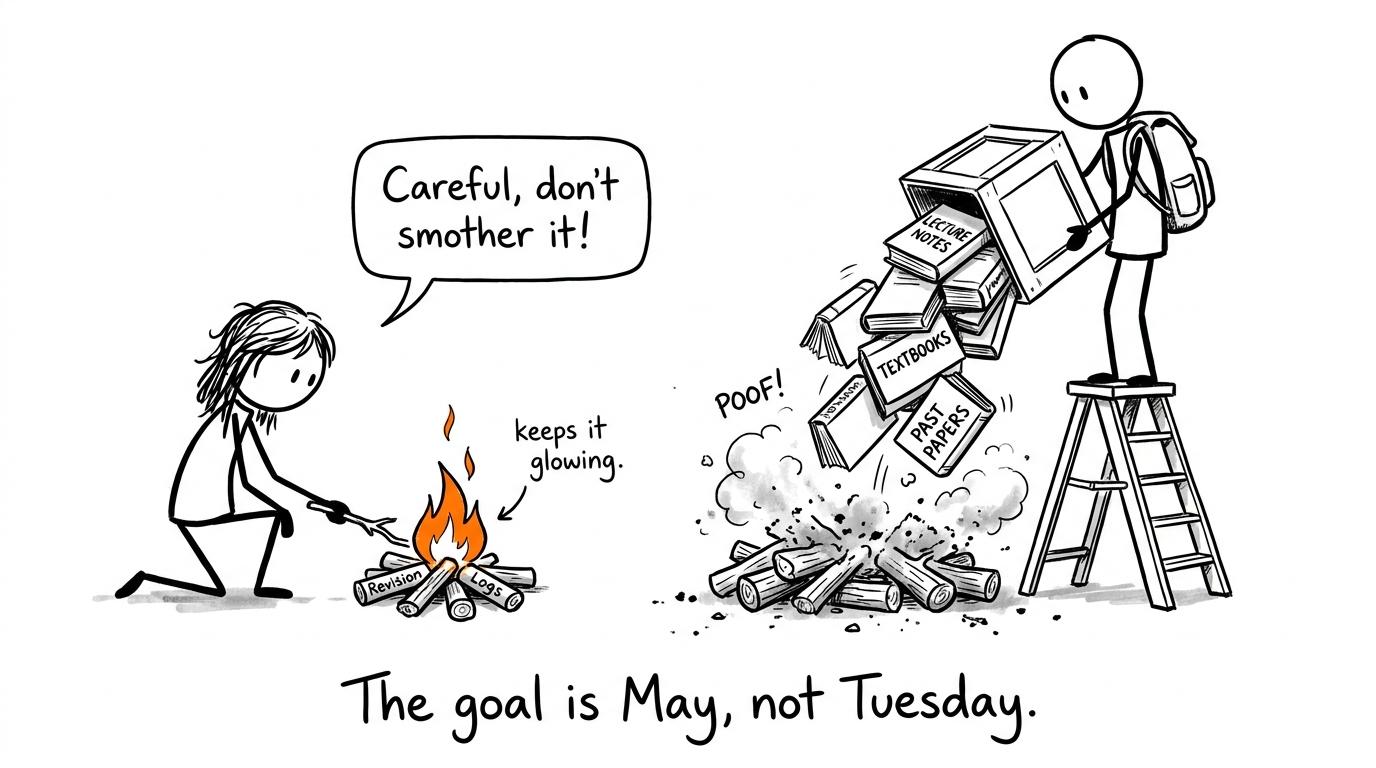 A steady revision campfire lasts longer than a sudden bonfire
Early confidence is not the same as an early peak
A true peak would mean that your exam performance reached its highest possible level months before the assessment and could only deteriorate afterwards. That is rarely a useful way to understand revision.
What often peaks early is familiarity. You have recently seen the quotations, model paragraphs and theme maps, so they feel easy. Exam readiness is broader. It includes:
- recalling evidence without prompts;
- adapting ideas to an unexpected question;
- analysing language, form and structure;
- making relevant links to context where required;
- sustaining a clear argument;
- managing time across the paper.
These abilities can continue improving even when recall temporarily feels less fluent. In fact, a slightly difficult retrieval attempt can be more informative than effortless rereading because it reveals exactly what needs refreshing.
GCSE English Literature assessment differs across AQA, Edexcel, OCR and Eduqas. The combinations of Shakespeare, nineteenth-century prose, modern texts, anthology poetry and unseen material are not identical, and paper structures vary. Many assessments require substantial knowledge of studied texts without taking those texts into the examination. Check your specification and follow your teacher's advice rather than using a revision plan designed for another board.
Replace constant revision with spaced maintenance
Once you know a text well, continuing to revise it heavily every day can produce diminishing returns. The better approach is a maintenance cycle.
Retrieve before reviewing
Begin with closed notes. Write down the quotations, themes, character links or structural features you can remember. Only then open your notes and correct omissions.
This order matters. Looking first tells you what seems familiar; retrieving first tells you what is available independently. The second question is much closer to what the examination demands.
Keep the task small enough to repeat. You might recall quotations for one character, plan one thematic argument or annotate a short extract from memory. Feedback is essential because repeated recall of an inaccurate quotation or confused interpretation can strengthen the wrong version.
Space your return to each text
Avoid finishing a text and then abandoning it until the final week. Return after a gap, then return again later. The precise interval is less important than creating genuine separation between attempts.
A simple rotating week could include:
- one quotation and theme recall session;
- one poetry comparison plan;
- one timed analytical paragraph;
- one short review of previous mistakes.
This is maintenance, not cramming. If a topic remains secure, keep the session brief. If recall has weakened, bring the next review forward.
Practise transfer, not scripts
A memorised essay can feel reassuring because every sentence is already decided. The risk is that the examination asks a different question.
Build flexible clusters instead: a small bank of useful evidence connected to several characters, themes and writer's methods. Then practise choosing and adapting that evidence. Planning unfamiliar questions is an efficient way to test flexibility without writing a full essay every time.
Full timed responses still matter, but they should test whether your ideas survive real conditions. They should not become a daily endurance exercise months before the exam.
How to balance English Literature with GCSE maths
Students rarely revise one subject in isolation. English may feel secure just as maths begins demanding more attention. That is not a reason to neglect English, but it is a reason to redistribute time.
Think of revision as a portfolio. Secure knowledge needs maintenance; weak knowledge needs investment. If English quotation recall is strong but quadratic equations are repeatedly costing marks, equal time is not automatically sensible.
Start by identifying the evidence. For maths, a timed mini test or past-paper section shows which topics are leaking marks. The GCSE maths revision hub lets you choose your board and move between lessons, questions and papers. You can also use the dedicated Edexcel GCSE Maths revision, AQA GCSE Maths revision, OCR GCSE Maths revision or Eduqas GCSE Maths revision area.
A balanced week might contain short English maintenance sessions alongside longer maths repair sessions. The GCSE maths revision timetable explains how to combine spaced topic work with exam practice without creating an impossible schedule.
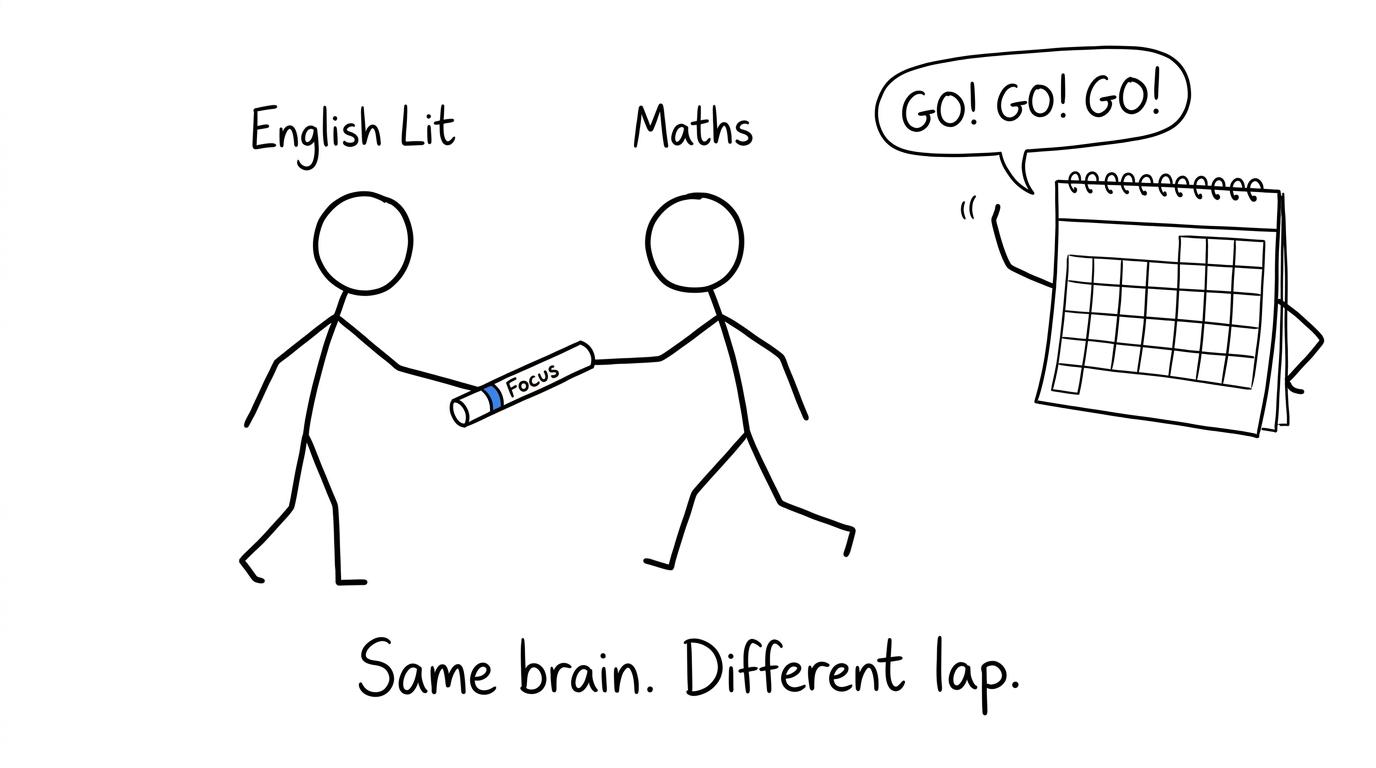 English Literature passes the focus baton to maths
The principle works in both subjects:
- attempt from memory;
- check against reliable feedback;
- identify the specific gap;
- practise that gap;
- retest it after time has passed.
In English, the feedback may come from teacher marking, a model response or official guidance. In maths, it may come from a mark scheme or video solution. The subject changes. The learning loop remains remarkably similar.
How to know whether your English knowledge is still fresh
Do not judge readiness by mood. Test it.
Choose one part of your course and ask whether you can:
- recall a small selection of accurate, versatile quotations;
- connect each quotation to more than one relevant idea;
- explain how the writer creates meaning;
- produce a clear argument for an unfamiliar question;
- organise that argument under time pressure;
- remember the requirements of your particular paper.
If you can do these things, a day of low confidence is not a crisis. Continue maintenance. If you cannot, the test has done something useful: it has located the gap early enough to repair it.
Apply the same evidence-led approach to maths. Edexcel GCSE Maths mini tests provide shorter checks, while Edexcel GCSE Maths past papers help build timing and stamina. Whatever your board, use materials matched to your tier and specification.
Adjusting revision as May approaches
Revision should change shape rather than simply become longer.
Earlier in the year, focus on building understanding: plot, character, theme, writer's methods and the structure of an effective response. In the middle phase, retrieve and connect that knowledge. Nearer the examination, add more timed planning, full responses and realistic paper practice.
For maths, the same progression moves from topic lessons to mixed questions and then timed papers. MathsGenie's one-month GCSE maths revision plan offers a practical structure for this final phase. Closer to the papers, GCSE predicted papers can provide fresh exam-style practice after weak topics have been addressed.
Predicted papers are practice, not certainty about what will appear. Use them to rehearse decisions and uncover gaps, never to justify ignoring the rest of the specification.
Common mistakes when trying not to peak early
Repeating the same comfortable tasks
Recopying quotations and rereading familiar notes can preserve confidence without testing recall. Close the book first. Make your brain produce something.
Stopping completely after a strong mock
A successful mock shows what worked under those conditions. It does not permanently secure every text until May. Keep a light retrieval schedule.
Revising every text equally
Some knowledge will remain strong while another poem, character or theme fades. Use short checks and direct time towards the weakest area.
Memorising complete answers
Prepared ideas are useful; rigid scripts are fragile. Practise reshaping evidence around different questions so that you answer the paper actually set.
Turning maintenance into burnout
Fear of forgetting can lead to daily full essays, constant quotation testing and guilt whenever another subject takes priority. Sustainable revision includes rest and variation. More effort is not always better-targeted effort.
Letting English confidence hide maths gaps
It is tempting to revise the subject that currently feels rewarding. Maths improvement usually requires questions, marking and correction, including topics you would rather avoid. Use past papers to decide where your time has the highest value.
Your goal is reliable recall, not permanent confidence
Feeling brilliant in January and uncertain in April does not prove that you peaked too early. Confidence rises and falls with familiarity, tiredness and the difficulty of the task in front of you. Exam readiness is built more quietly: knowledge retrieved after a gap, an argument adapted to a new question, and a mistake corrected before it can recur.
Keep English Literature warm with short, spaced retrieval and occasional timed writing. Give more time to whichever subjects currently contain the largest gaps. For GCSE maths, make MathsGenie your free revision base: use revision lessons to rebuild methods, practice questions and mini tests to strengthen them, then past papers, predicted papers, mark schemes and video solutions to test whether they hold under pressure.
You do not need to preserve one perfect moment of confidence until May. You need a system that can recreate useful knowledge when it matters. Start with one closed-book recall task, one maths diagnostic and one realistic entry in your revision planner today.