

OCR GCSE Maths Grade 6 Boundary: Marks Needed
OCR GCSE maths grade 6 boundary explained with dated past marks, Higher tier guidance, changing thresholds and a practical Year 11 revision target plan.
A Year 11 student opens a past paper, adds up the marks and reaches the question that matters most: is this enough for a grade 666? The short answer is that the OCR GCSE maths grade 6 boundary changes for every exam series. A grade 666 is available only on Higher tier, and recent summer boundaries have ranged from 109109109 out of 300300300 in June 2023 to 132132132 out of 300300300 in June 2026.
That gives students a useful reference, but not a guaranteed boundary for their own exams. The sensible aim is to build a buffer above previous thresholds rather than trying to land on one exact mark.
The answer at a glance
For OCR GCSE Mathematics J560:
- A grade 666 is available on Higher tier only.
- Higher tier consists of three papers worth 100100100 marks each.
- Your total is therefore out of 300300300 marks.
- The grade depends on your combined mark across all three papers.
- Recent June grade 666 boundaries have moved between exam series.
- A working revision target of around 140140140 marks creates more protection than aiming directly at a previous boundary.
You can enter practice-paper scores into the OCR GCSE Maths grade calculator to compare your total with historical boundaries. It is an estimate, not a prediction of the boundary OCR will set for a future series.
Recent OCR GCSE maths grade 6 boundaries
The following are overall Higher tier boundaries for OCR GCSE Mathematics J560. Each figure is the combined mark across the three papers, out of 300300300.
| Exam series | Grade 666 boundary | Percentage of available marks |
|---|---|---|
| June 2023 | 109109109 out of 300300300 | 36.3%36.3\%36.3% |
| June 2024 | 110110110 out of 300300300 | 36.7%36.7\%36.7% |
| June 2025 | 126126126 out of 300300300 | 42.0%42.0\%42.0% |
| June 2026 | 132132132 out of 300300300 | 44.0%44.0\%44.0% |
The calculation for June 2026 is:
132300×100=44%\frac{132}{300}\times 100=44\%300132×100=44%These figures reveal why a student should not treat an old OCR grade boundary as a permanent pass mark. A total of 120120120 would have exceeded the grade 666 boundary in June 2023 and June 2024, but it would not have reached the published boundary in June 2025 or June 2026.
The boundary is also based on the total. There is no requirement to earn exactly one third of the marks on every paper. A student might score 404040, 474747 and 454545, giving:
40+47+45=13240+47+45=13240+47+45=132Another student could reach the same total through a different combination. A difficult non-calculator paper can therefore be balanced by stronger performances on the calculator papers.
Which tier do you need for a grade 6?
OCR Foundation tier awards grades 111 to 555. Higher tier awards grades 444 to 999, with an allowed grade 333 in certain circumstances below the grade 444 boundary. Consequently, a student targeting grade 666 must be entered for Higher tier.
The OCR Higher tier assessment has three equally weighted papers:
- Paper 444: calculator permitted
- Paper 555: calculator not permitted
- Paper 666: calculator permitted
Each paper lasts 111 hour 303030 minutes and carries 100100100 marks. Students and parents can explore the complete set of board-specific resources on the OCR GCSE Maths revision page.
Tier decisions should be discussed with the school. They involve more than one mock result because Higher papers contain a broader and more demanding range of content. A grade 666 target needs secure knowledge of routine number, ratio, algebra, geometry and statistics as well as the ability to connect methods in unfamiliar questions.
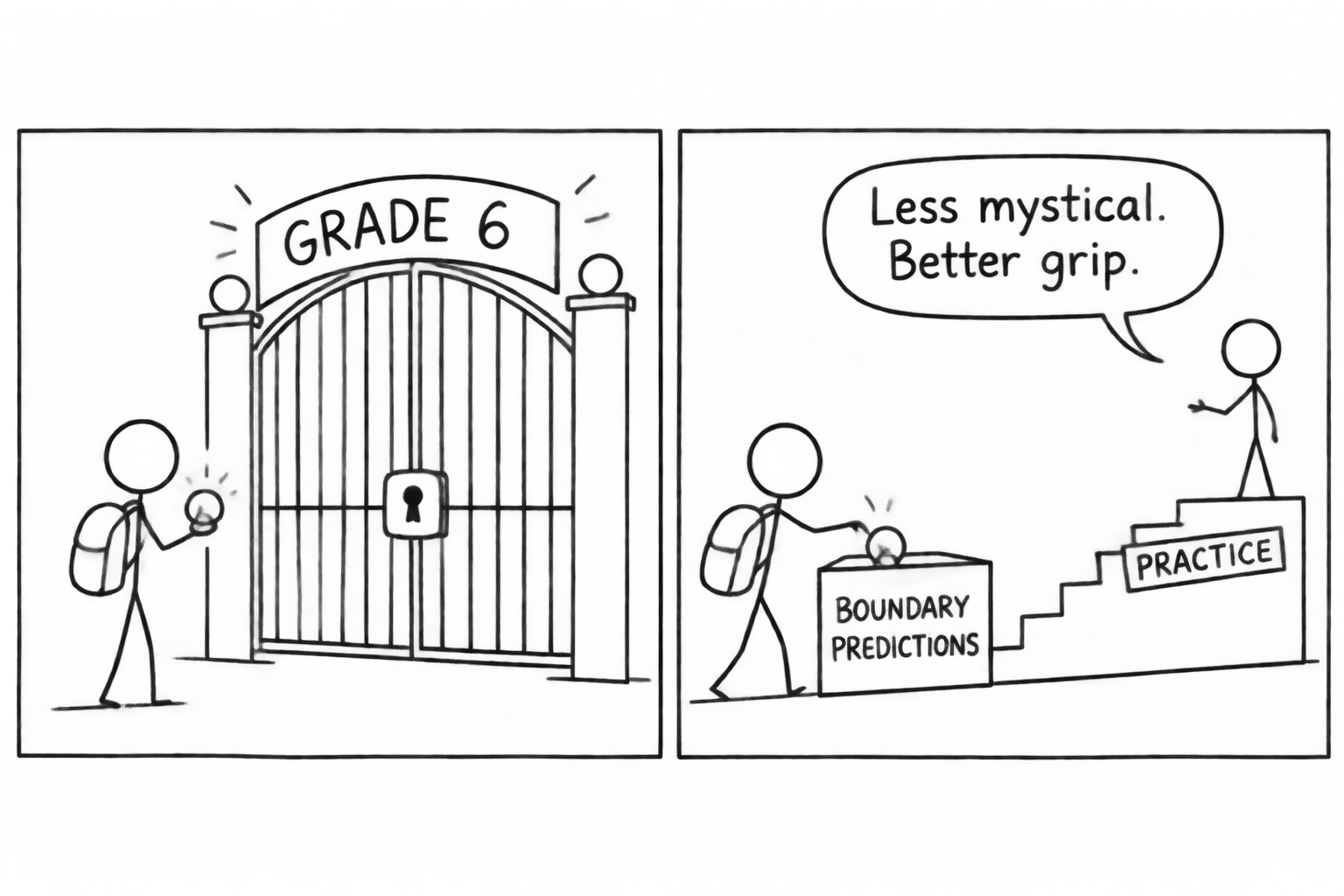 A student swaps a grade-boundary crystal ball for a practical revision staircase
Following a Year 11 student from score to target
Imagine a Year 11 student, Sam, completes three OCR Higher papers under timed conditions and records these marks:
38+41+43=12238+41+43=12238+41+43=122Sam wants to know whether this is a grade 666. The honest answer depends on which boundary is being used. The total is above the June 2023 and June 2024 grade 666 boundaries, but below those from June 2025 and June 2026.
That answer can feel frustrating. It is also useful. Sam is not far from a more secure target of 140140140 marks and needs another:
140−122=18140-122=18140−122=18marks across three papers. Spread evenly, that is an average improvement of:
183=6\frac{18}{3}=6318=6marks per paper.
Six extra marks feels different from the vague instruction to “get better at maths”. It might come from completing percentage questions accurately, showing algebraic working, checking units and collecting method marks on multi-step problems.
Sam’s next step should be diagnosis. The guide to finding your weakest OCR Maths topics explains how to turn marked papers into a focused revision list. Once those gaps are clear, Maths Genie Lessons can rebuild the methods before Sam attempts another full paper.
Why OCR grade boundaries change
Grade boundaries are set after the papers have been taken and marked. They are not fixed percentages announced in advance.
The purpose is to maintain a comparable standard when one set of papers is slightly more or less demanding than another. If a paper proves harder overall, a boundary may be lower. If students generally find a paper more accessible, the boundary may be higher. Awarding also uses statistical evidence and expert judgement across the qualification.
This does not mean OCR decides that a certain percentage of students must receive each grade. Nor does a higher boundary automatically mean students have become better at maths. It can reflect differences in how accessible that particular set of questions was.
Parents should therefore be cautious when converting a mock percentage directly into a promised grade. Schools may use historical OCR grade boundaries for mocks, but the final boundary for a live series cannot be known beforehand.
How to set a safer grade 6 maths target
A past boundary is a line. A revision target should be a zone above it.
For a student currently near 120120120 marks, aiming for approximately 140140140 is more useful than assuming that 126126126 or 132132132 will always be enough. This is not an official predicted boundary. It is a practical buffer that reduces dependence on boundary movement and an unusually difficult paper.
A calm weekly process looks like this:
- Complete a timed OCR paper without notes.
- Mark it strictly and record every lost mark by topic.
- Separate knowledge gaps from avoidable exam errors.
- Use a focused lesson and practice questions for the weakest areas.
- Complete a short mini test before returning to another full paper.
- Track the three-paper total rather than celebrating one unusually strong result.
The guide to using OCR past papers properly helps students move beyond simply completing paper after paper. Mark schemes matter because they show where correct working can earn credit even when the final answer is wrong.
Topics that can move the mark total
The best topic to revise is usually the one a student repeatedly gets wrong, not the one that feels most impressive. Grade 666 progress often comes from making dependable topics genuinely dependable.
For example, a student losing marks on repeated percentage methods can use the OCR percentage change lesson and practice. Someone struggling to translate words into algebra may need to return to solving equations step by step before tackling harder equation problems.
Data questions can also provide recoverable marks when the underlying method is secure. The averages from frequency tables revision resources combine explanations with targeted questions. These focused lessons are most effective when followed by exam-style practice and a later mixed test.
Common mistakes when using OCR grade boundaries
Treating one boundary as permanent
A June 2024 boundary describes June 2024. It does not tell students exactly what will be required in a later series.
Looking at one paper in isolation
The qualification grade comes from the combined total across all three papers. Paper-level boundaries can be informative, but they do not determine the final qualification grade.
Using Foundation figures for a grade 6 target
Foundation tier does not offer grade 666. Students targeting this grade need Higher tier resources and Higher tier past papers.
Aiming for the precise historical minimum
Working towards exactly 126126126 or 132132132 leaves no margin for a difficult question, a calculator error or a boundary increase. A buffer makes the target more resilient.
Completing papers without fixing mistakes
A past paper identifies the leaks; it does not repair them. Improvement happens when the student studies the missed topic, answers targeted practice questions and then checks whether the method can be recalled later.
Turn the boundary into a revision plan
The OCR GCSE maths grade 6 boundary is useful because it turns an abstract grade into a visible mark total. But the boundary itself cannot create those marks. Lessons, careful practice and honest marking can.
Start with the free GCSE Maths revision hub, choose OCR Higher tier and use Maths Genie Lessons on the topics that move marks most. Combine them with practice questions, mini tests, past papers, mark schemes and video solutions. The goal is not to guess the next boundary perfectly. It is to become strong enough that a small movement in the boundary no longer controls the result.















