Nth term GCSE maths: examples that make it click
Nth term GCSE maths explained with worked examples, common mistakes and exam-style questions. Find a reliable rule, check answers and practise confidently.
Nth term GCSE maths: finding the rule
You can spot that a sequence goes up by the same amount, yet still get its formula wrong. The missing piece is usually this: the difference tells you the multiplier of nnn, but you must also adjust the formula to match the first term. That is the central idea behind linear nth term GCSE maths questions.
Imagine a student who keeps writing “add four” when a question asks for the nth term. They understand how the sequence moves, but not how to jump straight to any position. This is a hypothetical student, but their mistake helps explain an important distinction.
A term-to-term rule takes you to the next number. An nth term rule takes you directly to whichever term you need.
Your quick checklist
For a linear sequence:
- Find the common difference.
- Multiply nnn by that difference.
- Adjust the expression to match the first term.
- Check your rule against more than one term.
The aim is not to guess an expression. It is to build one that works.
What does the nth term mean?
The letter nnn represents a term’s position. The first term has n=1n=1n=1, the second has n=2n=2n=2, and so on.
An nth term expression connects that position to the term’s value. If the rule is 3n+23n+23n+2, substituting a position gives the number in that position.
For a linear sequence, consecutive terms have a constant difference. Its nth term has the form:
an=dn+ca_n=dn+can=dn+cHere, ana_nan means the term in position nnn, ddd is the common difference, and ccc is the adjustment needed to fit the sequence.
Our imagined student’s first breakthrough is separating two questions: “Which position am I finding?” and “What number belongs there?” The position and the value are not interchangeable.
Nth term worked examples: a reliable method
An increasing sequence
Find the nth term of:
7, 11, 15, 19,…7,\ 11,\ 15,\ 19,\ldots7, 11, 15, 19,…Find the difference. Each term increases by 444, so begin with 4n4n4n.
Compare the first terms. When n=1n=1n=1, the expression 4n4n4n gives 444. The sequence actually starts at 777, so add 333.
Therefore:
an=4n+3a_n=4n+3an=4n+3Check another position. For the third term:
4×3+3=154\times3+3=154×3+3=15That matches. To find the twentieth term, substitute n=20n=20n=20:
4×20+3=834\times20+3=834×20+3=83The hypothetical student can now see why “add four” was incomplete. It describes the movement between terms, while 4n+34n+34n+3 describes every term’s position and value.
To turn this method into practice, work through MathsGenie’s nth term lesson and revision guide, then try the matching questions in its Lessons and Question Bank resources.
A decreasing sequence
Find the nth term of:
18, 13, 8, 3,…18,\ 13,\ 8,\ 3,\ldots18, 13, 8, 3,…The common difference is −5-5−5, so start with −5n-5n−5n.
At n=1n=1n=1, this gives −5-5−5. To reach the actual first term, 181818, add 232323:
an=−5n+23a_n=-5n+23an=−5n+23Check the fourth term:
−5×4+23=3-5\times4+23=3−5×4+23=3The method has not changed. A decreasing sequence simply needs a negative multiplier.
You can also calculate the adjustment directly:
c=first term−dc=\text{first term}-dc=first term−dHere, that gives c=18−(−5)=23c=18-(-5)=23c=18−(−5)=23. Be particularly careful when subtracting a negative number.
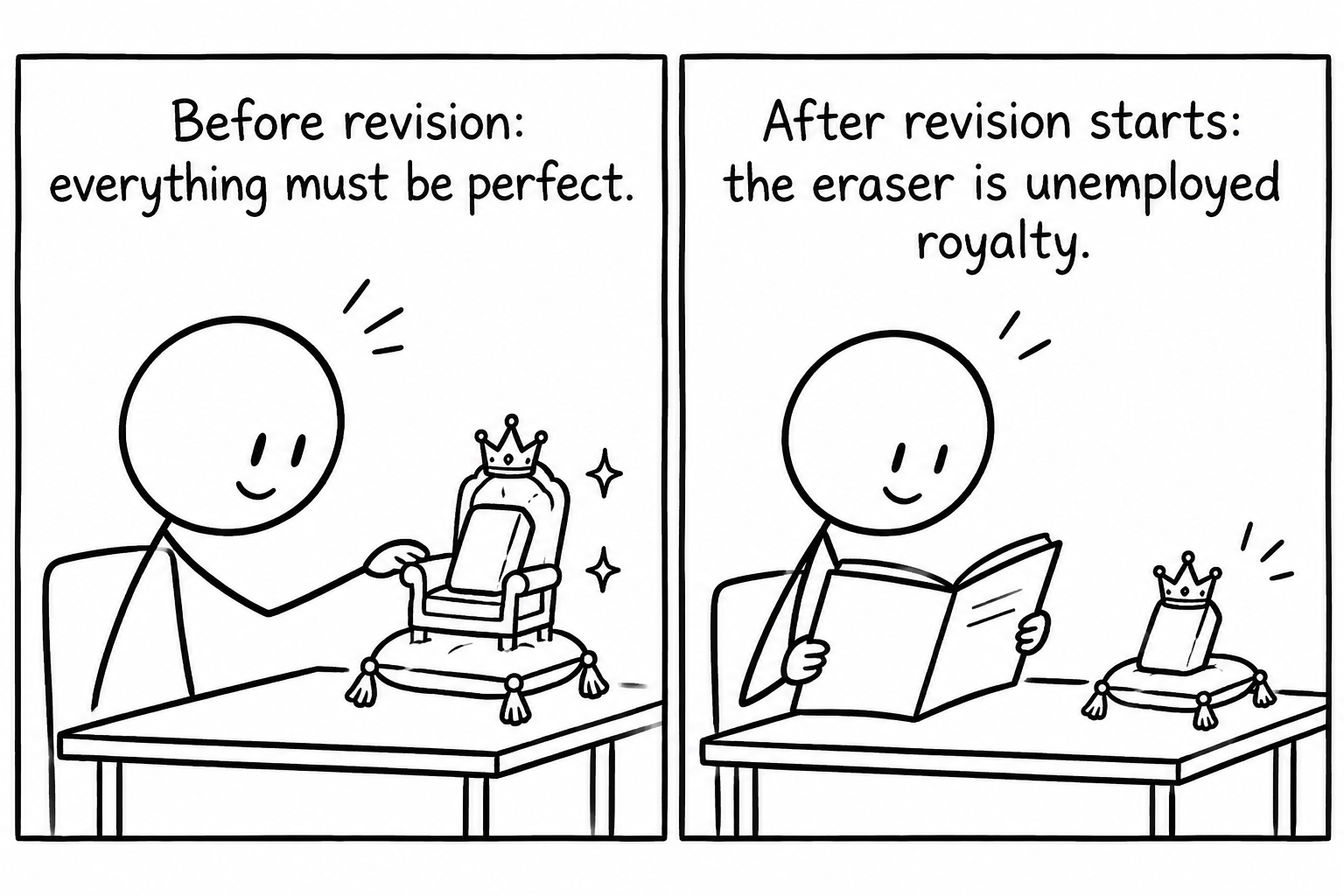 A stick-figure student stops arranging an elaborate throne for an eraser and starts revision instead.
How to check whether a number belongs to a sequence
An exam question may give a number and ask whether it appears in the sequence. Instead of generating terms until you reach it, set the nth term equal to that number.
For the rule 4n+34n+34n+3, decide whether 959595 is a term:
4n+3=954n+3=954n+3=95Subtract 333, then divide by 444:
4n=924n=924n=92 n=23n=23n=23Because 232323 is a positive whole number, 959595 is the twenty-third term.
For 969696, the same process gives:
n=96−34=23.25n=\frac{96-3}{4}=23.25n=496−3=23.25That is not a whole-number position, so 969696 does not belong to this sequence.
For sequences indexed from n=1n=1n=1, the position must be a positive integer. A negative or fractional answer does not identify a valid term.
Common mistakes that cost marks
Using the first term as the adjustment
For 7,11,15,19,…7,11,15,19,\ldots7,11,15,19,…, writing 4n+74n+74n+7 feels plausible because the sequence starts at 777. But substituting n=1n=1n=1 gives 111111.
The constant is the adjustment to 4n4n4n, not automatically the first term.
Forgetting the negative difference
For 18,13,8,3,…18,13,8,3,\ldots18,13,8,3,…, the difference is −5-5−5, not 555. Write the subtraction between consecutive terms if the sign is unclear:
13−18=−513-18=-513−18=−5Checking only the first term
Matching the first term is necessary, but it does not prove the whole rule works. Check a later term too. This helps catch an incorrect multiplier.
Applying a linear rule to every sequence
The method above depends on a constant first difference. If the differences change, stop and investigate rather than forcing the sequence into dn+cdn+cdn+c.
Quadratic sequences are a separate case. MathsGenie’s quadratic nth term revision guide explains that next step.
Exam-style nth term questions
Try these without looking at the answers. Show your difference, adjustment and final expression.
- Question A: Find the nth term of 6,10,14,18,…6,10,14,18,\ldots6,10,14,18,….
- Question B: Find the nth term of 14,11,8,5,…14,11,8,5,\ldots14,11,8,5,….
- Question C: A sequence has nth term 5n−25n-25n−2. Find its fifteenth term.
- Question D: Does 828282 belong to the sequence with nth term 6n+16n+16n+1? Explain your answer.
Answers and checks
Question A: The difference is 444. Since 4n4n4n starts at 444, add 222. The answer is 4n+24n+24n+2.
Question B: The difference is −3-3−3. Since −3n-3n−3n starts at −3-3−3, add 171717. The answer is −3n+17-3n+17−3n+17.
Question C: Substitute n=15n=15n=15:
5×15−2=735\times15-2=735×15−2=73Question D: Solving 6n+1=826n+1=826n+1=82 gives n=13.5n=13.5n=13.5. This is not a whole-number position, so 828282 is not a term.
For more practice, use the sequence exam-style question booklet. If your mistake concerns another algebra skill, the GCSE topic worksheets let you focus on that gap rather than repeat questions blindly.
Make the method stick
In our hypothetical student’s story, the click is not suddenly becoming good at spotting patterns. It is replacing guessing with a repeatable routine: difference, adjustment, check. Understanding that routine is the beginning; following it independently is what your practice needs to establish.
Start your next revision session with MathsGenie’s Lessons and Question Bank: follow the matching nth term lesson, then use the nth term questions to practise finding and checking each rule yourself.