Nth Term Exam Questions: GCSE Methods and Examples
Nth term exam questions explained through three GCSE examples, with clear working, method-mark guidance and practice to build your confidence in sequences.

Nth term exam questions: turn a pattern into a rule
You can see how a sequence continues. Then the question asks for its nth term, and suddenly spotting the pattern does not feel enough. The key to nth term exam questions is to connect each term's position to its value: find the differences, build a rule, then check it against the terms given.
That rule lets you find a distant term without writing everything before it. It also helps you decide whether a number belongs to the sequence.
Imagine a student working through three exam-style questions. These are original practice examples, not questions taken from a particular past paper. Each introduces another decision, from finding a linear rule to handling a quadratic sequence.
Your nth term checklist
Before doing any algebra:
- Label the positions, starting with n=1n=1n=1 unless told otherwise.
- Find the differences between consecutive terms.
- For a linear sequence, use un=dn+cu_n=dn+cun=dn+c, where ddd is the common difference.
- Find ccc by checking the first term.
- Test your expression against another given term.
Here, unu_nun means the value of the term at position nnn. Position and value are different things, and many mistakes begin when they get mixed up.
MathsGenie's matching Sequences (Nth Term) lesson covers this foundation. If you follow AQA, use the AQA sequences topic page.
Question one: find a linear nth term
Find an expression for the nth term of this arithmetic sequence:
7, 11, 15, 19, …7,\ 11,\ 15,\ 19,\ \ldots7, 11, 15, 19, …Our imaginary student notices that each term increases by 444. That gives the multiplier of nnn, but not the complete answer.
Start with the common difference
Write:
11−7=4,15−11=411-7=4,\qquad 15-11=411−7=4,15−11=4The rule therefore has the form:
un=4n+cu_n=4n+cun=4n+cThe sequence generated by 4n4n4n begins:
4, 8, 12, 16, …4,\ 8,\ 12,\ 16,\ \ldots4, 8, 12, 16, …Every given term is 333 greater, so:
un=4n+3\boxed{u_n=4n+3}un=4n+3Check before moving on
Substitute the first position:
u1=4×1+3=7u_1=4\times1+3=7u1=4×1+3=7Then check another position:
u3=4×3+3=15u_3=4\times3+3=15u3=4×3+3=15Both match. The student now has evidence, not just a plausible expression.
Where the working can earn marks
Writing 4n+c4n+c4n+c makes the correct multiplier visible. Depending on the question's mark scheme, an intermediate expression with the correct coefficient may earn a method mark even if the adjustment is wrong.
However, writing the common difference alone does not guarantee a mark. The marking points depend on the particular question. Show the difference, the developing expression and the final rule rather than assuming every written line earns something.
Once you can find the multiplier, adjust it and check it, practise that routine through MathsGenie's Lessons and nth term Question Bank.
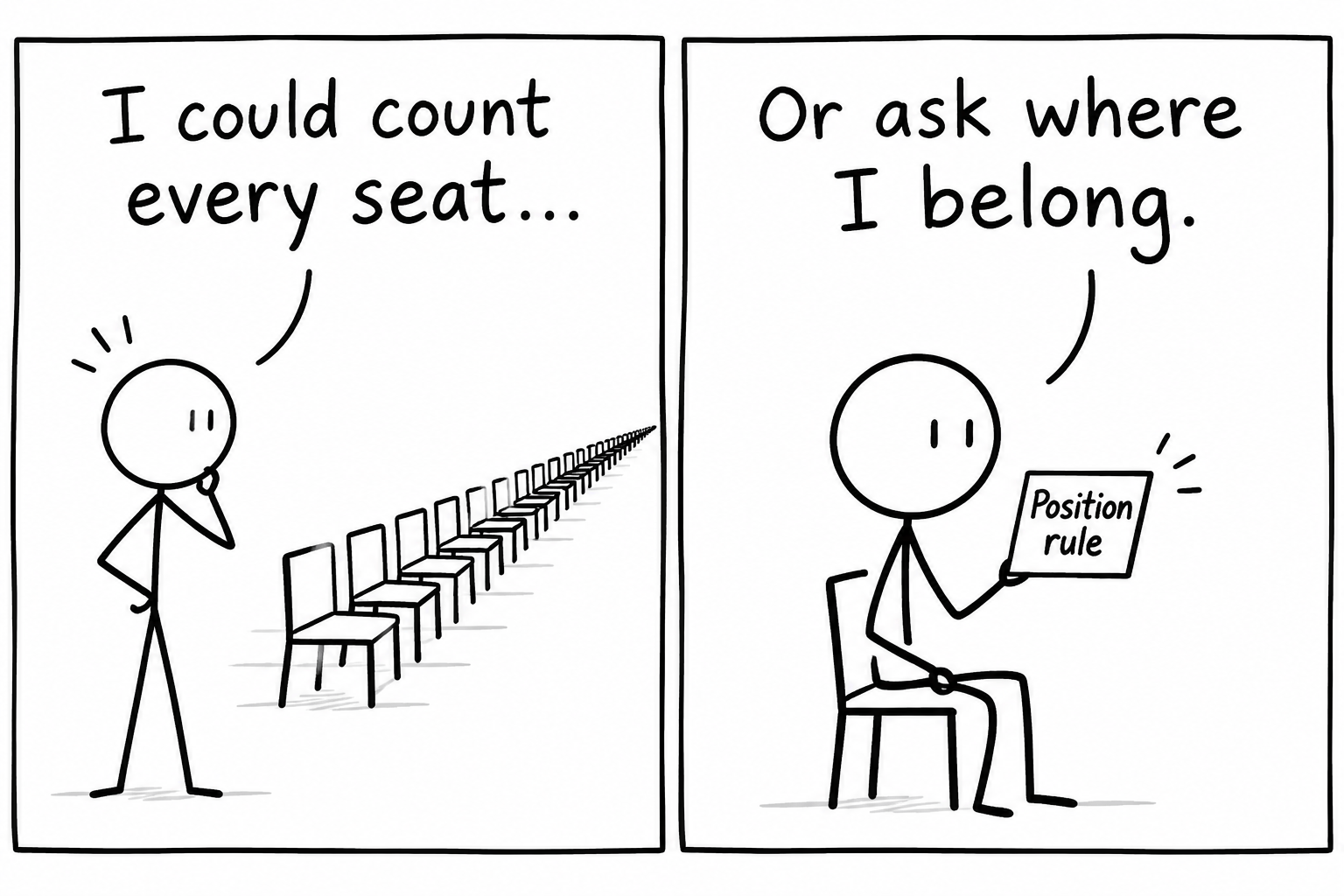 A stick-figure student considers counting an endless row of seats before choosing a position rule instead.
Question two: work backwards through a decreasing sequence
The first four terms of an arithmetic sequence are:
18, 13, 8, 318,\ 13,\ 8,\ 318, 13, 8, 3Find its nth term and determine whether −42-42−42 belongs to the sequence.
This time, the student must do more than produce a rule. They must use it to justify a decision.
Keep the negative difference
The common difference is:
13−18=−513-18=-513−18=−5Start with:
un=−5n+cu_n=-5n+cun=−5n+cUsing the first term:
18=−5+c18=-5+c18=−5+cTherefore:
un=23−5n\boxed{u_n=23-5n}un=23−5nChecking the second term gives 23−5×2=1323-5\times2=1323−5×2=13.
Test the proposed term
Set the expression equal to the proposed value:
23−5n=−4223-5n=-4223−5n=−42Solve:
−5n=−65-5n=-65−5n=−65 n=13n=13n=13Because 131313 is a positive integer, −42-42−42 is the thirteenth term.
The crucial distinction is that a term's value can be negative, while its position must be a positive integer for a sequence starting at the first term. A fractional or negative solution for nnn would not identify a valid position.
Make the reasoning visible
The useful evidence is the equation, its solution and the conclusion about the position. Do not stop at an unexplained yes. If you make an arithmetic slip, visible algebra may still meet a method-mark requirement, depending on the scheme.
Question three: find a quadratic nth term
Find the nth term of this quadratic sequence:
3, 8, 15, 24, 35, …3,\ 8,\ 15,\ 24,\ 35,\ \ldots3, 8, 15, 24, 35, …Quadratic nth terms belong to higher-tier GCSE content. If you are preparing for foundation tier, prioritise the linear methods above.
The student first tries the familiar differences:
5, 7, 9, 115,\ 7,\ 9,\ 115, 7, 9, 11They are not constant. However, their differences are:
2, 2, 22,\ 2,\ 22, 2, 2Use the second difference
For a quadratic sequence with rule un=an2+bn+cu_n=an^2+bn+cun=an2+bn+c, the constant second difference is 2a2a2a.
Here:
2a=2⇒a=12a=2\quad\Rightarrow\quad a=12a=2⇒a=1So compare the sequence with n2n^2n2:
n2:1, 4, 9, 16, 25n^2:\quad 1,\ 4,\ 9,\ 16,\ 25n2:1, 4, 9, 16, 25Subtracting these square numbers from the original terms leaves:
2, 4, 6, 8, 102,\ 4,\ 6,\ 8,\ 102, 4, 6, 8, 10That remainder has rule 2n2n2n. Therefore:
un=n2+2n\boxed{u_n=n^2+2n}un=n2+2nCheck the fourth term:
u4=42+2×4=16+8=24u_4=4^2+2\times4=16+8=24u4=42+2×4=16+8=24Show the route, not just the answer
The difference rows, identification of the quadratic component and remaining linear sequence show how the expression was built. These are useful stages for an examiner to assess, although the exact allocation varies.
If this comparison method needs another explanation, use MathsGenie's quadratic nth term lesson.
Common mistakes in an nth term GCSE exam
Using the first term as the constant. In dn+cdn+cdn+c, substituting n=1n=1n=1 gives d+cd+cd+c, not ccc. Always check your adjustment.
Losing a negative sign. Calculate the next term minus the previous term. Do not replace a decreasing sequence's difference with its positive size.
Giving a term-to-term rule. “Add four” tells you how to continue a sequence. An nth term expression connects position directly to value.
Assuming every sequence is linear. Check differences before choosing a formula. Changing first differences mean a linear rule will not fit all the terms.
Rounding a position. If solving a membership question produces a non-integer value of nnn, rounding it does not make the proposed number a term.
Exam-style practice
Try these without looking back:
- Find the nth term of the arithmetic sequence 6, 11, 16, 21,…6,\ 11,\ 16,\ 21,\ldots6, 11, 16, 21,….
- For un=31−4nu_n=31-4nun=31−4n, determine whether −17-17−17 is a term.
- Higher tier: find the nth term of the quadratic sequence 4, 11, 22, 37,…4,\ 11,\ 22,\ 37,\ldots4, 11, 22, 37,….
Answers: 5n+15n+15n+1; yes, at n=12n=12n=12; 2n2+n+12n^2+n+12n2+n+1.
When attempting nth term past paper questions, compare your working with the mark scheme, not just the final answer. Identify whether an error came from recognising the pattern, adjusting the constant or solving the equation. Then attempt another question targeting that specific step.
The sequences question booklet provides another source of practice with answers.
Turn the method into a reliable habit
Our imaginary student's progress comes from making each decision visible: differences, rule, check. You now have that same routine, but recognising it on the page is different from choosing it independently in an exam.
Build your confidence with MathsGenie's Lessons and Question Bank: revisit the nth term lesson, then answer nth term exam-style questions without looking at the solution first.