Long Multiplication GCSE Maths: Method and Examples
Long multiplication GCSE maths explained with worked examples, place-value tips and exam-style practice questions to help you calculate with confidence.
Long multiplication GCSE maths questions can feel frustrating when you know your times tables but still get the wrong answer. The method is to multiply by each digit separately, respect its place value, then add the partial products. The crucial detail: multiplying by a tens digit means multiplying by tens, so that row needs a zero placeholder.
Imagine a student who keeps repeating the same calculation, hoping greater concentration will fix it. Their first row is correct. Their second row looks reasonable. Yet the answer is wrong. We will follow this hypothetical student as they discover why, then use the same method with decimals.
Long multiplication: the quick checklist
Before you begin, keep these steps beside your working:
- Align whole numbers by place value, with units beneath units.
- Multiply by the units digit, working from right to left.
- Record any carried digits clearly.
- Start the tens row with a zero placeholder and use fresh carries.
- Add the partial products, then check against an estimate.
Formal written multiplication of integers and decimals is part of GCSE Maths at both foundation and higher tier. It also supports calculations involving money, measures and other topics.
The matching MathsGenie Multiplication and Division lesson page brings the topic’s lessons and questions together.
Why the second row needs a zero
Consider:
347×26347 \times 26347×26Our imagined student multiplies by 666, then by 222, and adds the results. The difficulty is that the 222 in 262626 represents 202020.
Long multiplication splits the calculation into:
347×26=(347×6)+(347×20)347 \times 26 = (347 \times 6) + (347 \times 20)347×26=(347×6)+(347×20)The second row must therefore be ten times the result of multiplying by 222. Its zero placeholder records that place value.
This is the moment the method can click. The student has a reason for shifting the second row left. They can now explain what each row represents, which makes a missing zero easier to catch.
Long multiplication worked examples
Whole numbers: carrying and the tens row
Calculate 347×26347 \times 26347×26 without a calculator.
Start with an estimate. Rounding gives:
350×30=10500350 \times 30 = 10500350×30=10500The exact answer should be reasonably close to this. An answer near one thousand would deserve another look.
Multiply by the units digit, 666. Work from right to left:
- 6×7=426 \times 7 = 426×7=42: write 222 in the units column and carry 444 to the tens column.
- 6×4+4=286 \times 4 + 4 = 286×4+4=28: write 888 in the tens column and carry 222 to the hundreds column.
- 6×3+2=206 \times 3 + 2 = 206×3+2=20: write the remaining 202020.
The first partial product is 208220822082.
Multiply by the tens digit, 222. Put a zero in the units column first, because this row represents multiplication by 202020:
- 2×7=142 \times 7 = 142×7=14: write 444 in the tens column and carry 111.
- 2×4+1=92 \times 4 + 1 = 92×4+1=9: write 999 in the hundreds column.
- 2×3=62 \times 3 = 62×3=6: write 666 in the thousands column.
The second partial product is 694069406940. Add the rows:
347× 26208269409022\begin{array}{r} 347 \\ \times\ 26 \\ \hline 2082 \\ 6940 \\ \hline 9022 \end{array}347× 26208269409022Therefore, 347×26=9022347 \times 26 = 9022347×26=9022.
If our student had forgotten the zero, they would have added 208220822082 and 694694694, producing 277627762776. That calculates multiplication by 888, because the rows represent 6+26 + 26+2. Naming the rows exposes the mistake.
Practise this same units-row, tens-row routine with the Multiplication and Division lessons and question bank while the method is fresh.
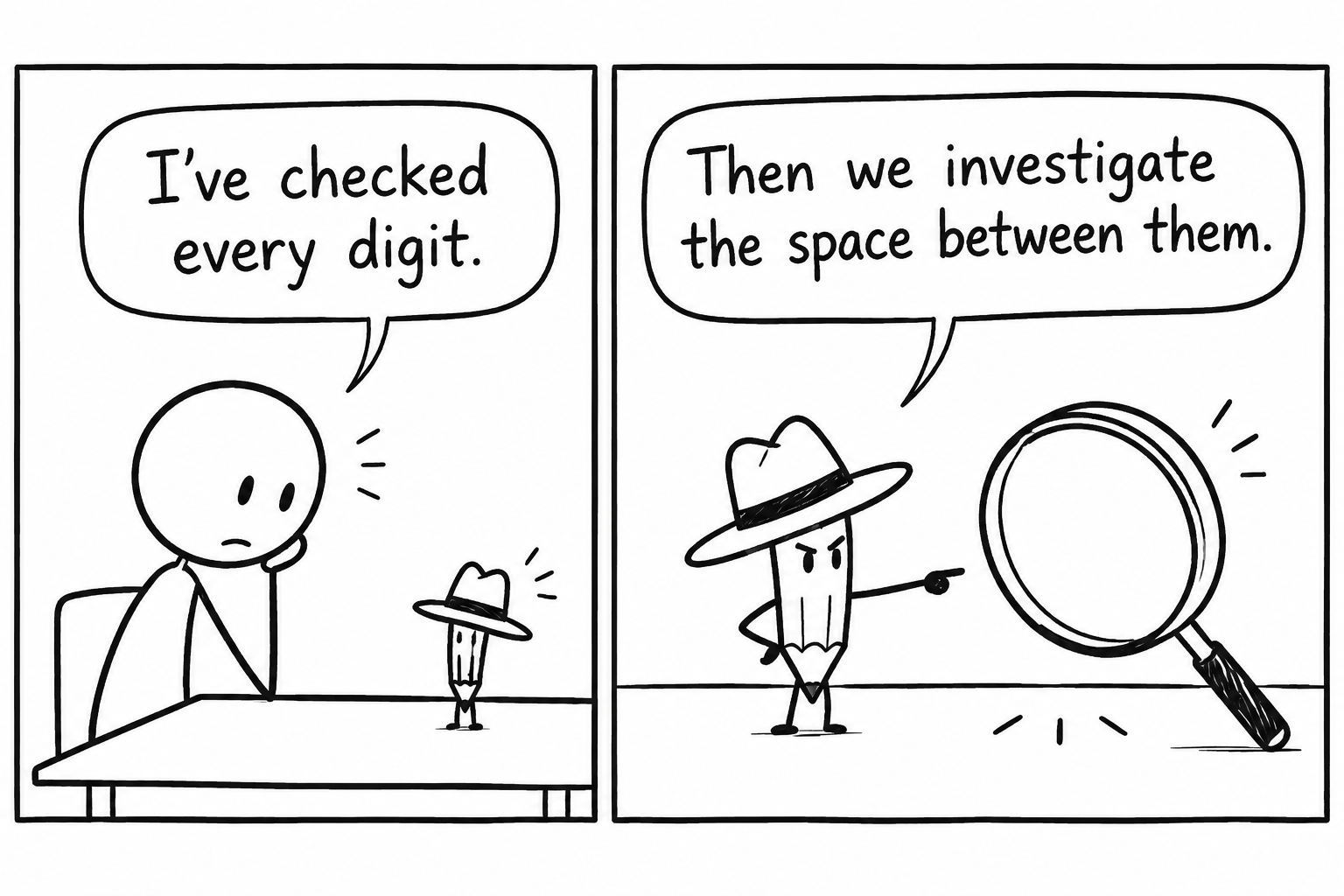 A stick-figure student and a pencil detective investigate the space between digits
Decimals: keep the method, adjust the scale
Calculate:
3.47×2.63.47 \times 2.63.47×2.6First calculate with whole numbers. We already know:
347×26=9022347 \times 26 = 9022347×26=9022Changing 3.473.473.47 to 347347347 multiplies it by 100100100. Changing 2.62.62.6 to 262626 multiplies it by 101010. The whole-number product is therefore 100010001000 times too large:
3.47×2.6=90221000=9.0223.47 \times 2.6 = \frac{9022}{1000} = 9.0223.47×2.6=10009022=9.022You can also count decimal places: two in the first factor and one in the second means three decimal places in the product before removing any unnecessary trailing zeros.
Check the size using 3.5×2.5=8.753.5 \times 2.5 = 8.753.5×2.5=8.75. An answer of 9.0229.0229.022 is plausible; 90.2290.2290.22 is not.
The stage-two Multiplication and Division lesson provides another route through the underlying written method.
Common mistakes and how to catch them
Forgetting the tens placeholder. Label the rows mentally as “multiply by units” and “multiply by tens”. For a hundreds row, use two zero placeholders.
Reusing old carries. Carries belong to the row being calculated. Cross out used carries neatly before beginning the next row, and record new ones separately.
Adding before finishing both rows. Complete each partial product first. Then switch deliberately from multiplication to column addition, checking any new carries.
Misplacing the decimal point. Track how much you scaled each factor. Decimal points do not need to line up as they do in addition.
Treating an estimate as proof. An estimate catches large errors, but cannot confirm every digit. Check each row as well.
Our hypothetical student now has a useful response to a wrong answer: locate the first incorrect row. That gives them something specific to repair.
Long multiplication questions: exam-style practice
Try these original practice questions without a calculator. Show both partial products where needed.
- A: Calculate 238×24238 \times 24238×24.
- B: Calculate 406×30406 \times 30406×30.
- C: Calculate 4.8×2.74.8 \times 2.74.8×2.7.
- D: A school buys 363636 revision guides at £7.85\pounds 7.85£7.85 each. Calculate the total cost.
Answers: A: 571257125712; B: 121801218012180; C: 12.9612.9612.96; D: £282.60\pounds 282.60£282.60.
For question D, calculate 785×36=28260785 \times 36 = 28260785×36=28260, then divide by 100100100 to convert the answer from pence to pounds.
Use the Multiplication and Division exam booklet for further questions with answers. When multiplication appears inside a worded problem, the Calculation Problems revision guide helps you connect the calculation to its context.
Turn understanding into reliable working
The student’s turning point was understanding the tens row; making that understanding dependable takes fresh questions and careful checking. Your turn: use each mistake to identify whether you need to practise carrying, place value or decimal scaling. Start with the MathsGenie Lessons and Question Bank and practise until you can explain every row of your long multiplication.