Long Multiplication Exam Questions for GCSE
Long multiplication exam questions explained through three GCSE examples, with clear working, method-mark guidance, common errors and practice questions.

Long multiplication exam questions become easier when you follow a consistent column method: align place values, calculate each partial product, shift the tens row correctly, then add. Clear working also gives the examiner evidence of your method if an arithmetic slip changes the answer.
The empty working space can feel intimidating, even when the arithmetic is familiar. We will follow a hypothetical student, Sam, through three GCSE questions, showing how to organise calculations and check the results.
Your long multiplication checklist
- Align digits by place value.
- Multiply by the units digit first.
- Record carried digits clearly.
- Shift the tens row one column left.
- Add the partial products.
- Estimate to check the answer.
- For decimals, restore the decimal point after multiplying the integers.
Mark allocations vary between questions. A method mark generally rewards a valid process, while an accuracy mark rewards correct calculation. Visible working helps examiners identify both.
For a refresher, use the Multiplication and Division lesson.
Before starting, leave enough space for both multiplication rows and the final total. Squashing the second row into a narrow gap makes place value harder to track. If your times tables feel uncertain, practise the facts that interrupt your working most often. Reducing those interruptions lets you concentrate on carrying and keeping the columns aligned.
Multiplying by a two-digit integer
Sam’s first question is:
347×26347 \times 26347×26The multiplier contains units and tens, so Sam calculates two partial products before adding them.
Multiply by the units
First calculate 347×6347 \times 6347×6, working from right to left:
7×6=424×6+4=283×6+2=20\begin{aligned} 7 \times 6 &= 42 \\ 4 \times 6 + 4 &= 28 \\ 3 \times 6 + 2 &= 20 \end{aligned}7×64×6+43×6+2=42=28=20Therefore,
347×6=2082347 \times 6 = 2082347×6=2082The extra 444 and 222 are carried values. Write them small and above the appropriate columns, keeping them separate from the answer.
Multiply by the tens
The 222 in 262626 represents 202020:
347×20=6940347 \times 20 = 6940347×20=6940The second partial product starts one column further left. A zero placeholder records that shift. Without it, the row would represent multiplication by 222.
Add and check
2082+6940=90222082 + 6940 = \boxed{9022}2082+6940=9022An estimate supports the result:
350×25=8750350 \times 25 = 8750350×25=8750The exact answer is reasonably close. Correct partial products may provide evidence for method marks even if the final addition contains a slip, depending on the mark scheme.
An estimate checks the size of an answer, but it cannot confirm every digit. If the result looks sensible, still check the carried values and final addition. When a result is much too small, inspect the tens row first: a missing place-value shift can change the answer substantially even when the individual multiplication facts are correct.
Practise this routine with the Multiplication and Division exam booklet.
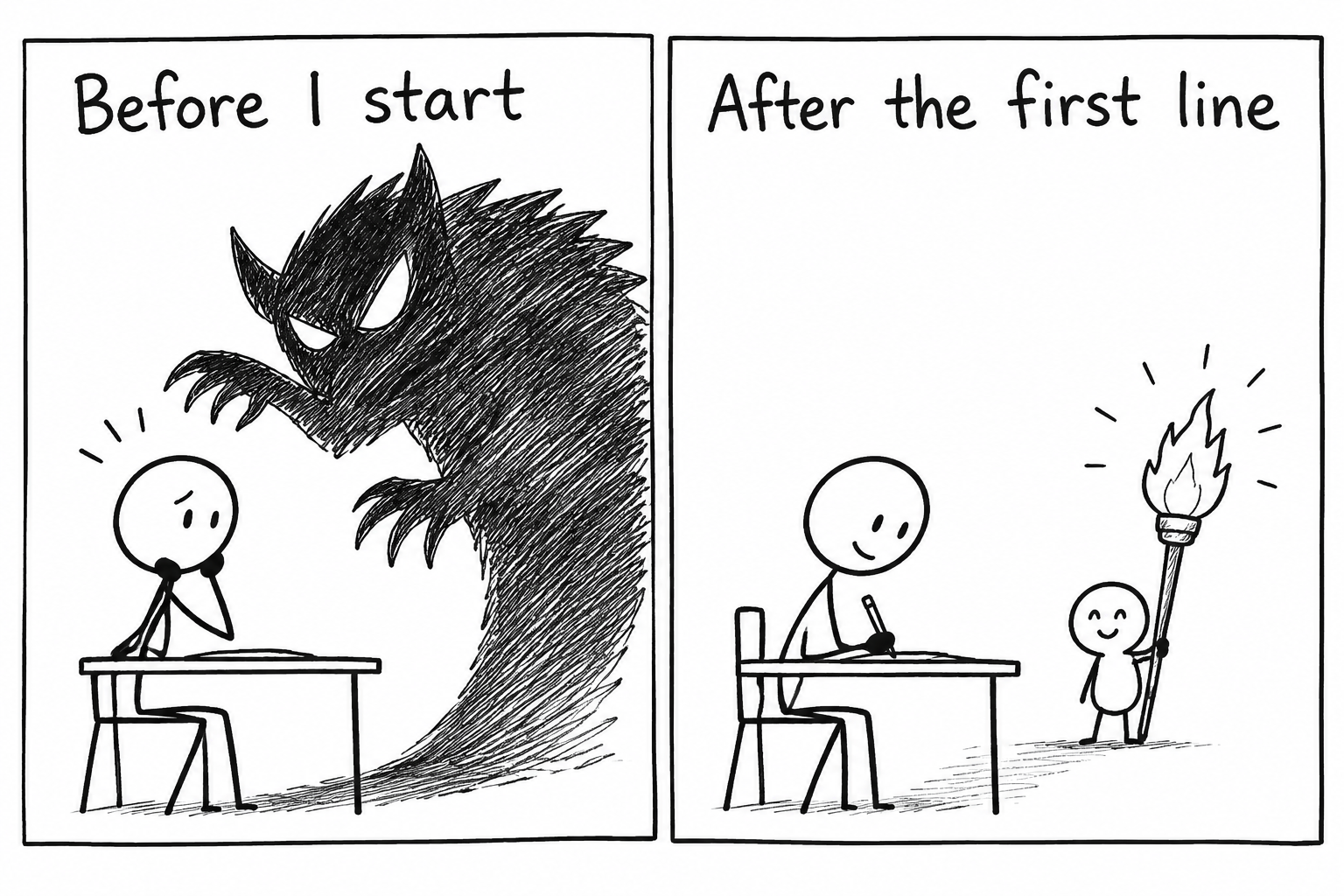 A student discovers that an intimidating exam problem becomes smaller after writing the first line
Finding the calculation inside a problem
A warehouse packs 236236236 notebooks into each crate. It fills 484848 crates. Work out the total number of notebooks.
Sam identifies equal groups and writes:
236×48236 \times 48236×48Choosing the correct operation is part of solving a worded question. The units and tens rows are:
236×8=1888236 \times 8 = 1888236×8=1888 236×40=9440236 \times 40 = 9440236×40=9440Adding gives:
1888+9440=113281888 + 9440 = \boxed{11328}1888+9440=11328The warehouse packs 113281132811328 notebooks. Including the unit connects the calculation to the question.
The working shows the operation, both partial products and their sum. These stages make the method easy to follow without lengthy written explanations.
Use the GCSE Maths Question Bank to practise recognising calculations in different contexts.
Long multiplication with decimals
A rectangular panel is 3.74 m3.74\text{ m}3.74 m long and 2.6 m2.6\text{ m}2.6 m wide. Calculate its area.
Sam multiplies length by width:
3.74×2.63.74 \times 2.63.74×2.6Temporarily ignoring the decimal points gives 374×26374 \times 26374×26. The partial products are:
374×6=2244374 \times 6 = 2244374×6=2244 374×20=7480374 \times 20 = 7480374×20=7480Adding gives:
2244+7480=97242244 + 7480 = 97242244+7480=9724There are two decimal places in 3.743.743.74 and one in 2.62.62.6, so the product needs three decimal places:
3.74×2.6=9.7243.74 \times 2.6 = 9.7243.74×2.6=9.724The area is:
9.724 m2\boxed{9.724\text{ m}^2}9.724 m2An estimate helps check decimal placement:
4×3=124 \times 3 = 124×3=12The result is plausible, whereas 97.2497.2497.24 or 0.97240.97240.9724 would suggest a place-value error. Keep the exact answer unless the question requests rounding.
Where method marks may come from
There is no universal mark allocation for long multiplication past paper questions. Depending on the question, useful evidence can include the correct multiplication, partial products, place-value shifts and final addition.
Units and decimal placement also matter when interpreting the result. They do not automatically earn separate marks; always check the relevant mark scheme.
Students using other specifications can access the AQA Multiplication and Division page, OCR Multiplication and Division lesson and WJEC Multiplication and Division page.
Common long multiplication mistakes
Forgetting the tens shift
In 343434, the 333 represents 303030. Start the second row with a zero placeholder or shift it one column left.
Misaligning columns
Keep units beneath units and tens beneath tens, especially when adding. Correct partial products can still produce an incorrect total if columns drift.
Losing carried digits
Write carries clearly and separate them from the main calculation. Check that each carried value has been included once.
Guessing decimal placement
Count decimal places in both original factors, then estimate. Avoid placing the decimal point simply where it looks right.
Showing only an answer
An unexplained wrong answer offers little evidence of a valid method. Record your partial products so an examiner can follow the calculation.
Exam-style practice
Try these without a calculator. Show both partial products and estimate each result.
- Calculate 584×37584 \times 37584×37.
- Calculate 706×54706 \times 54706×54.
- Calculate 3.28×1.73.28 \times 1.73.28×1.7.
- A school orders 363636 packs containing 242424 exercise books each. How many books are ordered?
- A rectangle measures 12.6 cm12.6\text{ cm}12.6 cm by 3.45 cm3.45\text{ cm}3.45 cm. Calculate its area.
Answers:
- 216082160821608
- 381243812438124
- 5.5765.5765.576
- 864864864 exercise books
- 43.47 cm243.47\text{ cm}^243.47 cm2
If an answer differs, check each row before restarting. Identify whether the mistake involved multiplication, carrying, addition or decimal placement. This makes the next practice attempt more useful.
After checking, cover the answers and repeat any question you missed on a fresh sheet. Explain the corrected step to yourself in a short sentence. Return to it in a later revision session to see whether the correction has stuck. Once the layout feels reliable, mix arithmetic questions with worded problems to practise choosing the operation independently.
Find further questions in the Edexcel GCSE Maths exam booklets.
Turn the method into exam confidence
Sam’s progress comes from breaking a large calculation into manageable decisions. Practise that sequence until the layout feels familiar, then apply it within worded problems.
Start with MathsGenie’s free revision lesson linked above, complete practice questions and check your working carefully. Consistent practice makes long multiplication exam questions easier to approach calmly.