Linear and Quadratic Simultaneous Equations Exam Questions
Linear and quadratic simultaneous equations exam questions: three worked GCSE examples, method-mark advice and practice to help you solve both variables.
A student can know how to solve a quadratic and still freeze when a question contains two equations. The difficulty is often deciding what to do first. For linear and quadratic simultaneous equations exam questions, the reliable approach is substitution: rearrange the linear equation, substitute into the quadratic equation, solve, then find the matching value of the other variable.
Imagine a student working through three practice questions. This is an illustrative revision session, not a real student case study. Each question introduces another decision, while the underlying method stays the same. Along the way, we will identify the working that can earn method marks, even when the final answer goes wrong.
The method to keep beside you
Simultaneous equations ask for values that satisfy both equations at the same time. Graphically, the solutions are the coordinates where the graphs intersect.
For a linear and quadratic pair, use this checklist:
- Rearrange the linear equation to make one variable the subject.
- Substitute that expression into the quadratic equation.
- Expand carefully and collect terms.
- Solve the resulting quadratic.
- Substitute each solution back into the linear equation.
- Write the answers as matching pairs and check them.
There may be two, one or no real solutions. Finding one pair does not automatically finish the question.
The GCSE maths lesson index is the starting point for locating MathsGenie's quadratic simultaneous equations lesson and its associated practice.
Question one: a straightforward substitution
Solve these simultaneous equations:
y=x+1y=x+1y=x+1 y=x2−5y=x^2-5y=x2−5Our imagined student notices that both equations already give an expression for yyy. Because both expressions equal the same quantity, they can be set equal:
x+1=x2−5x+1=x^2-5x+1=x2−5Rearranging gives:
x2−x−6=0x^2-x-6=0x2−x−6=0This substitution is the key method step. In an exam, write it down clearly: it shows how the two original equations became one equation in one unknown.
Solve, then return to the other variable
Factorise:
(x−3)(x+2)=0(x-3)(x+2)=0(x−3)(x+2)=0Therefore:
x=3orx=−2x=3\quad\text{or}\quad x=-2x=3orx=−2The student nearly stops here. But the question asks for simultaneous solutions, so each value needs its matching yyy value.
Using y=x+1y=x+1y=x+1:
x=3 ⟹ y=4x=3\implies y=4x=3⟹y=4 x=−2 ⟹ y=−1x=-2\implies y=-1x=−2⟹y=−1The solutions are:
(x,y)=(3,4)or(−2,−1)(x,y)=(3,4)\quad\text{or}\quad(-2,-1)(x,y)=(3,4)or(−2,−1)A quick check in the quadratic equation confirms both pairs. For instance, substituting x=−2x=-2x=−2 gives y=(−2)2−5=−1y=(-2)^2-5=-1y=(−2)2−5=−1.
Exact mark allocations depend on the question's mark scheme. However, correct substitution, solving the resulting quadratic and finding the corresponding values are important stages to make visible.
Build on this substitution routine with the quadratic simultaneous equations lesson and question practice in MathsGenie's GCSE Lessons and Question Bank.
Question two: substitution into a squared term
Solve these simultaneous equations:
x2+y2=25x^2+y^2=25x2+y2=25 y=x+1y=x+1y=x+1This time, replacing yyy means replacing the whole squared term:
x2+(x+1)2=25x^2+(x+1)^2=25x2+(x+1)2=25The brackets matter. They preserve the instruction to square the entire expression.
Expand before collecting terms
The student writes the expansion separately:
(x+1)2=x2+2x+1(x+1)^2=x^2+2x+1(x+1)2=x2+2x+1Substituting this expansion gives:
x2+x2+2x+1=25x^2+x^2+2x+1=25x2+x2+2x+1=25Collecting terms and rearranging:
2x2+2x−24=02x^2+2x-24=02x2+2x−24=0Divide every term by 222:
x2+x−12=0x^2+x-12=0x2+x−12=0Then factorise:
(x+4)(x−3)=0(x+4)(x-3)=0(x+4)(x−3)=0So:
x=−4orx=3x=-4\quad\text{or}\quad x=3x=−4orx=3Using y=x+1y=x+1y=x+1, the solution pairs are:
(x,y)=(−4,−3)or(3,4)(x,y)=(-4,-3)\quad\text{or}\quad(3,4)(x,y)=(−4,−3)or(3,4)Both satisfy the original circle equation:
(−4)2+(−3)2=25(-4)^2+(-3)^2=25(−4)2+(−3)2=25 32+42=253^2+4^2=2532+42=25The useful exam habit here is to show the substitution before expanding. If an expansion error follows, your earlier working still demonstrates a correct approach; any credit depends on the specific mark scheme.
If expanding brackets is the stumbling block, revisit that skill through the GCSE algebra lessons before attempting another full question.
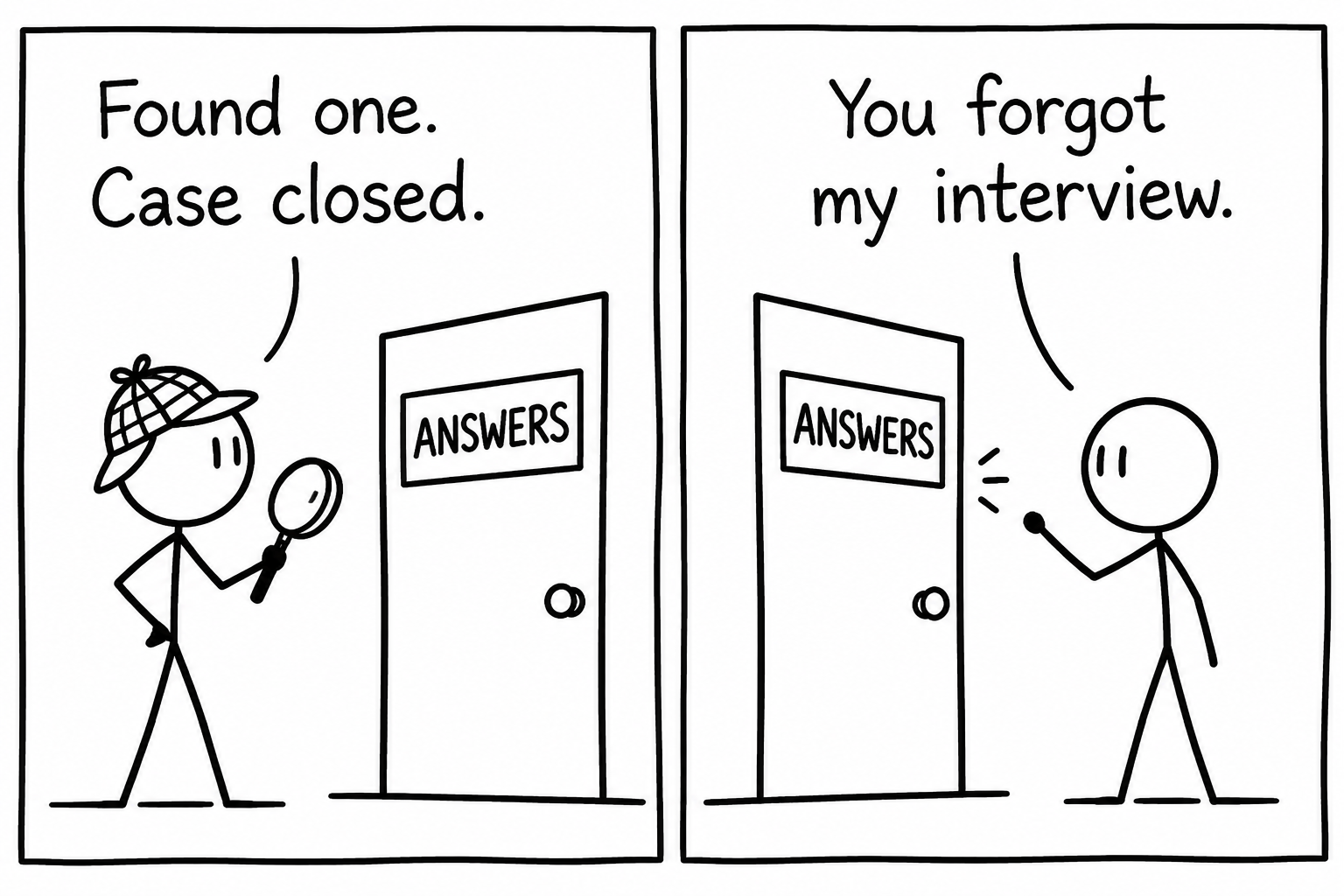 A stick figure detective thinks the case is closed after finding one answer, while another answer waits behind the door.
Question three: when factorising does not work
Solve these simultaneous equations, giving exact answers:
y=x+1y=x+1y=x+1 y=x2−x−1y=x^2-x-1y=x2−x−1The opening step is familiar:
x+1=x2−x−1x+1=x^2-x-1x+1=x2−x−1Therefore:
x2−2x−2=0x^2-2x-2=0x2−2x−2=0The student looks for integer factors, finds none, and pauses. This is a decision point, not evidence that the substitution was wrong.
Use the quadratic formula
For ax2+bx+c=0ax^2+bx+c=0ax2+bx+c=0:
x=−b±b2−4ac2ax=\frac{-b\pm\sqrt{b^2-4ac}}{2a}x=2a−b±b2−4acHere, a=1a=1a=1, b=−2b=-2b=−2 and c=−2c=-2c=−2. Substituting carefully:
x=2±(−2)2−4(1)(−2)2x=\frac{2\pm\sqrt{(-2)^2-4(1)(-2)}}{2}x=22±(−2)2−4(1)(−2) x=2±122=1±3x=\frac{2\pm\sqrt{12}}{2}=1\pm\sqrt{3}x=22±12=1±3Now return to y=x+1y=x+1y=x+1. Keep the two branches separate:
x=1+3 ⟹ y=2+3x=1+\sqrt{3}\implies y=2+\sqrt{3}x=1+3⟹y=2+3 x=1−3 ⟹ y=2−3x=1-\sqrt{3}\implies y=2-\sqrt{3}x=1−3⟹y=2−3The answers are:
(x,y)=(1+3, 2+3)(x,y)=(1+\sqrt{3},\,2+\sqrt{3})(x,y)=(1+3,2+3)or
(x,y)=(1−3, 2−3)(x,y)=(1-\sqrt{3},\,2-\sqrt{3})(x,y)=(1−3,2−3)Because exact answers were requested, retain the surds. Decimal approximations can help you check, but should not replace these final answers.
For further revision, locate the quadratic formula topic in the MathsGenie GCSE lesson collection.
Common mistakes that cost marks
Squaring only part of an expression. Remember that (x+1)2=x2+2x+1(x+1)^2=x^2+2x+1(x+1)2=x2+2x+1. Writing the substitution with brackets gives you a clear expression to expand.
Stopping after solving the quadratic. Values of xxx alone are incomplete when the question asks for both variables. Substitute each root back into the simpler original equation.
Mixing the solution pairs. Keep each branch on its own line. In the third example, the positive surd in xxx belongs with the positive surd in yyy.
Forcing factorisation. If simple integer factors are not available, consider the quadratic formula. A quadratic with awkward roots can still come from perfectly correct working.
Hiding the method. A page of calculator results gives little evidence of your reasoning. Show the substituted equation, the resulting quadratic and the calculation of the second variable.
Exam-style practice to try independently
Now close the worked solutions and attempt these original questions. They are exam-style practice, not reproduced past paper questions.
Practice A
y=x+2,y=x2y=x+2,\qquad y=x^2y=x+2,y=x2Practice B
x2+y2=20,y=x+2x^2+y^2=20,\qquad y=x+2x2+y2=20,y=x+2For each question, write the substitution before doing any algebra. Then give both solution pairs and check them in the original equations.
Check your answers afterwards: Practice A gives (2,4)(2,4)(2,4) and (−1,1)(-1,1)(−1,1). Practice B gives (2,4)(2,4)(2,4) and (−4,−2)(-4,-2)(−4,−2).
When tackling linear and quadratic simultaneous equations past paper questions, use the accompanying mark scheme to identify the first stage where your working diverged. Correct that stage, then retry the question without looking.
Turn the method into a reliable habit
Our imagined student now has a repeatable route through substitution, squared brackets and exact roots. Your next step is to practise recognising those decisions without prompts. Start your next linear and quadratic simultaneous equations practice session with MathsGenie's Lessons and Question Bank.